
The Create, Move, and Copy toolbar groups contain the core drawing and editing commands for SkyCiv CAD. Activate any tool by clicking its toolbar button or pressing its keyboard shortcut, then interact with the canvas to place or transform geometry.
All create and copy tools respect the active snap settings for precision placement.
Create
The Create toolbar group provides all geometry drawing tools. Activate a tool by clicking its button or pressing its keyboard shortcut, then click on the canvas to place geometry. All create tools respect the active snap settings.
Create Point
Place individual reference points on the canvas
P
The Create Point tool places individual coordinate points on the canvas. Points act as precise anchors that other geometry can snap to, and are useful as reference markers in structural drawings.
[__INSERT_IMAGE__]
Step-by-step
- 1Click Create Point in the toolbar (or press P) to activate point-creation mode.
- 2Click anywhere on the canvas to place a point at that location.
- 3Alternatively, type coordinates in
X,Yformat (e.g.100,200) and press Enter. - 4Continue clicking or typing coordinates to place additional points in the same session.
- 5Press Esc to exit point-creation mode.
Tip: Snaps automatically align points to grid intersections, existing endpoints, midpoints, and other geometric features. You can place as many points as needed before pressing Esc.
Create Line
Draw a straight line segment between two points
L
The Create Line tool draws individual straight line segments. Each click-pair defines one line. This is the most fundamental drawing tool in SkyCiv CAD and is used extensively in structural and architectural drawings.
[__INSERT_IMAGE__]
Step-by-step
- 1Click Create Line (or press L) to activate line-creation mode.
- 2Click on the canvas to set the start point.
- 3Move the mouse – a live preview of the line follows the cursor.
- 4Click to set the end point, or type a length value and press Enter for a precise distance.
- 5Press Esc to exit.
Tip: Press Shift+Tab to toggle between Cartesian (X, Y offset) and Polar (length, angle) input modes for precise dimensional control.
Create Polyline
Draw a chain of connected line segments as a single object
Ctrl+L
The Create Polyline tool draws a continuous chain of line segments stored as a single object. Polylines are ideal for outlines in structural drawings where all segments must remain joined. This tool is in a dropdown group – click the arrow on the toolbar button to reveal the Create Spline variant.
[__INSERT_IMAGE__]
Step-by-step
- 1Click Create Polyline (or press Ctrl+L) to activate polyline mode.
- 2Click on the canvas to set the first vertex.
- 3Continue clicking to add additional connected vertices – each click extends the polyline.
- 4Press Esc to finish. The polyline is stored as a single continuous shape.
Tip: To create a closed polyline, snap the final click onto the first vertex. Snaps align each vertex to grid intersections and existing geometry.
Create Spline
Draw a smooth curved line through a series of control points
SP
The Create Spline tool draws smooth, continuously curved lines defined by a series of control points. Useful for organic curves, road alignments, or any geometry requiring smooth curvature. Found in the Polyline dropdown group.
[__INSERT_IMAGE__]
Step-by-step
- 1Expand the Polyline dropdown and click Create Spline (or press SP).
- 2Click on the canvas to set the first control point.
- 3Continue clicking to place additional control points – the curve updates live.
- 4Press Esc to finish the spline.
Tip: Use the Shapes options panel to control the spline tension and interpolation behavior. Snaps align control points to grid intersections and existing geometry.
Create Arc
Draw a circular arc defined by two base points and a rise height
A
The Create Arc tool draws a circular arc defined by two base points and a rise height – the perpendicular distance from the chord midpoint to the arc peak. Commonly used for curved beams, arched openings, and rounded structural elements.
[__INSERT_IMAGE__]
Step-by-step
- 1Click Create Arc (or press A) to activate arc mode.
- 2Click on the canvas to set the first base point.
- 3Type a chord length and press Enter, or click to set the second base point.
- 4Type the rise height and press Enter, or move the mouse and click to set it visually.
- 5The arc is created with the specified dimensions.
Tip: You can freely mix typed values and mouse clicks – type the chord length precisely, then click the rise visually. Use the Shapes panel to adjust arc segment count and other curve properties.
Create Rectangle
Draw an axis-aligned rectangle by defining two opposite corners
R
The Create Rectangle tool draws an axis-aligned rectangle by defining two diagonally opposite corners. The result is a closed polyline with four right-angle corners – useful for floor plans, plate outlines, and structural cross-sections.
[__INSERT_IMAGE__]
Step-by-step
- 1Click Create Rectangle (or press R) to activate rectangle mode.
- 2Click on the canvas to set the first corner.
- 3Move the mouse – a live rectangle preview follows the cursor.
- 4Click to set the opposite corner and complete the rectangle.
Tip: Snaps align both corners to grid intersections and existing geometry. To enter exact dimensions, type the width and height using coordinate input after setting the first corner.
Create Circle
Draw a circle by placing a center point and setting a radius
C
The Create Circle toolbar button opens a dropdown group with three variants: standard circle, circle by 4 arcs, and n-polygon. The standard circle places a full 360° circle defined by a center point and radius.
[__INSERT_IMAGE__]
Step-by-step
- 1Click Create Circle (or press C).
- 2Click on the canvas to set the center point.
- 3Move the mouse outward to preview the radius.
- 4Type a radius value and press Enter for an exact size, or click to confirm visually.
Tip: Use the Shapes panel to set the circle segment count. Snaps align the center to grid intersections and other geometric features.
Create Circle by 4 Arcs
Draw a circle constructed from four connected arc segments
The Create Circle by 4 Arcs variant constructs a circle from four connected arc segments. Useful when downstream tools need to work with the circle as distinct arc entities rather than a single circular object. Found in the Circle dropdown group.
[__INSERT_IMAGE__]
Step-by-step
- 1Expand the Circle dropdown and click Create Circle by 4 Arcs.
- 2Click on the canvas to set the center point.
- 3Move the mouse to preview the radius.
- 4Type a radius value and press Enter, or click to confirm the size.
- 5The resulting circle is composed of four arc segments joined at the cardinal points.
Tip: This tool is particularly useful for DXF/DWG export workflows that expect individual arc entities rather than a single circle object. Use the Shapes panel to control arc segment properties.
Create n-Polygon
Draw a regular polygon with a configurable number of sides
The Create n-Polygon tool draws a regular polygon with any number of sides, placed by center point and circumscribed radius. Found in the Circle dropdown group. The resulting shape is stored as a closed polyline.
[__INSERT_IMAGE__]
Step-by-step
- 1Open the Shapes panel and set the desired number of sides (default: 6).
- 2Expand the Circle dropdown and click Create n-Polygon.
- 3Click on the canvas to set the center point.
- 4Move the mouse outward to preview the polygon size.
- 5Type a radius value and press Enter, or click to confirm.
Tip: Set the number of sides in the Shapes panel before activating the tool – the count cannot be changed mid-placement. Snaps align the center to grid intersections and existing geometry.
Create Hatch
Fill a closed region with a repeating hatch pattern
H
The Create Hatch tool fills a closed boundary region with a repeating hatch pattern. Hatches are widely used in structural and architectural drawings to denote material sections – concrete, steel, earth, and more.
[__INSERT_IMAGE__]
Step-by-step
- 1Click Create Hatch (or press H) to activate hatch mode.
- 2Click inside a closed boundary region on the canvas – the boundary is detected automatically.
- 3The hatch pattern fills the detected region.
Tip: The boundary must be fully closed for automatic detection to work. Use the Shapes panel to select pattern style, scale, and angle before placing.
Move
The Move toolbar group repositions selected objects. All move tools require a selection first – use the Selection tools to select objects, then activate the desired operation from the Move dropdown.
Relative Move
Translate selected objects by a vector defined by two picked points
M
The Relative Move tool translates selected objects by a displacement vector – pick a base point, then pick or type a destination to shift all selected objects by the same offset. Equivalent to AutoCAD’s MOVE command.
[__INSERT_IMAGE__]
Step-by-step
- 1Select the objects to move.
- 2Click Relative Move (or press M).
- 3Click anywhere on the canvas to set the base point of the move vector.
- 4Move the mouse – a live preview shows the displaced objects.
- 5Click to place, or type an exact distance and press Enter.
Tip: Press Shift+Tab to switch between Cartesian (X, Y) and Polar (length, angle) input modes for precise displacement control.
Rotate
Rotate selected objects around a center point by a specified angle
Ctrl+R
The Rotate tool rotates selected objects about a chosen center point. Rotate by dragging interactively or type an exact angle in degrees. Equivalent to AutoCAD’s ROTATE command.
[__INSERT_IMAGE__]
Step-by-step
- 1Select the objects to rotate.
- 2Click Rotate (or press Ctrl+R).
- 3Click on the canvas to set the rotation center point.
- 4Move the mouse to preview the rotation angle.
- 5Click to confirm, or type an angle in degrees and press Enter.
Tip: Snaps align the rotation center to grid intersections and key geometry. When you know a specific edge or direction that should align with a new angle, use Relative Rotate instead to avoid manual angle calculation.
Relative Rotate
Rotate objects by aligning a reference direction to a new target direction
Relative Rotate (Reference Rotate) lets you rotate a selection by specifying an existing from direction and a new target direction. Ideal when you know a specific edge or line should align with a target angle or point – no manual angle arithmetic needed.
[__INSERT_IMAGE__]
Step-by-step
- 1Select the objects to rotate.
- 2Click Relative Rotate in the Move dropdown.
- 3Click to set the rotation center point.
- 4Click a reference point to define the current (from) direction.
- 5Move the mouse – a preview shows the angle without yet rotating the objects.
- 6Click the target point to complete the rotation, or type an angle and press Enter.
Tip: Use Relative Rotate when you know what existing direction should align with a new direction. For simple absolute-angle rotations, use Rotate.
Align
Move and rotate a selection so two source points match two destination points
The Align tool moves and rotates a selection in a single operation by matching two source points on the selection to two destination points on the drawing. Particularly powerful for snapping components into place when you have two known reference locations.
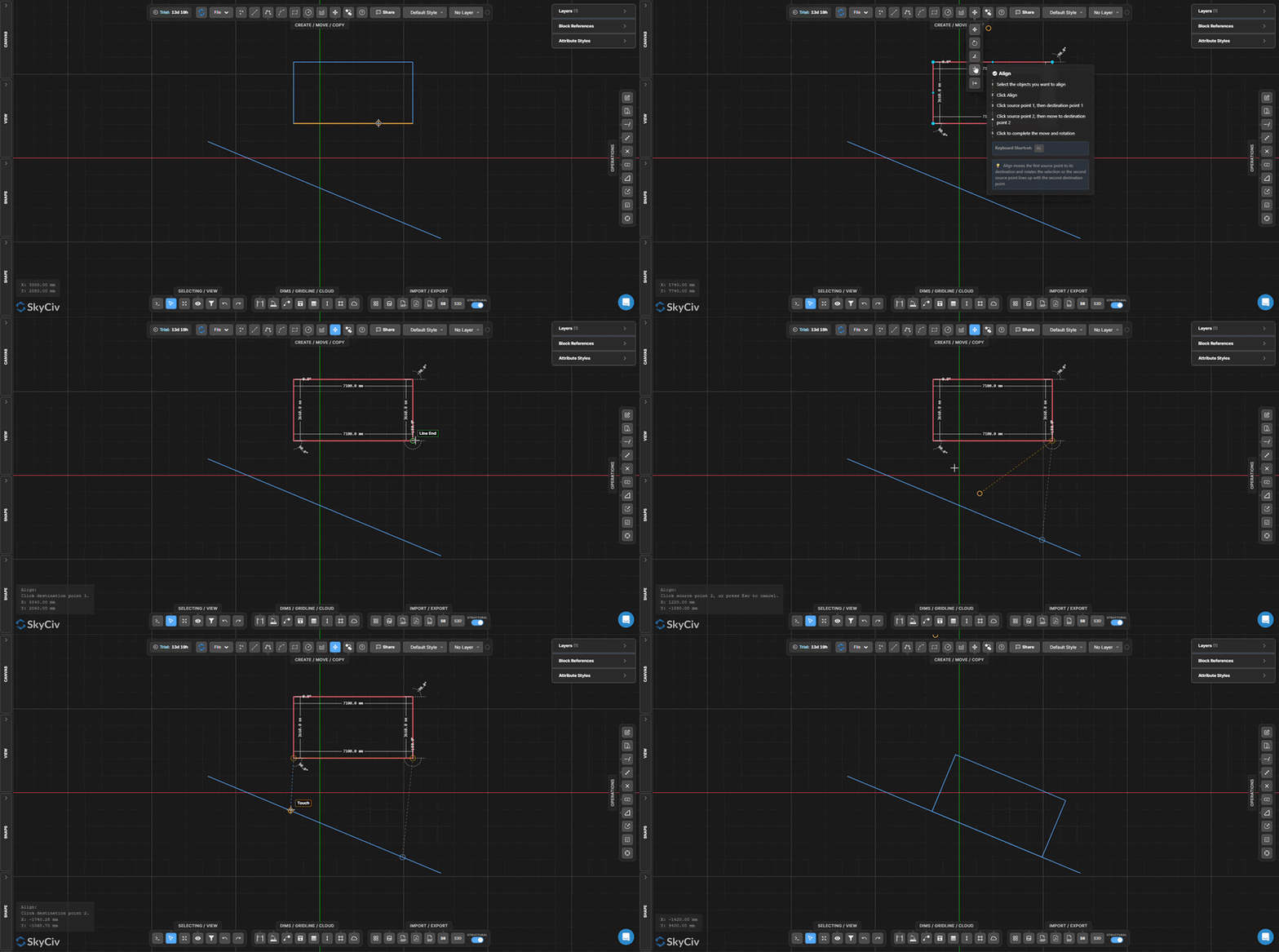
Step-by-step
- 1Select the objects to align.
- 2Click Align in the Move dropdown.
- 3Click source point 1 (on the selection), then destination point 1 (on the canvas).
- 4Click source point 2 (on the selection), then move to destination point 2.
- 5Click to complete – the selection is simultaneously translated and rotated so both point pairs coincide.
Tip: Align moves source point 1 to destination point 1, then rotates the entire selection so source point 2 lines up with destination point 2. Use snaps to pick exact points on existing geometry.
Mirror
Reflect selected objects across a user-defined mirror line
MI
The Mirror tool reflects selected objects across a mirror axis defined by two points. The original objects are replaced by their mirrored counterparts. To keep the originals, use Mirror Copy instead.
[__INSERT_IMAGE__]
Step-by-step
- 1Select the objects to mirror.
- 2Click Mirror (or press MI) in the Move dropdown.
- 3Click to set the start point of the mirror line.
- 4Click to set the end point of the mirror line.
- 5The selection is reflected across the defined axis.
Tip: The mirror line can be at any angle. Snap to existing geometry for a precise axis. Use Mirror Copy when you need to keep both the original and the mirrored result.
Copy
The Copy toolbar group creates duplicates of selected objects – by displacement, mirror, array, offset, or rotation. Select objects first, then activate the desired copy operation from the Copy dropdown.
Relative Copy
Copy selected objects and displace the copy by a user-defined vector
The Relative Copy tool duplicates selected objects and places the copy at an offset defined by picking a base point and a destination. The workflow is identical to Relative Move – but the originals stay in place.
[__INSERT_IMAGE__]
Step-by-step
- 1Select the objects to copy.
- 2Click Relative Copy in the Copy dropdown.
- 3Click anywhere on the canvas to set the base point.
- 4Move the mouse – a live preview of the copy follows the cursor.
- 5Click to place the copy, or type an exact distance and press Enter.
Tip: Press Shift+Tab to toggle between Cartesian and Polar input modes. You can place multiple copies by continuing to click – press Esc to exit.
Mirror Copy
Create a mirrored duplicate while keeping the original objects
ML
Mirror Copy creates a reflected duplicate of selected objects across a user-defined axis, leaving the originals in place. Use this instead of Mirror when you need both the original and its reflection.
[__INSERT_IMAGE__]
Step-by-step
- 1Select the objects to mirror-copy.
- 2Click Mirror Copy (or press ML) in the Copy dropdown.
- 3Click to set the start point of the mirror line.
- 4Click to set the end point of the mirror line.
- 5A mirrored copy is created – the originals remain unchanged.
Tip: The mirror axis can be at any angle. Snap to existing geometry to define a precise axis. Use Mirror if you want to replace the originals rather than keep them.
Copy Array
Distribute copies of selected objects in a linear array pattern
AR
The Copy Array tool distributes multiple copies of selected objects along a vector direction. The number of copies and total span are configured in the Shapes panel, making it ideal for regularly spaced structural elements such as columns, trusses, and bolt groups.
[__INSERT_IMAGE__]
Step-by-step
- 1Select the objects to array.
- 2Set the copy count and span distance in the Shapes panel.
- 3Click Copy Array (or press AR) in the Copy dropdown.
- 4Click to set the base point of the array.
- 5Move the mouse to set the direction, then click to create the copies.
Tip: Configure the copy count and span in the Shapes panel before activating the tool. For rotational arrays (circular patterns), use Copy by Rotation instead.
Offset Copy
Create a parallel copy of lines or polylines at a specified perpendicular distance
O
The Offset Copy tool creates a parallel duplicate of selected lines or polylines at a specified perpendicular distance. Equivalent to AutoCAD’s OFFSET command – commonly used for wall thickness, lane markings, and parallel structural members.
[__INSERT_IMAGE__]
Step-by-step
- 1Select the lines or polylines to offset.
- 2Enter the offset distance in the Shapes panel.
- 3Click Offset Copy (or press O) in the Copy dropdown.
- 4The offset copy is created parallel to the original at the specified distance.
Tip: Use a positive value to offset to one side and a negative value for the other. The direction is relative to the orientation of the original line.
Copy by Rotation
Create multiple rotated copies arranged around a center point
The Copy by Rotation tool creates multiple copies of selected objects in a circular (polar) pattern around a center point. Useful for radially symmetric structures such as bolt groups on a flange or members in a circular truss.
[__INSERT_IMAGE__]
Step-by-step
- 1Select the objects to copy by rotation.
- 2Set the copy count and total rotation angle in the Shapes panel.
- 3Click Copy by Rotation in the Copy dropdown.
- 4Click to set the rotation center point.
- 5Move the mouse to preview, then click to create the copies.
Tip: For evenly spaced copies around a full circle, set the angle to 360° and the count to the desired number. Configure both values in Shapes before activating the tool.
