
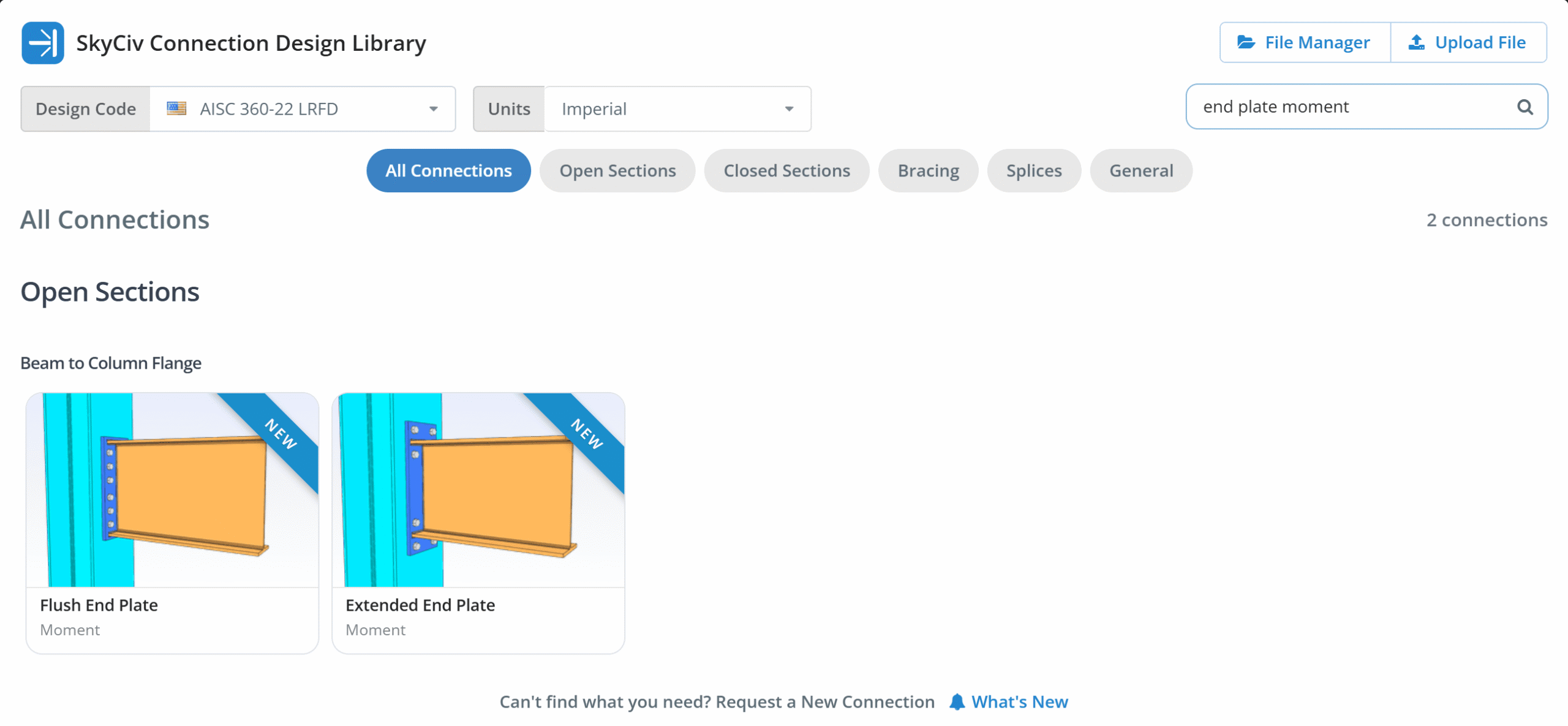
Starting a design is quick. When you open the connection design module, the starter screen (the SkyCiv Connection Design Library) asks for your design code and units, then shows every connection available for that code as a card. Tabs and a search box narrow the cards down to the one you want.
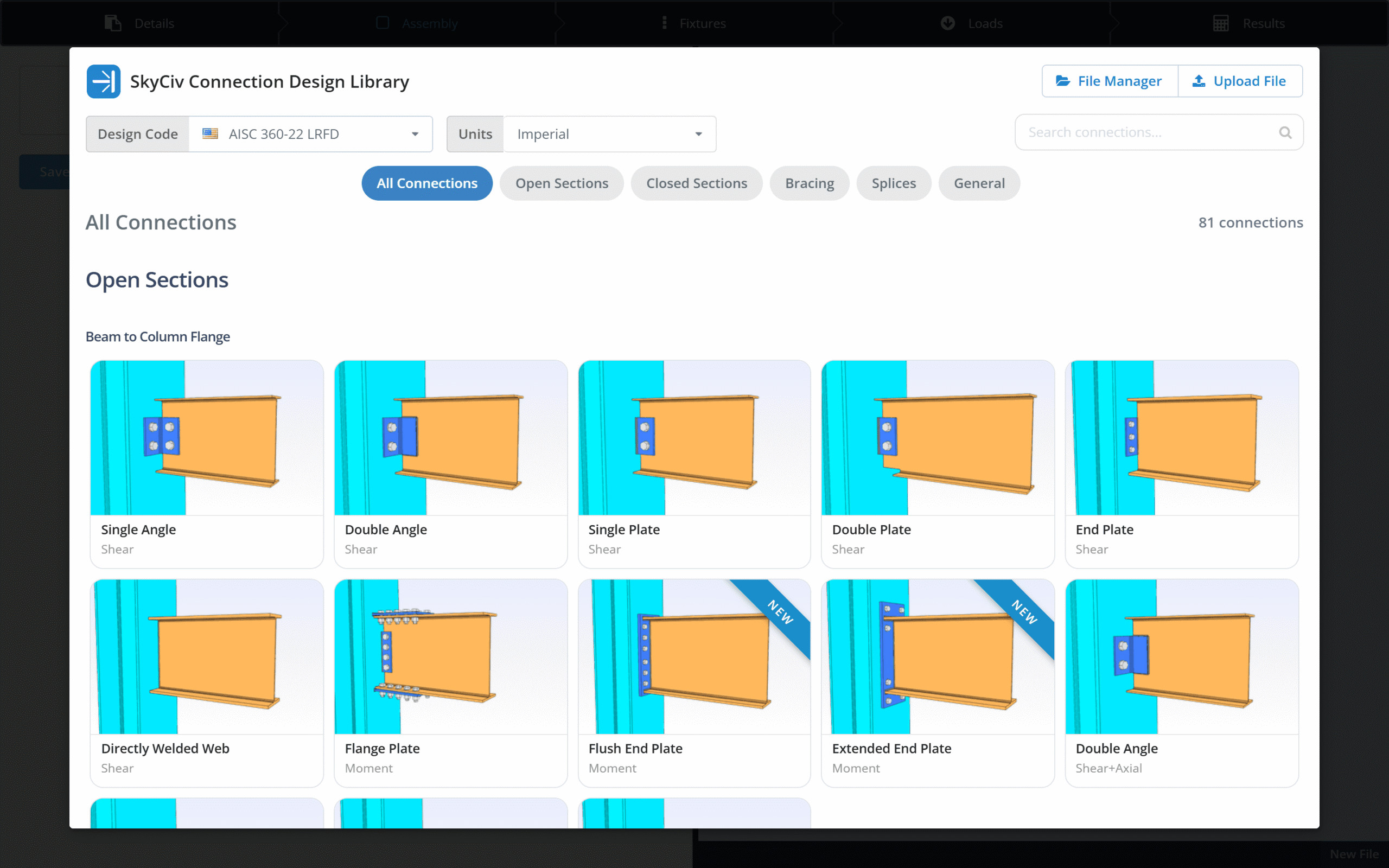
Here, you will need to provide the following information:
- Design Code
- Units
- Connection Group
- Connection Type
- Orientation
- The Connection
Design Code
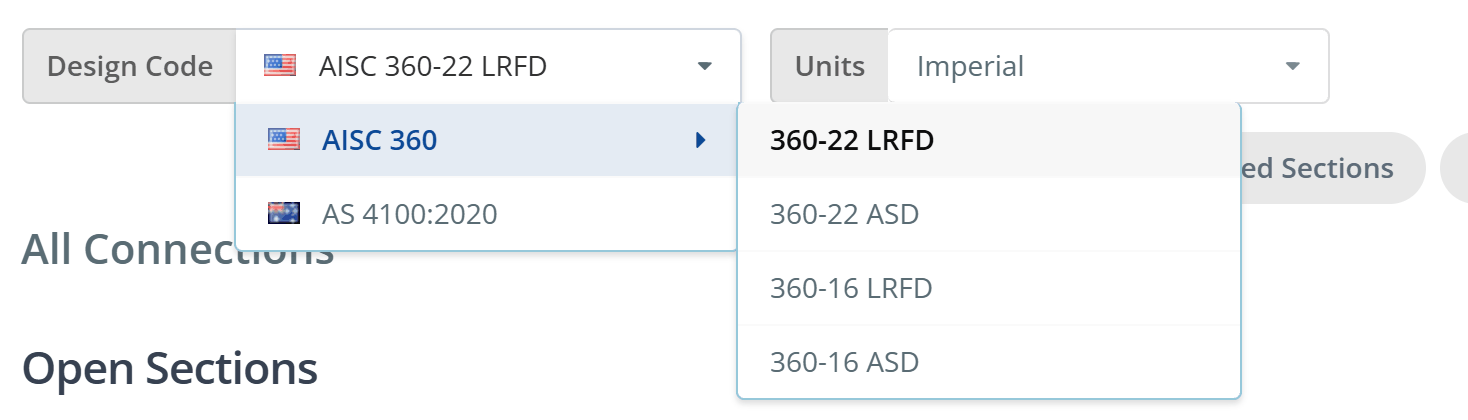
The design code is the standard your design checks are written against. Pick it first, because it drives everything after it: which checks run, the resistance and safety factors, the design coefficients, and which connections are offered.
The design codes SkyCiv Connection Design supports are:
In the Design Code dropdown, the four AISC options sit in a submenu under AISC 360: hover over it, then pick the edition and method.
Coverage is not equal between the codes. AISC 360 covers every connection group and type below. AS 4100:2020 covers I-shape to I-shape shear and moment connections, and column and beam splices. If you need a shear plus axial connection, a brace, a channel connection or an HSS column, choose AISC.
Units
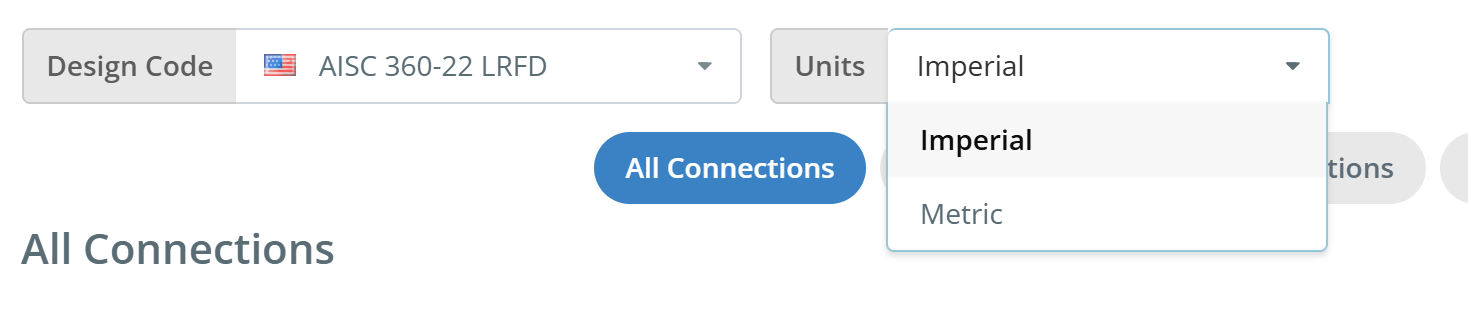
Mixing units is an easy way to get a wrong answer, and converting by hand between inches and millimetres, or kip and kN, wastes time you would rather spend on the design. So the module works in whichever system you picked and reports in the same one.
Under AISC 360-22 and AISC 360-16 you can choose Imperial or Metric. Under AS 4100:2020 the units are fixed to Metric, so you will not see the Units selector.
Connection Groups

The connection group describes what is connecting to what: the member framing in, and the support it frames into. Pick a group from the row of tabs under the search box:
- All Connections, every card for the chosen code, under a heading for each group
- Open Sections, I-shape to I-shape (beam to column and beam to beam) and channel to channel
- Closed Sections, an I-shape beam framing into an HSS column
- Bracing
- Splices, column splices and beam splices
- General, the bolt group, weld group and lifting lug calculators
Under AS 4100:2020 the connections are in Open Sections and Splices. Closed Sections, Bracing and General are AISC 360 only, as are the channel to channel connections.
Types

The type groups connections by the load they are built to carry. Once you pick a group, a second row of tabs lists its types:
- Open Sections and Closed Sections: All, Shear, Shear + Axial, Moment
- Bracing: All, Vertical Brace, Truss Brace, Horizontal Brace, Knee Brace, Chevron Brace
- Splices: All, Column Splice, Beam Splice
All Connections and General have no type tabs. Here is what each type carries:
| Type | Axial | Shear | Moment |
| Shear Connections | X | ✅ | X |
| Shear + Axial Connections | ✅ | ✅ | X |
| Moment Connections | ✅ | ✅ | ✅ |
| Brace Connections | ✅ | X | X |
| Splice Connections | ✅ | ✅ | ✅ |
Brace connections cover vertical, chevron, knee, horizontal and truss braces. Splices cover column splices and beam splices.
Under AS 4100:2020 the types offered are shear, moment, column splice and beam splice.
Orientations
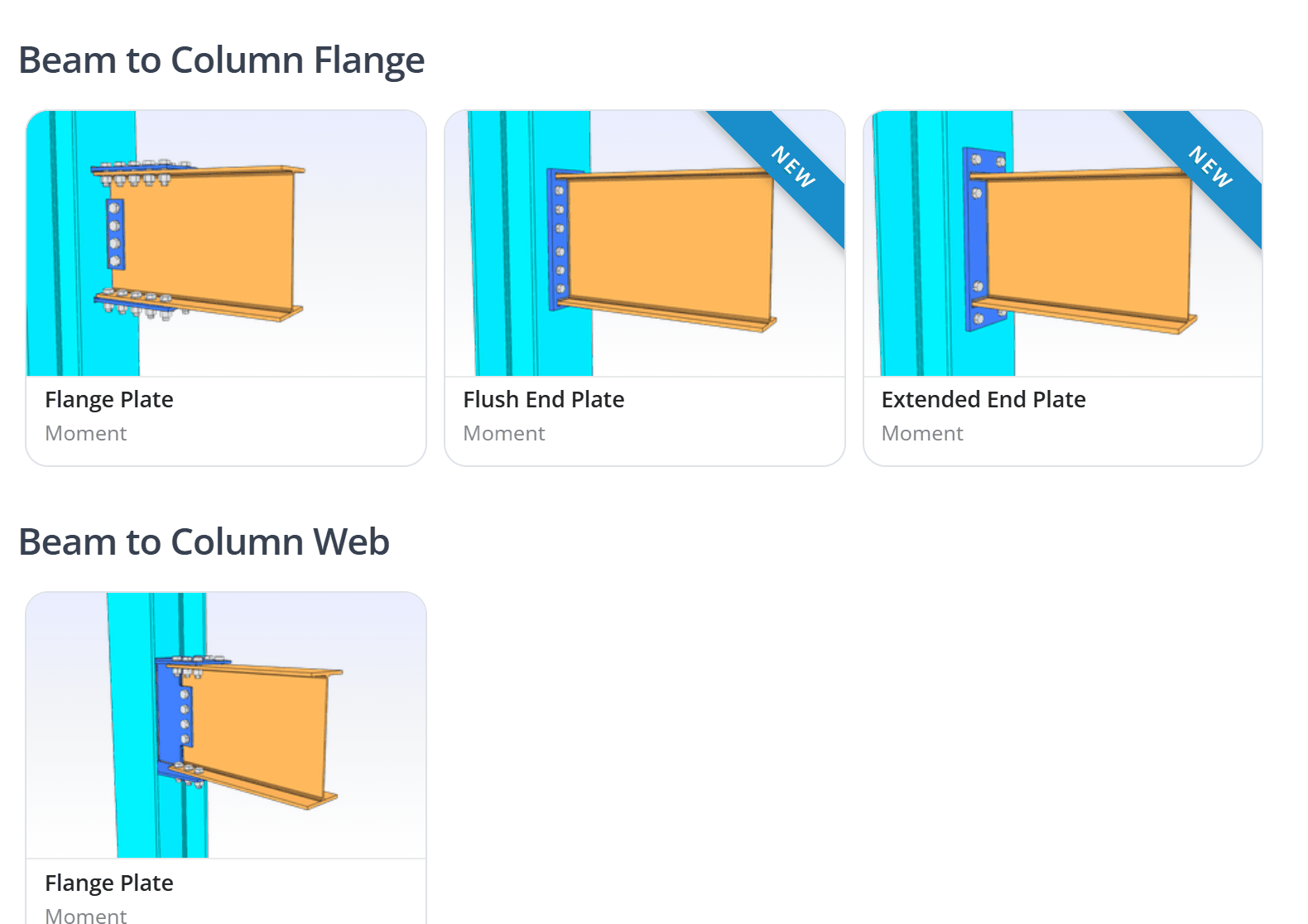
The design checks do not stop at the beam and the connection components. The supporting member matters too, and where on that member you land changes the answer. Framing into a column flange puts the load into a different load path than framing into the web, and the local limit states of the support, such as web local yielding and local flange bending, often govern.
There is no separate orientation selector. Within each group, the cards are listed under a heading for each orientation:
| Short name | Heading on the starter screen |
| BCF | Beam to Column Flange |
| BCW | Beam to Column Web |
| BBW | Beam to Beam Web, framing into the web of a supporting beam (girder) |
| BCbW | Beam to HSS Column (Short Side) |
| BChW | Beam to HSS Column (Long Side) |
| BBC | Beam to Back of Channel |
| BFC | Beam to Front of Channel |
| BrCF | Brace to Column Flange |
| BrCW | Brace to Column Web |
| BrGF | Brace to Girder Flange |
Splices and horizontal braces have no orientation and are listed under Others. Which orientations you see depends on the connection. A moment connection, for example, is offered to the column flange and the column web but not beam to beam, and the end plate moment connections are offered to the column flange only.
Searching
The search box above the tabs filters the cards as you type, matching the connection name, type, group and orientation. Words can be in any order, so "end plate moment" and "moment end plate" find the same cards.
The Connection
The cards show the connections available for the group and type you picked. Each card carries a sample image so you can check you are looking at the connection you had in mind before you commit to it, and cards marked NEW are recent additions. Click the one you want and the model opens, ready for sections and loads.
If the connection you need is not there, use Request a New Connection at the bottom of the starter screen. What’s New, next to it, lists recent additions.
If you are not sure which configuration suits the job, the list of supported connection types sets out every option by code and category, and the guide to connection design covers the workflow from here on.
Try it now
The starter screen takes about thirty seconds to work through, and you can do it without an account. Pick a code, a connection group and a type, choose a connection, and see which checks run.
Sign-up to Free Account
A free account lets you save and reload your connection files, which the free tool does not. It also gives you access to the rest of SkyCiv’s structural software, including Structural 3D.
Connection Design Standalone
Want to use the connection design module only? Click the button below for the standalone pricing.
