
The development length of reinforcement is a critical parameter in structural concrete design, ensuring that reinforcing bars can adequately transfer stresses between the concrete and steel. Section 13 of AS 3600 (2018) provides the requirements and methodologies for calculating development length to achieve proper anchorage of reinforcement. This ensures structural integrity, safety, and serviceability under various loading conditions. The development length is influenced by bar size, concrete strength, bond conditions, cover, spacing, and whether the bar is in tension or compression. The provision covers basic development lengths for straight bars, adjustments for epoxy coatings, confinement effects, and conditions where bars are hooked or bundled.
The latest SkyCiv Foundation Design update supports standard hooked reinforcements, enabling precise development length checks. Users can now customize footing bar ends as straight bars, cogs, or 180° hooks, ensuring flexibility for various design needs. This guide outlines the step-by-step process for determining the required development length for pad footings following AS 3600 Section 13, considering relevant modification factors to comply with code requirements.
Want to try SkyCiv’s Foundation Design software? Our free tool allows users to perform concrete footing calculations without downloading or installing anything!
Starter Bar Development Length Check
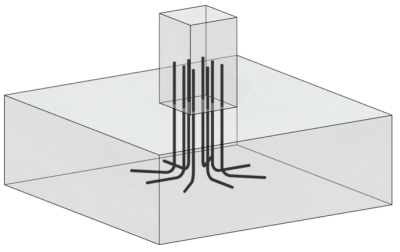
Following AS 3600 (2018) Section 13.1.5.1, the development length of starter bars is the minimum embedment required to ensure adequate reinforcement anchorage into concrete. This is critical for transferring stress between the bar and the surrounding concrete to prevent bond failure. The required length is calculated based on bar diameter, concrete strength, and bond conditions, ensuring structural integrity under service and ultimate loads.
Section 13.1.5.1: Development length of deformed bars in compression (lsy,cb)
Basic development length:
Where:
fsy = Rebar yield strength (MPa)
fc‘ = Concrete strength
db = Starter bar diameter (mm)
The SkyCiv Foundation Design module checks each load combination to determine if the column is subjected to tensile forces. If so, the required development length is calculated following Section 13.1.2 (Development length for a deformed bar in tension). A brief explanation of this calculation is provided later in the guide. For starter bars in tension, the required length is taken as 0.5 lsy,tb, the value for a cogged or hooked bar (Eq. 7).
Required footing thickness (Dreq)
The thickness of the footing should be greater than or equal to the calculated required embedment of the starter bars. The minimum footing thickness is checked by using Equations 3 and 4.
\( D_{\text{req’d}} = c + d_{b,x} + d_{b,z} + l_{sy} \) (Eq. 3)
\( D_{\text{req’d}} \leq t \) (Eq. 4)
Where:
t = Footing Thickness (mm)
c = Bottom concrete cover (mm)
db,x, db,z = Footing bar size in the x and z directions (mm)
lsy = Development length required in compression or tension (mm)
Development Length Check For Footing Reinforcements
The SkyCiv Foundation Design module allows users to specify bar end configurations as Straight, 90° Cog or 180° Hook, separately for the left and right ends of the bars.
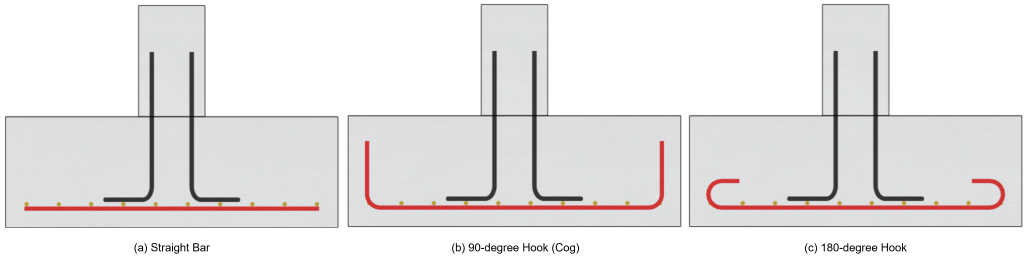
Calculating the required development length for footing reinforcements directly influences the footing’s dimensions, ensuring they are adequate to anchor the reinforcement against tensile forces. Section 13.1.2 provides a guide on determining the required development length of the footing reinforcements.
Basic development length:
Where:
k1 = 1.3 for rebar with 300 mm or more of concrete cast below the bar (1.0 otherwise)
k2 = (132 – db)/100
k3 = 1-(0.15(cd – db)/db), limited to 0.7 ≤ k3 ≤ 1.0
cd = Lesser of the concrete cover and half the clear spacing between bars, (s – db)/2 (mm)
f’c is limited to 65 MPa in this equation
Straight bar:
90° cog or 180° hooked bar:
Section 13.1.2.2 also specifies that the value of lsy,t calculated as above shall be multiplied by the following:
- Multiplied by 1.5 for epoxy-coated bars
- Multiplied by 1.3 when lightweight concrete is used
- Multiplied by 1.5 & 1.3 for both epoxy-coated bars and lightweight concrete is used
Anchorage Length Provided
The SkyCiv Foundation Design module assesses the anchorage length on the left and right sides of each column face. Each anchorage length must meet or exceed the required development length. The Anchorage length provided shall be calculated from the critical section for bending. Critical bending distance is equal to 0.70 of the length of support (asup), wherein asup is equivalent to half of the column dimension (half the diameter for a circular column). Where the anchorage length provided is less than the effective depth of the footing, the development length check is not needed at that location.
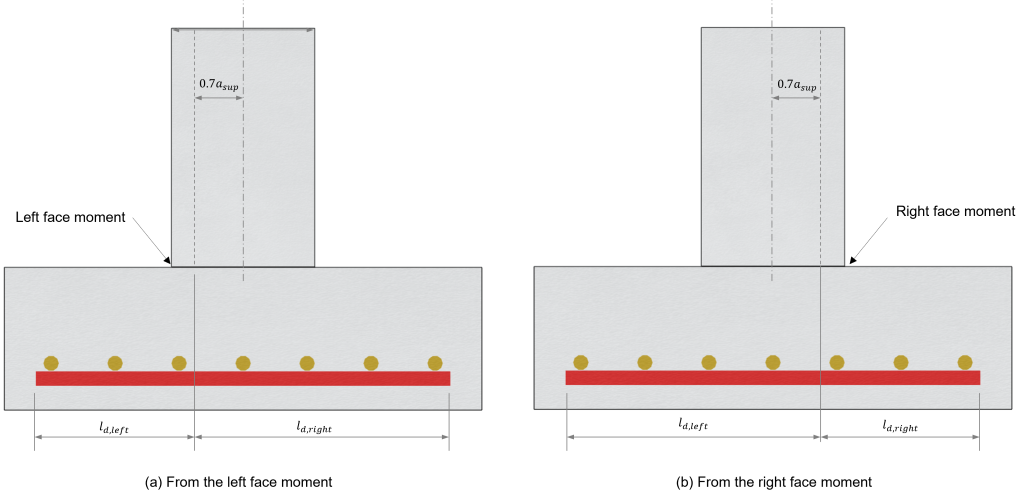
\( l_{\text{provided}} \geq l_{sy,t} \) (Eq. 8)
Detailing Check: Verification of Footing Thickness (t):
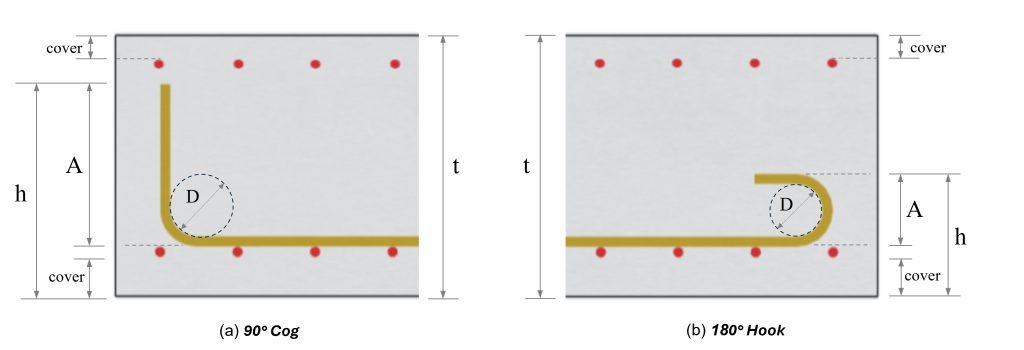
The SkyCiv Foundation Design module checks whether the footing thickness is adequate based on bar configuration and concrete cover. If it is insufficient or the bars protrude, it issues a warning instead of a design failure. The module evaluates the footing thickness at each end of the longitudinal and transverse reinforcements in both the top and bottom layers. The minimum pin diameter (D) is based on AS 3600 Section 17.2.3.2: 5db, or 8db for epoxy-coated bars of 20 mm or more. The overall dimension of the cog or hook (h) is then taken from the standard hook dimensions for the bar size and pin diameter; for the z-direction bars, the x-direction bar size is added to h.
\( \left( h + c \right) \leq t \) (Eq. 9)
Changes from AS 3600 (2009)
SkyCiv Foundation Design also supports AS 3600 (2009). Select it as the design code with Australian Standard (AS 3600:2009, AS 2159-2009) instead of Australian Standard (AS 3600:2018, AS 2159-2009). The development length checks follow the same steps for both editions. The only difference is the lower limit of the basic development length in tension, Section 13.1.2.2:
| Item | AS 3600 (2009) | AS 3600 (2018) |
|---|---|---|
| Basic development length in tension, \(l_{sy,tb}\) (13.1.2.2) | \( \max \left( \frac{0.5 k_{1} k_{3} f_{sy} d_{b}}{k_{2} \sqrt{f’_{c}}}, \; 29 k_{1} d_{b} \right) \) | \( \max \left( \frac{0.5 k_{1} k_{3} f_{sy} d_{b}}{k_{2} \sqrt{f’_{c}}}, \; 0.058 f_{sy} k_{1} d_{b} \right) \) |
| Lower limit of \(l_{sy,tb}\) | \(29 k_{1} d_{b}\), independent of the bar strength | \(0.058 f_{sy} k_{1} d_{b}\), proportional to the bar strength |
| Factors \(k_{1}\), \(k_{2}\), \(k_{3}\) and \(c_{d}\) | Same | Same |
| Development length in compression, \(l_{sy,cb}\) (13.1.5.1) | Same (Eq. 1) | Same (Eq. 1) |
| 90° cog or 180° hook | Same: \(0.5 \, l_{sy,tb}\) | Same: \(0.5 \, l_{sy,tb}\) |
| Epoxy-coated bars and lightweight concrete | Same: × 1.5 and × 1.3 | Same: × 1.5 and × 1.3 |
| Required footing thickness for starter bars | Same (Eq. 3 and 4) | Same (Eq. 3 and 4) |
| Anchorage length provided | Same (Eq. 8) | Same (Eq. 8) |
| Detailing check of the footing thickness | Same (Eq. 9) | Same (Eq. 9) |
The two lower limits are equal for \(f_{sy} = 500\,\text{MPa}\), since \(0.058 \times 500 = 29\), so with D500N bars both editions give the same development length. For bars of lower strength, the 2018 lower limit is smaller: with \(f_{sy} = 250\,\text{MPa}\) it is \(0.058 \times 250 = 14.5 \, k_{1} d_{b}\), half of the 2009 value of \(29 \, k_{1} d_{b}\). The lower limit only governs where it is greater than the first term of the equation.
Want to try SkyCiv’s Foundation Design software? Our free tool allows users to perform concrete footing calculations without downloading or installing anything!

Product Developer
BSc (Civil), MSc (Civil)
