
SkyCiv Structural 3D imports structural models from CAD, BIM and other structural analysis software (DXF, DWG, PDF, Revit, IFC, SAF, Etabs, STAAD.Pro, RISA, Space Gass and more) and exports them back out, so you can move models between SkyCiv and the rest of your workflow. This page lists every supported file format and explains how each import and export works in SkyCiv 3D software di analisi strutturale.
Supported File Formats
| Formato | Importare | Esportare | Note |
|---|---|---|---|
| SkyCiv File (.Esportazione nell'API SkyCiv) | Sì | Sì | Native SkyCiv format (API format), optionally with solver results |
| Revit (.rvt) | Sì | Sì | Also via the SkyCiv Revit plugin |
| IFC (.ifc) | Sì | Sì | |
| DXF (.dxf) | Sì | Sì | Members and plates as lines and faces |
| DWG (.dwg) | Sì | Opened in CloudCAD | |
| PDF (.pdf) | Sì | Through CloudCAD, SkyCiv Markup or the AI Assistant | |
| SAF (.xlsx) | Sì | Sì | Formato di analisi strutturale |
| Etabs (.e2k or .txt) | Sì | ||
| STAAD.Pro (.Esportazione nell'API SkyCiv) | Sì | ||
| Space Gass (.testo) | Sì | Sì | |
| RISA 3D (.r3d) | Sì | ||
| Strand7 (.testo) | Sì | ||
| Microstran (.arco) | Sì | ||
| Multiframe (.testo) | Sì | ||
| CSV (.csv) | Sì | Sì | Import nodes or members; export model data and results as CSV or XLSX |
| STL and STP (.stl, .stp) | Sì | 3D geometry of the model |
How to Import a File
There are two ways to import a file into Structural 3D:
- File > Importare, then pick the format from the list.
- From the welcome screen that opens with Structural 3D, fai clic su Upload a File, then drag and drop your file or click Click to Upload. Hover over View the supported file types to see the formats it accepts. SkyCiv picks the importer from the file extension; for a .txt file, it asks which software the file comes from (Etabs, Space Gass, Strand7 or Multiframe).
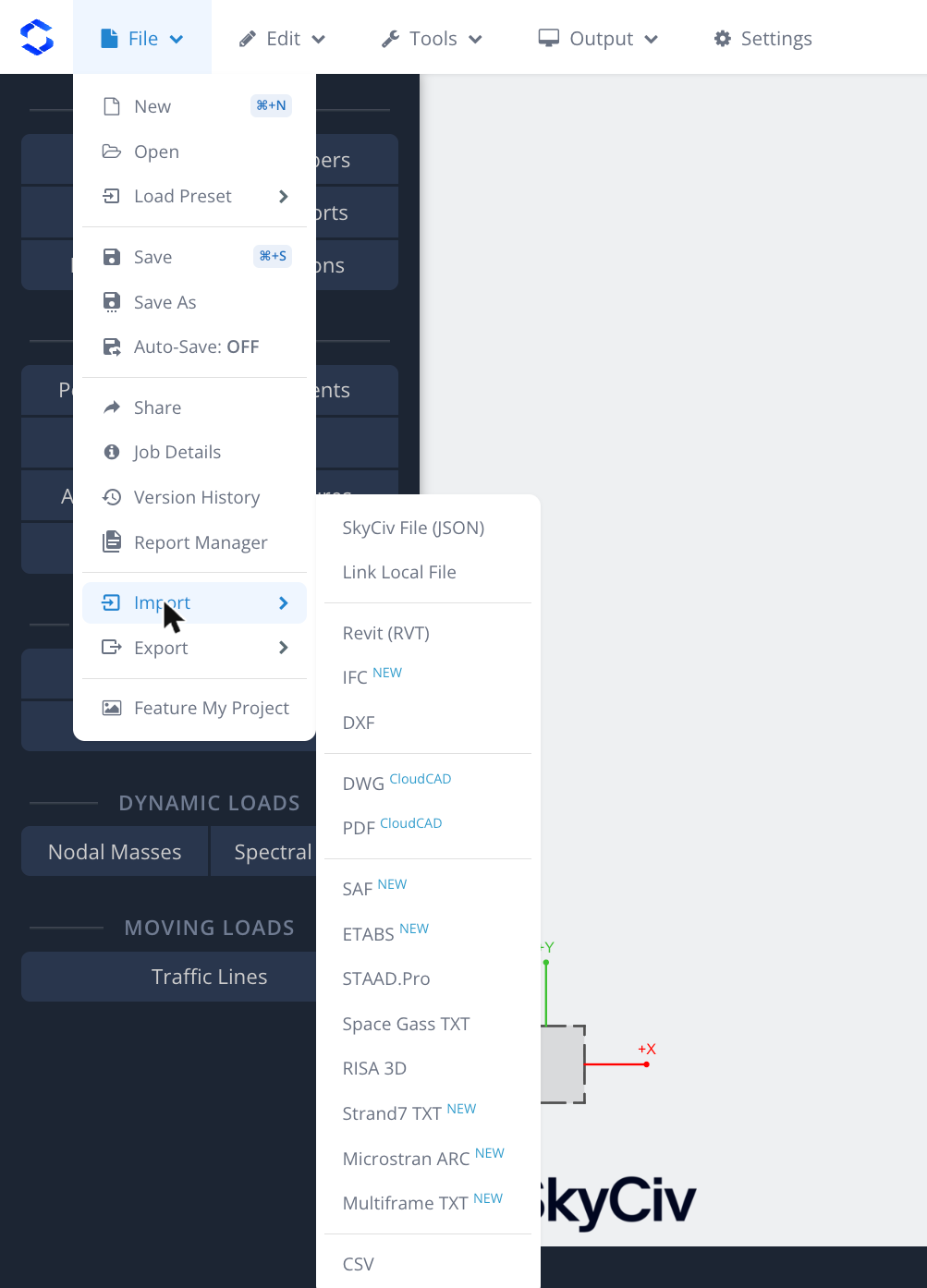
Most importers replace the model that is open. Il json, DXF and CSV importers have a Cancella i dati precedenti durante l'importazione opzione: untick it to add the imported data to your current model instead.
Importing a SkyCiv File (.Esportazione nell'API SkyCiv)
File > Importare > SkyCiv File (JSON) opens a model saved in the SkyCiv JSON (API) formato. If you untick Cancella i dati precedenti durante l'importazione, you can select several files at once and merge them into the current model, with two extra options:
- Remove unused sections and materials
- New Model Location: an X, E, Z offset (per esempio 0,0,0) to place the imported model at.
File > Importare > Link Local File live-links Structural 3D to a JSON file on your computer through SkyCiv Desktop, so the model updates as the file changes. Use it to connect third-party tools like Grasshopper, Revit, Excel or your own applications. Inserisci il File Path and pick a Poll Frequency (Alto, Medium or Low).
Importazione da CAD (DXF)
A common issue for engineers is obtaining an analytical model from Software CAD: CAD stores geometry and faces, while structural analysis software needs nodes and elements for finite element analysis. DXF (Disegno del formato eXchange) bridges the two, and most CAD and BIM programs can export it, including AutoCAD, Revit, Rinoceronte, Tekla Structures, SketchUp (vedere Importazione da SketchUp a SkyCiv), VectorWorks, Lavori solidi, Microstran and SAP2000.
Fai clic su File > Importare > DXF. Prepare the DXF file so that:
- Members are LINE, POLYLINE or LWPOLYLINE entities drawn along the member centerlines.
- Plates are 3DFACE, POLYLINE or LWPOLYLINE entities in the mid-plane of the plate. A 3DFACE can have at most 4 vertices and must be on a layer called PLATE, SLAB or WALL to be recognized.
- Plates with more than 4 vertices are only supported in the horizontal plane.
The import dialog asks which units the DXF file uses (mm, centimetro, m, ft, pollici, o costume (Enter Scaling Factor)) and converts them to the units you work in. You can also round the nodal coordinates (6 decimal places by default) and choose to Move structure to origin, Import polylines with more than 2 vertices as plates rather than members e Cancella i dati precedenti durante l'importazione. Read our full article on come importare file DXF nel software SkyCiv Structural Analysis for what can and cannot be imported this way.
Importing DWG and PDF Drawings
DWG files and PDF drawings carry 2D geometry rather than an analytical model, so SkyCiv offers tools to turn them into one.
CloudCAD
File > Importare > DWG e File > Importare > PDF open SkyCiv CloudCAD in a new tab, where you import the drawing (CloudCAD’s own File > Importare menu takes DXF, DWG, PDF, JPG/PNG and SVG), trace or edit the structure on it, then send it to Structural 3D. Per saperne di più, visitare How to import a DWG file into SkyCiv Structural Analysis Software.
Markup SkyCiv
SkyCiv Markup is built for working from PDF plans. Drag and drop a PDF (o fare clic Browse…), then mark up the structure on your drawings: colonne, travi, slabs and walls, with levels and gridlines (il Modello menu has the Levels Manager, Detect Gridlines e Markup Legend). Fai clic su Costruire to generate the analysis model and Apri in S3D to continue in Structural 3D. The AI Assistant is also available in Markup: describe your structural system and it marks up your plans for you. You can also export the marked-up quantities with Modello > Export Quantities (CSV).
Assistente AI
Aggiunta rastremata, il Assistente AI can work from a drawing too. Click the attach button (the paperclip) in the prompt box, choose your PDF, and describe what to build from it, for example "Build the steel frame shown on this plan, con 4 m storey heights". The AI Assistant also accepts images, CSV, Excel and HTML files. As with any AI-generated model, check the geometry, sezioni, supports and loads it creates before you rely on the results.

Importazione da Revit (.rvt) and IFC
You can import a Revit model into SkyCiv in two ways:
- Se hai installato Revit, utilizzare il Plugin SkyCiv Revit to push any model from Revit directly into your SkyCiv file storage with a click of a button.
- Without Revit, fai clic su File > Importare > Revit (RVT) in Structural 3D and upload the .rvt file. Files from Revit 2022, 2023, 2024, 2025 e 2026 sono supportati. SkyCiv shows a preview of the model, then imports it when you confirm.

IFC models are imported with File > Importare > IFC. Revit import and export, and IFC export, need the Autodesk integrations included in your SkyCiv plan; senza di loro, SkyCiv prompts you to upgrade.
Importing from Other Structural Analysis Software
Structural 3D imports models from the following software. Each importer replaces the current model with the imported one:
- SAF (.xlsx): the Structural Analysis Format, an open Excel-based exchange format initiated by the Nemetschek Group and managed by SCIA. Vedi il SAF guide for details.
- Etabs (.e2k, or the .txt version of the same text file)
- STAAD.Pro (.Esportazione nell'API SkyCiv)
- Space Gass TXT (.testo)
- RISA 3D (.r3d)
- Strand7 TXT (.testo)
- Microstran ARC (.arco)
- Multiframe TXT (.testo)
These importers bring in the structural model (nodi, membri, sezioni, materials and supports) e, where the source file holds them, i carichi, so that your model is ready to check and solve. Always review the imported model before you solve it.
Importazione da Excel (.csv)
Models can be generated from Excel in two ways:
- Utilizzando il nostro Plugin Excel-SkyCiv, which uses Microsoft Excel and the SkyCiv API to generate and import a model.
- Importing a CSV of your nodes or members with File > Importare > CSV:
- Nel Import from CSV File dialogo, scegliere Nodi o Elementi. The dialog lists the columns the CSV file needs: for nodes, the Node ID and X, E, Z position; per i membri, the Member ID, nodo A, nodo B, genere, ID sezione, Rotazione dei membri, porre fine alle fissità, compensazioni, Cable Length and Tension/Compression Limit.
- Fill in and save your CSV file in that format.
- Back in the dialog, fai clic su Caricare un file and choose your CSV file.
- Se Cancella i dati precedenti durante l'importazione is ticked, the imported data replaces the existing data of that type.

Exporting Models from Structural 3D
SkyCiv exports models in a range of file formats for two-way data transfer. Fai clic su File > Esportare and choose the format.
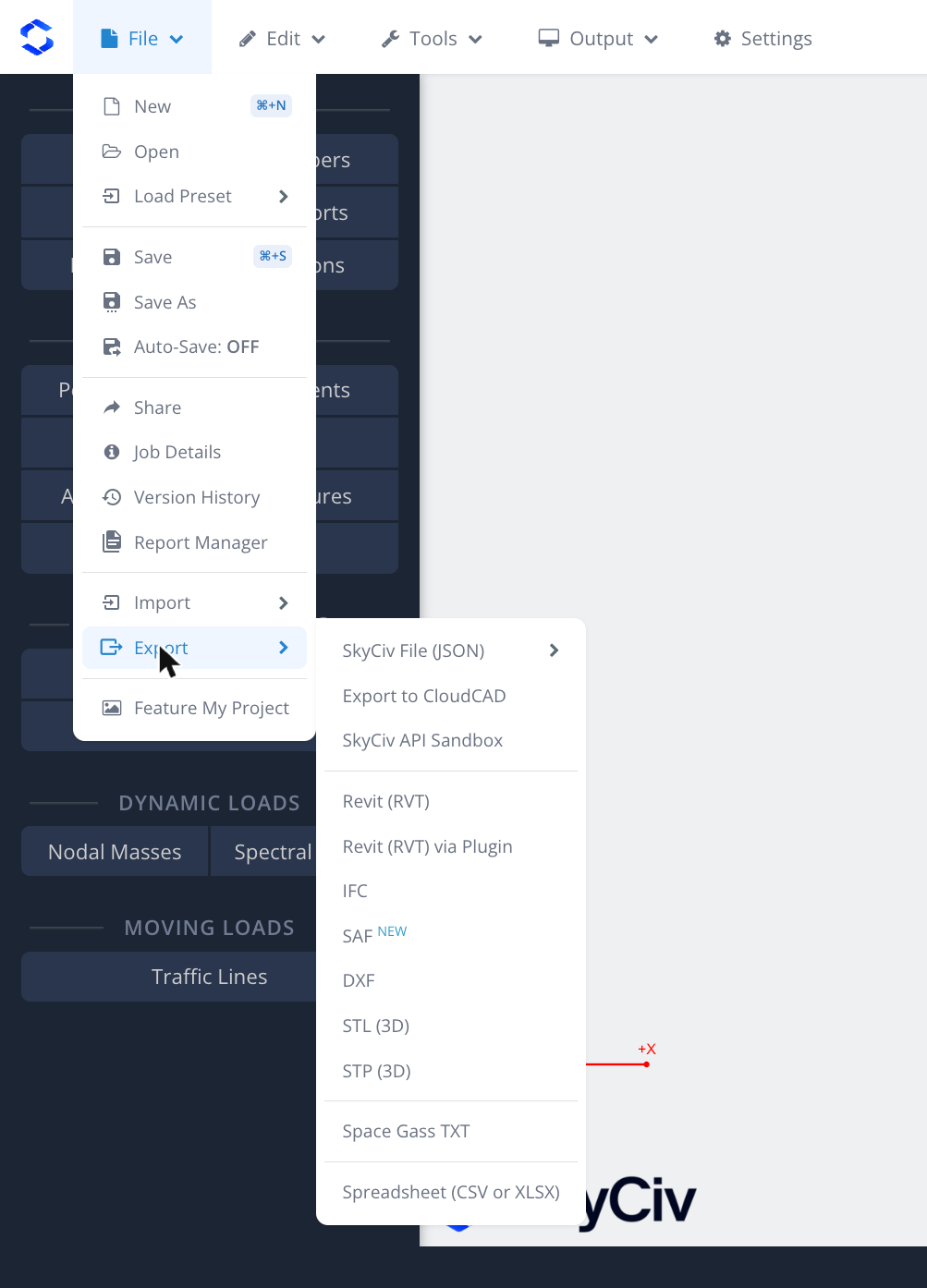
SkyCiv File (JSON) and the SkyCiv API
File > Esportare > SkyCiv File (JSON) downloads the model in the native SkyCiv JSON format. Scegliere Include Solver Results to store the results of a solved model in the file, so they can be viewed after import without solving again (the file takes longer to generate), o Exclude Solver Results for the model only.
The JSON file is the model in the format of the SkyCiv API, a good basis to automate and create custom solutions to your structural needs. SkyCiv API Sandbox opens the model directly in the API sandbox, in API v2 or v3 format.
Esporta in CloudCAD sends the model to SkyCiv CloudCAD to create 2D drawings from it.
Revit (.rvt) and IFC
File > Esportare > Revit (RVT) generates a Revit file to open in Autodesk Revit. The analytical model exports all the necessary data into Revit, compresi i membri, sezioni (famiglie), supporti, carichi e materiali. When the file is ready, fai clic su Scarica. File > Esportare > IFC works the same way for IFC.

Revit (RVT) via Plugin sends your changes back to a model that was pushed from Revit with the SkyCiv Revit plugin. Scegliere Metodo 1 to merge the S3D model into the model currently open in Revit, o Metodo 2 to merge it into the Revit model from your last push to S3D.
SAF (.xlsx)
File > Esportare > SAF downloads the model as a SAF Excel file, to open in SAF-compliant software.
DXF
File > Esportare > DXF apre il Esporta file DXF dialogo. Sotto Esportare, scegliere:
- 2D Lines (Members only): a 2D drawing in the XY, Piano XZ o YZ. Imposta il 2D Limits to capture only the members between two coordinates along the axis normal to that plane.
- 3D Lines (Elementi & Piastre) (l'impostazione predefinita), 3D Lines (Members only) o 3D Lines (Plates only).
Scala magnifies (sopra 1) or reduces (sotto 1) the drawing. DXF Entity for Plates sets how plates are written: POLYLINE for horizontal plates and 3DFACE for others (l'impostazione predefinita, needed if you plan to open the DXF in ETABS), 3DFACE for all plates, or POLYLINE for all plates. A plate with more than 4 vertices is always written as a POLYLINE. Leggi il nostro articolo su Exporting from SkyCiv to SketchUp.
STL and STP (3D)
STL (3D) e STP (3D) export the model as 3D geometry, as seen in the 3D renderer. Since this is an analytical model, members are connected at their centerlines, so they are likely to clash like so:

Space Gass (.testo)
File > Esportare > Space Gass TXT exports the model in the Space Gass text file format, compresi:
- Unità
- Nodi, members and plates
- Vincoli
- Section data and materials
- Offset
- Node loads (punti carichi e momenti)
- Concentrated member loads (punti carichi e momenti)
- Carichi distribuiti
- Pressure forces
- Prestressed forces
- Carichi di peso proprio
- Load cases and load combinations
Spreadsheet (CSV or XLSX)
File > Esportare > Spreadsheet (CSV or XLSX) exports tables of model data (nodi, membri, piastre, supporti, materiali, sections and load combinations) e, once the model is solved, nodale, member and plate results, for one load combination or all of them. For a CSV file, you can choose the formatting: a period decimal point with comma separators, or a comma decimal point with semicolon separators.
