
Cos'è un plinto eccentrico?
In alcuni casi, le colonne sono posizionate in modo eccentrico rispetto al centro del plinto. Footings that are not concentrically loaded are known as "Eccentric Footings". Inoltre, when footings are subjected to an axial load "P" and a bending moment "M" or a lateral force "H", the footing experiences an unbalanced stress distribution along its base. The same effect is produced by an axial load acting at an eccentricity "e" dal baricentro della fondazione.
Un momento, a lateral force acting at a height h above the base of the footing, or a column offset from the center of the footing can all be converted to an equivalent eccentricity of the axial load:
[math] e = \frac{M + H \, h}{P} [math]
Di conseguenza, the total combined stress at the base of the footing is equal to the sum of the stress due to the axial load over the footing area (PAPÀ) and the bending moment over the section modulus "S" of the footing (SM). For a rectangular footing of length L (in the direction of the eccentricity) and width B:
[math] q = \frac{P}{A} \pm \frac{M}{S} = \frac{P}{B \, L} \left( 1 \pm \frac{6 \, e}{L} \right) \quad \text{with} \quad A = B \, L, \quad S = \frac{B \, L^{2}}{6} [math]
Si presume che la pressione vari linearmente, come mostrato in figura 1. Questa distribuzione è valida quando il carico assiale rientra nel nocciolo centrale d'inerzia dell'area del plinto, ovvero, where the eccentricity "e" is not more than L/6. The following equations for soil pressure (q) can be used to determine the minimum and maximum pressures at the extreme edges of the footing (1).
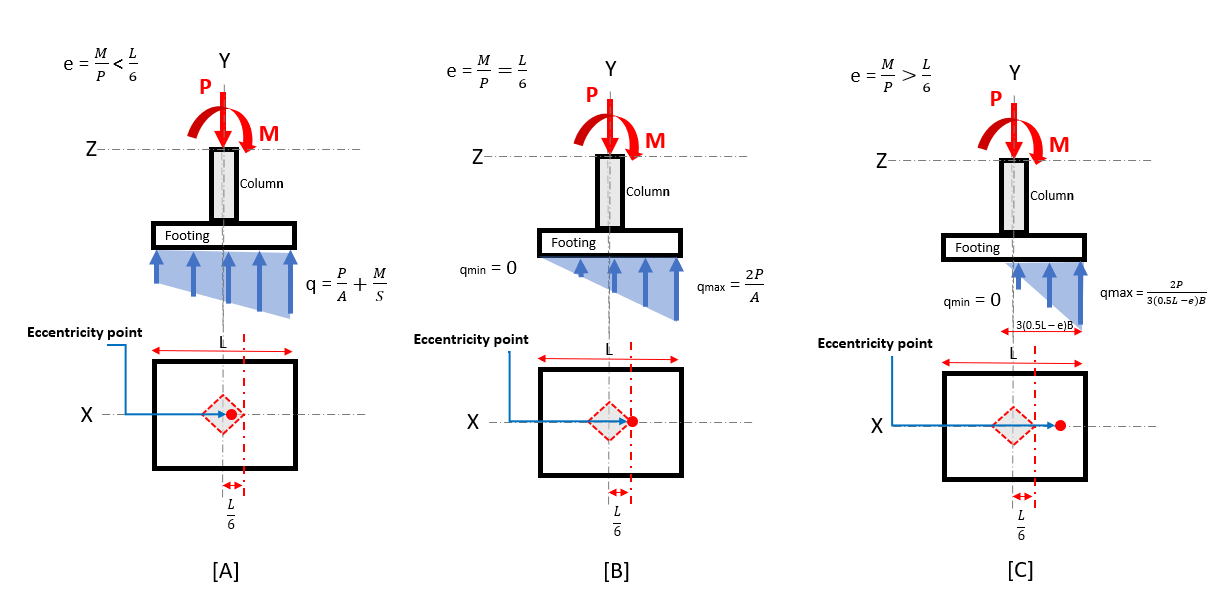
Figura 1. Distribuzione della pressione del terreno del plinto eccentrico
(un carico) eccentrico entro il limite del nocciolo d'inerzia (b) eccentric at the kern boundary (c) eccentrico al di fuori del limite del nocciolo d'inerzia
Figure 1A depicts the footing when the eccentricity is located inside the kern boundary (e < L/6). The entire footing is in compression and the soil pressure has a trapezoidal distribution where:
[math] q_{max} = \frac{P}{A} + \frac{M}{S} \qquad q_{min} = \frac{P}{A} – \frac{M}{S} [math]
La Figura 1B mostra il plinto quando l'eccentricità si trova sul limite del nocciolo d'inerzia (e = L/6). The entire footing is still in contact with the soil, but the soil pressure now has a triangular distribution, dropping to zero at the far edge:
[math] q_{max} = \frac{2 \, P}{A} \qquad q_{min} = 0 [math]
La Figura 1C mostra il plinto quando l'eccentricità si trova al di fuori del limite del nocciolo d'inerzia (e > L/6). The soil cannot resist tension, so part of the footing lifts off the soil and the pressure is only distributed over a contact length of 3(L/2 – e) measured from the most compressed edge. The soil pressure still has a triangular distribution, and the equation P/A + M/S no longer applies. Anziché:
[math] q_{max} = \frac{2 \, P}{3 \, B \left( \frac{L}{2} – e \right)} [math]
When the load is eccentric in both directions (biaxial eccentricity e_x and e_z on a footing of dimensions L_x and L_z), the whole base stays in compression only when the load falls inside the rhombus-shaped kern:
[math] \frac{6 \, e_{x}}{L_{x}} + \frac{6 \, e_{z}}{L_{z}} \leq 1 [math]
Outside of it, only part of the base is in contact with the soil and the pressure at the most loaded corner rises quickly. Fare riferimento a questo collegamento per un articolo più dettagliato su distribuzione della pressione del suolo.
Eccentric Footings in the SkyCiv Foundation Design Module
SkyCiv’s Foundation Design Module does not use the kern equations above to design the footing. It is integrated with Finite Element Analysis (BRUTTA): the footing is meshed into plate elements supported on compression-only soil springs, whose stiffness comes from the Modulo di reazione del sottofondo you enter in the soil properties. Because the springs cannot take tension, the part of the footing that would lift off the soil is detected by the analysis itself, so the same model covers loads inside and outside the kern, in one or both directions.
Modeling the eccentricity
Eccentricity enters the model in three ways:
- Carichi di colonna: nel Carichi di colonna tabella, each load has an axial force P, shears Vx e Vz, e momenti Mx e Mz. The axial force is applied as a uniform pressure over the column footprint, and the moments as a linearly varying pressure over it.
- Lateral forces: the shears Vx and Vz are converted into additional moments at the footing, using a lever arm equal to the column Altezza plus half of the footing thickness.
- Column position: for isolated footings, il X-offset e Z-offset del Colonna (center-to-center distance between the column and the footing, a PRO feature) place the column off the center of the footing. For combined footings, each column is positioned with its Distanza dal bordo X e Z-offset. The axial load then acts eccentrically on the footing without needing an extra moment.
Loads and moments can be applied in either direction, and their signs are kept, so moments that add to or cancel the effect of a column offset are both handled.
Soil pressure results
The FEA gives the soil pressure at every node of the mesh, which shows the real, non-linear distribution under the flexible footing rather than the linear distribution assumed above.
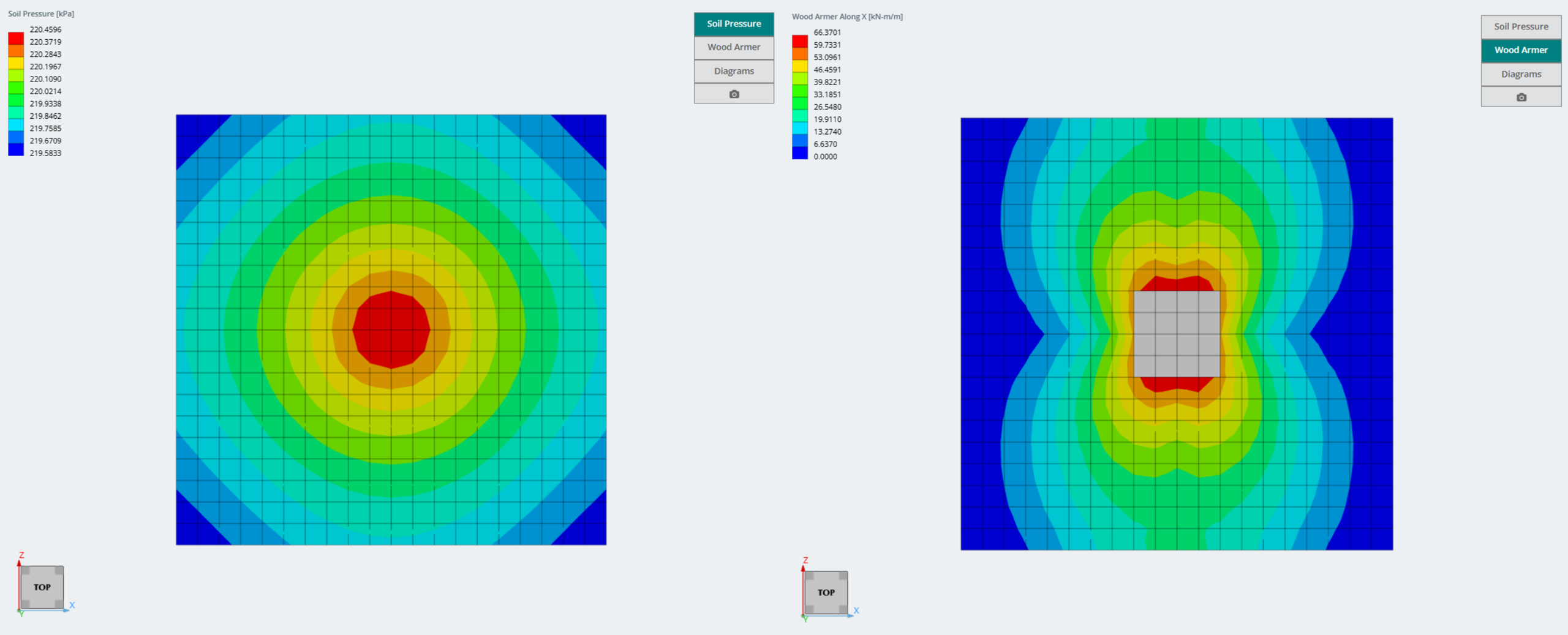
Il Analisi agli elementi finiti – Pressione del suolo section of the report shows the service and ultimate soil pressure contours, and a table of the maximum and minimum soil pressures with the (x, z) coordinates where they occur, measured from the upper left corner of the foundation plan. The results are based on the envelope of the load combinations, or on the service and ultimate loads you enter when Custom Load is turned on.
The maximum service soil pressure is then checked against the Capacità portante lorda ammissibile del terreno. Per AS 3600, you can also turn on Eseguire il controllo del cuscinetto del terreno ULS to compare the maximum ultimate soil pressure against the Capacità portante massima del suolo multiplied by the geotechnical reduction factor. The overturning, sliding and uplift checks of the report complete the stability checks of an eccentric footing.
Moment demand for flexure
The moments used for the flexural design come from the same FEA results. Nel Impostazioni di design, sotto Flexure Check, il Calcolo della domanda del momento setting has two options:
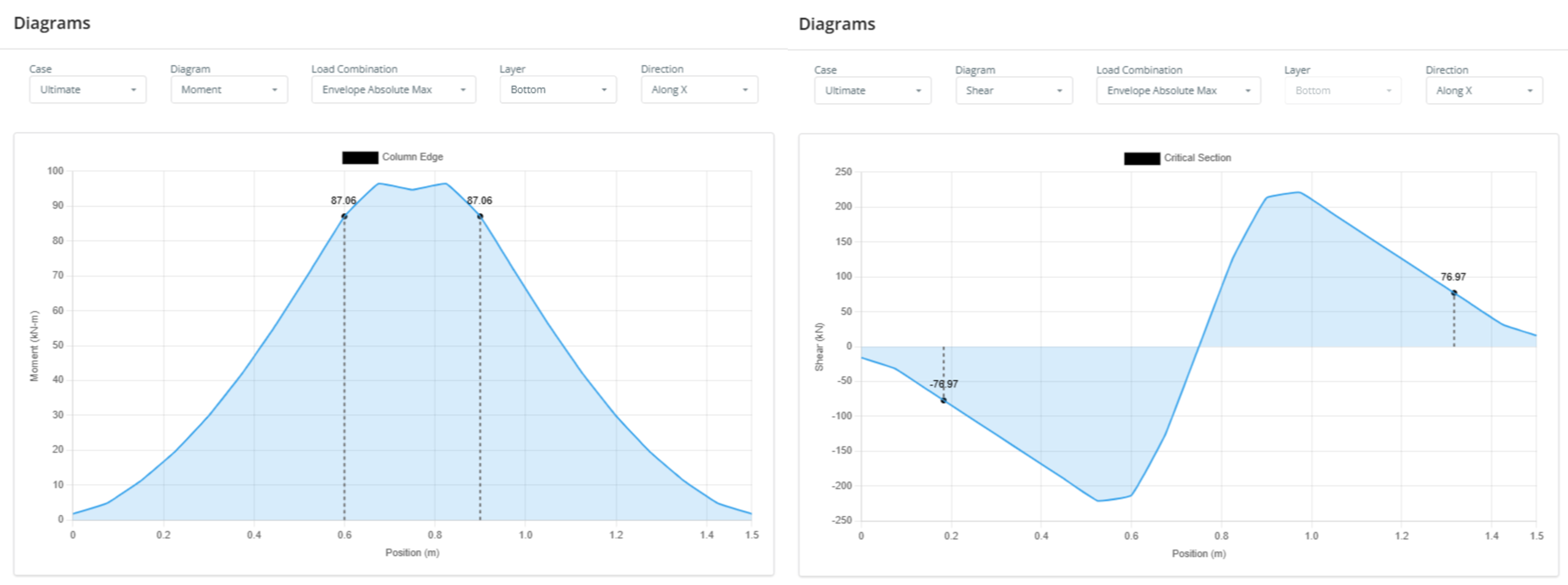
- Metodo della media a strisce (predefinito): the footing is divided into strips, and the moments are calculated as if each strip acts as a beam in its direction. Shear and moment diagrams are generated from the FEA results with this method, giving a clearer picture of the internal forces across the footing.
- Metodo del picco del legname: uses the maximum Wood-Armer moments of the plates, for a conservative design. It is the default for ACI 318-14.
Desidera provare il software Foundation Design di SkyCiv? Il nostro strumento gratuito consente agli utenti di eseguire calcoli di plinti in calcestruzzo senza alcun download o installazione!
Riferimenti
- Strutture in cemento armato: Analisi e progettazione, Seconda edizione. McGraw-Hill Professional.
