
Holen Sie sich die optimiertesten Abschnitte für Ihre Designs, mit einem einzigen Klick.
Der SkyCiv Member Design Designer spart Benutzern Zeit, indem jeder mögliche Abschnitt in einer bestimmten Datenbank überprüft und die Form mit der geringsten Querschnittsfläche und dem besten Nutzenverhältnis ausgewählt wird. Zur Zeit, the Designer supports the SkyCiv steel, cold formed steel and timber member design codes (AISC, BS, Eurocode, AS, NZS, CSA, IS, AISI, AS / NZS 4600, NDS and AS 1720). Damit der Designer korrekt funktioniert, müssen einige Kriterien erfüllt sein:
- Der Abschnitt muss aus einer Bibliothek im Section Builder geladen werden
- Das Mitgliedsdesign Prüfen Die Funktion muss lauffähig sein
Der Designer ist auf allen unseren Stählen vorhanden, Software für die Konstruktion von Holz und kaltgeformten Bauteilen über SkyCiv Structural 3D, SkyCiv Beam und unsere Standalone-Design-Software. Möchten Sie eine vollständige Video-Komplettlösung?? Besuchen Sie unser Beispiel-Tutorial zu dieser Funktion.
Starten des Designers
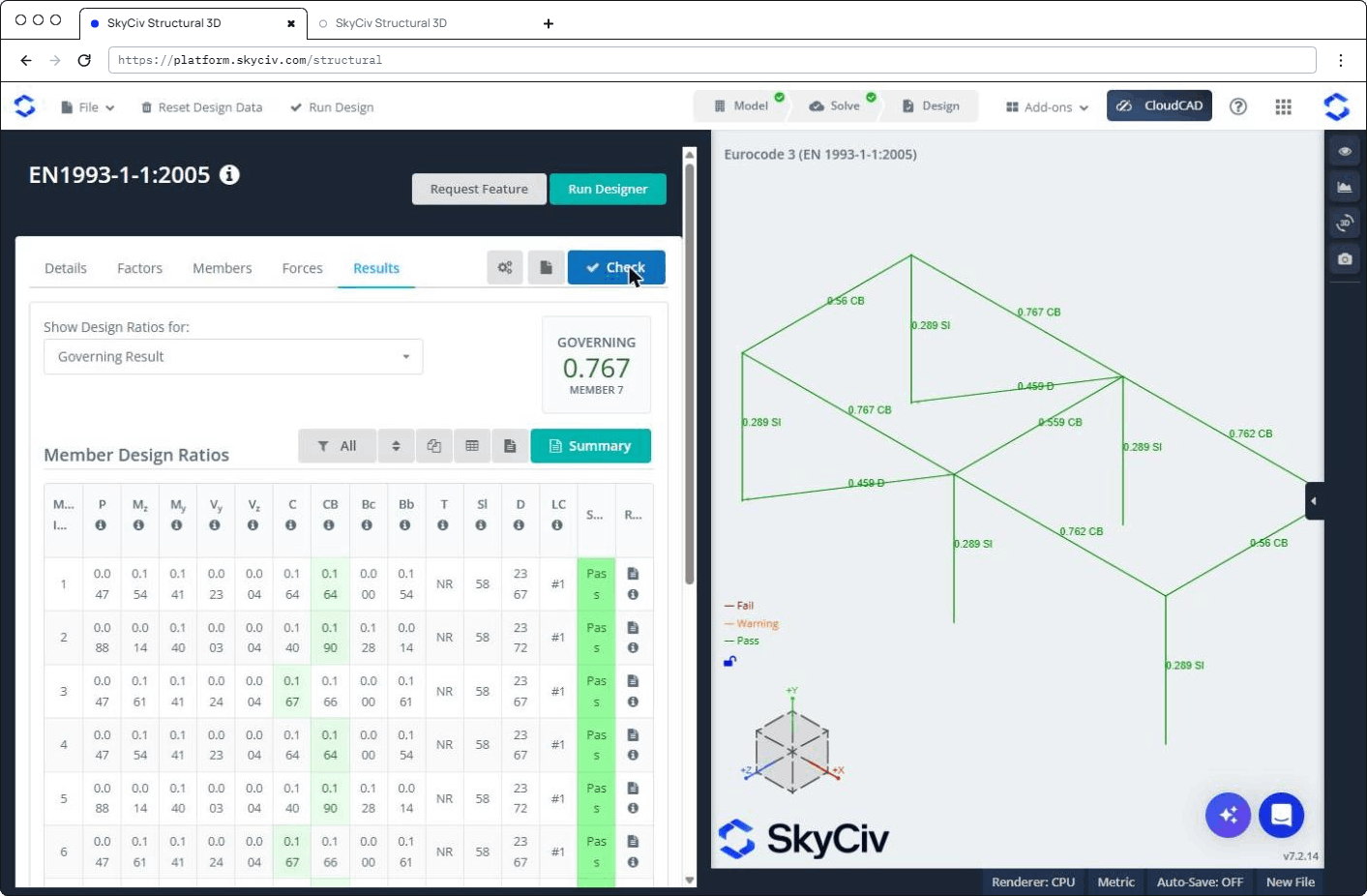
Um das Member Design zu starten Designer, Sie müssen zuerst das Member Design-Modul öffnen, für das Sie Ihre Struktur entwerfen möchten. In this example we are running a Eurocode 3 (IM 1993-1-1:2005) steel check. Sobald das Modul geöffnet ist, Klicken Sie einfach auf die Führen Sie Designer aus Klicken Sie auf die Schaltfläche in der oberen rechten Ecke des Moduls. Im folgenden Modell, a steel frame with HE 200 B columns, IPE 360 beams and SHS100x100x5 bracing, all members pass the check with a governing utility ratio of 0.767, so there is room to use lighter sections:
Designer Settings
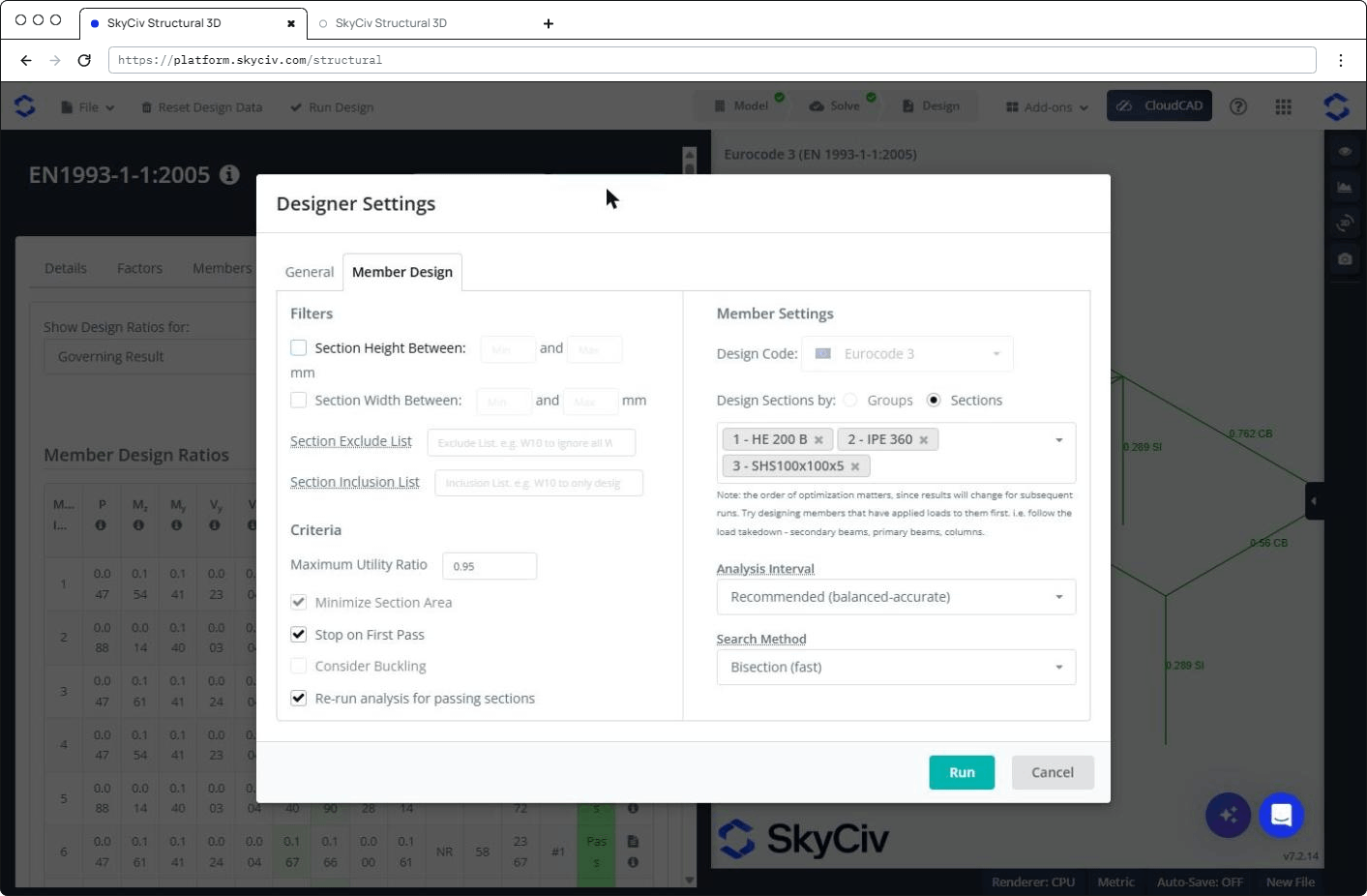
Benutzern stehen eine Reihe von Steuerelementen und Einstellungen zur Verfügung, einschließlich eines angestrebten Nutzenverhältnisses, Abschnittshöhen-/-breitengrenzen und welche Abschnitte Sie entwerfen möchten. Durch Anklicken des Führen Sie Designer aus Taste, bleibt die Designer Settings wird auftauchen. Its Mitgliedsdesign tab holds the following options:
Mit der Allgemeines tab has the Auto Commit Changes Wählen Sie die Mitglieder aus, die Sie wiederholen möchten: when ticked, the Designer automatically commits the optimized sections into the current model.
Filter
Standardmäßig, the Designer looks at all the sections of the library the section was loaded from. These options will govern what sections the Designer looks at when selecting the most optimized section:
- Section Height Between und Section Width Between: only test sections whose height or width is in the given range (in mm for metric models).
- Section Exclude List: skip any section whose name contains one of these entries. Zum Beispiel, W6x will exclude any section with W6x in its name. Comma separate multiple entries.
- Section Inclusion List: only test sections whose name contains one of these entries. This overrides the Section Exclude List. Comma separate multiple entries.
Kriterien
- Maximales Nutzenverhältnis: any result with a higher UR than specified will not be considered a valid choice. Die Standardeinstellung ist 0.95.
- Minimize Section Area: the Designer always looks for the passing section with the smallest cross sectional area (this option is always on).
- Stop on First Pass: on by default. Skips the remaining sections once the lightest section that meets the criteria is found, saving unnecessary results and solving time.
- Consider Buckling: also uses the buckling factor along with the Maximum Utility Ratio to decide if the criteria is met. To enable it, re-solve your model with Lineare statische + Knicken.
- Re-run analysis for passing sections: on by default. Re-runs the analysis whenever a section meeting the criteria is found, whatever the Analyseintervall. This may slow down the Designer, but gives a more accurate model once the changes are committed.
Mitgliedereinstellungen
In this area of the settings, bleibt die Design-Code of the Member Design module is shown. Unter Design Sections by, users can choose to design by Abschnitte (der Standard) or by Gruppen. The Designer will import whichever sections are designable in this module, Der Benutzer hat jedoch die Kontrolle darüber, welche Abschnitte er entwerfen möchte. Der Designer entwirft jeweils einen einzelnen Abschnitt.
Mit der Analyseintervall ist eine wichtige Einstellung, und teilt der Software mit, wie oft der FEA-Löser erneut ausgeführt werden soll. Its quickest option is Fast Run (an interval of 0) – meaning we will use the same internal forces when testing each section. Das ist normalerweise in Ordnung, seit dem Biegemoment, Scherkraft- und Axialergebnisse ändern sich beim Ändern eines Abschnitts nicht allzu sehr. Jedoch, deflection results will change and can affect the results – as we use a lighter section, Das Durchbiegungsergebnis muss aktualisiert werden, wenn das Eigengewicht reduziert wird.
So users can increase the frequency at which the solver is run between testing sections. Die einzige Einschränkung besteht darin, dass dadurch der Prozess verlangsamt wird, da der FEA-Löser zwischen Abschnittsänderungen ausgeführt werden muss. Die Optionen sind:
- Fast Run (low accuracy): does not re-run the analysis between sections. The sections are tested against the current force results.
- Recommended (balanced-quick): re-runs the analysis every 7 Querschnitte.
- Recommended (balanced-accurate): re-runs the analysis every 3 Querschnitte. This is the default.
- Slow Run (highest accuracy): re-runs the analysis between every single section test.
For large models, the default is lowered to keep the run time reasonable: balanced-quick for models with more than 500 Elemente, und Fast Run for models with more than 2000 Elemente.
Mit der Search Method sets how the Designer searches the section library for a section that meets your criteria:
- Bisection (CSA- und australische Standards): der Standard. Jumps through the ranked list of sections, halving the range left to search after each test, and skips sections that are unlikely to meet the criteria. This can save up to 70% of the design checks. In rare cases, it might not find the absolute best section.
- Sequential (slow): tests the sections one by one, from the lightest. It is slower, but goes through the whole list.
Sehen Der Prozess des Designers below for how each method works.
Der Prozess des Designers
Der Designer wird wie folgt ausgeführt:
- Führt eine erste Analyse/Entwurf durch, um sicherzustellen, dass das Modell korrekt eingerichtet ist, und um aktuelle Ergebnisse zu ermitteln
- Beginnt mit dem Testen des ersten Abschnitts:
- Ordnet alle Abschnitte in der angegebenen Bibliothek in der Reihenfolge ihrer Querschnittsfläche. If the current section already passes, heavier sections are left out
- Ändert einen Abschnitt im Modell und führt die Analyse erneut aus (abhängig von Analyseintervall Einstellung)
- Mit den neuen Analyseergebnissen (Biegen, Durchbiegung usw.) we test the next section, picked by the Search Method (siehe unten)
- Speichern Sie die Ergebnisse und führen Sie die nächste Analyse durch
- Mit dem Sequential search method, the sections are tested one by one, from the lightest. Für Geschwindigkeit und Leistung, Alle unnötigen Tests werden übersprungen. Dies sind wenn (ein) der Letzte 5 Tests haben schlechtere Ergebnisse erbracht oder (b) Wir haben bereits das bestmögliche Nutzenverhältnis gefunden (c) Wir scheitern in großer Zahl, wir werden überspringen 5 Querschnitte
- Beginnen Sie mit dem nächsten Abschnitt, with the updated sections from previous iterations carried through
Bisection search
Mit dem Bisection search method, the sections are ranked by cross-sectional area, with a small weighting given to their elastic section moduli, so that sections of similar area are ordered by their bending capacity. The Designer then:
- Starts from the current section. If it passes, it searches the lighter sections; if it fails, it searches the heavier ones
- Tests the section halfway between the lightest section known to pass and the heaviest section known to fail, and keeps the half of the range that holds the answer
- When a tested section fails but its utility ratio is close to the limit, it moves in smaller steps, so that more of the lighter sections around the limit get tested
- Stops when the range can’t be narrowed any further, and keeps the lightest passing section it found
The jumps through the list are large at the start and get smaller as the search closes in. Since a large change of section changes the forces in the model the most, the Designer re-runs the analysis more often after large jumps: before the next test after a jump of more than 20 sections in the list, and at least every 2 oder 3 tests for smaller jumps (or more often if your Analyseintervall is shorter). Mit Fast Run, the analysis is never re-run, whatever the size of the jumps.
Order of the sections
The order in which the sections are designed matters, da wir das Modell im Laufe der Zeit aktualisieren werden, wenn Sie am Ende leichtere Elemente aus den Optimierungen früherer Abschnitte erhalten, Sie wirken sich auf die Ergebnisse nachfolgender Abschnittsoptimierungen aus. Wenn es hilft, Benutzer können im Protokoll genau sehen, was der Designer unten getan hat Protokoll anzeigen wenn die Ergebnisse zurückkommen.
Betrachten Sie den Fall wobei die Spalten zuerst optimiert werden. Sie könnten bestehen, aber dann beginnen Sie mit der Gestaltung der Balken oben (vielleicht dicker/schwerer machen) Wenn Sie dann zurückgehen, überprüfen Sie die Spalten erneut, sie könnten scheitern. Jedoch, Optimierung in umgekehrter Reihenfolge, sollte dieses Problem nicht haben.
Ergebnisse
The results will display in a popup. For each section, it shows the original and optimized section, the number of tests, a note, the utility ratio, the savings (the reduction in cross sectional area) and a checkbox to commit it. When the Designer made the model lighter, it also shows the total material savings (the weight of the model before the Designer run compared to the optimized model). Im folgenden Beispiel, alles 3 Teile des Modells wurden optimiert, for a 26% material saving:
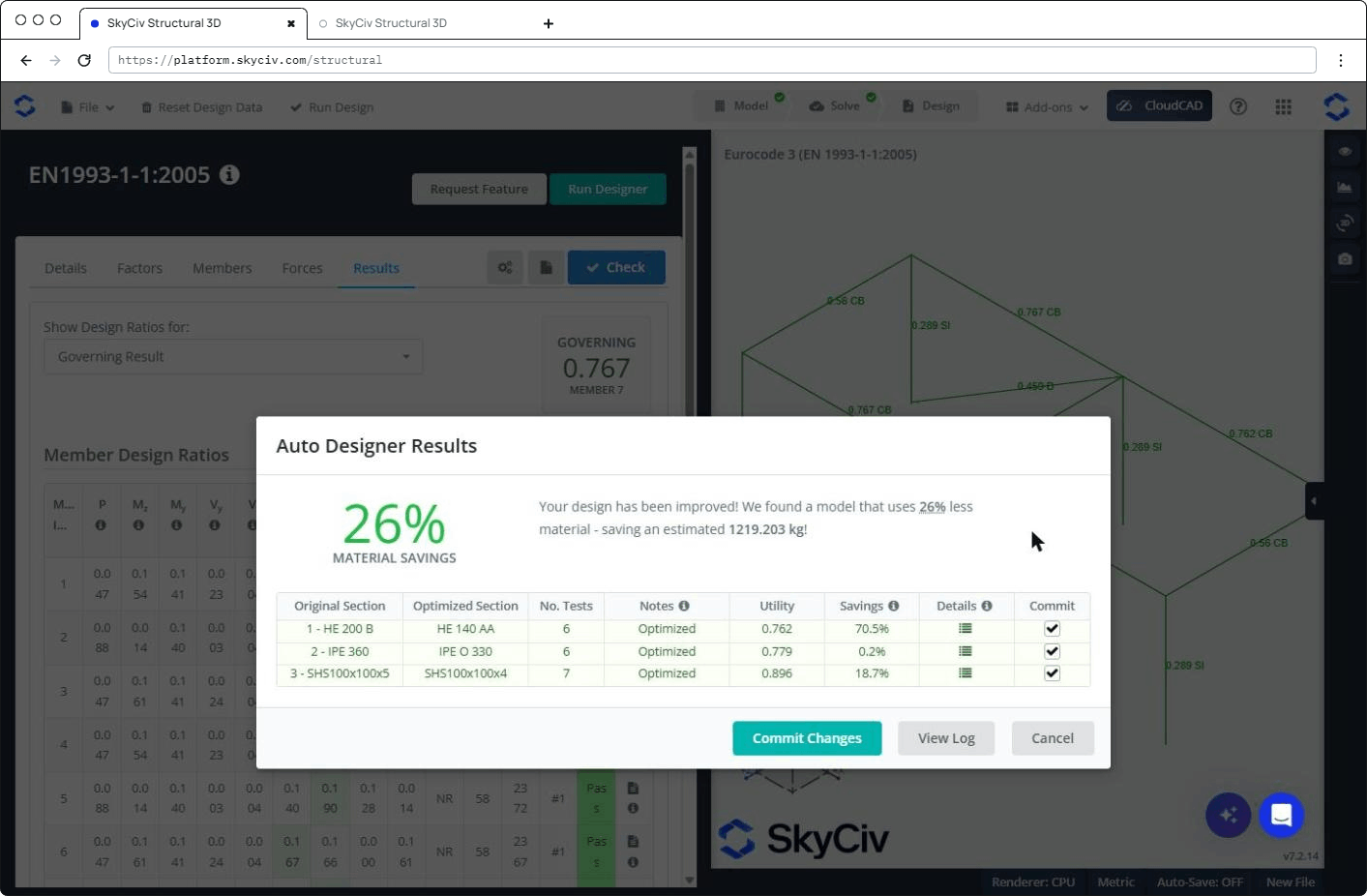
Mit der Anmerkungen column tells you what happened to each section:
- No Change: no change was made to your section. Either it is the best option, or there is no passable section in the tested range.
- Optimized: this is the best option found in the tested range.
- Now Passing: the section was failing before, but now passes.
- Not Passable: no section in the range is passable.
- Best Option: this is the best option found in the tested range, but it may still be failing.
- Skipped: the section could not be optimized and was left unchanged. The reason is shown above the table.
Wir können uns alle Läufe und ihre Ergebnisse genauer ansehen, indem wir auf das Symbol unten klicken Einzelheiten. Daraufhin wird die folgende detaillierte Liste der Läufe angezeigt. Zum Beispiel, Abschnitt auswählen 3 (SHS100x100x5) wird Folgendes zeigen:
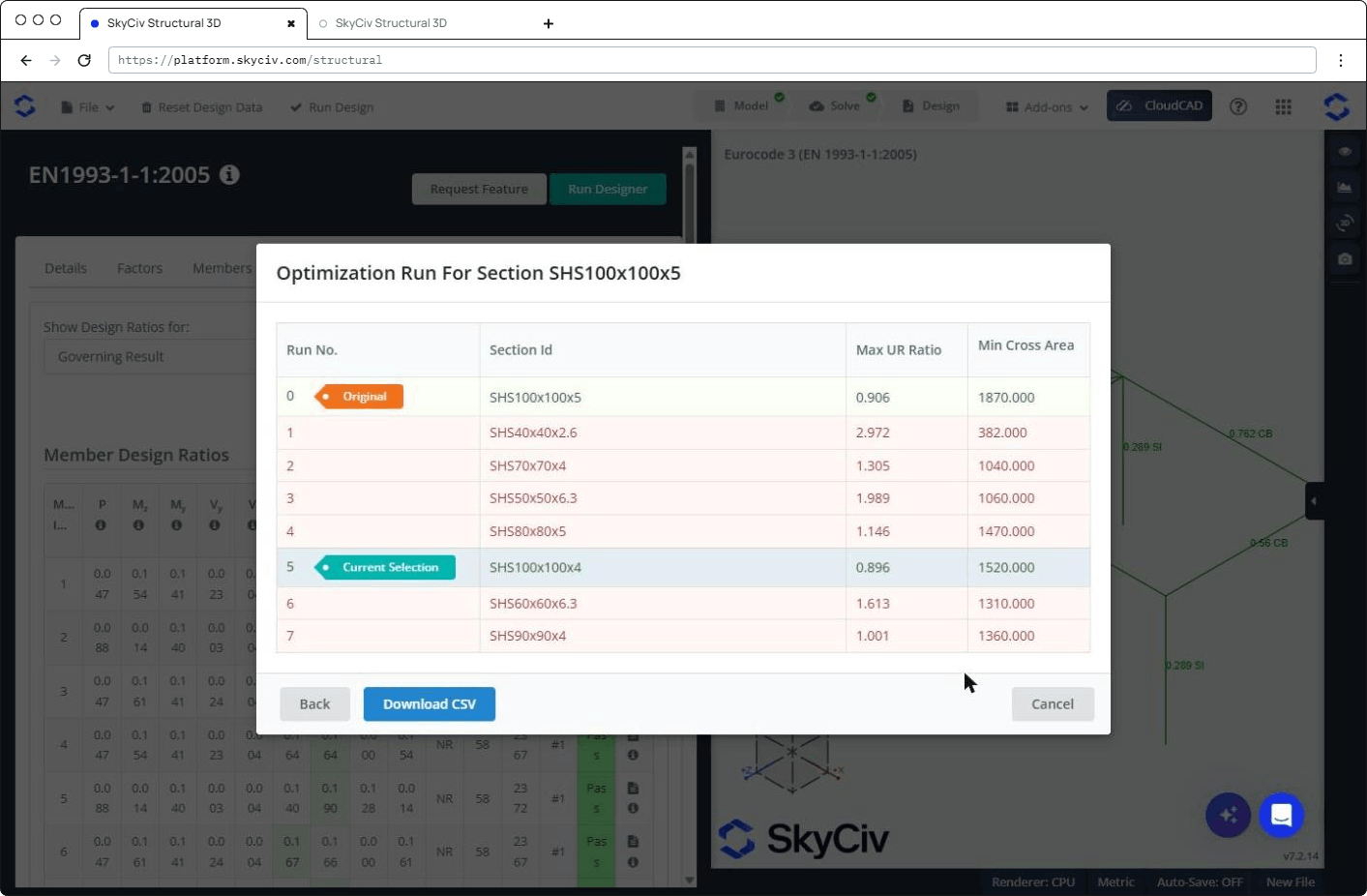
From here we can sort by Max UR Ratio or cross area by clicking the column headers, and download the list with Download CSV. The original section and the selected section are labeled. Dadurch können Benutzer die Optimierungsläufe überprüfen, um sicherzustellen, dass der richtige Abschnitt ausgewählt wurde. Im obigen Beispiel, we kept the default maximum Utility Ratio of 0.95 and the Designer minimized the cross section area: it selected SHS100x100x4, the lightest section tested that still meets this design criteria.
Festschreiben Ihrer Ergebnisse
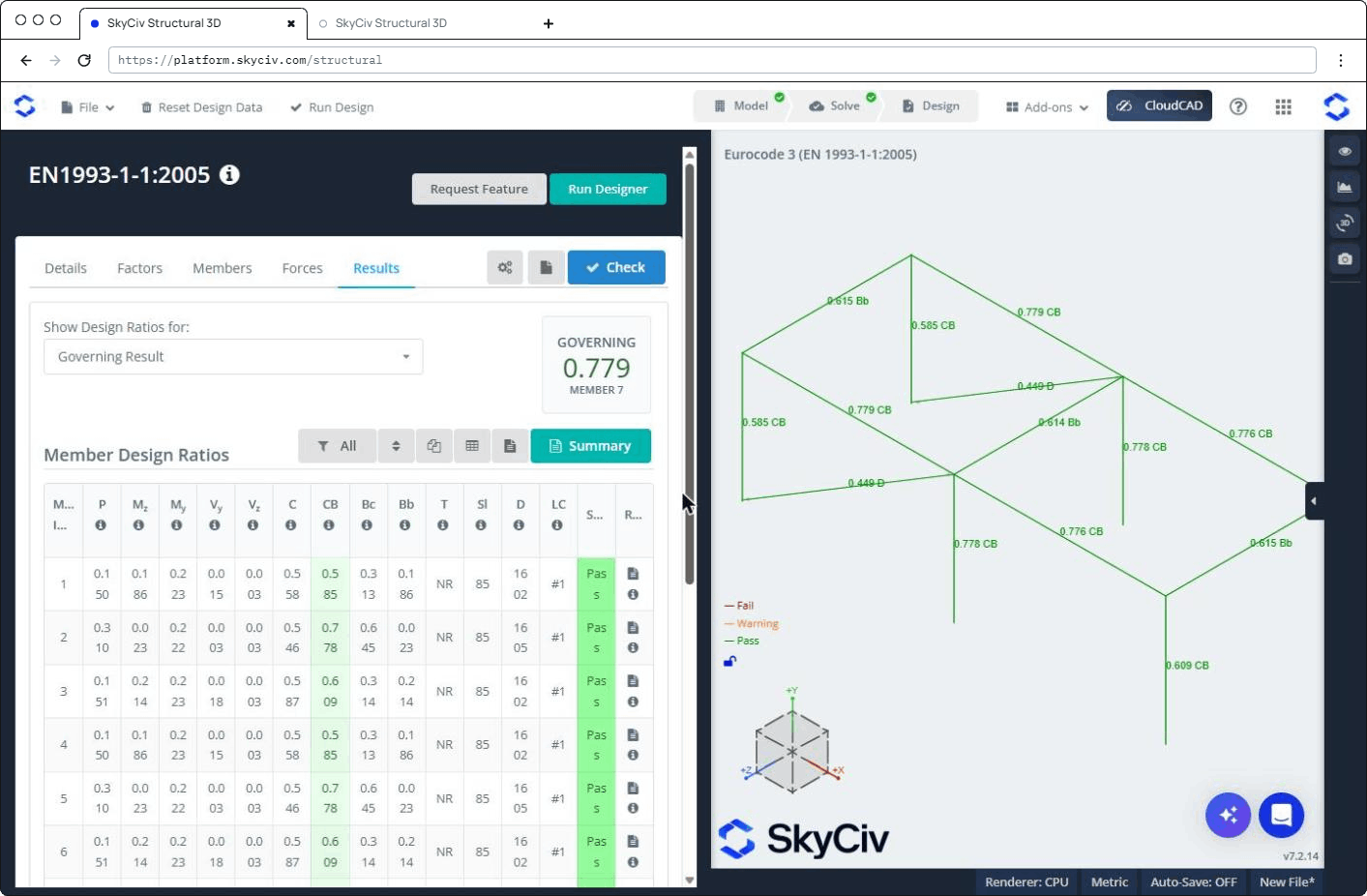
Sobald Sie mit den Ergebnissen zufrieden sind, Du kannst schlagen In der Menüleiste auf der linken Seite und klicke Änderungen übernehmen to accept the sections that are ticked under Begehen. Die Software übernimmt diese Formen sowohl im Design-Modul als auch im Design-Modul, und Ihr Strukturmodell. The software will also re-solve the model and re-run your design check to give you the most up to date results. So in unserem obigen Beispiel, after committing we can see the sections are all still passing, with a governing utility ratio of 0.779:
Ändern Sie Ihren Abschnitt im Designmodus, bedeutet, dass Ihre Analyseergebnisse nicht mit Ihrem aktuellen Modell übereinstimmen. If you change sections in any other way, Wir empfehlen dringend, noch einmal zurückzugehen, Ihr Modell aufzulösen und die Entwurfsprüfung erneut durchzuführen, um sicherzustellen, dass Ihre Analyse- und Entwurfsergebnisse synchron sind.
Designing Failing Members
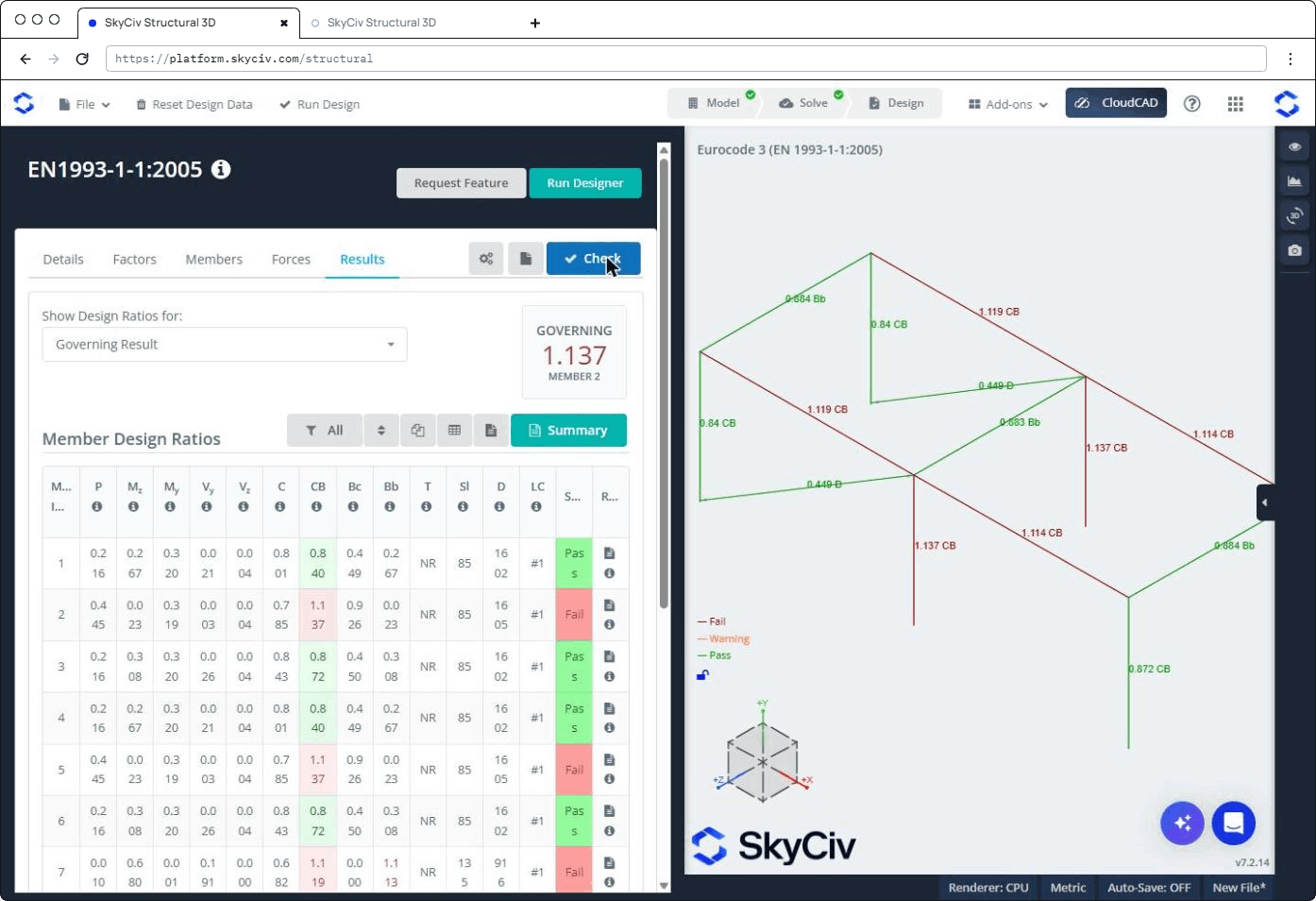
The Designer doesn’t only make passing members lighter: when a section fails, it searches the heavier sections for the lightest one that passes. To show this, we took the optimized model from above and increased the first load combination from 1.2D + 1.6L to 1.6D + 2.4L.. After solving and re-running the check, the middle columns and the long beams fail, with a governing utility ratio of 1.137:
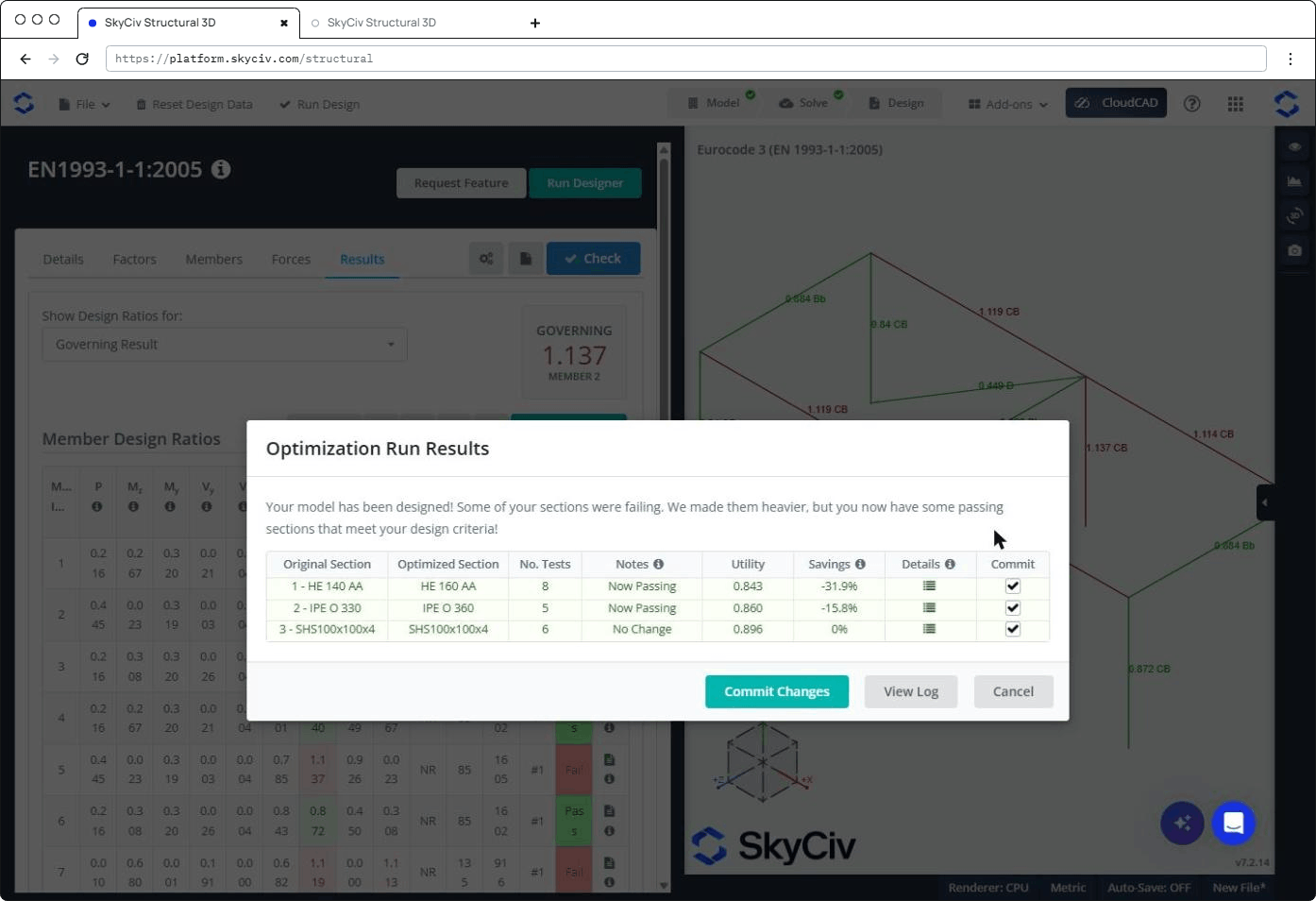
Running the Designer again with the same settings, the failing columns and beams are moved up to heavier sections (ER 140 AA to HE 160 AA, and IPE O 330 to IPE O 360) and marked Now Passing. Since the sections got heavier, ihre Savings are negative. The bracing still passes, so it is left as No Change:
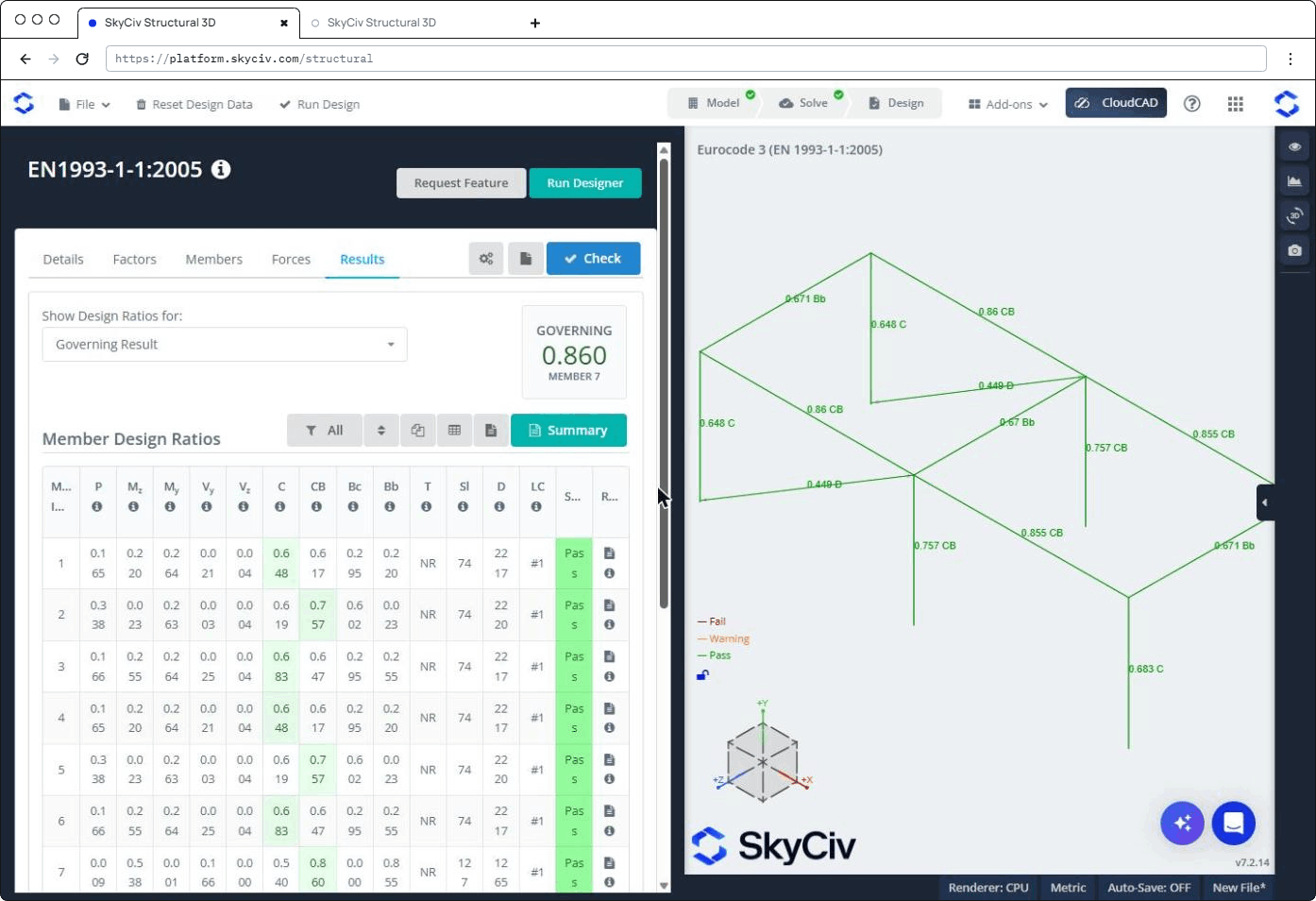
After committing, all the members pass again, with a governing utility ratio of 0.860:
Fehlerbehebung
Wenn Sie den Designer nicht zum Laufen bringen können, Sie sollten Folgendes überprüfen:
- Werden Ihre Abschnitte aus der SkyCiv-Abschnittsdatenbank geladen?? Die Abschnitte müssen aus der Section Builder-Datenbank geladen werden, Auf diese Weise weiß der Designer, welchen Abschnittskatalog er testen muss. If a section was loaded from a library table that is no longer in the current section library (a legacy table), the Designer skips it and says so: re-select the section from the Section Builder library and run the Designer again
- Can you run a Member Design “Check”? Dadurch wird bestätigt, dass alle Abschnitte gestaltbar sind und Ihr Modell korrekt eingerichtet ist. Da der Designer dies durchläuft, Damit es funktioniert, muss es für Ihr Basismodell laufen
- Haben Sie spezielle Elemente? (verjüngt sich, Starre Elemente)? Die Benutzeroberfläche sollte dies verhindern, aber in bestimmten Fällen kann dies trotzdem passieren. Please remove those special elements from the Designer Settings and try run the Designer again
- Überprüfen Sie, ob Ihre Materialien mit dem zu testenden Designcode übereinstimmen. Nochmal, Dies sollte von der Benutzeroberfläche blockiert werden, kann aber in einigen Fällen passieren. Gehen Sie zurück zu Ihrem Modell und überprüfen Sie, ob diese Abschnitte mit dem Designcode übereinstimmen, den Sie ausführen möchten. Zum Beispiel, NDS sollte über geeignete NDS-Materialien verfügen, oder AISC sollte dem Abschnitt ein Stahlmaterial zugewiesen haben.
- Handelt es sich bei Ihrem Modell um ein Einheitensystem, das dem Entwurfsstandard-Einheitensystem entgegengesetzt ist?? Wir empfehlen, US-Designcodes in Imperial und AS auszuführen,IM,BS,CSA usw.. Standards alle in metrisch
