
Add members by distance or angle from an existing node
The Relative Member tool in SkyCiv Structural 3D creates a new member from an existing node, by entering how far the other end is in X, Y and Z, or by entering its length and angle in one of the global planes. You don’t need to know the coordinates of the new node: SkyCiv works them out from the reference node, adds the node and connects it with a member.
This is the quickest way to model members that are not aligned with the global axes, such as rafters, Hosenträger, cantilevers and inclined struts, or to extend several nodes of a model by the same distance in one step. A closely related tool, Relativen Knoten hinzufügen, does the same thing without creating a member. You can also ask the AI Assistant to add these members for you in plain language (siehe unten).
Opening the Relative Member tool
Select one or more nodes, then either:
- Drehen Sie die Ansicht, sodass Sie die beiden gemeinsamen Sparren einfach mit einer Auswahl von links nach rechts auswählen können R., oder
- right-click the selection and choose Stäbe > Relatives Mitglied hinzufügen.
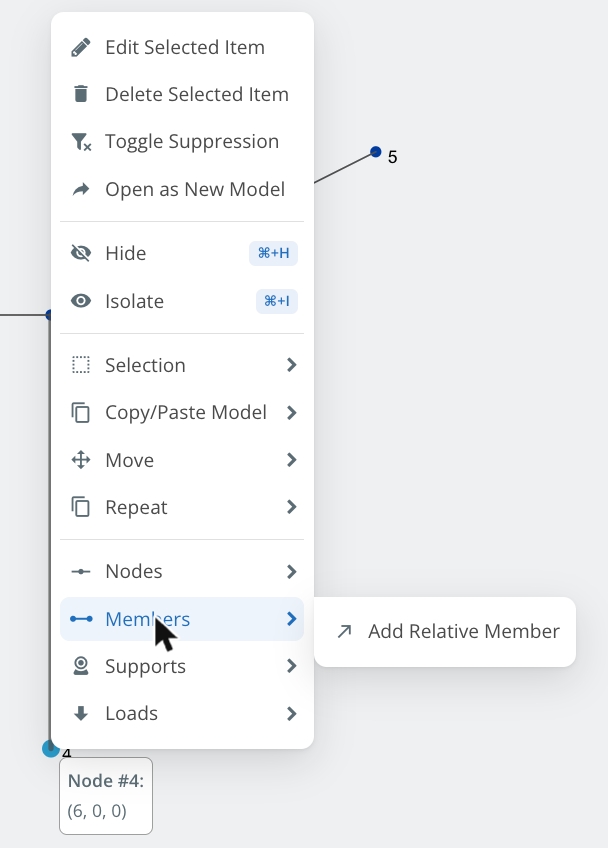
Das Relatives Mitglied hinzufügen panel opens over the model. You can drag it by its title bar anywhere in the model space, so it doesn’t hide the part of the model you are working on. Close it with the × in its title bar, oder drücken Esc. Das ich icon gives a quick reminder of how the tool works.
The panel has these fields:
- Ref. Knoten-ID(s): the node, or nodes, the new members start from. It is filled with the nodes you selected, and you can type other node IDs, durch Kommata abgetrennt.
- Methode: how the position of the new node is defined, by distances (X.,UND,Z-Abstand) or by a distance and an angle in a plane (XY-Ebene, XZ-Ebene, und ZY-plane oder YZ-plane depending on the vertical axis of the model).
- The inputs of that method, in den Längeneinheiten Ihres Modells.
- Abschnitts-ID: the section assigned to the new members. Start typing to search the sections of the model. It remembers the last section you used.
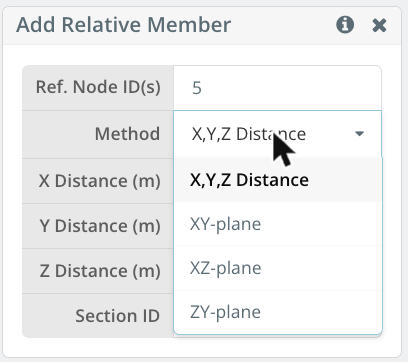
As you type, a dashed line previews the new member from each reference node to its new node. Drücken Sie Vergiss nicht, dass du mir in dem Video folgen kannst, das ich von diesem ganzen Prozess gemacht habe in any field to create the member. If an input is not valid (for example a reference node that doesn’t exist, or all distances left at zero), a message tells you what to fix and nothing is created.
Adding a relative member with X, Y and Z distances
X.,UND,Z-Abstand is the default method. Enter the change in position from the reference node to the new node along each global axis:
- X-Abstand, Y Distance und Z-Abstand: the distances along X, Y and Z, positive or negative. A field you leave empty counts as zero.
Use it when you know how far the end of the member is from its start along each axis, which works in 2D and 3D models alike.
Beispiel: a sloping member from the top of a column
A portal frame has its top right corner at Node 3, beim (6, 4, 0) Mio.. To add a member that rises 1.5 m over 3 m to the right, select Node 3, Drehen Sie die Ansicht, sodass Sie die beiden gemeinsamen Sparren einfach mit einer Auswahl von links nach rechts auswählen können R., und eintreten 3 im X-Abstand und 1.5 im Y Distance. The dashed line shows where the member will go:
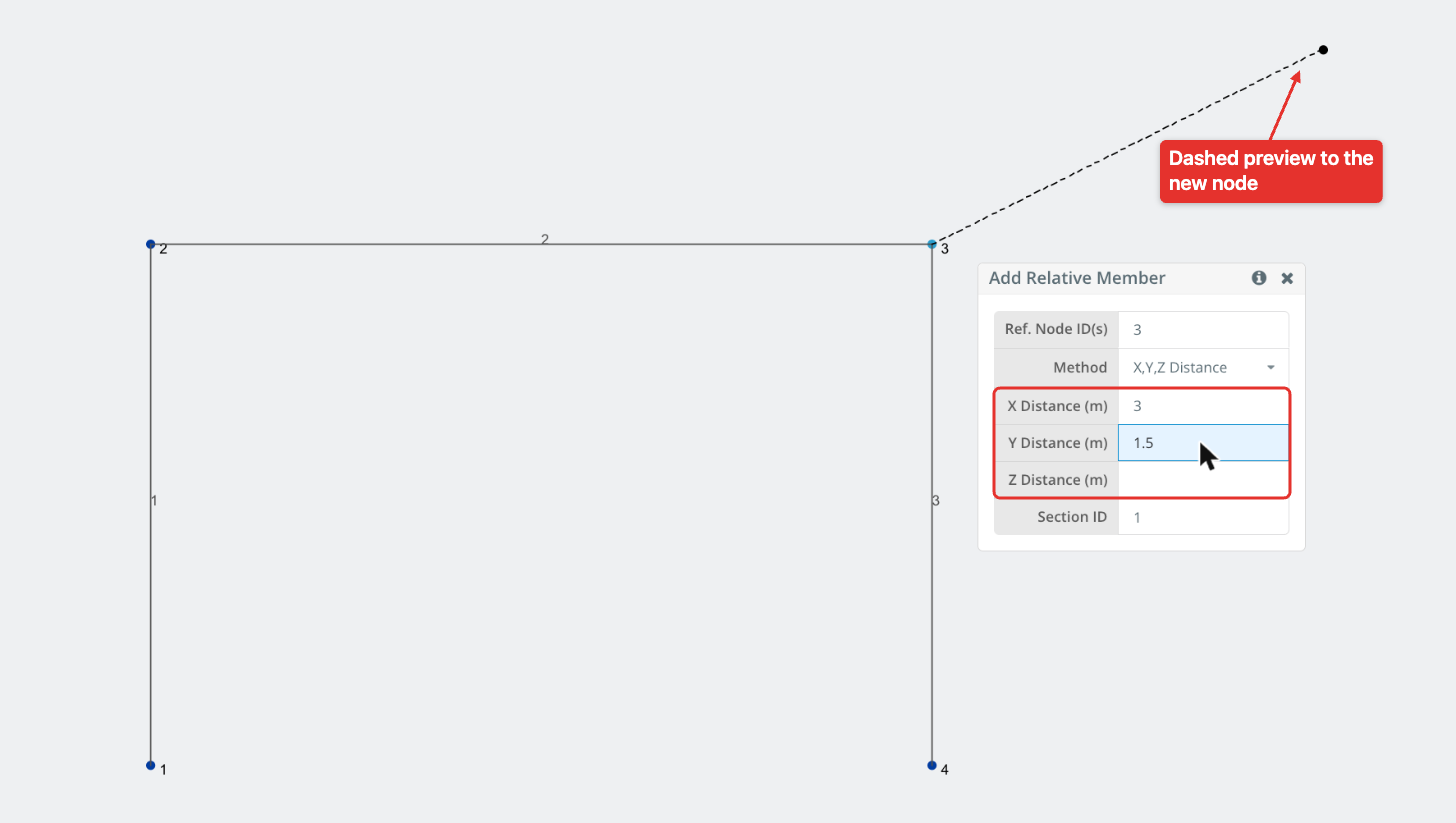
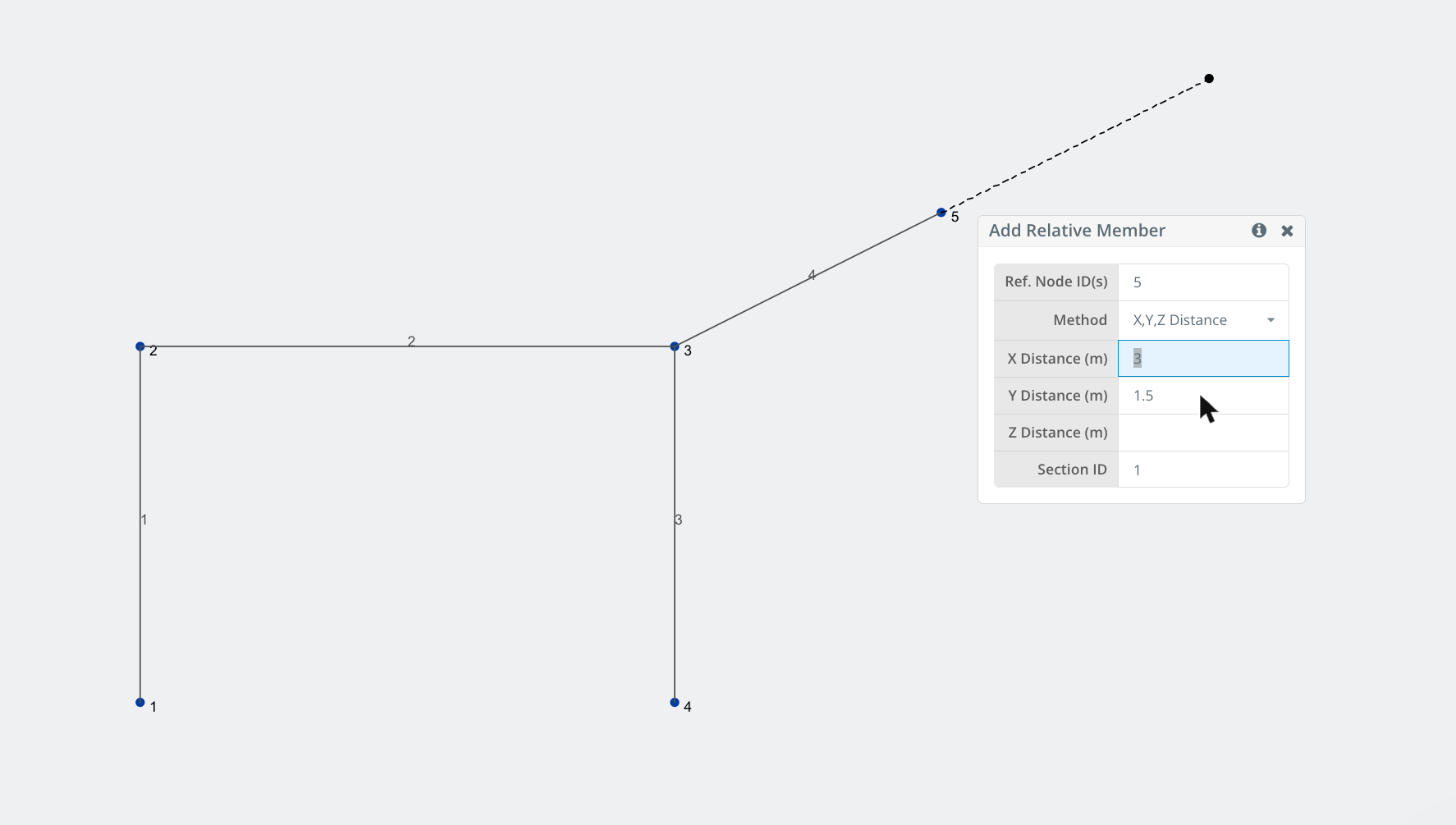
Drücken Sie Vergiss nicht, dass du mir in dem Video folgen kannst, das ich von diesem ganzen Prozess gemacht habe klicken, um den Stab zu erstellen. SkyCiv adds Node 5 beim (9, 5.5, 0) m and a member from Node 3 zum Knoten 5.
Chaining members
The panel stays open after each member, und Ref. Knoten-ID(s) changes to the node just created. The distances you entered are kept, so pressing Vergiss nicht, dass du mir in dem Video folgen kannst, das ich von diesem ganzen Prozess gemacht habe again adds the next member from the new node with the same offset. Change the values between members to model a chain of members of different lengths and directions, without going back to the model.
Adding a relative member by angle and distance
The plane methods create a member of a given length at a given angle, in a plane parallel to one of the global planes through the reference node. Use them when you know the length and slope of a member rather than its X, Y- und Z-Komponenten. Pick the plane in Methode, then enter:
- Distanz: the length of the new member.
- Winkel (Sie): the angle of the member in the plane, in Grad, measured from the first axis of the plane towards the second. Negative angles go the other way.
| Methode | Angle measured from | Towards |
|---|---|---|
| XY-Ebene | +X. | +UND |
| XZ-Ebene | +X. | +MIT |
| ZY-plane (Y is the vertical axis) | +MIT | +UND |
| YZ-plane (Z is the vertical axis) | +UND | +MIT |
The list shows ZY-plane when Y is the vertical axis of the model and YZ-plane when Z is, so that the angle in the vertical plane is always measured up from the horizontal axis.
Beispiel: an inclined member in the XY plane
From Node 5 of the previous example, add a 3 m member sloping down at 60° from the horizontal. With Node 5 as the reference node, wählen XY-Ebene im Methode, eingeben 3 im Distanz und -60 im Winkel (Sie):
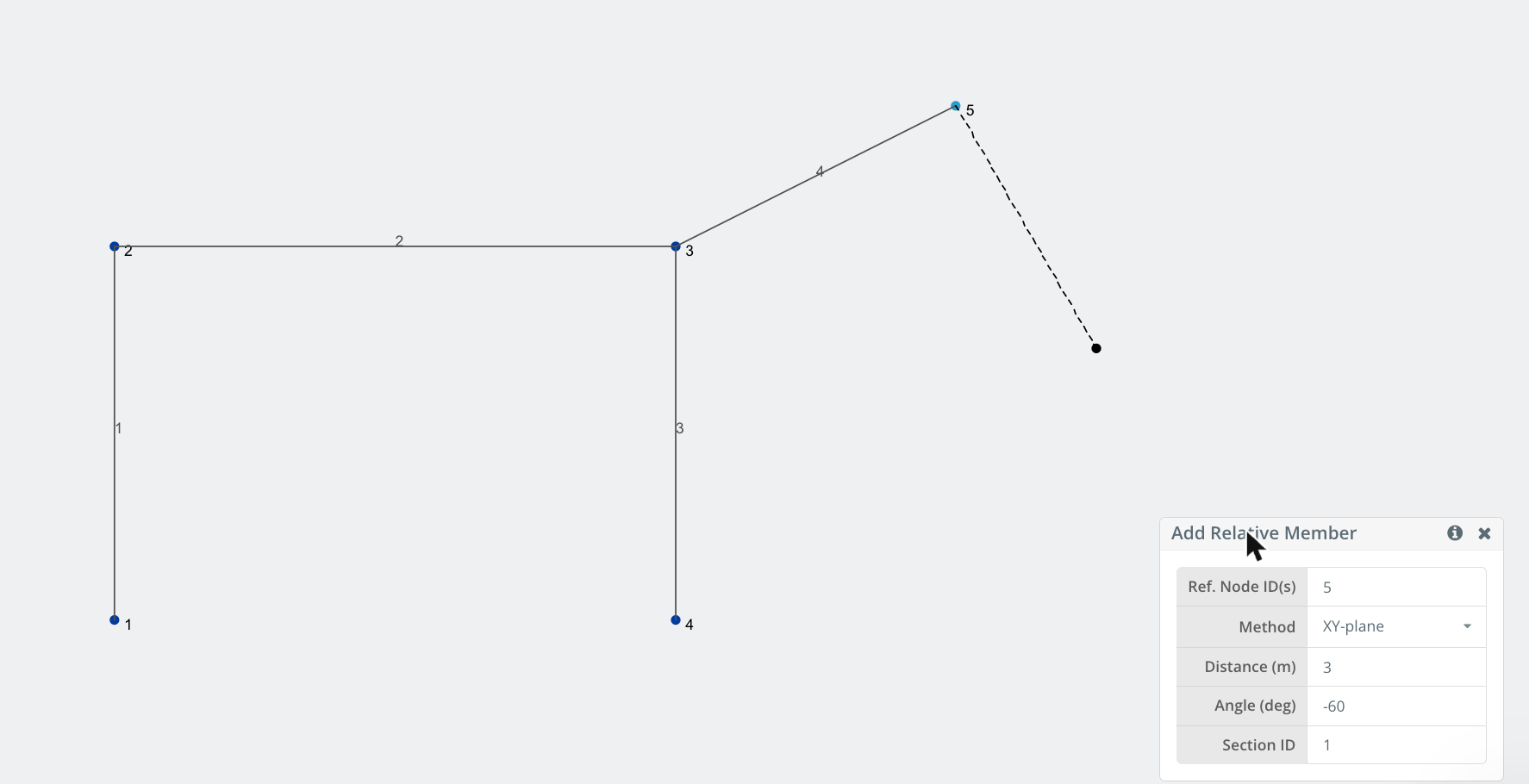
Drücken Sie Vergiss nicht, dass du mir in dem Video folgen kannst, das ich von diesem ganzen Prozess gemacht habe to create it. As with distances, the new node becomes the reference node so you can keep going.
Adding relative members from multiple nodes
The tool works on several reference nodes at once: it creates one new node and one member from each of them, all with the same offset. The nodes don’t need to be in the same plane and can be anywhere in the model.
Select the nodes before pressing R. (the tool only uses nodes, not members, from the selection), or type their IDs in Ref. Knoten-ID(s), durch Kommata abgetrennt. In diesem Beispiel, eintreten 2,3 mit einem Y Distance von 2 m previews a 2 m extension of both columns:
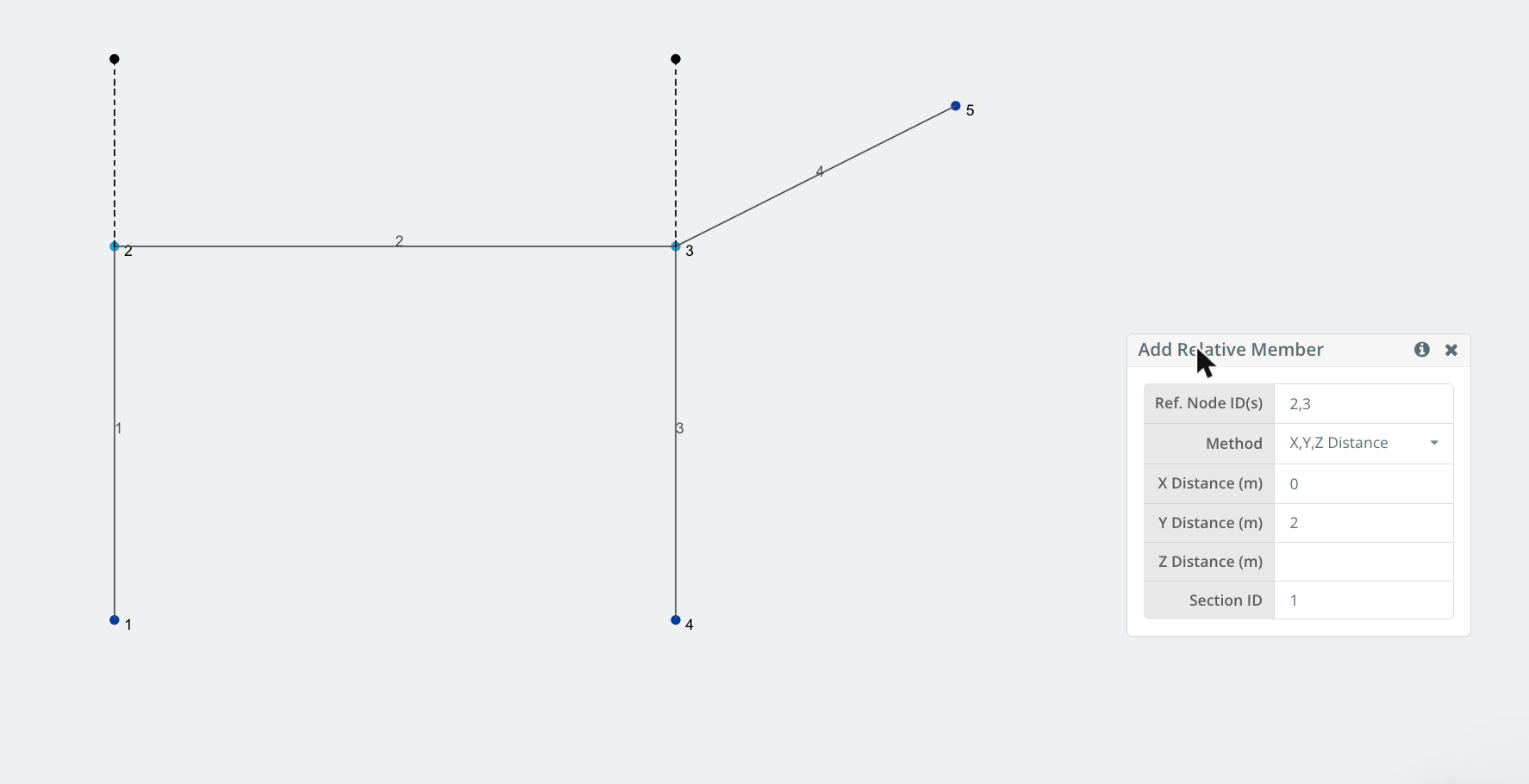
Drücken Sie Vergiss nicht, dass du mir in dem Video folgen kannst, das ich von diesem ganzen Prozess gemacht habe to create the members. Ref. Knoten-ID(s) then lists all the new nodes, so the next Vergiss nicht, dass du mir in dem Video folgen kannst, das ich von diesem ganzen Prozess gemacht habe extends each of them again.
This is handy for repetitive geometry, for example to add the columns of a mezzanine above every node of a floor, or to extend the frames of a model generated with Baugruppenvorlagen.
Adding relative nodes
To add nodes at a relative position without connecting them with members, right-click the selected nodes and choose Knoten > Relativen Knoten hinzufügen. Das Relativen Knoten hinzufügen panel works exactly like Relatives Mitglied hinzufügen, with the same methods and the same preview, but has no Abschnitts-ID: it only creates the nodes.
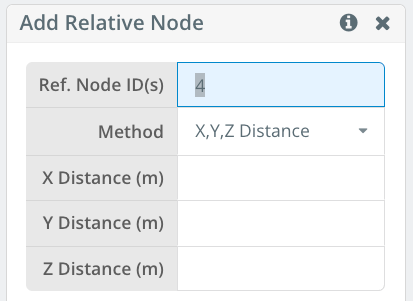
To move existing nodes by a distance rather than create new ones, benutzen wobei das Modell identisch um die x = 0m-Achse gedreht wurde in the operations of Structural 3D.
Adding relative members with the AI Assistant
For larger or repetitive edits, der KI-Assistent für strukturelles 3D can do the same job from a single prompt. Click the sparkle icon in the bottom right corner to open the KI-Modellassistent Panel, and describe the members you want with the node IDs, Abstände und Winkel, as you would enter them in the Relative Member tool. Zum Beispiel:
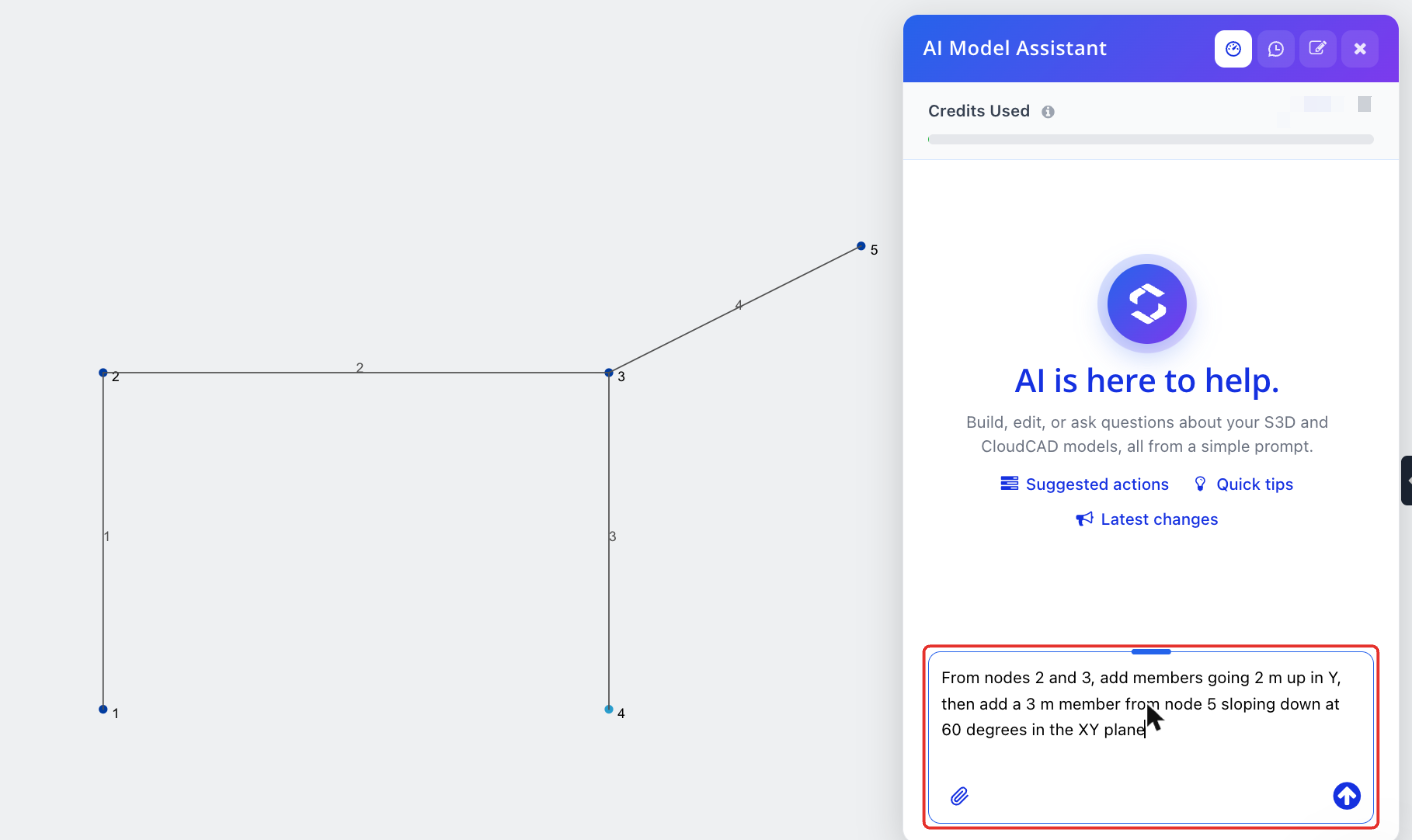
You can combine several steps in one request, such as extending a set of nodes by a distance and then adding an inclined member at a given angle, or ask for members in terms of the structure ("add a 2 m cantilever at the top of every column"). Wenn es fertig ist, Der KI-Assistent sagt Ihnen, was sich geändert hat, und du wählst Halten oder Rückgängig machen. Check the new nodes and members in the model, wie bei jeder KI-generierten Änderung. Für jede Anfrage werden AI-Credits verwendet.
Tipps
- Every member created with the tool can be undone with Strg+Z (Befehl+Z auf dem Mac), like any other change to the model.
- If the new end falls exactly on an existing node, the tool connects the member to that node instead of creating a duplicate, so you can close a frame by ending a relative member on a node that is already there.
- Set up the Querschnitte of your model first, so you can pick the right one in Abschnitts-ID as you go.
