
Σε σχεδιασμό σύνδεσης από χάλυβα, μπουλόνια are usually designed as a bolt group that acts as one body to resist a given load. The strength of a bolt group is normally set by the controlling strength of its most critical bolt. Τα άμεσα φορτία κατανέμονται στον συνολικό αριθμό των μπουλονιών, while the induced moment due to the load eccentricity is distributed in relation to the bolt group’s moment of inertia and distance from the centroid. This is called elastic analysis. Because of its simplified and conservative assumptions about load distribution, Συχνά δημιουργεί υπερβολικά σχεδιασμένες βιδωτές συνδέσεις.
When talking about value engineering and economical designs, the inelastic approach is preferred by most fabricators. It requires fewer bolts for the same magnitude of load. Να κάνουμε την ανελαστική προσέγγιση, the instantaneous centre of rotation (ICOR) μέθοδος που χρησιμοποιεί επαναλήψεις είναι ο καλύτερος τρόπος.
Σε αυτό το άρθρο, we demonstrate how to calculate the strength of a βιδωτή σύνδεση χρησιμοποιώντας τη μέθοδο ICOR. The reactions per bolt are calculated using Equation (7-1) στη σελίδα 7-7 του Εγχειριδίου AISC 15th Edition. That is then used to check whether the assumed location of the instantaneous centre of the bolt group is correct. Τελικά, μόλις έχουμε τη σωστή θέση IC, we calculate the bolt group coefficient C to determine its strength.
Worked by hand, the ICOR method is a long process, because finding the Instantaneous Centre (IC) is trial and error. With a computer solver the IC of a bolt group is found by programmed iterations instead. ο Επίλυση ομάδας SkyCiv Bolt uses a fast iteration method to determine the IC location and the bolt group coefficient in seconds. It is used by both the AISC and AS 4100 connection modules.
The worked example below is the same calculation the solver performs, shown long hand so you can follow what it is doing.
Λήψη των ιδιοτήτων της ομάδας Bolt
Let’s start with a simple analysis of a bolt group of four bolts loaded with an eccentric vertical shear load of 10 kips . The eccentricity of the load along the x axis is 4 ίντσες στα δεξιά της ομάδας μπουλονιών. The angle from the vertical is zero and the eccentricity along the y axis is zero.
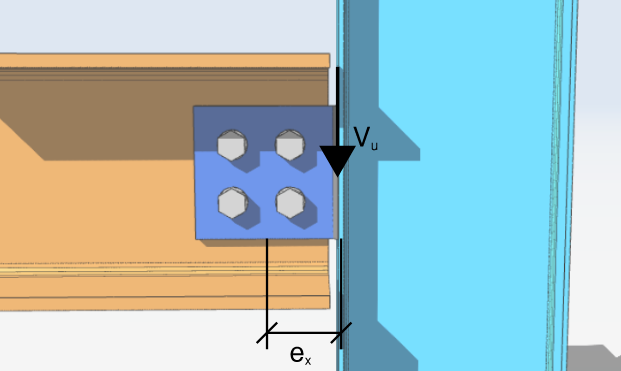
[math] V_{u} = 10\,kips [math]
[math] \theta = 0\,deg [math]
[math] e_{x} = 4\,in [math]
[math] e_{y} = 0\,in [math]
The first thing to do is to get the coordinates of all the bolts in the group. Visual guides and tables are highly recommended.
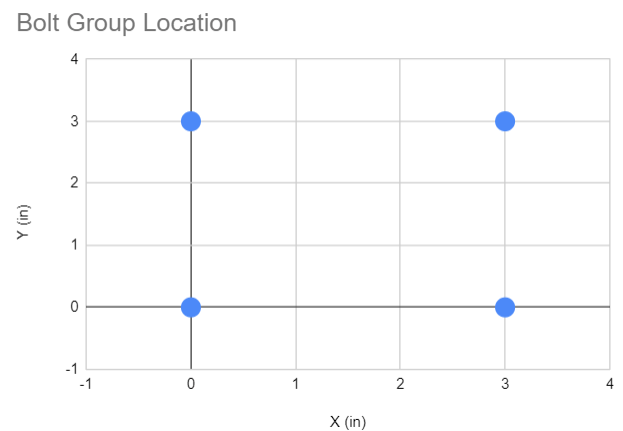
| Ταυτότητα καταστήματος | Χ (σε) | ΚΑΙ (σε) |
| 1 | 0 | 0 |
| 2 | 0 | 3 |
| 3 | 3 | 0 |
| 4 | 3 | 3 |
To get the centroid of the bolt group along the x and y axes, χρειαζόμαστε τον παρακάτω τύπο.
Αφήνω [mathin] n [mathin] = συνολικός αριθμός μπουλονιών
[math] X_{CG} = \frac{\sum X}{n} [math]
[math] Y_{CG} = \frac{\sum Y}{n} [math]
Τότε, η λύση μας είναι:
[math] X_{CG} = \frac{\sum X}{n} = \frac{0\,in + 0\,in + 3\,in + 3\,in}{4} = 1.5\,in [math]
[math] Y_{CG} = \frac{\sum Y}{n} = \frac{0\,in + 3\,in + 0\,in + 3\,in}{4} = 1.5\,in [math]
Υποθέστε τη θέση του I.C.
Μετά τη λήψη του κέντρου, we assume the location of the instantaneous centre (IC). Σαν πρώτη προσπάθεια, we can assume the IC sits at the geometric centroid of the bolt group.
Έτσι, υποθέτω
[math] X_{IC} = X_{CG} = 1.5\,in [math]
[math] Y_{IC} = Y_{CG} = 1.5\,in [math]
Then we tabulate the displacement of each bolt from the IC. Get the distance along x and the distance along y first, then the resultant displacement.
| Ταυτότητα καταστήματος | cx (σε) | cy (σε) | ντο (σε) |
| 1 | -1.5 | -1.5 | 2.121 |
| 2 | -1.5 | 1.5 | 2.121 |
| 3 | 1.5 | -1.5 | 2.121 |
| 4 | 1.5 | 1.5 | 2.121 |
Οπου,
[math] c_{x} = X_{i} – X_{IC} [math]
[math] c_{y} = Y_{i} – Y_{IC} [math]
[math] c = \sqrt{ {\left( c_{x} \right)}^{2} + {\left( c_{y} \right)}^{2} } [math]
Για το μπουλόνι αρ. 1, η λύση μας είναι
[math] c_{x} = 0\,in – 1.5\,in = -1.5\,in [math]
[math] c_{y} = 0\,in – 1.5\,in = -1.5\,in [math]
[math] c = \sqrt{ {\left( -1.5\,in \right)}^{2} + {\left( -1.5\,in \right)}^{2} } = 2.121\,in [math]
Υπολογίστε την παραμόρφωση ανά απόσταση μπουλονιού από το IC
After getting the bolt distances from the assumed IC location, we calculate the deformation of each bolt as a function of its distance.
Η μέγιστη παραμόρφωση ανά μπουλόνι, [mathin] \Delta_{max} = 0.34\,in [mathin], βασίζεται σε πειραματικά δεδομένα για ένα μπουλόνι ASTM όπως περιγράφεται στη σελίδα AISC 7-8. By linear proportion, και ρύθμιση [mathin] \Delta_{max} = 0.34\,in [mathin], we can calculate the deformation of an individual bolt relative to its share of the maximum distance [mathin] c_{max} [mathin]. Η εξίσωση για να πάρει [mathin] \Delta [mathin] φαίνεται παρακάτω.
[math] \Delta_{1} = 0.34\,in \times \left( \frac{c}{c_{max}} \right) [math]
Για το μπουλόνι αρ. 1, η παραμόρφωση είναι
[math] \Delta_{1} = 0.34\,in \times \left( \frac{2.121\,in}{2.121\,in} \right) = 0.34\,in [math]
Because the IC was assumed at the centroid, all four bolts are the same distance from it, so all four reach the same deformation. The calculated deformations are tabulated below.
| Ταυτότητα καταστήματος | [mathin] \Delta [mathin] (σε) |
| 1 | 0.34 |
| 2 | 0.34 |
| 3 | 0.34 |
| 4 | 0.34 |
Λάβετε τις αντιδράσεις ανά μπουλόνι
Αφού έχουμε την παραμόρφωση ανά μπουλόνι, we use AISC 15th Ed. Εξ (7-1) για να λάβετε τις αντιδράσεις ανά μπουλόνι.
[math] R = R_{ult} \left( 1 – e^{-10\Delta} \right)^{0.55} [math]
ο [mathin] R_{ult} [mathin] στην εξίσωση είναι το υποτιθέμενο τελικό φορτίο σε ένα μπουλόνι, την οποία μπορούμε να ορίσουμε ως αντοχή στη διάτμηση του μπουλονιού.
[math] R_{ult} = \phi R_{n} [math]
Για το παράδειγμά μας, we use a bolt shear strength of [mathin] 24.4\,kip [mathin]. Another value is equally valid, because it cancels out when we calculate the bolt group coefficient [mathin] C [mathin] αργότερα.
Για το μπουλόνι αρ. 1, η υπολογιζόμενη αντίδραση είναι
[math] R = R_{ult} \left( 1 – e^{-10\Delta} \right)^{0.55} [math]
[math] R = 24.4\,kip \left( 1 – e^{-10 \times \left( 0.34\,in \right)} \right)^{0.55} [math]
[math] R = 23.949\,kip [math]
Για τα υπόλοιπα μπουλόνια, οι υπολογιζόμενες αντιδράσεις είναι οι εξής. The components of the bolt reaction [mathin] R [mathin] κατά μήκος των x και y φαίνονται επίσης.
| Ταυτότητα καταστήματος | Ρ (δέρμα μόσχου ακατέργαστου) | Rx (δέρμα μόσχου ακατέργαστου) | Ράι (δέρμα μόσχου ακατέργαστου) |
| 1 | 23.949 | 16.937 | -16.937 |
| 2 | 23.949 | -16.937 | -16.937 |
| 3 | 23.949 | 16.937 | 16.937 |
| 4 | 23.949 | -16.937 | 16.937 |
| ⅀Rx = 0 | ⅀Ry = 0 |
Each bolt force acts perpendicular to the line joining that bolt to the IC, which is what sets the sign of its two components. Για μπουλόνι Νο. 1, the solutions for the x and y components are shown below.
[math] R_{x} = -R \left( \frac{c_{y}}{c} \right) = -23.949 \times \left( \frac{-1.5\,in}{2.121\,in} \right) = 16.937\,kip [math]
[math] R_{y} = R \left( \frac{c_{x}}{c} \right) = 23.949 \times \left( \frac{-1.5\,in}{2.121\,in} \right) = -16.937\,kip [math]
Next we need the moment each bolt reaction produces about the IC. Use the components [mathin] R_{x} [mathin] και [mathin] R_{y} [mathin] with the lever arms [mathin] c_{y} [mathin] και [mathin] c_{x} [mathin].
[math] M_{r} = -R_{x} c_{y} + R_{y} c_{x} [math]
Για μπουλόνι Νο. 1, η στιγμή αντίδραση για το IC είναι
[math] M_{r} = -16.937\,kip \times \left( -1.5\,in \right) + \left( -16.937\,kip \right) \times \left( -1.5\,in \right) [math]
[math] M_{r} = 50.811\,kip\text{-}in [math]
As a check, the same moment is [mathin] R \times c = 23.949 \times 2.121 = 50.8\,kip\text{-}in [mathin], because the force is perpendicular to the radius.
Every bolt here sits the same distance from the assumed IC and carries the same force, so every bolt returns the same moment. The moment reactions are tabulated below.
| Ταυτότητα καταστήματος | κύριος (κοτόπουλο) |
| 1 | 50.811 |
| 2 | 50.811 |
| 3 | 50.811 |
| 4 | 50.811 |
| ⅀Κύριος = 203.244 |
Επαλήθευση της θέσης IC
Τώρα που έχουμε τις αντιδράσεις διάτμησης και ροπής ανά μπουλόνι, we use them to determine the load this bolt group resists. Take the resultant of the sum of all reactions along x and the sum of all reactions along y.
Από την προηγούμενη ενότητα, we calculated that
[math] \sum R_{x} = 0\,kip [math]
και
[math] \sum R_{y} = 0\,kip [math]
Έτσι,
[math] P_{u} = \sqrt{ {\left( \sum R_{x} \right)}^{2} + {\left( \sum R_{y} \right)}^{2} } = 0\,kip [math]
The resulting load is [mathin] P_{u} = 0\,kip [mathin]. A bolt group rotating about its own centroid carries pure moment and no net force, so it cannot resist the applied shear. That already tells us the first assumed IC location is wrong, and we could stop here. For the purpose of this discussion, we will carry on through the remaining steps.
[math] P_{ux} = -P_{u}\sin\left( \theta \right) = 0\,kip [math]
[math] P_{uy} = -P_{u}\cos\left( \theta \right) = 0\,kip [math]
[math] M_{u} = -P_{ux}\left( Y_{CG} + e_{y} – Y_{IC} \right) + P_{uy} \left( X_{CG} + e_{x} – X_{IC} \right) = 0\,kip\text{-}in [math]
Από,
[math] P_{ux} \neq \sum R_{x} [math]
[math] P_{uy} \neq \sum R_{y} [math]
[math] M_{u} \neq \sum M_{r} [math]
The applied moment is zero while the bolt reactions sum to 203.244 κοτόπουλο, so equilibrium is not satisfied. The assumed location of the I.C. είναι λάθος, and we move to the next assumed location.
SkyCiv has the bolt group calculation built into its connection design modules. Θέλετε να δοκιμάσετε το λογισμικό σχεδιασμού σύνδεσης?
Δεύτερη Επανάληψη
Για τη δεύτερη επανάληψη μας, let us assume the I.C. βρίσκεται στις συντεταγμένες που φαίνονται παρακάτω. Because the load is a downward shear applied to the right of the group, the true IC lies to the left of the centroid, so the trial moves in that direction.
Υποθέτω
[math] X_{IC} = 0.062\,in [math]
[math] Y_{IC} = 1.5\,in [math]
Then repeat the steps from the first iteration. The table below shows the coordinates, the distance of each bolt from the assumed I.C., and the corresponding deformation with respect to that distance.
| Ταυτότητα καταστήματος | Χ (σε) | ΚΑΙ (σε) | cx (σε) | cy (σε) | ντο (σε) | [mathin] \Delta [mathin] (σε) |
| 1 | 0 | 0 | -0.062 | -1.5 | 1.501 | 0.155 |
| 2 | 0 | 3 | -0.062 | 1.5 | 1.501 | 0.155 |
| 3 | 3 | 0 | 2.938 | -1.5 | 3.299 | 0.34 |
| 4 | 3 | 3 | 2.938 | 1.5 | 3.299 | 0.34 |
This time the bolts are not all the same distance from the IC, so only the far pair reaches the 0.34 in limit. The near pair deforms less and therefore carries less load.
Σημειώστε ότι το υπολογιζόμενο κεντροειδές του ομάδα μπουλονιών is unchanged, since the bolt coordinates have not moved.
[math] X_{CG} = 1.5\,in [math]
[math] Y_{CG} = 1.5\,in [math]
Then we calculate the reactions along x, the reactions along y, και την αντίστοιχη στιγμή. Οι τιμές παρατίθενται παρακάτω.
| Ταυτότητα καταστήματος | Ρ (δέρμα μόσχου ακατέργαστου) | Rx (δέρμα μόσχου ακατέργαστου) | Ράι (δέρμα μόσχου ακατέργαστου) | κύριος (κοτόπουλο) |
| 1 | 21.4 | 21.4 | -0.9 | 32.1 |
| 2 | 21.4 | -21.4 | -0.9 | 32.1 |
| 3 | 23.9 | 10.9 | 21.3 | 79.0 |
| 4 | 23.9 | -10.9 | 21.3 | 79.0 |
| ⅀Rx = 0 | ⅀Ry = 41 | ⅀Κύριος = 222 |
Επόμενο, προσδιορίζουμε το προκύπτον φορτίο όλων των αντιδράσεων κατά μήκος των x και y.
[math] P_{u} = \sqrt{ {\left( \sum R_{x} \right)}^{2} + {\left( \sum R_{y} \right)}^{2} } [math]
[math] P_{u} = \sqrt{ {\left( 0\,kip \right)}^{2} + {\left( 40.703\,kip \right)}^{2} } [math]
[math] P_{u} = 40.703\,kip [math]
Then the components of the resultant load, based on the given [mathin] \theta [mathin], are shown below.
[math] P_{ux} = -P_{u}\sin\left( \theta \right) = -41\,kip \times \sin\left( 0\,deg \right) = 0\,kip [math]
[math] P_{uy} = -P_{u}\cos\left( \theta \right) = -41\,kip \times \cos\left( 0\,deg \right) = -41\,kip [math]
We then use these components to solve for the moment load about the assumed I.C.
[math] M_{u} = -P_{ux} \left( Y_{CG} + e_{y} – Y_{IC} \right) + P_{uy} \left( X_{CG} + e_{x} – X_{IC} \right) [math]
[math] M_{u} = -0\,kip \left( 1.5\,in + 0\,in – 1.5\,in \right) + \left( -41\,kip \right) \left( 1.5\,in + 4\,in – 0.062\,in \right) [math]
[math] M_{u} = -222\,kip\text{-}in [math]
Επόμενο, ας συγκρίνουμε το υπολογισμένο [mathin] P_{ux} [mathin], [mathin] P_{uy} [mathin] και [mathin] M_{u} [mathin] against the reactions of the bolt group.
[math] P_{ux} \approx -\sum R_{x} [math]
[math] P_{uy} \approx -\sum R_{y} [math]
[math] M_{u} \approx -\sum M_{r} [math]
Numerically that is 0 against 0, -41 kip against -41 δέρμα μόσχου ακατέργαστου, και -222 kip-in against -222 κοτόπουλο. The left hand side is close enough to the right hand side that we can take the assumed location of the I.C. as correct.
In practice the solver keeps moving the trial IC until these three residuals fall inside a tolerance, rather than stopping on a visual match.
Επίλυση συντελεστή C
Μόλις το I.C. η τοποθεσία καθορίζεται, we can get the bolt group coefficient C with the formula below.
[math] C = \frac{P_{u}}{\phi R_{n}} = \frac{40.703\,kip}{24.4\,kip} = 1.668 [math]
The coefficient means the group carries 1.668 times the strength of a single bolt. Note that this is well below the four bolts present, because the eccentricity costs the group most of its nominal capacity. It is also where the choice of [mathin] R_{ult} [mathin] cancels, which is why any consistent value could be used at the start.
Δωρεάν αριθμομηχανή Bolt Group
See how we design our bolted connections with this approach in the connection design module. Pick a bolted connection, set the bolt layout and the eccentricity, and the report gives the IC location and the C coefficient along with every other check. Εκτελείται στο πρόγραμμα περιήγησης, χωρίς τίποτα για εγκατάσταση.
Για περισσότερη λειτουργικότητα, including saving and reloading your files, sign up for a free account.
