
Double angle connection design to AISC 360 means checking two bolt groups and the angles between them against the beam end reaction. Στην πλευρά της δοκού ελέγχετε τη διάτμηση του μπουλονιού, bearing and tear-out on the angles and the beam web, διάτμηση μπλοκ, shear yielding and rupture of the angles, και γωνιακή κάμψη. On the support side you repeat those checks for the outstanding legs bolted to the column. Αναλυτικά τα όρια στην απόσταση, Διατμητική Αντοχή Μπουλονιών, gage and connection depth apply to both sides.
Αυτή η σελίδα λειτουργεί ένα πραγματικό παράδειγμα από την αρχή μέχρι το τέλος: a W16x26 beam framing into the flange of a W14x90 column, με α 50 αντίδραση kip LRFD, a pair of 2L4x3-1/2×1/4 angles and three rows of 3/4 in A325-N bolts on each side, σχεδιασμένο για AISC 360-16 και το Εγχειρίδιο AISC 15η Έκδοση. Κάθε εξίσωση γράφεται με τους αριθμούς της, με την ίδια σειρά με το φύλλο υπολογισμού AISC που το Σχεδιασμός σύνδεσης SkyCiv παράγει μονάδα για αυτή τη σύνδεση.
What is a double angle connection?
A double angle connection is a pair of steel angles, ένα σε κάθε πλευρά του ιστού της δοκού, με το ένα πόδι βιδωμένο (ή συγκολλημένα) στον ιστό και το άλλο πόδι βιδωμένο στο μέλος στήριξης. Μεταφέρει την τελική διάτμηση της δοκού και ταξινομείται ως απλή σύνδεση στο AISC 360-16 Β3.4, so the angles are detailed to flex rather than resist moment.
It is a common σύνδεση διάτμησης for beams framing into column flanges, column webs and girders. Because the beam web sits between two angles, the beam-side bolts work in double shear, and the connection is symmetric, so it does not twist the beam. Οι άλλες επιλογές για την ίδια δουλειά είναι οι ενιαίο πιάτο (γλωττίδα διάτμησης) Η σύνδεση, ο σύνδεση μονής γωνίας και η διάτμηση σύνδεση τελικής πλάκας. Μπορείτε να ελέγξετε αυτό το παράδειγμα απευθείας στο double angle connection calculator.
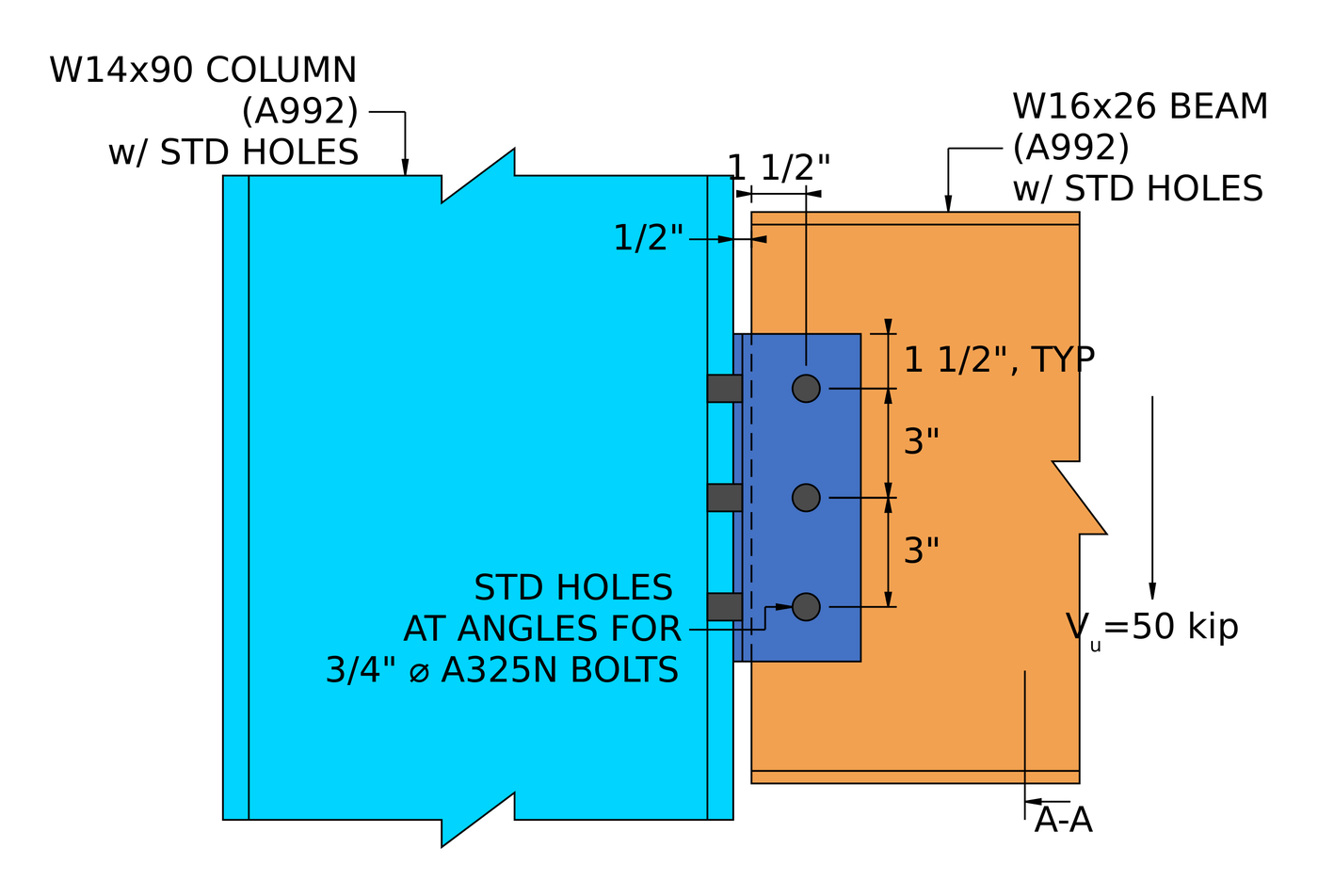
Ανύψωση του παραδείγματος σύνδεσης. The angles are bolted to the column flange and to the beam web, με α 1/2 in clearance between the beam end and the column.
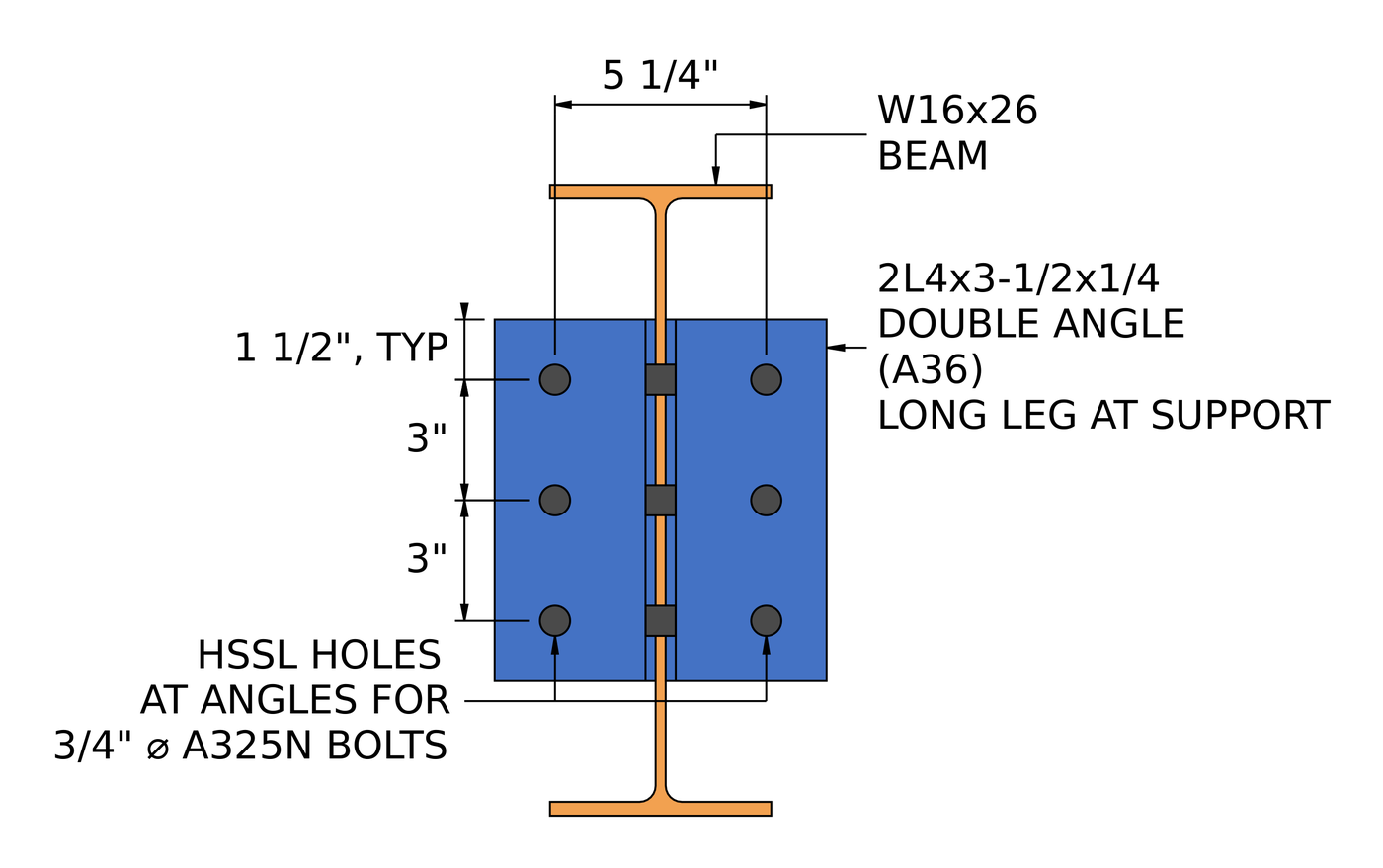
Ενότητα Α-Α. The long legs are bolted to the column at a 5 1/4 στο gage, through horizontal short-slotted holes in the angles.
How do you design a double angle connection? Τα βήματα με μια ματιά
- Ελέγξτε τα όρια λεπτομερειών στην πλευρά της δοκού: απόσταση, αποστάσεις ακμών, βάθος, υπολογίζω.
- Check the beam-side bolt group in double shear.
- Check bolt bearing and tear-out on the angles at the beam side.
- Ελέγξτε το ρουλεμάν του μπουλονιού και το σκίσιμο στο πλέγμα της δοκού.
- Συνδυάστε διάτμηση, ρουλεμάν και σχίσιμο ανά μπουλόνι στην πλευρά της δοκού.
- Check block shear of the angles at the beam side.
- Check shear yielding and shear rupture of the angles at the beam side.
- Ελέγξτε τη γωνία κάμψης στην πλευρά της δοκού χρησιμοποιώντας τη διαδικασία διπλής αντιμετώπισης.
- Check shear and moment interaction of the angles at the beam side.
- Ελέγξτε τα όρια λεπτομερειών στην πλευρά στήριξης.
- Check the support-side bolt group in single shear.
- Check bolt bearing and tear-out on the angles at the support side.
- Ελέγξτε το ρουλεμάν του μπουλονιού και το σκίσιμο στη φλάντζα της στήλης.
- Συνδυάστε διάτμηση, ρουλεμάν και σχίσιμο ανά μπουλόνι στην πλευρά στήριξης.
- Check block shear of the angles at the support side.
- Check shear yielding and shear rupture of the angles at the support side.
- Ελέγξτε τη γωνία κάμψης στην πλευρά στήριξης χρησιμοποιώντας τη διαδικασία διπλής αντιμετώπισης.
- Check shear and moment interaction of the angles at the support side.
Είσοδοι σχεδίασης για αυτό το παράδειγμα
Ο κώδικας σχεδίασης είναι AISC 360-16 LRFD. Οι ιδιότητες ενότητας προέρχονται από το Εγχειρίδιο AISC.
| Είδος | Σύμβολο | αξία |
|---|---|---|
| Παραγοντική κατακόρυφη διάτμηση | [mathin] V_{u} [mathin] | 50 δέρμα μόσχου ακατέργαστου |
| Δέσμη | W16x26, A992 | |
| Βάθος δοκού | [mathin] d_{bm} [mathin] | 15.7 σε |
| Πάχος ιστού δοκού | [mathin] t_{wb} [mathin] | 0.25 σε |
| Πλάτος φλάντζας δοκού / πάχος | [mathin] b_{fb},\ t_{fb} [mathin] | 5.5 σε / 0.345 σε |
| Περιοχή δοκού | [mathin] A_{bm} [mathin] | 7.68 σε ² |
| Απόδοση δοκού / εφελκυστική τάση | [mathin] F_{yb},\ F_{ub} [mathin] | 50 ksi / 65 ksi |
| Στήλη | Παράδειγμα σχεδίασης σύνδεσης AISC, A992 | |
| Βάθος στήλης / πάχος ιστού | [mathin] d_{sup},\ t_{ws} [mathin] | 14 σε / 0.44 σε |
| Πλάτος φλάντζας στήλης / πάχος | [mathin] b_{fs},\ t_{fs} [mathin] | 14.5 σε / 0.71 σε |
| Επιφάνεια στήλης | [mathin] A_{sup} [mathin] | 26.5 σε ² |
| Απόδοση στήλης / εφελκυστική τάση | [mathin] F_{ys},\ F_{us} [mathin] | 50 ksi / 65 ksi |
| Μέτρο ελαστικότητας | [mathin] E [mathin] | 29000 ksi |
| Είδος | Σύμβολο | αξία |
|---|---|---|
| Γωνίες | 2L4x3-1/2×1/4, A36, long leg at support | |
| Βάθος γωνίας | [mathin] d_{a} [mathin] | 9 σε |
| Πάχος γωνίας | [mathin] t_{a} [mathin] | 0.25 σε |
| Πλάτος ποδιού στη δοκό / στην υποστήριξη | [mathin] b_{a,NSL},\ b_{a,OSL} [mathin] | 3.5 σε / 4 σε |
| Απόδοση γωνίας / εφελκυστική τάση | [mathin] F_{ya},\ F_{ua} [mathin] | 36 ksi / 58 ksi |
| Μπουλόνια (και οι δύο πλευρές) | 3/4 στο Α325-Ν | |
| Διάμετρος μπουλονιού | [mathin] d_{b} [mathin] | 0.75 σε |
| Μπουλόνι ονομαστικής εφελκυσμού / τάση διάτμησης | [mathin] F_{nt},\ F_{nv} [mathin] | 90 ksi / 54 ksi |
| Διατμητικά αεροπλάνα, πλευρά δοκού / πλευρά στήριξης | [mathin] N_{s} [mathin] | 2 / 1 |
| Τρύπες στην πλευρά της δοκού (γωνία / δέσμη) | Πρότυπο (ΣΜΝ) / πρότυπο (ΣΜΝ) | |
| Τρύπες στην πλευρά στήριξης (γωνία / στήλη) | Οριζόντια με κοντή σχισμή (HSSL) / πρότυπο (ΣΜΝ) |
| Γεωμετρία | Σύμβολο | Πλευρά δοκού | Πλευρά στήριξης |
|---|---|---|---|
| Σειρές μπουλονιών / απόσταση σειρών | [mathin] n_{r},\ s_{r} [mathin] | 3 / 3 σε | 3 / 3 σε |
| Στήλες μπουλονιών / απόσταση στηλών | [mathin] n_{c},\ s_{c} [mathin] | 1 / 0 σε | 1 / 0 σε |
| Υπολογίζω | [mathin] g [mathin] | 2 σε | 5.25 σε |
| Κατακόρυφη απόσταση ακμών στη γωνία | [mathin] L_{ev,a} [mathin] | 1.5 σε | 1.5 σε |
| Οριζόντια απόσταση ακμής στη γωνία | [mathin] L_{eh,a} [mathin] | 1.5 σε | 1.5 σε |
| Εκκεντρικότητα μπουλονιών | [mathin] e [mathin] | 2 σε | 0 σε |
| Διάκενο ιστού δοκού έως στήλη | [mathin] clr [mathin] | 0.5 σε |
Βήμα 1: Λεπτομερή όρια στην πλευρά της δοκού (AISC 360-16 J3.3, J3.4, J3.5)
Πριν από οποιονδήποτε έλεγχο αντοχής, η διάταξη του μπουλονιού πρέπει να είναι κατασκευαστή και να ταιριάζει με τις υποθέσεις πίσω από τις εξισώσεις αντοχής. Οι βίδες που είναι πολύ κοντά σκίζονται ανάμεσα στις τρύπες, οι άκρες που είναι πολύ κοντά σκίζονται, and angles that are too short or too deep change how the connection rotates.
Για ένα 3/4 στο μπουλόνι η ελάχιστη απόσταση είναι [mathin] 2\tfrac{2}{3} d_{b} = 2\,in [mathin] (J3.3) και η ελάχιστη απόσταση ακμών είναι 1 σε (Πίνακας J3.4). The maximum spacing is 24 times the thinner part, here the 1/4 in angle or the 1/4 in beam web, which gives 6 σε (J3.5). The angles have to be at least half as deep as the beam’s T dimension, so they are stiff enough to brace the beam end, και όχι πιο βαθιά από όσο μπορεί να πάρει ο ιστός της δέσμης. The bolt gage on the beam-side legs has to leave room to enter and tighten the bolts.
| Όριο λεπτομερειών | Οριο (σε) | Πραγματικός (σε) | DCR | Αποτέλεσμα |
|---|---|---|---|---|
| Ελάχιστη απόσταση σειρών μπουλονιών | 2.000 | 3.000 | 0.667 | cdot K_a |
| Μέγιστη απόσταση σειρών μπουλονιών | 6.000 | 3.000 | 0.500 | cdot K_a |
| Ελάχιστη απόσταση γωνίας κάθετης ακμής | 1.000 | 1.500 | 0.667 | cdot K_a |
| Ελάχιστη οριζόντια απόσταση γωνίας | 1.000 | 1.500 | 0.667 | cdot K_a |
| Ελάχιστη απόσταση δοκού οριζόντιας άκρης | 1.000 | 1.500 | 0.667 | cdot K_a |
| Ελάχιστο βάθος σύνδεσης | 6.813 | 9.000 | 0.757 | cdot K_a |
| Μέγιστο βάθος σύνδεσης | 14.125 | 9.000 | 0.637 | cdot K_a |
| Minimum bolt gage for double angle | 1.375 | 2.000 | 0.688 | cdot K_a |
Για ένα ελάχιστο όριο η αναλογία είναι όριο έναντι του πραγματικού, και για ένα μέγιστο είναι πραγματικό πάνω από το όριο. Η κυρίαρχη σειρά είναι το ελάχιστο βάθος σύνδεσης, το μισό 13 5/8 in T dimension of the W16x26:
[math] DCR = \frac{d}{c} = \frac{6.8125\,in}{9\,in} = 0.75694 [math]
DCR = 0.757 < 1.0, Εντάξει
Βήμα 2: Ομαδική διάτμηση μπουλονιών στην πλευρά της δοκού (AISC 360-16 J3.6)
The beam web is sandwiched between the two angles, so every beam-side bolt is in double shear. The bolt group has to carry the full reaction through those shear planes.
Συντελεστής ομάδας μπουλονιών
The reaction acts 2 in from the beam-side bolt line, αλλά η εκκεντρικότητα αγνοείται εδώ. Σελίδα εγχειριδίου AISC 10-9 επιτρέπει αυτό για μια μόνο κάθετη σειρά μπουλονιών με εκκεντρότητα όχι μεγαλύτερη από 3 σε, οπότε ο συντελεστής ομάδας μπουλονιών είναι απλώς ο αριθμός των μπουλονιών:
[math] C = 3 [math]
Αντοχή ομάδας μπουλονιών
Οπου [mathin] \phi = 0.75 [mathin], [mathin] d_{b} = 0.75\,in [mathin], [mathin] F_{nv} = 54\,ksi [mathin] για μπουλόνι A325-N με σπειρώματα που περιλαμβάνονται, [mathin] N_{s} = 2 [mathin] shear planes and [mathin] h_{f} [mathin] is the filler factor from J5.2(ένα). There are no fillers, Έτσι:
[math] h_{f} = 0.85 \lt 1 – 0.4 \left( t – 0.25\,in \right) \le 1 [math]
[math] h_{f} = 0.85 \lt 1 – (0.4) \times \left( (0\,in) – (0.25\,in) \right) \le 1 [math]
[math] h_{f} = 1 [math]
[math] \phi R_{n} = \phi\, F_{nv}\, \frac{\pi}{4} \left( d_{b} \right)^{2} N_{s}\, C\, h_{f} [math]
[math] \phi R_{n} = (0.75) \times (54\,ksi) \times \frac{\pi}{4} \times \left( (0.75\,in) \right)^{2} \times (2) \times (3) \times (1) [math]
[math] \phi R_{n} = 107.35\,kip [math]
DCR = 50 δέρμα μόσχου ακατέργαστου / 107.35 κιπ = 0.466 < 1.0, Εντάξει
Βήμα 3: Bolt bearing and tear-out on the double angle at the beam side (AISC 360-16 J3.10)
Each beam-side bolt pushes on the edge of its hole in both angles. Η γωνία είτε παραμορφώνεται στην τρύπα (ρουλεμάν, καλύπτεται σε 2.4 Διατμητική Αντοχή Μπουλονιών) ή σκίζει μια λωρίδα στην επόμενη τρύπα ή στο κάτω άκρο (λυσσασμένο, 1.2 Διατμητική Αντοχή Μπουλονιών). The beam pushes the bolts down, άρα το κάτω μπουλόνι, πλησιέστερα στο κάτω άκρο της γωνίας, είναι ο αδύναμος.
Καθαρή απόσταση για τον ακραίο μπουλόνι, με [mathin] L_{ev,a} = 1.5\,in [mathin] and the standard hole dimension [mathin] d_{h} = 0.8125\,in [mathin]:
[math] l_{c1} = L_{ev,a} – \frac{d_{h}}{2} = (1.5\,in) – \frac{(0.8125\,in)}{2} = 1.0938\,in [math]
Clear distance between the inner bolts, με [mathin] s_{r} = 3\,in [mathin]:
[math] l_{c2} = s_{r} – d_{h} = (3\,in) – (0.8125\,in) = 2.1875\,in [math]
Both angles bear on each bolt, so the ply thickness is [mathin] 2t_{a} = 0.5\,in [mathin], με [mathin] F_{ua} = 58\,ksi [mathin], [mathin] C = 3 [mathin] και [mathin] n_{r} = 3 [mathin]:
[math] \phi R_{n} = \phi \left[ \min\left(1.2\, l_{c1},\, 2.4\, d_{b}\right) 2t_{a} F_{ua} + \min\left(1.2\, l_{c2},\, 2.4\, d_{b}\right) 2t_{a} F_{ua} \left( n_{r} – 1 \right) \right] \left( \frac{C}{n_{r}} \right) [math]
[math] \phi R_{n} = (0.75) \times \left[ \min\left(1.2 \times (1.0938\,in),\, 2.4 \times (0.75\,in)\right) \times (0.5\,in) \times (58\,ksi) + \min\left(1.2 \times (2.1875\,in),\, 2.4 \times (0.75\,in)\right) \times (0.5\,in) \times (58\,ksi) \times \left( (3) – 1 \right) \right] \times \left( \frac{(3)}{(3)} \right) [math]
[math] \phi R_{n} = 106.85\,kip [math]
DCR = 50 δέρμα μόσχου ακατέργαστου / 106.85 κιπ = 0.468 < 1.0, Εντάξει
Το σχίσιμο διέπει τον ακραίο μπουλόνι, επειδή 1.2 Το lc1 είναι μικρότερο από 2.4 Διπλή διάτμηση. The inner bolts are limited by bearing.
Βήμα 4: Ρουλεμάν μπουλονιών και σχίσιμο στον ιστό της δοκού (AISC 360-16 J3.10)
Ο ίδιος έλεγχος ισχύει και για τον ιστό της δοκού, which is a single 1/4 in ply carrying all three bolts. The beam is not coped and its top flange is well clear of the bolts, έτσι κάθε μπουλόνι έχει σαν εσωτερικό μπουλόνι.
[math] l_{c2} = s_{r} – d_{h} = (3\,in) – (0.8125\,in) = 2.1875\,in [math]
Οπου [mathin] t_{wb} = 0.25\,in [mathin], [mathin] F_{ub} = 65\,ksi [mathin], [mathin] C = 3 [mathin] και [mathin] \phi = 0.75 [mathin]:
[math] \phi R_{n} = \phi\, \min\left(1.2\, l_{c2},\, 2.4\, d_{b}\right) t_{wb} F_{ub}\, C [math]
[math] \phi R_{n} = (0.75) \times \min\left(1.2 \times (2.1875\,in),\, 2.4 \times (0.75\,in)\right) \times (0.25\,in) \times (65\,ksi) \times (3) [math]
[math] \phi R_{n} = 65.813\,kip [math]
DCR = 50 δέρμα μόσχου ακατέργαστου / 65.813 κιπ = 0.760 < 1.0, Εντάξει
Αυτή είναι η υψηλότερη αναλογία αντοχής στη σύνδεση. The two angles give 0.5 in of A36 steel against the bolts, but the beam web is only 0.25 σε παχιά, so the web has about 60% of the angles’ bearing capacity even with the higher 65 ksi tensile strength.
Βήμα 5: Αποτελεσματική αντοχή της ομάδας μπουλονιών στην πλευρά της δοκού (AISC 360-16 J3.6 Σχόλιο)
Διάτμηση μπουλονιών, Το ρουλεμάν και το σκίσιμο δεν είναι πραγματικά ξεχωριστοί έλεγχοι. Κάθε μπουλόνι φέρει τη μικρότερη από την αντοχή του στη διάτμηση και τη φέρουσα ή σχισμή του σε κάθε φύλλο από το οποίο περνά, και η αντοχή της ομάδας είναι το άθροισμα αυτών των τιμών ανά μπουλόνι.
Strength of one bolt in double shear:
[math] \phi r_{v} = \phi\, F_{nv}\, \frac{\pi}{4} \left( d_{b} \right)^{2} N_{s}\, h_{f} [math]
[math] \phi r_{v} = (0.75) \times (54\,ksi) \times \frac{\pi}{4} \times \left( (0.75\,in) \right)^{2} \times (2) \times (1) = 35.785\,kip [math]
Bearing and tear-out of one bolt on the double angle, for the edge bolt and for an inner bolt:
[math] \phi r_{n1e} = \phi\, \min\left(1.2\, l_{c1},\, 2.4\, d_{b}\right) 2t_{a} F_{ua} [math]
[math] \phi r_{n1e} = (0.75) \times \min\left(1.2 \times (1.0938\,in),\, 2.4 \times (0.75\,in)\right) \times (0.5\,in) \times (58\,ksi) = 28.547\,kip [math]
[math] \phi r_{n1i} = \phi\, \min\left(1.2\, l_{c2},\, 2.4\, d_{b}\right) 2t_{a} F_{ua} [math]
[math] \phi r_{n1i} = (0.75) \times \min\left(1.2 \times (2.1875\,in),\, 2.4 \times (0.75\,in)\right) \times (0.5\,in) \times (58\,ksi) = 39.15\,kip [math]
Ρουλεμάν και σχίσιμο ενός μπουλονιού στον ιστό της δοκού:
[math] \phi r_{n2} = \phi\, \min\left(1.2\, l_{c2},\, 2.4\, d_{b}\right) t_{wb} F_{ub} [math]
[math] \phi r_{n2} = (0.75) \times \min\left(1.2 \times (2.1875\,in),\, 2.4 \times (0.75\,in)\right) \times (0.25\,in) \times (65\,ksi) = 21.938\,kip [math]
Οι βίδες αριθμούνται από την κορυφή της γραμμής, τόσο μπουλόνι 3 is the edge bolt on the angles:
[math] \phi r_{eff,1} = \min\left( \phi r_{v},\, \phi r_{n1i},\, \phi r_{n2} \right) = \min\left( (35.785\,kip),\, (39.15\,kip),\, (21.938\,kip) \right) = 21.938\,kip [math]
[math] \phi r_{eff,2} = \min\left( \phi r_{v},\, \phi r_{n1e},\, \phi r_{n2} \right) = \min\left( (35.785\,kip),\, (28.547\,kip),\, (21.938\,kip) \right) = 21.938\,kip [math]
| Μπουλόνι | Διάτμηση μπουλονιών (δέρμα μόσχου ακατέργαστου) | Ρουλεμάν / λυσσασμένο, διπλή γωνία (δέρμα μόσχου ακατέργαστου) | Ρουλεμάν / λυσσασμένο, ιστός δοκού (δέρμα μόσχου ακατέργαστου) | Αποτελεσματική δύναμη (δέρμα μόσχου ακατέργαστου) |
|---|---|---|---|---|
| 1 | 35.78 | 39.15 | 21.94 | 21.94 |
| 2 | 35.78 | 39.15 | 21.94 | 21.94 |
| 3 | 35.78 | 28.55 | 21.94 | 21.94 |
[math] \sum \phi r_{eff} = n_{1}\, \phi r_{eff,1} + n_{2}\, \phi r_{eff,2} = (2) \times (21.938\,kip) + (1) \times (21.938\,kip) = 65.813\,kip [math]
[math] \phi R_{n,eff} = \left( \frac{C}{n_{r}} \right) \sum \phi r_{eff} = \left( \frac{(3)}{(3)} \right) \times (65.813\,kip) = 65.813\,kip [math]
DCR = 50 δέρμα μόσχου ακατέργαστου / 65.813 κιπ = 0.760 < 1.0, Εντάξει
Bearing on the beam web governs all three bolts, so the effective strength equals the beam web result from Step 4. Μπορείτε να εκτελέσετε την ίδια σύνδεση στο δωρεάν αριθμομηχανή σχεδιασμού σύνδεσης and try a heavier beam or a fourth bolt row to see how the web ratio moves.
Βήμα 6: Block shear of the double angle at the beam side (AISC 360-16 J4.3)
A block of each angle can tear out along the bolt line: shear down the line of holes to the top of the angle, συν την ένταση στην ελεύθερη άκρη της γωνίας. Με μία στήλη μπουλονιού, αυτό είναι ένα μπλοκ σχήματος L.
Καθαρή επιφάνεια σε τάση, με [mathin] 2t_{a} = 0.5\,in [mathin], [mathin] n_{c} = 1 [mathin], [mathin] s_{c} = 0\,in [mathin], [mathin] L_{eh,a} = 1.5\,in [mathin] και [mathin] d_{h} = 0.8125\,in [mathin]. Κάθε τρύπα προσθέτει 1/16 για ζημιά κατά τη διάτρηση (Β4.3):
[math] A_{nt} = 2t_{a} \left[ (n_{c}-1)\, s_{c} + L_{eh,a} – (n_{c} – 0.5)\left( d_{h} + 0.0625\,in \right) \right] [math]
[math] A_{nt} = (0.5\,in) \times \left[ ((1)-1) \times (0\,in) + (1.5\,in) – ((1) – 0.5) \times ((0.8125\,in) + (0.0625\,in)) \right] = 0.53125\,in^{2} [math]
Μικτά και καθαρά εμβαδά σε διάτμηση:
[math] A_{gv} = 2t_{a} \left[ L_{ev,a} + (n_{r}-1)\, s_{r} \right] = (0.5\,in) \times \left[ (1.5\,in) + ((3)-1) \times (3\,in) \right] = 3.75\,in^{2} [math]
[math] A_{nv} = 2t_{a} \left[ d_{a} – L_{ev,a} – (n_{r} – 0.5)\left( d_{h} + 0.0625\,in \right) \right] [math]
[math] A_{nv} = (0.5\,in) \times \left[ (9\,in) – (1.5\,in) – ((3) – 0.5) \times ((0.8125\,in) + (0.0625\,in)) \right] = 2.6563\,in^{2} [math]
Διατμητική αντοχή μπλοκ, με [mathin] U_{bs} = 1 [mathin] για ομοιόμορφη τάση, [mathin] F_{ua} = 58\,ksi [mathin], [mathin] F_{ya} = 36\,ksi [mathin] και [mathin] \phi = 0.75 [mathin]:
[math] \phi R_{n} = \phi \left( 0.6\, F_{ua} A_{nv} + U_{bs} F_{ua} A_{nt} \le 0.6\, F_{ya} A_{gv} + U_{bs} F_{ua} A_{nt} \right) [math]
[math] \phi R_{n} = (0.75) \times \left( 0.6 \times (58\,ksi) \times (2.6563\,in^{2}) + (1) \times (58\,ksi) \times (0.53125\,in^{2}) \le 0.6 \times (36\,ksi) \times (3.75\,in^{2}) + (1) \times (58\,ksi) \times (0.53125\,in^{2}) \right) [math]
[math] \phi R_{n} = 83.859\,kip [math]
DCR = 50 δέρμα μόσχου ακατέργαστου / 83.859 κιπ = 0.596 < 1.0, Εντάξει
Η διατμητική πλευρά της εξίσωσης κυβερνά. Το A36 έχει χαμηλό λόγο απόδοσης προς εφελκυσμό, έτσι το μεικτό επίπεδο διάτμησης υποχωρεί πριν από τη διάρρηξη του καθαρού διατμητικού επιπέδου.
Βήμα 7: Shear yielding and shear rupture of the double angle at the beam side (AISC 360-16 J4.2)
The full reaction passes down through the two angle legs as vertical shear. Το ακαθάριστο τμήμα δεν πρέπει να αποδίδει, και το τμήμα του διχτυού μέσα από τις οπές των μπουλονιών δεν πρέπει να σπάσει.
Απόδοση διάτμησης (Εξ. J4-3)
[math] A_{gv} = d_{a}\, 2t_{a} = (9\,in) \times (0.5\,in) = 4.5\,in^{2} [math]
[math] \phi R_{n,sy} = \phi\, 0.6\, F_{ya} A_{gv} = (1) \times 0.6 \times (36\,ksi) \times (4.5\,in^{2}) = 97.2\,kip [math]
Διάτμηση ρήξη (Εξ. J4-4)
[math] A_{nv} = 2t_{a} \left[ d_{a} – n_{r}\left( d_{h} + 0.0625\,in \right) \right] = (0.5\,in) \times \left[ (9\,in) – (3) \times ((0.8125\,in) + (0.0625\,in)) \right] = 3.1875\,in^{2} [math]
[math] \phi R_{n,sr} = \phi\, 0.6\, F_{ua} A_{nv} = (0.75) \times 0.6 \times (58\,ksi) \times (3.1875\,in^{2}) = 83.194\,kip [math]
[math] \phi R_{n} = \min\left( \phi R_{n,sy},\, \phi R_{n,sr} \right) = \min\left( (97.2\,kip),\, (83.194\,kip) \right) = 83.194\,kip [math]
DCR = 50 δέρμα μόσχου ακατέργαστου / 83.194 κιπ = 0.601 < 1.0, Εντάξει
Βήμα 8: Flexure of the double angle at the beam side, διπλής αντιμετώπισής της διαδικασίας (AISC 360-16 F11.2)
Η αντίδραση μεταφέρεται από τη γραμμή του μπουλονιού στην πλευρά της δοκού μέχρι τη φτέρνα της γωνίας, so each angle leg acts as a short cantilever plate in bending. Ενα βαθύ, Το λεπτό πόδι μπορεί να λυγίσει στο πλάι πριν υποχωρήσει. Το Εγχειρίδιο AISC το χειρίζεται αυτό με τη διαδικασία για μια δοκό που ανταποκρίνεται και στις δύο φλάντζες, treating each leg like a beam web with the flanges cut away. Το μη στηριγμένο μήκος είναι ο μετρητής στην πλευρά της δοκού, [mathin] L_{b} = 2\,in [mathin].
Έλεγχος εύρους
Οπου [mathin] E = 29000\,ksi [mathin], [mathin] F_{ya} = 36\,ksi [mathin], [mathin] d_{a} = 9\,in [mathin] και [mathin] t_{a} = 0.25\,in [mathin]:
[math] \frac{L_{b} d}{t^{2}} = \frac{(2\,in) \times (9\,in)}{(0.25\,in)^{2}} = 288 [math]
[math] \frac{0.08 E}{F_{y}} = \frac{0.08 \times (29000\,ksi)}{(36\,ksi)} = 64.444 \qquad \frac{1.9 E}{F_{y}} = \frac{1.9 \times (29000\,ksi)}{(36\,ksi)} = 1530.6 [math]
Έτσι [mathin] \frac{0.08E}{F_{y}} \lt \frac{L_{b} d}{t^{2}} \le \frac{1.9E}{F_{y}} [mathin], και Εξ. Ισχύει το F11-2.
Section moduli of one angle leg
[math] Z = \frac{t_{a} \left( d_{a} \right)^{2}}{4} = \frac{(0.25\,in) \times ((9\,in))^{2}}{4} = 5.0625\,in^{3} [math]
[math] S = \frac{t_{a} \left( d_{a} \right)^{2}}{6} = \frac{(0.25\,in) \times ((9\,in))^{2}}{6} = 3.375\,in^{3} [math]
Συντελεστής τροποποίησης πλευρικού λυγισμού (Εγχειρίδιο AISC Εξ. 9-15)
With no cope on the angles, [mathin] d_{ct} = 0\,in [mathin]:
[math] C_{b} = \left[ 3 + \ln\left( \frac{L_{b}}{d_{a}} \right) \right] \left( 1 – \frac{d_{ct}}{d_{a}} \right) \ge 1.84 [math]
[math] C_{b} = \left[ 3 + \ln\left( \frac{(2\,in)}{(9\,in)} \right) \right] \times \left( 1 – \frac{(0\,in)}{(9\,in)} \right) \ge 1.84 [math]
[math] C_{b} = 1.84 [math]
Αντοχή σε κάμψη
Με [mathin] \phi = 0.9 [mathin], και ένας παράγοντας του 2 for the two angles:
[math] \phi M_{n} = \phi \left[ C_{b} \left[ 1.52 – 0.274 \left( \frac{L_{b} d}{t^{2}} \right) \left( \frac{F_{ya}}{E} \right) \right] F_{ya} S \le F_{ya} Z \right] 2 [math]
[math] \phi M_{n} = (0.9) \times \left[ (1.84) \times \left[ 1.52 – 0.274 \times ((288)) \times \left( \frac{(36\,ksi)}{(29000\,ksi)} \right) \right] \times (36\,ksi) \times (3.375\,in^{3}) \le (36\,ksi) \times (5.0625\,in^{3}) \right] \times 2 [math]
[math] \phi M_{n} = 27.337\,kip\text{-}ft \;(328.04\,kip\text{-}in) [math]
Το πλαστικό καπάκι ροπής [mathin] F_{ya} Z [mathin] κυβερνά, so the legs are not prone to buckling at this depth and thickness.
Ισοδύναμη διατμητική ικανότητα
[math] \phi V_{n} = \frac{\phi M_{n}}{L_{b}} = \frac{(27.337\,kip\text{-}ft)}{(2\,in)} = 164.03\,kip [math]
DCR = 50 δέρμα μόσχου ακατέργαστου / 164.03 κιπ = 0.305 < 1.0, Εντάξει
Βήμα 9: Shear and moment interaction of the double angle at the beam side (Εγχειρίδιο AISC Εξ. 10-5)
The angle legs carry shear and bending at the same section at the same time, οπότε τα δύο πρέπει να ελεγχθούν μαζί. Το Εγχειρίδιο χρησιμοποιεί μια κυκλική αλληλεπίδραση μεταξύ της αντοχής σε διάτμηση και της αντοχής σε κάμψη.
Η στιγμή στη γωνία είναι ο χρόνος αντίδρασης επί του μη στηριγμένου μήκους, με [mathin] V_{r} = 50\,kip [mathin] και [mathin] L_{b} = 2\,in [mathin]:
[math] M_{r} = V_{r}\, L_{b} = (50\,kip) \times (2\,in) = 8.3333\,kip\text{-}ft [math]
Με [mathin] \phi V_{n} = 97.2\,kip [mathin] από διατμητική απόδοση στο Βήμα 7 και [mathin] \phi M_{n} = 27.337\,kip\text{-}ft [mathin] από το Βήμα 8:
[math] I_{nt} = \left( \frac{V_{r}}{\phi V_{n}} \right)^{2} + \left( \frac{M_{r}}{\phi M_{n}} \right)^{2} [math]
[math] I_{nt} = \left( \frac{(50\,kip)}{(97.2\,kip)} \right)^{2} + \left( \frac{(8.3333\,kip\text{-}ft)}{(27.337\,kip\text{-}ft)} \right)^{2} = 0.35753 [math]
DCR = 0.35753 / 1.0 = 0.358 < 1.0, Εντάξει
Βήμα 10: Λεπτομερή όρια στην πλευρά στήριξης (AISC 360-16 J3.3, J3.4, J3.5)
The outstanding legs are bolted to the column flange, οπότε ισχύουν οι ίδιοι κανόνες απόστασης και ακμών, plus two gage limits. The bolts must sit far enough out from the beam web to be entered and tightened, and they must stay far enough in from the edge of the column flange.
The angles have horizontal short-slotted holes here. The horizontal edge distance on the angle is measured across the end of the slot, οπότε ο Πίνακας J3.5 προσαύξηση του 1/8 in for a short slot raises its minimum from 1 σε 1.125 σε. The edge distance on the column flange is what is left of the 14.5 in flange outside the 5.25 στο gage:
[math] L_{eh,sup} = \frac{b_{fs} – g}{2} = \frac{(14.5\,in) – (5.25\,in)}{2} = 4.625\,in [math]
| Όριο λεπτομερειών | Οριο (σε) | Πραγματικός (σε) | DCR | Αποτέλεσμα |
|---|---|---|---|---|
| Ελάχιστη απόσταση σειρών μπουλονιών | 2.000 | 3.000 | 0.667 | cdot K_a |
| Μέγιστη απόσταση σειρών μπουλονιών | 6.000 | 3.000 | 0.500 | cdot K_a |
| Ελάχιστη απόσταση γωνίας κάθετης ακμής | 1.000 | 1.500 | 0.667 | cdot K_a |
| Ελάχιστη οριζόντια απόσταση γωνίας | 1.125 | 1.500 | 0.750 | cdot K_a |
| Υποστηρίξτε την ελάχιστη απόσταση οριζόντιας άκρης | 1.000 | 4.625 | 0.216 | cdot K_a |
| Ελάχιστο μετρητή μπουλονιού στη στήριξη | 4.375 | 5.250 | 0.833 | cdot K_a |
| Minimum bolt gage for double angle | 3.000 | 5.250 | 0.571 | cdot K_a |
Η κυρίαρχη σειρά είναι ο ελάχιστος μετρητής μπουλονιού στο στήριγμα:
[math] DCR = \frac{d}{c} = \frac{(4.375)}{(5.25)} = 0.83333 [math]
DCR = 0.833 < 1.0, Εντάξει
Βήμα 11: Διάτμηση ομάδας μπουλονιών στην πλευρά στήριξης (AISC 360-16 J3.6)
Each support-side bolt passes through one angle leg and the column flange, άρα έχει ένα επίπεδο διάτμησης. There are six of them, three per angle, and they share the reaction equally because the eccentricity at the support is zero.
Οπου [mathin] d_{b} = 0.75\,in [mathin], [mathin] N_{s} = 1 [mathin], [mathin] N_{V} = 6 [mathin] bolts in shear, [mathin] h_{f} = 1 [mathin] with no fillers (J5.2(ένα)) και [mathin] \phi = 0.75 [mathin]:
[math] \phi R_{n} = \phi\, F_{nv}\, \frac{\pi}{4} \left( d_{b} \right)^{2} N_{s}\, N_{V}\, h_{f} [math]
[math] \phi R_{n} = (0.75) \times (54\,ksi) \times \frac{\pi}{4} \times \left( (0.75\,in) \right)^{2} \times (1) \times (6) \times (1) [math]
[math] \phi R_{n} = 107.35\,kip [math]
DCR = 50 δέρμα μόσχου ακατέργαστου / 107.35 κιπ = 0.466 < 1.0, Εντάξει
The result matches Step 2. Three bolts in double shear and six bolts in single shear have the same number of shear planes.
Βήμα 12: Bolt bearing and tear-out on the double angle at the support side (AISC 360-16 J3.10)
On the support side the angles are pushed down while the column flange holds the bolts in place, έτσι τα μπουλόνια αντέχουν προς τα πάνω στις γωνιακές οπές. Το πάνω μπουλόνι, πλησιέστερα στο άνω άκρο της γωνίας, είναι το ακραίο μπουλόνι εδώ. Each angle is a single 1/4 in ply.
The holes are short slots running horizontally, so the dimension across the slot in the direction of the load is the standard [mathin] d_{h} = 0.8125\,in [mathin]:
[math] l_{c1} = L_{ev,a} – \frac{d_{h}}{2} = (1.5\,in) – \frac{(0.8125\,in)}{2} = 1.0938\,in [math]
[math] l_{c2} = s_{r} – d_{h} = (3\,in) – (0.8125\,in) = 2.1875\,in [math]
Οπου [mathin] t_{a} = 0.25\,in [mathin], [mathin] F_{ua} = 58\,ksi [mathin], [mathin] N_{V} = 6 [mathin] και [mathin] n_{r} = 3 [mathin]. One line of bolts is calculated and then scaled by [mathin] N_{V}/n_{r} [mathin] for the two angles:
[math] \phi R_{n} = \phi \left[ \min\left(1.2\, l_{c1},\, 2.4\, d_{b}\right) t_{a} F_{ua} + \min\left(1.2\, l_{c2},\, 2.4\, d_{b}\right) t_{a} F_{ua} \left( n_{r} – 1 \right) \right] \left( \frac{N_{V}}{n_{r}} \right) [math]
[math] \phi R_{n} = (0.75) \times \left[ \min\left(1.2 \times (1.0938\,in),\, 2.4 \times (0.75\,in)\right) \times (0.25\,in) \times (58\,ksi) + \min\left(1.2 \times (2.1875\,in),\, 2.4 \times (0.75\,in)\right) \times (0.25\,in) \times (58\,ksi) \times \left( (3) – 1 \right) \right] \times \left( \frac{(6)}{(3)} \right) [math]
[math] \phi R_{n} = 106.85\,kip [math]
DCR = 50 δέρμα μόσχου ακατέργαστου / 106.85 κιπ = 0.468 < 1.0, Εντάξει
This equals the beam-side result in Step 3. Two lines of single 1/4 in plies give the same total bearing thickness as one line through both angles.
Βήμα 13: Ρουλεμάν μπουλονιού και σχίσιμο στη φλάντζα της στήλης (AISC 360-16 J3.10)
The bolts also bear on the column flange. The column runs past the connection in both directions, έτσι δεν υπάρχει άκρη για να σκιστεί και κάθε μπουλόνι αντέχει σαν ένα εσωτερικό μπουλόνι.
[math] l_{c2} = s_{r} – d_{h} = (3\,in) – (0.8125\,in) = 2.1875\,in [math]
Οπου [mathin] t_{fs} = 0.71\,in [mathin], [mathin] F_{us} = 65\,ksi [mathin] και [mathin] N_{V} = 6 [mathin]:
[math] \phi R_{n} = \phi\, \min\left(1.2\, l_{c2},\, 2.4\, d_{b}\right) t_{fs} F_{us}\, N_{V} [math]
[math] \phi R_{n} = (0.75) \times \min\left(1.2 \times (2.1875\,in),\, 2.4 \times (0.75\,in)\right) \times (0.71\,in) \times (65\,ksi) \times (6) [math]
[math] \phi R_{n} = 373.81\,kip [math]
DCR = 50 δέρμα μόσχου ακατέργαστου / 373.81 κιπ = 0.134 < 1.0, Εντάξει
Βήμα 14: Αποτελεσματική αντοχή της ομάδας μπουλονιών στην πλευρά στήριξης (AISC 360-16 J3.6 Σχόλιο)
Όπως στην πλευρά της δοκού, Κάθε μπουλόνι παρέχει τη μικρότερη από την αντοχή του στη διάτμηση και τη φέρουσα ή σχισμή του σε κάθε φύλλο, και η δύναμη της ομάδας είναι το άθροισμα.
Shear strength of one bolt, from the group strength in Step 11:
[math] \phi r_{v} = \frac{\phi R_{n}}{N_{V}} = \frac{(107.35\,kip)}{(6)} = 17.892\,kip [math]
Bearing and tear-out of one bolt on one angle, για το ακραίο μπουλόνι και ένα εσωτερικό μπουλόνι:
[math] \phi r_{n1e} = \phi\, \min\left(1.2\, l_{c1},\, 2.4\, d_{b}\right) t_{a} F_{ua} = (0.75) \times \min\left(1.2 \times (1.0938\,in),\, 2.4 \times (0.75\,in)\right) \times (0.25\,in) \times (58\,ksi) = 14.273\,kip [math]
[math] \phi r_{n1i} = \phi\, \min\left(1.2\, l_{c2},\, 2.4\, d_{b}\right) t_{a} F_{ua} = (0.75) \times \min\left(1.2 \times (2.1875\,in),\, 2.4 \times (0.75\,in)\right) \times (0.25\,in) \times (58\,ksi) = 19.575\,kip [math]
Ρουλεμάν ενός μπουλονιού στη φλάντζα της στήλης:
[math] \phi r_{n2} = \phi\, \min\left(1.2\, l_{c2},\, 2.4\, d_{b}\right) t_{fs} F_{us} = (0.75) \times \min\left(1.2 \times (2.1875\,in),\, 2.4 \times (0.75\,in)\right) \times (0.71\,in) \times (65\,ksi) = 62.303\,kip [math]
Οι βίδες αριθμούνται από την κορυφή της γραμμής, τόσο μπουλόνι 1 είναι το ακραίο μπουλόνι στην πλευρά στήριξης:
[math] \phi r_{eff,1} = \min\left( \phi r_{v},\, \phi r_{n1e},\, \phi r_{n2} \right) = \min\left( (17.892\,kip),\, (14.273\,kip),\, (62.303\,kip) \right) = 14.273\,kip [math]
[math] \phi r_{eff,2} = \min\left( \phi r_{v},\, \phi r_{n1i},\, \phi r_{n2} \right) = \min\left( (17.892\,kip),\, (19.575\,kip),\, (62.303\,kip) \right) = 17.892\,kip [math]
| Μπουλόνι | Διάτμηση μπουλονιών (δέρμα μόσχου ακατέργαστου) | Ρουλεμάν / λυσσασμένο, διπλή γωνία (δέρμα μόσχου ακατέργαστου) | Ρουλεμάν / λυσσασμένο, υποστήριξη (δέρμα μόσχου ακατέργαστου) | Αποτελεσματική δύναμη (δέρμα μόσχου ακατέργαστου) |
|---|---|---|---|---|
| 1 | 17.89 | 14.27 | 62.30 | 14.27 |
| 2 | 17.89 | 19.57 | 62.30 | 17.89 |
| 3 | 17.89 | 19.57 | 62.30 | 17.89 |
[math] \sum \phi r_{eff} = n_{1}\, \phi r_{eff,1} + n_{2}\, \phi r_{eff,2} = (1) \times (14.273\,kip) + (2) \times (17.892\,kip) = 50.058\,kip [math]
[math] \phi R_{n,eff} = \left( \frac{N_{V}}{n_{r}} \right) \sum \phi r_{eff} = \left( \frac{(6)}{(3)} \right) \times (50.058\,kip) = 100.12\,kip [math]
DCR = 50 δέρμα μόσχου ακατέργαστου / 100.12 κιπ = 0.499 < 1.0, Εντάξει
Here the inner bolts are limited by AISC bolt shear and the top bolt by tear-out of the angle. The thick column flange never governs.
Βήμα 15: Block shear of the double angle at the support side (AISC 360-16 J4.3)
The same L-shaped block can tear out of each outstanding leg. The difference from Step 6 is the hole size: the tension plane runs horizontally, κατά μήκος των υποδοχών, so the net tension area uses the slot length [mathin] d_{h} = 1\,in [mathin]. The shear planes run vertically, κατά μήκος των υποδοχών, so they use [mathin] d_{h} = 0.8125\,in [mathin].
[math] A_{nt} = 2t_{a} \left[ (n_{c}-1)\, s_{c} + L_{eh,a} – (n_{c} – 0.5)\left( d_{h} + 0.0625\,in \right) \right] [math]
[math] A_{nt} = (0.5\,in) \times \left[ ((1)-1) \times (0\,in) + (1.5\,in) – ((1) – 0.5) \times ((1\,in) + (0.0625\,in)) \right] = 0.48438\,in^{2} [math]
[math] A_{gv} = 2t_{a} \left[ L_{ev,a} + (n_{r}-1)\, s_{r} \right] = (0.5\,in) \times \left[ (1.5\,in) + ((3)-1) \times (3\,in) \right] = 3.75\,in^{2} [math]
[math] A_{nv} = (0.5\,in) \times \left[ (9\,in) – (1.5\,in) – ((3) – 0.5) \times ((0.8125\,in) + (0.0625\,in)) \right] = 2.6563\,in^{2} [math]
[math] \phi R_{n} = \phi \left( 0.6\, F_{ua} A_{nv} + U_{bs} F_{ua} A_{nt} \le 0.6\, F_{ya} A_{gv} + U_{bs} F_{ua} A_{nt} \right) [math]
[math] \phi R_{n} = (0.75) \times \left( 0.6 \times (58\,ksi) \times (2.6563\,in^{2}) + (1) \times (58\,ksi) \times (0.48438\,in^{2}) \le 0.6 \times (36\,ksi) \times (3.75\,in^{2}) + (1) \times (58\,ksi) \times (0.48438\,in^{2}) \right) [math]
[math] \phi R_{n} = 81.82\,kip [math]
DCR = 50 δέρμα μόσχου ακατέργαστου / 81.82 κιπ = 0.611 < 1.0, Εντάξει
Βήμα 16: Shear yielding and shear rupture of the double angle at the support side (AISC 360-16 J4.2)
The outstanding legs carry the reaction into the column as vertical shear, so they get the same gross and net section checks as the beam-side legs.
Απόδοση διάτμησης (Εξ. J4-3)
[math] A_{gv} = d_{a}\, 2t_{a} = (9\,in) \times (0.5\,in) = 4.5\,in^{2} [math]
[math] \phi R_{n,sy} = \phi\, 0.6\, F_{ya} A_{gv} = (1) \times 0.6 \times (36\,ksi) \times (4.5\,in^{2}) = 97.2\,kip [math]
Διάτμηση ρήξη (Εξ. J4-4)
[math] A_{nv} = 2t_{a} \left[ d_{a} – n_{r}\left( d_{h} + 0.0625\,in \right) \right] = (0.5\,in) \times \left[ (9\,in) – (3) \times ((0.8125\,in) + (0.0625\,in)) \right] = 3.1875\,in^{2} [math]
[math] \phi R_{n,sr} = \phi\, 0.6\, F_{ua} A_{nv} = (0.75) \times 0.6 \times (58\,ksi) \times (3.1875\,in^{2}) = 83.194\,kip [math]
[math] \phi R_{n} = \min\left( (97.2\,kip),\, (83.194\,kip) \right) = 83.194\,kip [math]
DCR = 50 δέρμα μόσχου ακατέργαστου / 83.194 κιπ = 0.601 < 1.0, Εντάξει
Βήμα 17: Flexure of the double angle at the support side, διπλής αντιμετώπισής της διαδικασίας (AISC 360-16 F11.2)
The outstanding legs bend between the support bolt line and the beam web. The lever arm is half of what is left of the 5.25 in gage after the 0.25 in beam web:
[math] L_{b} = \frac{g – t_{wb}}{2} = \frac{(5.25\,in) – (0.25\,in)}{2} = 2.5\,in [math]
Έλεγχος εύρους
[math] \frac{L_{b} d}{t^{2}} = \frac{(2.5\,in) \times (9\,in)}{(0.25\,in)^{2}} = 360 [math]
Τα όρια είναι ίδια με το Βήμα 8, 64.444 και 1530.6, άρα Εξ. Ισχύει το F11-2. Οι μονάδες τομής είναι επίσης οι ίδιες: [mathin] Z = 5.0625\,in^{3} [mathin] και [mathin] S = 3.375\,in^{3} [mathin].
Συντελεστής τροποποίησης πλευρικού λυγισμού (Εγχειρίδιο AISC Εξ. 9-15)
[math] C_{b} = \left[ 3 + \ln\left( \frac{(2.5\,in)}{(9\,in)} \right) \right] \times \left( 1 – \frac{(0\,in)}{(9\,in)} \right) \ge 1.84 [math]
[math] C_{b} = 1.84 [math]
Αντοχή σε κάμψη
[math] \phi M_{n} = (0.9) \times \left[ (1.84) \times \left[ 1.52 – 0.274 \times ((360)) \times \left( \frac{(36\,ksi)}{(29000\,ksi)} \right) \right] \times (36\,ksi) \times (3.375\,in^{3}) \le (36\,ksi) \times (5.0625\,in^{3}) \right] \times 2 [math]
[math] \phi M_{n} = 27.337\,kip\text{-}ft \;(328.04\,kip\text{-}in) [math]
The plastic cap governs again, so the flexural strength is the same as at the beam side. Only the lever arm changes.
Ισοδύναμη διατμητική ικανότητα
[math] \phi V_{n} = \frac{\phi M_{n}}{L_{b}} = \frac{(27.337\,kip\text{-}ft)}{(2.5\,in)} = 131.22\,kip [math]
DCR = 50 δέρμα μόσχου ακατέργαστου / 131.22 κιπ = 0.381 < 1.0, Εντάξει
Βήμα 18: Shear and moment interaction of the double angle at the support side (Εγχειρίδιο AISC Εξ. 10-5)
Η πλευρά στήριξης χρησιμοποιεί την ίδια κυκλική αλληλεπίδραση με το Βήμα 9, but the lever arm is 2.5 σε αντί για 2 σε, so the moment is larger.
[math] M_{r} = V_{r}\, L_{b} = (50\,kip) \times (2.5\,in) = 10.417\,kip\text{-}ft [math]
[math] I_{nt} = \left( \frac{V_{r}}{\phi V_{n}} \right)^{2} + \left( \frac{M_{r}}{\phi M_{n}} \right)^{2} [math]
[math] I_{nt} = \left( \frac{(50\,kip)}{(97.2\,kip)} \right)^{2} + \left( \frac{(10.417\,kip\text{-}ft)}{(27.337\,kip\text{-}ft)} \right)^{2} = 0.4098 [math]
DCR = 0.4098 / 1.0 = 0.410 < 1.0, Εντάξει
Summary of the double angle connection design checks
| Έλεγχος σχεδιασμού | Ζήτηση | Χωρητικότητα | DCR | Αποτέλεσμα |
|---|---|---|---|---|
| Λεπτομερή όρια στην πλευρά της δοκού | 6.813 σε | 9.000 σε | 0.757 | cdot K_a |
| Διάτμηση ομάδας μπουλονιών στην πλευρά της δοκού | 50.000 δέρμα μόσχου ακατέργαστου | 107.354 δέρμα μόσχου ακατέργαστου | 0.466 | cdot K_a |
| Bolt bearing and tear-out on double angle at beam side | 50.000 δέρμα μόσχου ακατέργαστου | 106.847 δέρμα μόσχου ακατέργαστου | 0.468 | cdot K_a |
| Ρουλεμάν μπουλονιών και σχίσιμο σε ιστό δοκού | 50.000 δέρμα μόσχου ακατέργαστου | 65.813 δέρμα μόσχου ακατέργαστου | 0.760 | cdot K_a |
| Αποτελεσματική αντοχή της ομάδας μπουλονιών στην πλευρά της δοκού | 50.000 δέρμα μόσχου ακατέργαστου | 65.813 δέρμα μόσχου ακατέργαστου | 0.760 | cdot K_a |
| Block shear of double angle at beam side | 50.000 δέρμα μόσχου ακατέργαστου | 83.859 δέρμα μόσχου ακατέργαστου | 0.596 | cdot K_a |
| Shear yielding and rupture of double angle at beam side | 50.000 δέρμα μόσχου ακατέργαστου | 83.194 δέρμα μόσχου ακατέργαστου | 0.601 | cdot K_a |
| Flexure of double angle at beam side | 50.000 δέρμα μόσχου ακατέργαστου | 164.025 δέρμα μόσχου ακατέργαστου | 0.305 | cdot K_a |
| Αλληλεπίδραση διάτμησης και ροπής στην πλευρά της δοκού | 0.358 | 1.000 | 0.358 | cdot K_a |
| Λεπτομερή όρια στην πλευρά στήριξης | 4.375 σε | 5.250 σε | 0.833 | cdot K_a |
| Διάτμηση ομάδας μπουλονιών στην πλευρά στήριξης | 50.000 δέρμα μόσχου ακατέργαστου | 107.354 δέρμα μόσχου ακατέργαστου | 0.466 | cdot K_a |
| Bolt bearing and tear-out on double angle at support side | 50.000 δέρμα μόσχου ακατέργαστου | 106.847 δέρμα μόσχου ακατέργαστου | 0.468 | cdot K_a |
| Bolt bearing and tear-out on column flange | 50.000 δέρμα μόσχου ακατέργαστου | 373.815 δέρμα μόσχου ακατέργαστου | 0.134 | cdot K_a |
| Αποτελεσματική αντοχή της ομάδας μπουλονιών στην πλευρά στήριξης | 50.000 δέρμα μόσχου ακατέργαστου | 100.116 δέρμα μόσχου ακατέργαστου | 0.499 | cdot K_a |
| Block shear of double angle at support side | 50.000 δέρμα μόσχου ακατέργαστου | 81.820 δέρμα μόσχου ακατέργαστου | 0.611 | cdot K_a |
| Shear yielding and rupture of double angle at support side | 50.000 δέρμα μόσχου ακατέργαστου | 83.194 δέρμα μόσχου ακατέργαστου | 0.601 | cdot K_a |
| Flexure of double angle at support side | 50.000 δέρμα μόσχου ακατέργαστου | 131.220 δέρμα μόσχου ακατέργαστου | 0.381 | cdot K_a |
| Αλληλεπίδραση διάτμησης και ροπής στην πλευρά στήριξης | 0.410 | 1.000 | 0.410 | cdot K_a |
Η σύνδεση περνάει κάθε έλεγχο. Η υψηλότερη αναλογία, 0.833, is a detailing limit rather than a strength check: ο 5 1/4 in support gage against its 4.375 στο ελάχιστο. Από τους ελέγχους που συγκρίνουν φορτίο με χωρητικότητα, bolt bearing on the 1/4 in beam web governs at 0.760, which is also why the effective strength of the beam-side bolt group is 0.760. The angles themselves have plenty of reserve, with block shear at the support side the highest of them at 0.611.
Τι να αλλάξετε εάν αποτύχει ένας έλεγχος
- Bearing on the beam web or beam-side effective strength: προσθέστε μια σειρά μπουλονιών, which means deeper angles, or pick a beam with a thicker web. A larger bolt raises the 2.4 d καπάκι στο ρουλεμάν.
- Διάτμηση μπουλονιών: προσθέστε μια σειρά μπουλονιών ή χρησιμοποιήστε ένα μεγαλύτερο μπουλόνι. A325-X (τα νήματα εξαιρούνται) ή τα μπουλόνια A490 αυξάνουν τη διατμητική τάση.
- Tear-out on the angles: increase the vertical edge distance at the top or bottom of the angles, or use thicker angles.
- Διάτμηση μπλοκ, shear rupture or shear yielding of the angles: use thicker or deeper angles. Μια μεγαλύτερη απόσταση οριζόντιας ακμής αυξάνει επίσης την περιοχή τάσης διάτμησης του μπλοκ.
- Γωνιακή κάμψη ή αλληλεπίδραση: μειώστε το μετρητή έτσι ώστε ο μοχλοβραχίονας L_b να είναι πιο κοντός, or use thicker angles.
- Support gage or edge distance: ρυθμίστε το μετρητή εντός του πλάτους της φλάντζας της στήλης, or switch the leg orientation so the wider leg sits where the gage needs room.
Συχνές ερωτήσεις
Why is the 2 in eccentricity ignored on the beam side?
Σελίδα εγχειριδίου AISC 10-9 σας επιτρέπει να παραμελήσετε την εκκεντρότητα μιας μεμονωμένης κάθετης σειράς μπουλονιών όταν δεν είναι μεγαλύτερη από 3 σε. Here the beam-side bolts are 2 μέσα από τη γωνιακή φτέρνα, so the bolt group coefficient is taken as the full bolt count, 3, and every bolt carries an equal share of the reaction. On the support side the bolts are symmetric about the beam web, so the eccentricity there is zero.
Why are the bolts in double shear at the beam and single shear at the column?
Στο δοκάρι, each bolt passes through one angle, the beam web and the other angle, so it is cut on two planes. Στη στήλη, each bolt passes through one angle leg and the column flange only, so it is cut on one plane. Because there are six support bolts against three beam bolts, both sides end up with six shear planes and the same 107.35 kip bolt shear strength.
Why does the edge bolt switch from the bottom to the top between the two sides?
The beam pushes its bolts down on the angles, so the angles tear out toward their bottom edge at the beam side. At the column the angles are pushed down while the column flange holds its bolts, so the bolts bear upward on the angle holes and tear-out runs toward the top edge. The clear distance is the same, but it applies to bolt 3 on one side and bolt 1 on the other.
Why use short-slotted holes in the outstanding legs?
Horizontal short slots in the legs bolted to the column give the erector fit-up tolerance across the beam, which helps when the column flange or beam length is slightly off. Επειδή οι υποδοχές είναι οριζόντιες και το φορτίο κάθετο, ρουλεμάν και σκίσιμο χρησιμοποιήστε την τυπική διάσταση οπής σε όλη την υποδοχή. The slot length only appears in block shear tension and in the edge distance increment from Table J3.5.
Why is a double coped beam procedure used to check an angle?
Each angle leg is a thin, deep plate bending over a short span between the bolt line and its support, which is the same situation as a beam web with both flanges coped away. The AISC Manual procedure for double coped beams covers lateral-torsional buckling of that plate. In this example the legs are short enough that the plastic moment cap governs, so buckling does not reduce the strength.
Which check usually governs a double angle connection?
Two angles put two plies against every beam-side bolt, while the beam web is a single ply. So when the beam web is thin, bearing on the web tends to control before the angles do. In this example bearing on the 0.25 in W16x26 web governs at 0.760, ahead of block shear of the angles at 0.611.
Αυτό το παράδειγμα ακολουθεί το AISC 15th edition ή το AISC 16th edition Manual?
Ακολουθεί την AISC 360-16 και το Εγχειρίδιο AISC 15η Έκδοση, που είναι γραμμένο γύρω από αυτήν την Προδιαγραφή. Το Εγχειρίδιο AISC 16th Edition συνδυάζεται με το τελευταίο 360-22 Προσδιορισμός. The limit states for a double angle connection are the same in both, αλλά οι παραπομπές όρων και σελίδων μετακινούνται, Επομένως, ελέγξτε τα σε σχέση με την έκδοση που χρησιμοποιεί το έργο σας.
Πώς θα άλλαζε αυτό για το AISC ASD αντί για το LRFD?
Οι οριακές καταστάσεις και οι ονομαστικές αντοχές είναι πανομοιότυπες. Με το AISC ASD συγκρίνετε την αντίδραση σε επίπεδο υπηρεσίας με την ονομαστική αντοχή διαιρούμενη με έναν παράγοντα ασφαλείας αντί να πολλαπλασιαστεί με έναν παράγοντα αντίστασης. Ένας παράγοντας αντίστασης του 0.75 γίνεται παράγοντας ασφάλειας του 2.00, διατμητική απόδοση 1.00 γίνεται 1.50, και της κάμψης 0.90 γίνεται 1.67. Οι συνδυασμοί φορτίων αλλάζουν επίσης, οπότε η ζήτηση είναι μικρότερη.
Design a double angle connection for free
Κάθε αριθμός σε αυτήν τη σελίδα προέρχεται από μία λύση. Pick the double angle configuration, εισάγετε τη δέσμη σας, υποστήριξη, γωνίες, μπουλόνια και αντίδραση, και δείτε κάθε έναν από αυτούς τους ελέγχους στο πρόγραμμα περιήγησής σας. Δεν υπάρχει τίποτα για εγκατάσταση.
Η ενότητα SkyCiv Connection Design είναι το λογισμικό σχεδιασμού σύνδεσης πίσω από αυτό το παράδειγμα. Σας δίνει την πλήρη αναφορά υπολογισμού με κάθε εξίσωση και τους αριθμούς σας σε αυτήν, όπως τα παραπάνω βήματα, συν κάθε χωρητικότητα και DCR, για AISC 360-16 (LRFD και ASD) και ως 4100:2020. ο αριθμομηχανή μπουλονιών καλύπτει μόνοι τους τους ελέγχους της ομάδας μπουλονιών.
βιβλιογραφικές αναφορές
- AISC 360-16, Προδιαγραφές για δομικά κτίρια από χάλυβα: Β3.4, Β4.3, F11.2 (Εξ. F11-2), J3.3, J3.4 (Πίνακας J3.4), J3.5 (Πίνακας J3.5), J3.6 (Εξ. J3-1) και Σχολιασμός, J3.10 (Εξ. J3-6a, J3-6c), J4.2 (Εξ. J4-3, J4-4), J4.3 (Εξ. J4-5), J5.2(ένα).
- Εγχειρίδιο AISC Steel Construction, 15ου Έκδοση: Μέρος 9, Εξ. 9-15 (σελίδα 9-9); Μέρος 10, σελίδα 10-9 και Εξ. 10-5 (σελίδα 10-90).
- Υπολογισμός ομάδας μπουλονιών με χρήση ICOR
- Σχεδιασμός χαλύβδινων συνδέσεων με χρήση AISC 360-16
- Μπουλόνια στο SkyCiv Connection Design

Χάρολντ Μουνάλεμ
Υπεύθυνος προϊόντων, Σχεδιασμός σύνδεσης
10+ χρόνια στο σχεδιασμό σύνδεσης χάλυβα
LinkedIn

