
Τα δομικά χαλύβδινα μέλη συνδέονται μεταξύ τους μέσω στοιχείων πλήρωσης ή συνδετήρων που θα μπορούσαν να είναι γωνιακά τμήματα, plates or even parallel flange channels (PFC). Αυτές είναι μερικές από τις κοινές διαμορφώσεις που υιοθετούνται σε θέσεις εργασίας, ειδικά όταν χρησιμοποιούνται κυρίως μπουλόνια ή βιδωτές συνδέσεις. For welded connections, Τα μέλη μερικές φορές συνδέονται απευθείας μεταξύ τους χωρίς στοιχεία πλήρωσης ή ενδιάμεσους συνδέσμους. In this article we focus on bolts, εξαγωνική κεφαλή και βυθισμένη, και μερικές από τις κοινές βιδωτές συνδέσεις που χρησιμοποιούνται.
Εξάγωνα και αντίθετα μπουλόνια
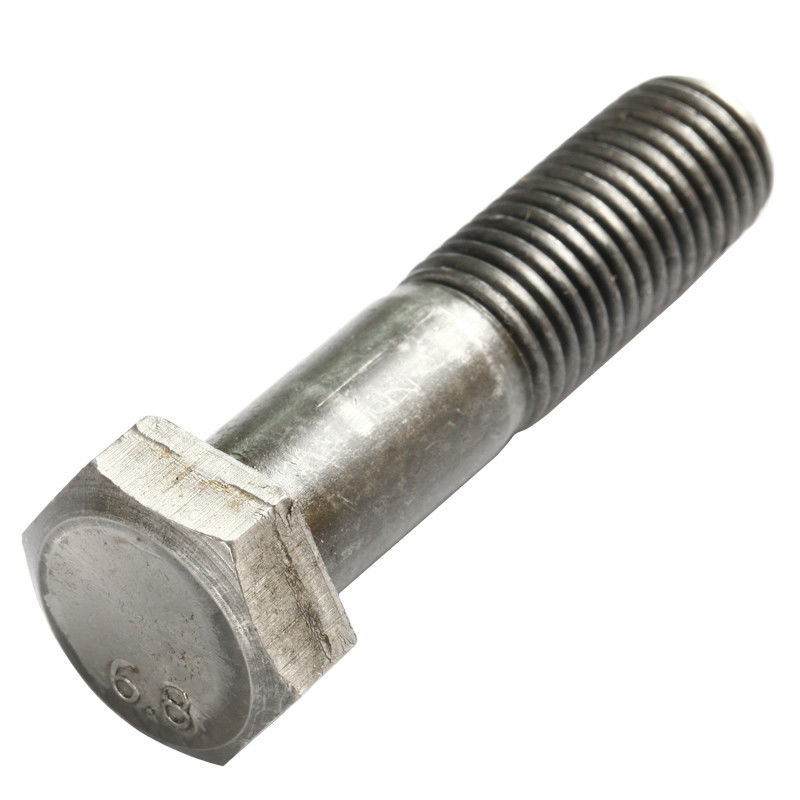

The hexagonal head bolt on the left is the normal structural fastener. The countersunk bolt on the right has a tapered head that sits flush with the surface of the ply, which matters where a protruding head would foul a bearing surface or a moving part. That taper is also what reduces its bearing capacity, as covered below.
Αμερικανικό Ινστιτούτο Χάλυβα (AISC)
Η AISC χρησιμοποιεί κυρίως αγγλικές μονάδες (ίντσα, λίβρες) although the SI counterpart is also supported and available. One thing to take note of is that the dimensions in the English system are usually in increments of one eighth of an inch (⅛”), που μπορεί να μην ταιριάζει ακριβώς με αυτά στο SI.
Σύγκριση διαμέτρου μπουλονιών
| ½” | – |
| ⅝” | Μ16 |
| ¾” | Μ20 |
| ⅞” | Μ22 |
| 1" | Μ24 |
| 1 ⅛” | Μ27 |
| 1 ¼” | Μ30 |
| 1 ⅜” | – |
| 1 ½” | Μ36 |
These are nearest practical equivalents, not interchangeable sizes. A ¾” bolt is 19.05 mm against 20 mm for an M20, so the hole sizes and edge distances differ and the two cannot be substituted for one another on a drawing.
Μπουλόνια υψηλής αντοχής
Specifications for bolt materials are covered by the American Society for Testing and Materials (ASTM), and AISC sorts them into two groups by strength:
Ομάδα Α — ASTM F3125 Grades A325, A325M and F1852; ASTM A354 Grade BC; ASTM A449
Ομάδα Β — ASTM F3125 Grades A490, A490M and F2280; ASTM A354 Grade BD
ASTM F3125 is a consolidated specification that absorbed the older standalone A325, Α490, F1852 and F2280 documents, which is why those now appear as grades within it rather than as specifications in their own right. Older drawings and calculations still call them out the old way.
Besides differences in strength and other properties, these groups have different requirements for minimum pretension depending on bolt diameter.
Ευρωκώδικας 3 (Εθνικό Παράρτημα ΗΒ)
The Eurocode is entirely in SI units, so bolts are designated in millimetres with the size prefixed by “Μ”, for example M16 meaning a 16 mm diameter bolt.
| Μ12 |
| Μ16 |
| Μ20 |
| Μ24 |
| Μ30 |
Bolt Classes and Strengths
Eurocode bolts are classified by a two-part designation that encodes both strengths. For a class written as a.b, the ultimate tensile strength is ένα × 100 MPa, and the yield strength is σι/10 of that value. So Class 4.6 has an ultimate tensile strength of 400 MPa and a yield of 240 MPa, while Class 8.8 has 800 MPa ultimate and 640 MPa yield.
Getting these two the right way round matters, because the bolt resistance formulas take the ultimate value. In calculating actual bolt resistances, the capacity is also affected by the preload, called pretension in AISC terms, which in certain cases increases the bolt carrying capacity if the right amount of tension is applied.
| Τάξη | Εντάσεως, fub (MPa) | Απόδοση παραγωγής, fyb (MPa) | Diameter range |
| 4.6 | 400 | 240 | Μ5 – Μ36 |
| 4.8 | 400 | 320 | Μ1.6 – Μ16 |
| 5.8 | 500 | 400 | Μ5 – Μ24 |
| 8.8 | 800 | 640 | Μ1.6 – Μ36 |
| 9.8 | 900 | 720 | Μ1.6 – Μ16 |
| 10.9 | 1000 | 900 | Μ5 – Μ36 |
| 12.9 | 1200 | 1080 | Μ1.6 – Μ36 |
Σημειώσεις για εξάγωνα και αντίθετα μπουλόνια
The differences in geometry between hexagonal and countersunk bolts affect the bearing capacity, because the tapered head removes material from the ply it sits in. The effective thickness in bearing is the ply thickness less the depth of the countersink, which is what the figure below shows. (See AISC Manual 14th edn, Σύκο. 7-10.)
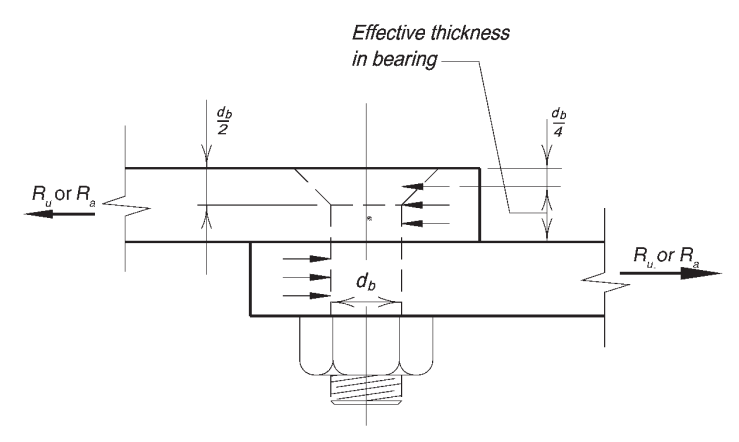
Φιγούρα 1. Αποτελεσματικό πάχος στη στήριξη ενός αντιβυθισμένου μπουλονιού
Προδιαγραφές σύνδεσης και οπές μπουλονιών
Οι κοχλιωμένες συνδέσεις μπορούν να χαρακτηριστούν ως σφιγμένες, προτεταμένη ή ολισθηρή. These conditions play a large role in the choice of bolt hole used. Hole types are standard (κανονικός, in EN terms), υπερμεγέθη, or slotted short or long, and they are adopted according to the connection specification. The RCSC specification sets out the requirements for the snug-tight condition. If the connection is designed for anything other than snug-tight, that condition must be clearly identified on the drawings, whether it is an AISC pretension or an EN preloading requirement.
The distinction is not paperwork. A snug-tight bolt resists load by bearing once it has slipped into contact, while a slip-critical connection is designed so that the clamping force stops the plies moving at all.
Slip-critical connections matter wherever slip has to be prevented, and different factors are applied in the calculation of slip resistance depending on the hole type, since an oversized or slotted hole gives the ply more room to move before it bears. Στις περισσότερες περιπτώσεις, standard or normal bolt holes are adopted together with a specified level of pretension or preload. These variables can be modelled and analysed using tools like Ανάλυση και Σχεδιασμός Μεταλλικών Κατασκευών SkyCiv, which helps engineers account for connection behaviour in the wider structural system.
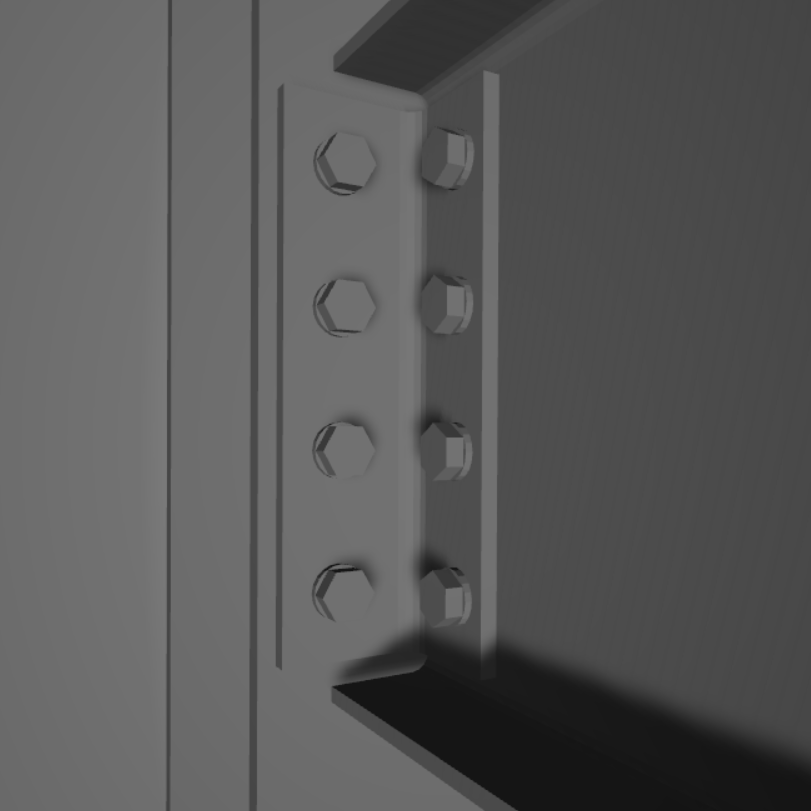
Φιγούρα 2. Βιδωμένη γωνία, ένα είδος διατμητικής σύνδεσης
Βιδωτές συνδέσεις
Bolted connections can be used both in shear plate connectors such as web plates, μπλουζάκια, and web and seat angles, and in moment connections (άκαμπτος, fully restrained) που χρησιμοποιούν συνήθως πληρωτικό, συνέχεια και πλάκες συναρμογής. Using bolts means adding an intermediate connector or connecting element of the kind just mentioned.
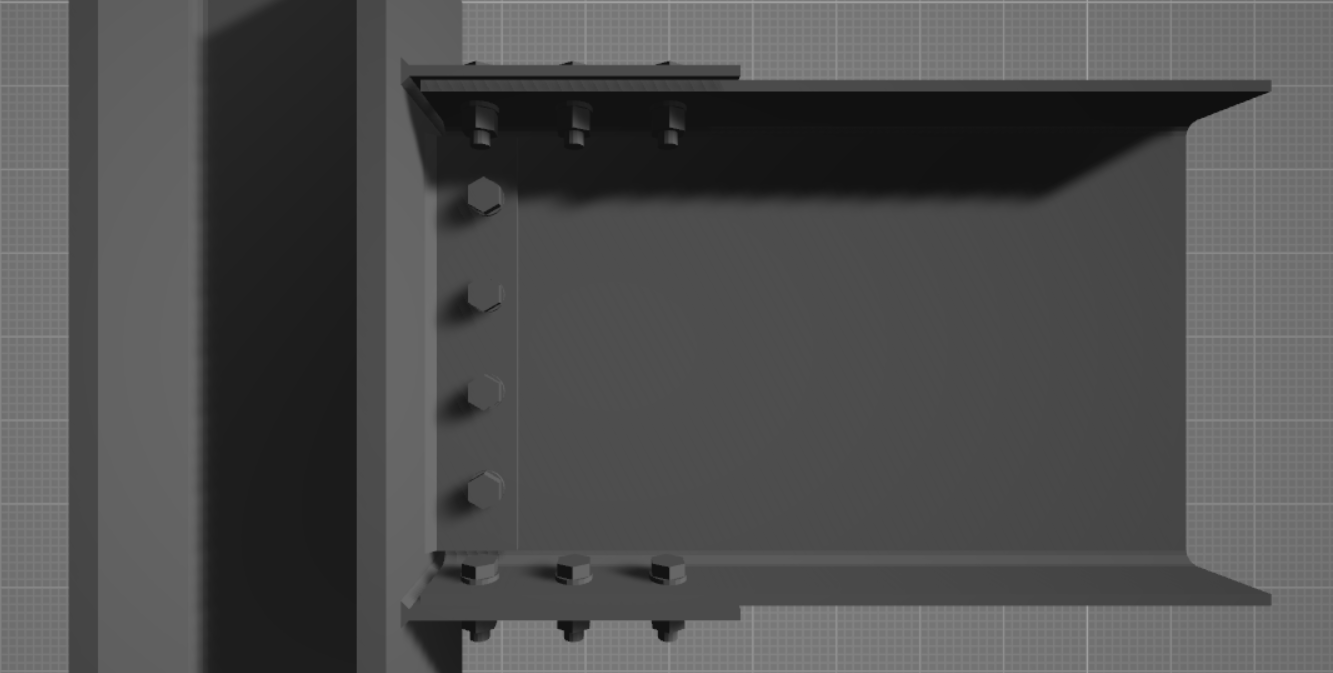
Φιγούρα 3. Βιδωτή σύνδεση πλάκας φλάντζας
In theory there are many ways to combine connection configurations. Στην πράξη, buildability and fabrication cost mean certain connection types are favoured over others and are therefore more widely adopted. Here are some of the common connection types that use bolts, with brief descriptions.
Κουρεύω (Απλός) Συνδέσεις
- Μονό/Διπλό Πιάτο (tab or fin) uses a plate or plates to connect a beam web to the supporting member, a girder or a column. One side usually needs a weld at the edge of the plate, while bolts connect it in lap to the beam web.
- Μονόκλινο/Διπλή γωνία is similar to plates, except that angles can be bolted on both sides of the connection.
- Γωνία καθίσματος, όπως υποδηλώνει το όνομα, uses an angle section to bear the flange of the supported member (or the flat wall for a closed section) so the beam can sit on it. Bolts can be used throughout this connection type.
Στιγμή (Συγκρατημένος) Συνδέσεις
- Πλάκες φλάντζας, used alongside a shear connection, provide continuity to flanges framing into the columns of a moment-resisting frame, or more generally in member splices.
- Collar and Through Plates are found on HSS columns (RHS ή CHS) forming part of a moment-resisting frame. A through plate cuts through the column, while a collar plate is fitted around it, worn much like a collar on a shirt. Both are expensive to fabricate because of the cutting and fitting involved.
Επισκεφθείτε το άρθρο μας στο Τύποι χαλύβδινων συνδέσεων να μάθω περισσότερα, compare fasteners in bolts vs welds vs rivets, or try our αριθμομηχανή διατμητικής αντοχής μπουλονιών. ο bolts documentation covers how bolt grades, hole types and pretension are entered in the connection design module.
Try it now
Pick a bolted connection, set the bolt grade, diameter and hole type, and every bolt check comes back with its utilization ratio and the clause behind it. Εκτελείται στο πρόγραμμα περιήγησης, χωρίς τίποτα για εγκατάσταση.
βιβλιογραφικές αναφορές
[1] Αμερικανικό Ινστιτούτο Χάλυβα (AISC). (2016). Προδιαγραφές για δομικά κτίρια από χάλυβα. Σικάγο, Ο 60601-6204
[2] Αμερικανικό Ινστιτούτο Χάλυβα (AISC). (2011). Εγχειρίδιο κατασκευών από χάλυβα. 14th Ed. Σικάγο, Ο 60601-6204
[3] The Steel Construction Institute και The British Construction Steelwork Association. (2014). Αρμοί σε Μεταλλικές Κατασκευές Απλοί Αρμοί σε Ευρωκώδικα 3. Ascot SL5 7QN; Λονδίνο SW1A 2ES, Ηνωμένο Βασίλειο
[4] The Steel Construction Institute και The British Construction Steelwork Association. (2014). Αρμοί σε Χαλύβδινες Κατασκευές Αρμοί Αντίστασης Ροπής στον Ευρωκώδικα 3. Ascot SL5 7QN; Λονδίνο SW1A 2ES, Ηνωμένο Βασίλειο
