
什么是偏心基础?
在某些情况下, 列偏心于基脚中心. Footings that are not concentrically loaded are known as "Eccentric Footings". 此外, when footings are subjected to an axial load "P" and a bending moment "M" or a lateral force "H", the footing experiences an unbalanced stress distribution along its base. The same effect is produced by an axial load acting at an eccentricity "e" 从基础的质心开始.
片刻, a lateral force acting at a height h above the base of the footing, or a column offset from the center of the footing can all be converted to an equivalent eccentricity of the axial load:
[math] e = \frac{M + H \, h}{P} [math]
结果是, the total combined stress at the base of the footing is equal to the sum of the stress due to the axial load over the footing area (P / A) and the bending moment over the section modulus "S" of the footing (多发性硬化症). For a rectangular footing of length L (in the direction of the eccentricity) and width B:
[math] q = \frac{P}{A} \pm \frac{M}{S} = \frac{P}{B \, L} \left( 1 \pm \frac{6 \, e}{L} \right) \quad \text{with} \quad A = B \, L, \quad S = \frac{B \, L^{2}}{6} [math]
假定压力线性变化, 如图 1. 当轴向载荷落在立足区域的范围内时,此分布有效, 那是, where the eccentricity "e" is not more than L/6. The following equations for soil pressure (q) can be used to determine the minimum and maximum pressures at the extreme edges of the footing (1).
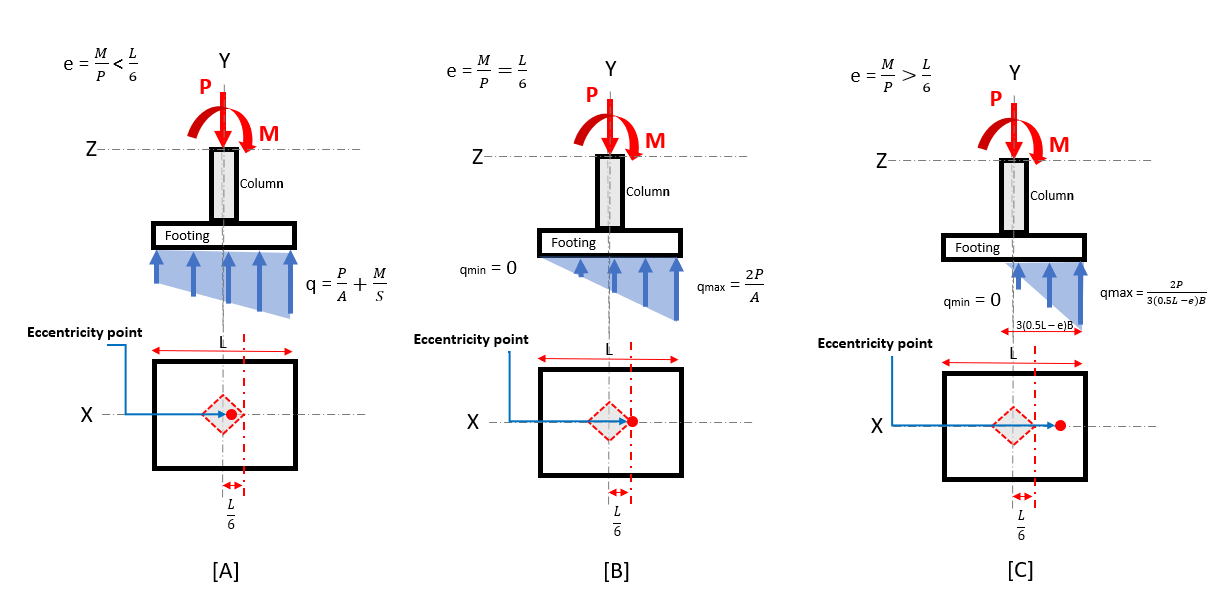
数字 1. 偏心桩基土压力分布
(一个) 核心边界内的偏心 (b) eccentric at the kern boundary (C) 核心边界之外的偏心
Figure 1A depicts the footing when the eccentricity is located inside the kern boundary (Ë < L/6). The entire footing is in compression and the soil pressure has a trapezoidal distribution where:
[math] q_{max} = \frac{P}{A} + \frac{M}{S} \qquad q_{min} = \frac{P}{A} – \frac{M}{S} [math]
图1B描绘了偏心度位于核边界处的基础 (e = L/6). The entire footing is still in contact with the soil, but the soil pressure now has a triangular distribution, dropping to zero at the far edge:
[math] q_{max} = \frac{2 \, P}{A} \qquad q_{min} = 0 [math]
图1C描绘了当偏心距位于核边界之外时的立足点 (Ë > L/6). The soil cannot resist tension, so part of the footing lifts off the soil and the pressure is only distributed over a contact length of 3(升/2 – Ë) measured from the most compressed edge. The soil pressure still has a triangular distribution, and the equation P/A + M/S no longer applies. 代替:
[math] q_{max} = \frac{2 \, P}{3 \, B \left( \frac{L}{2} – e \right)} [math]
When the load is eccentric in both directions (biaxial eccentricity e_x and e_z on a footing of dimensions L_x and L_z), the whole base stays in compression only when the load falls inside the rhombus-shaped kern:
[math] \frac{6 \, e_{x}}{L_{x}} + \frac{6 \, e_{z}}{L_{z}} \leq 1 [math]
Outside of it, only part of the base is in contact with the soil and the pressure at the most loaded corner rises quickly. 请参阅此链接以获取更详细的文章 土压力分布.
Eccentric Footings in the SkyCiv Foundation Design Module
SkyCiv’s Foundation Design Module does not use the kern equations above to design the footing. It is integrated with Finite Element Analysis (丑陋): the footing is meshed into plate elements supported on compression-only soil springs, whose stiffness comes from the 路基反力模量 you enter in the soil properties. Because the springs cannot take tension, the part of the footing that would lift off the soil is detected by the analysis itself, so the same model covers loads inside and outside the kern, in one or both directions.
Modeling the eccentricity
Eccentricity enters the model in three ways:
- 柱荷载: 在里面 Column Loads 表, each load has an axial force P, shears Vx 和 电压, 和时刻 Mx 和 Mz. The axial force is applied as a uniform pressure over the column footprint, and the moments as a linearly varying pressure over it.
- Lateral forces: the shears Vx and Vz are converted into additional moments at the footing, using a lever arm equal to the column 高度 plus half of the footing thickness.
- Column position: for isolated footings, 的 X-offset 和 Z-offset 的 柱 (center-to-center distance between the column and the footing, a PRO feature) place the column off the center of the footing. For combined footings, each column is positioned with its X-edge Distance 和 Z-offset. The axial load then acts eccentrically on the footing without needing an extra moment.
Loads and moments can be applied in either direction, and their signs are kept, so moments that add to or cancel the effect of a column offset are both handled.
Soil pressure results
The FEA gives the soil pressure at every node of the mesh, which shows the real, non-linear distribution under the flexible footing rather than the linear distribution assumed above.
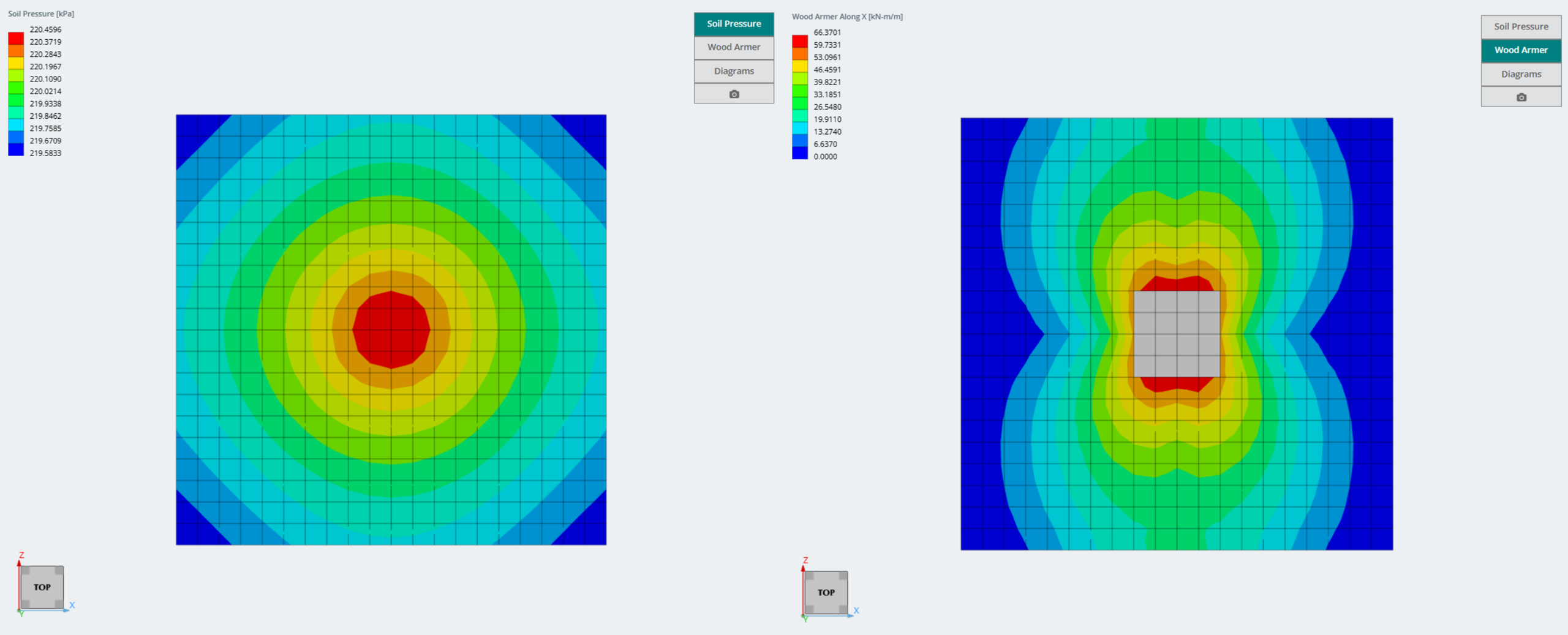
该 有限元分析 – 土压力 section of the report shows the service and ultimate soil pressure contours, and a table of the maximum and minimum soil pressures with the (X, 与) coordinates where they occur, measured from the upper left corner of the foundation plan. The results are based on the envelope of the load combinations, or on the service and ultimate loads you enter when Custom Load is turned on.
The maximum service soil pressure is then checked against the 土壤总允许承载力. 对于AS 3600, you can also turn on Perform ULS soil bearing check to compare the maximum ultimate soil pressure against the Ultimate Soil Bearing Capacity multiplied by the geotechnical reduction factor. The overturning, sliding and uplift checks of the report complete the stability checks of an eccentric footing.
Moment demand for flexure
The moments used for the flexural design come from the same FEA results. 在 设计设置, 下 Flexure Check, 的 力矩需求计算 setting has two options:
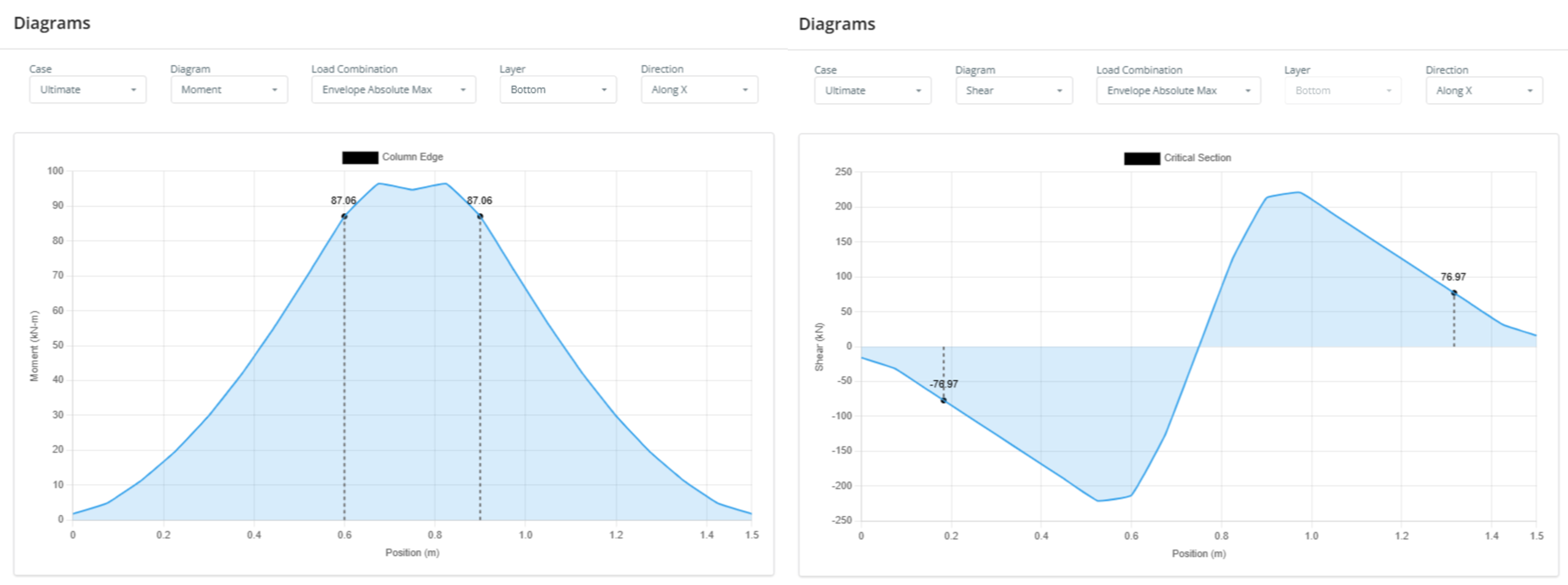
- Strip average method (默认): the footing is divided into strips, and the moments are calculated as if each strip acts as a beam in its direction. Shear and moment diagrams are generated from the FEA results with this method, giving a clearer picture of the internal forces across the footing.
- 巅峰木臂法: uses the maximum Wood-Armer moments of the plates, for a conservative design. It is the default for ACI 318-14.
想要试用SkyCiv的Foundation Design软件? 我们的免费工具允许用户执行 混凝土基础计算 无需任何下载或安装!
参考资料
- 钢筋混凝土结构: 分析与设计, 第二版. 麦格劳-希尔专业人士.
