SkyCiv文档

SkyCiv 软件指南 — 教程, 使用指南和技术文章

单板连接

The single plate connection, 或剪切板, is one of the simple shear connections set out in Part 10 of the AISC Manual, and a fabricator favourite because it is the cheapest of the group: one plate, one weld line, one bolt group.

板总是在车间焊接到支架上,通常 现场螺栓连接 到连接梁. It can be welded to the beam instead on a shop-assembled frame. What you should not do is put that weld in the field: field welding is labour-intensive and expensive next to running a bolt in.

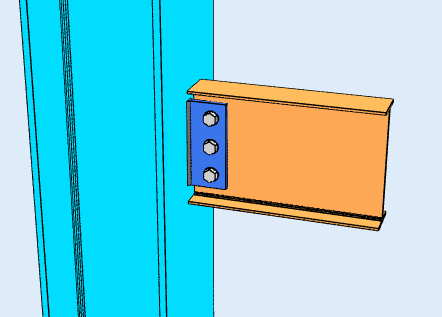
在 SkyCiv 连接设计中建模的单板剪力板连接

两种配置类型

Which configuration you are in decides which rules apply, and it follows from the geometry rather than from a setting you choose.

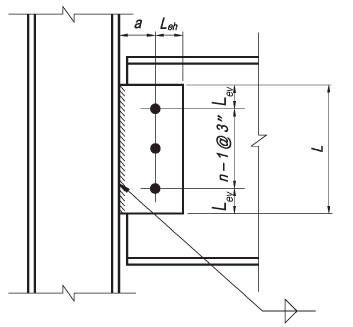
  1. 常规配置

    • 只允许有一排垂直的螺栓. 连接中的螺栓数量必须介于 2 和 12.
    • 螺栓线到熔接线的距离必须等于或小于 3-1/2 在.
    • 标准孔 (性病) 或水平短槽孔 (高速SSL) 被允许使用如表中所述 10-9 第 15 版 AISC 手册.
    • 垂直边缘距离必须满足 AISC 规格表 J3.4 要求. 板和梁腹板的水平边距均应大于或等于2d, 其中 d 是螺栓直径.
    • 板厚或梁腹板厚度必须满足表中给出的最大厚度要求 10-9 第 15 版 AISC 手册.Conventional single plate configuration
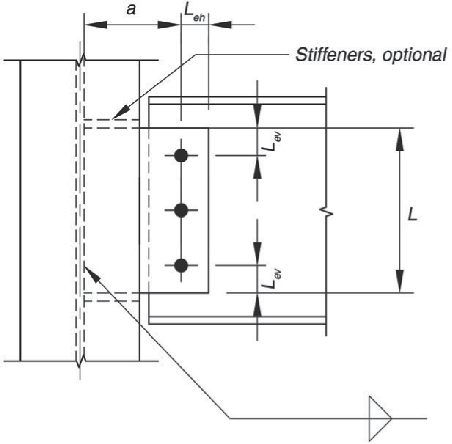
  2. 扩展配置

    • 螺栓数量不限.
    • 焊接线到最靠近支撑的螺栓线的距离不受限制.
    • 孔的使用必须满足 AISC 规范第 J3.2 节的要求.
    • 水平和垂直边缘距离必须满足 AISC 规格表 J3.4 要求. Extended single plate configuration

Designing a Single Plate Connection in SkyCiv

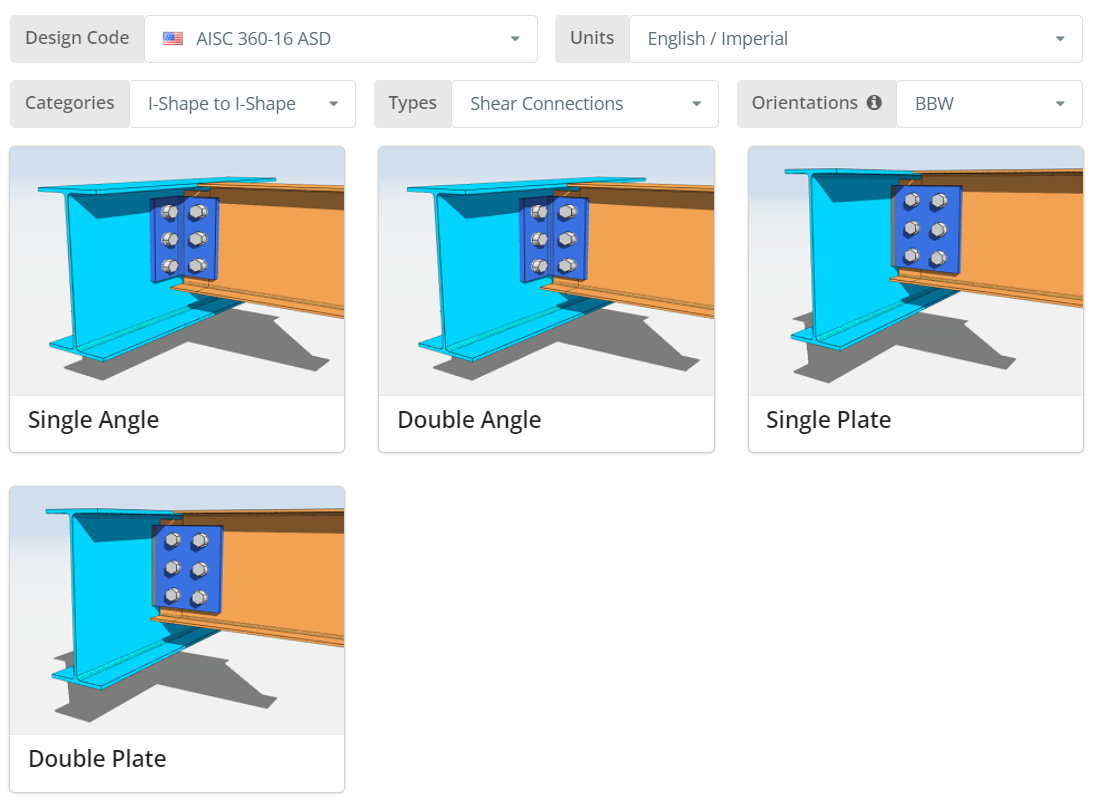
Selecting the single plate connection in SkyCiv Connection Design

The design code can be AISC 360-16 ASD 或 LRFD, and units English/Imperial or SI/Metric. Orientation is BCF, BCW 或 BBW; hover the tooltip for what each one means. 点击 “单板” 瓦.

详细信息选项卡

Details tab in SkyCiv Connection Design

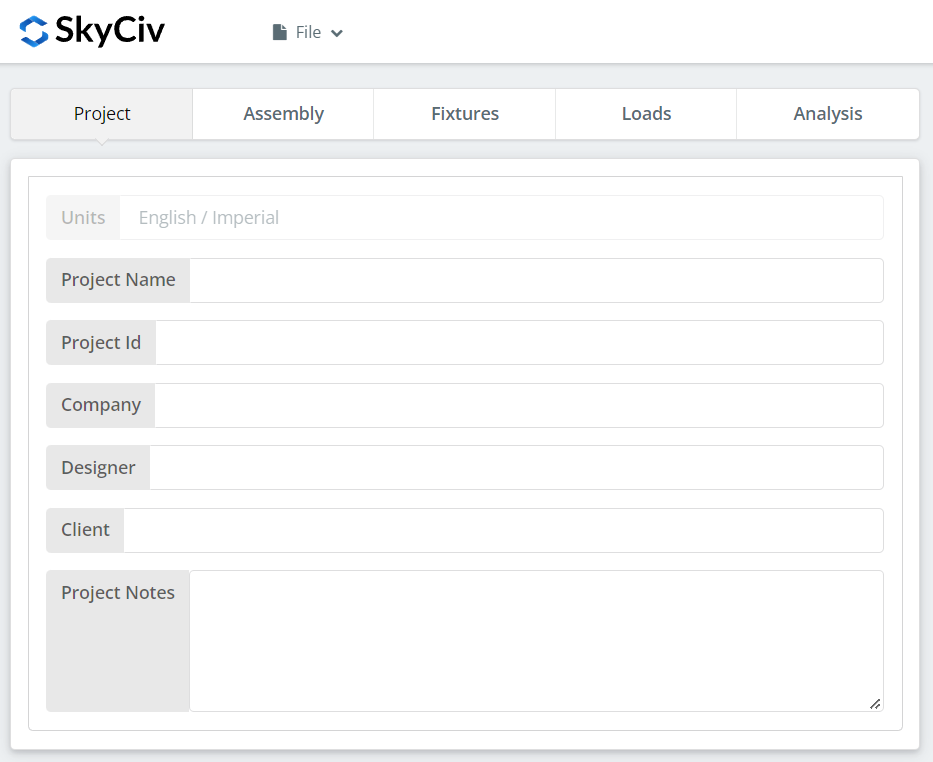
Record the project details here. None of it changes the calculations, but it carries into the report.

装配标签

Three tabs sit under Assembly: the Girder, the Beam, and the Connection, which holds the single plate.

大梁选项卡

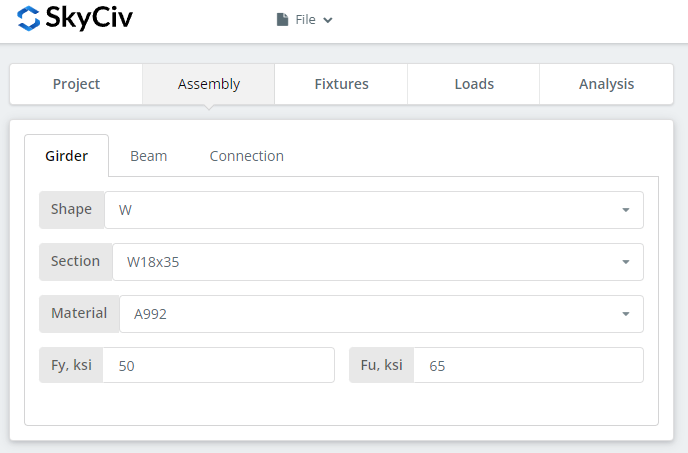
Supporting girder section and grade inputs

Specify the section and material grade of the supporting member. A992 and A36 are in the list; for anything else choose Custom and enter Fy and Fu.

光束选项卡

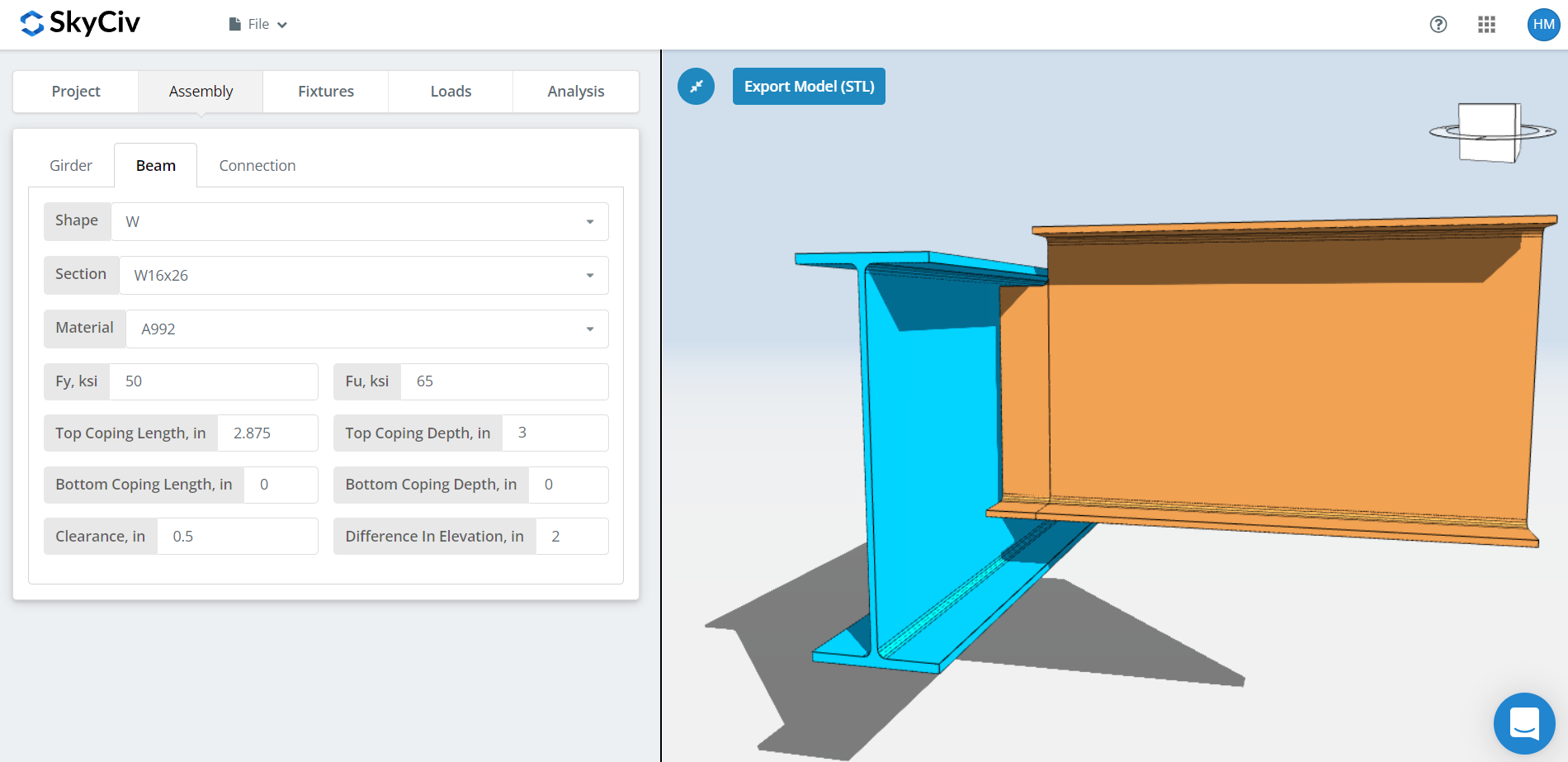
Beam section, cope, clearance and elevation inputs

The same inputs for the beam, plus cope dimensions, beam clearance and the difference in elevation.

For BBW orientation the coping is worked out automatically, and you can override it. The automatic cope recalculates whenever you change the beam section, the girder section, the clearance or the difference in elevation.

The clearance is also what puts you in one configuration or the other. A clearance small enough that the beam still sits inside the girder will usually give a conventional single plate, unless the girder flange is wide enough that the distance from the bolt to the girder web exceeds 3-1/2″. A clearance that puts the beam completely outside the girder flange gives an extended single plate. For the difference in elevation, a positive value means the beam is above the girder and a negative value below.

连接选项卡

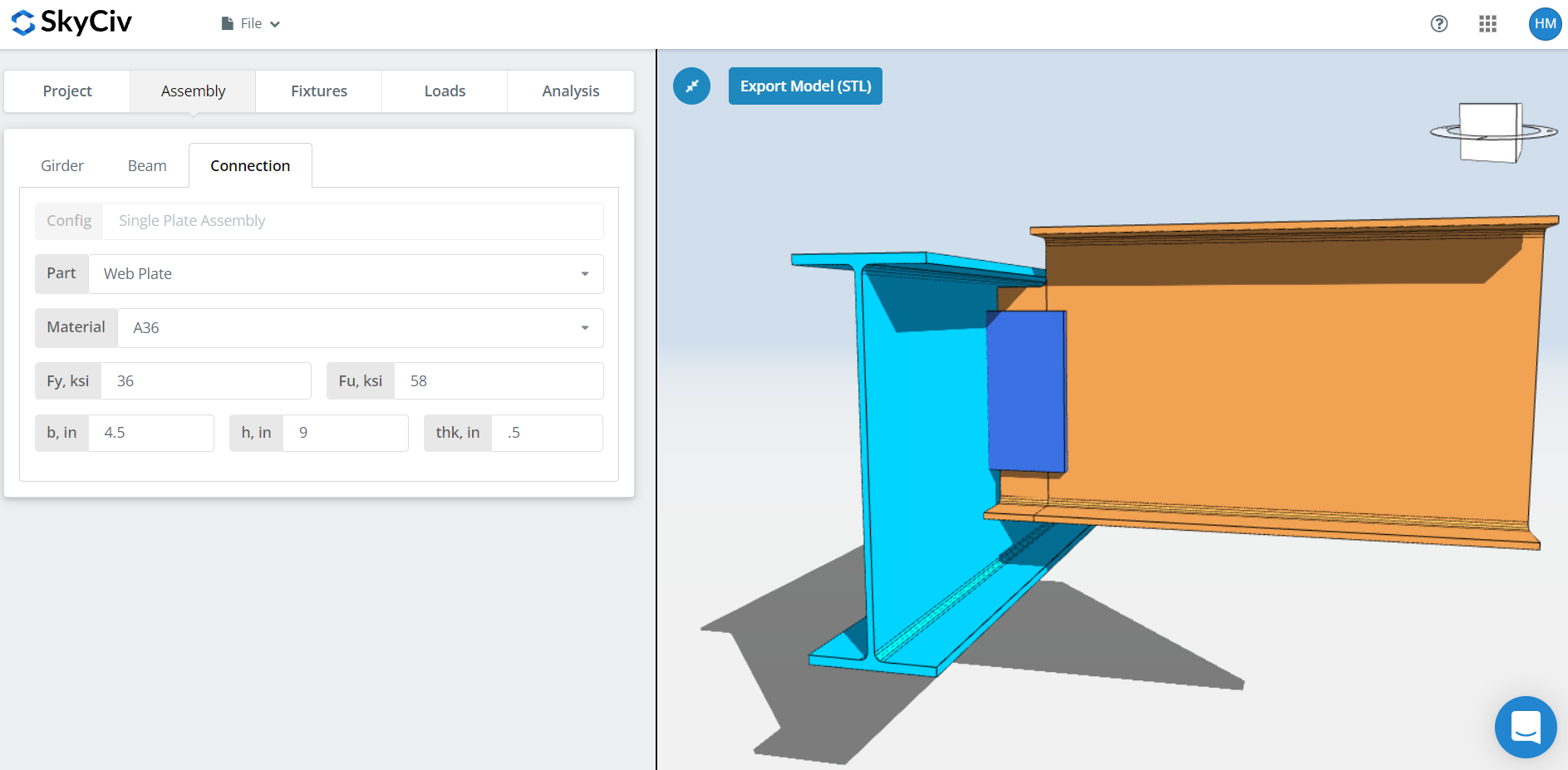
Single plate dimension inputs

Set the plate properties: grade A36 or A992, or Custom with your own Fy and Fu, then the plate width ‘b’, height ‘hand thickness ‘thk’.

Watch the 3D renderer as you go. The plate height should sit within the beam depth, and the plate width has to be wide enough for the beam to bolt or weld to, which matters most in an extended configuration.

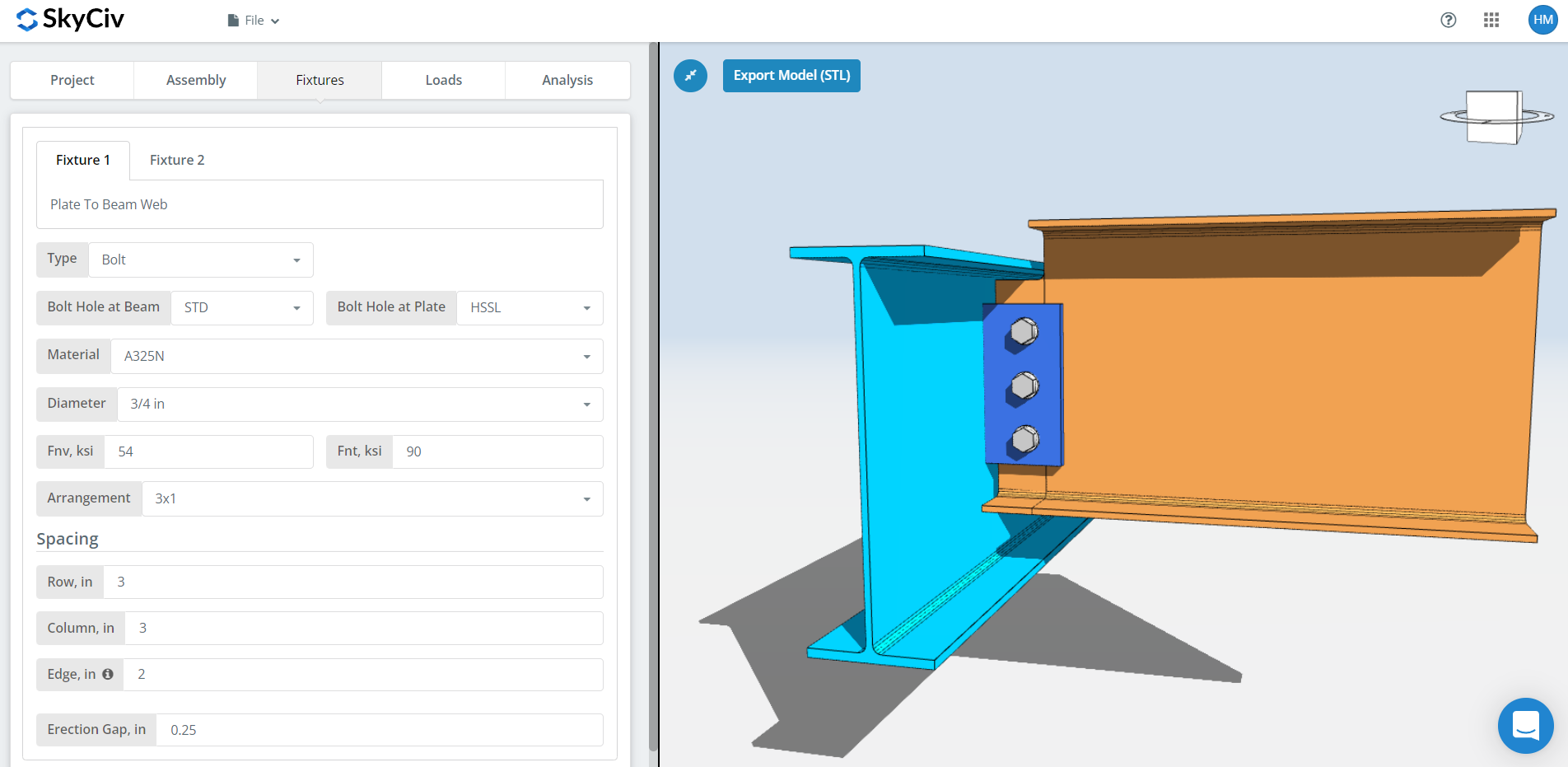
治具 1 标签

Bolt inputs for the plate to beam web connection

治具 1 is the plate to beam web connection. It can be bolted or welded; this walkthrough uses bolted.

第一, the bolt hole types at the beam and at the plate. Fabricators usually ask for standard holes (性病) in the beam and horizontal short-slotted holes (高速SSL) in the plate, which buys fitting tolerance in the field. Note that those two are also the only hole types the conventional configuration permits, so reaching for oversized holes moves you into the extended configuration rules.

下一个, the bolt material or grade: A307, A325, A490 or Custom. A325 and A490 are grades within ASTM F3125, which consolidated the older standalone specifications. Choose N or X for a bearing-type connection and SC for slip-critical.

Slip-critical joints have lower design bolt capacity than bearing-type, so use them where slip actually matters: oversized or slotted holes, load reversal, or fatigue. Between N and X, X gives the larger bolt shear capacity, but the threads must be excluded from the shear plane, and the erector has to know that. Between SC(一个) and SC(乙), SC(乙) gives the larger capacity and requires a more thoroughly prepared faying surface, for example SSPC-SP6 commercial blast cleaning.

Then the bolt diameter, from 5/8to 1-1/2or the metric equivalents, and the arrangement, 取决于 12 螺栓行和列, with the row and column spacing.

Worth knowing: if you need more bolt group capacity, opening up the spacing can do it instead of adding bolts, as long as the plate height still fits within the beam depth. The bolt group strength uses the instantaneous centre of rotation method (ICOR), so a wider spacing is credited with the capacity it actually provides. Check with your fabricator first, 尽管. Many prefer 3spacing typical throughout.

的 “边缘” input is the distance from the beam end to the first bolt column.

最后的, the erection gap. This is the gap that lets the beam be dropped into place on site. It costs capacity, so specify it only where erection actually needs it.

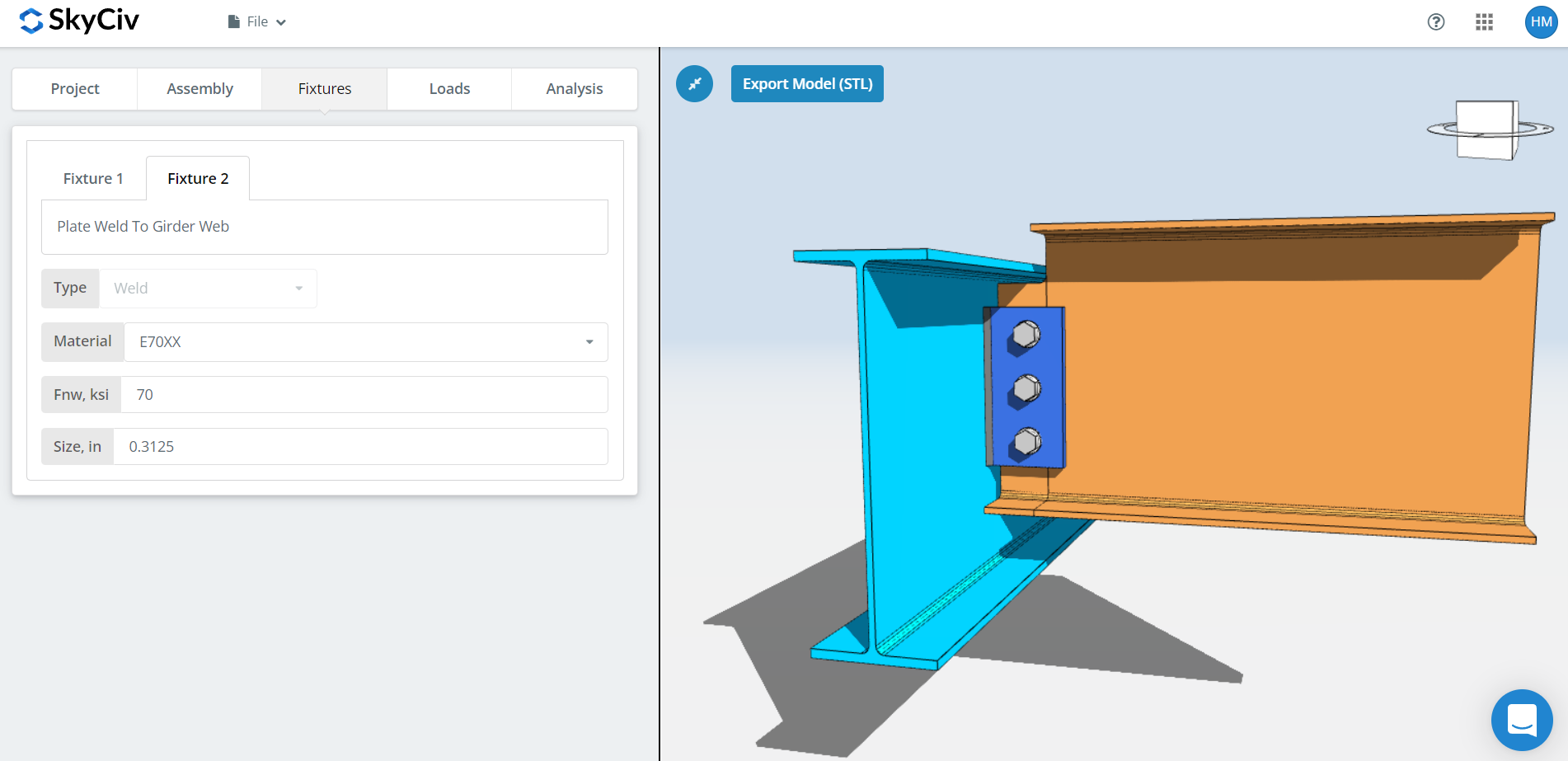
治具 2 标签

Weld inputs for the plate to support connection

治具 2 is the plate to support connection, whether that support is a girder web, a column flange or a column web. For a single plate this is welded only.

Specify the weld material, or ‘Customwith your own Fnw if the electrode is not listed, then the weld size. For single plate connections the weld needs to be at least 5/8 板厚的倍数, so that the weld develops the plate.

That rule has a cost consequence worth planning around. 桌子 8-12 第 15 版 AISC 手册, 页 8-126, shows a large jump in weld passes between 5/16and 3/8″ 鱼片: 5/16″ needs a single pass, 3/8″ needs three. A 1/2plate needs only a 5/16fillet to develop it, which keeps you in single-pass territory. So if the connection is short of capacity, increase the plate height to the maximum allowable before you increase the thickness. A thicker plate demands a larger weld, and a larger weld means more passes, more deposited metal and more labour time.

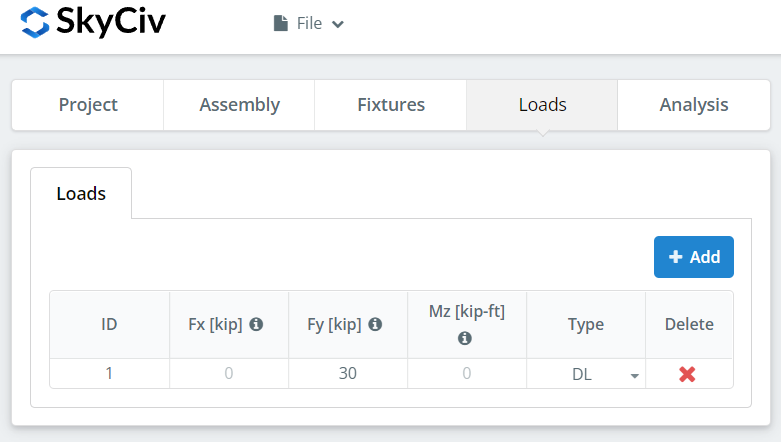
负载选项卡

Load inputs for a single plate connection

Enter the vertical shear under ‘Fy’.

Match the load to the design method you picked at the start. LRFD takes factored loads against design strength; ASD takes service loads against allowable strength. The software cannot tell which you typed.

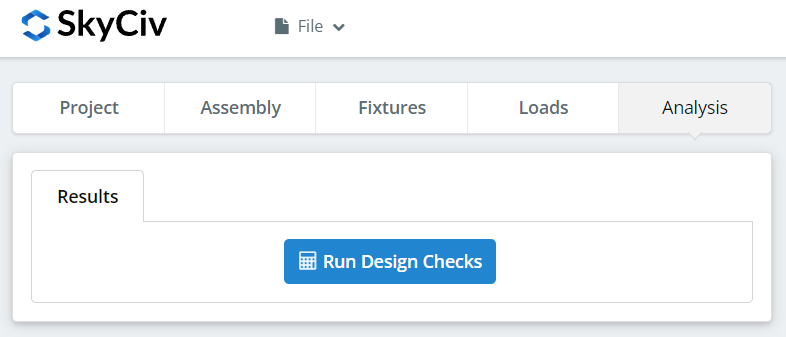
结果选项卡

Results tab in SkyCiv Connection Design

请点击 “运行设计检查”. Anything missing from the earlier tabs is flagged here rather than silently defaulted.

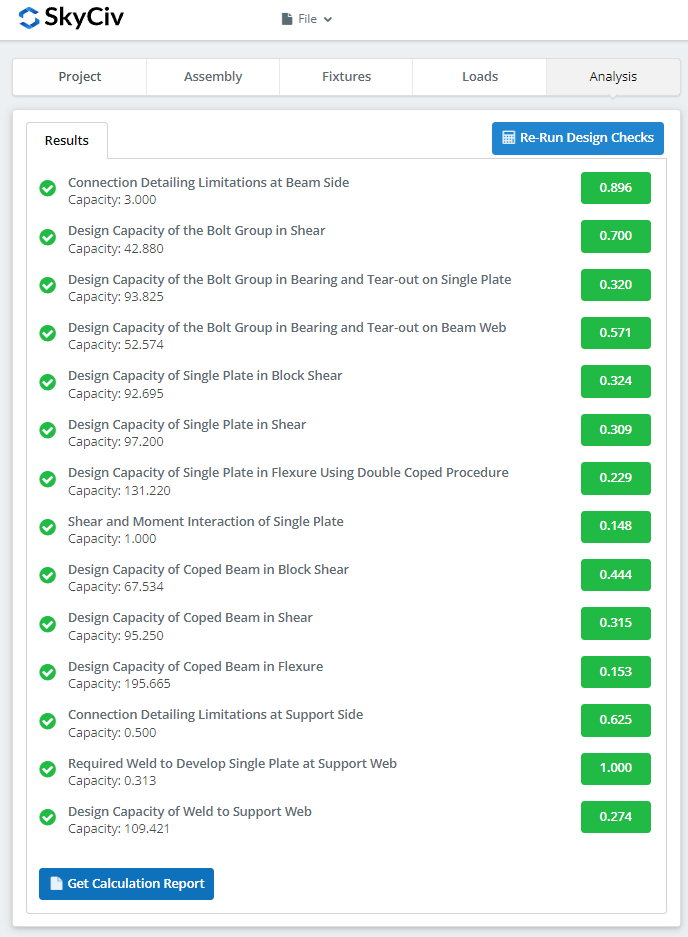
Design check summary for a single plate connection

The summary shows whether the connection passed, with a utilization ratio against each check. 如果失败, change the inputs on the earlier tabs and click “重新运行设计检查”. When it passes, “View Calculation Reportopens the detailed report.

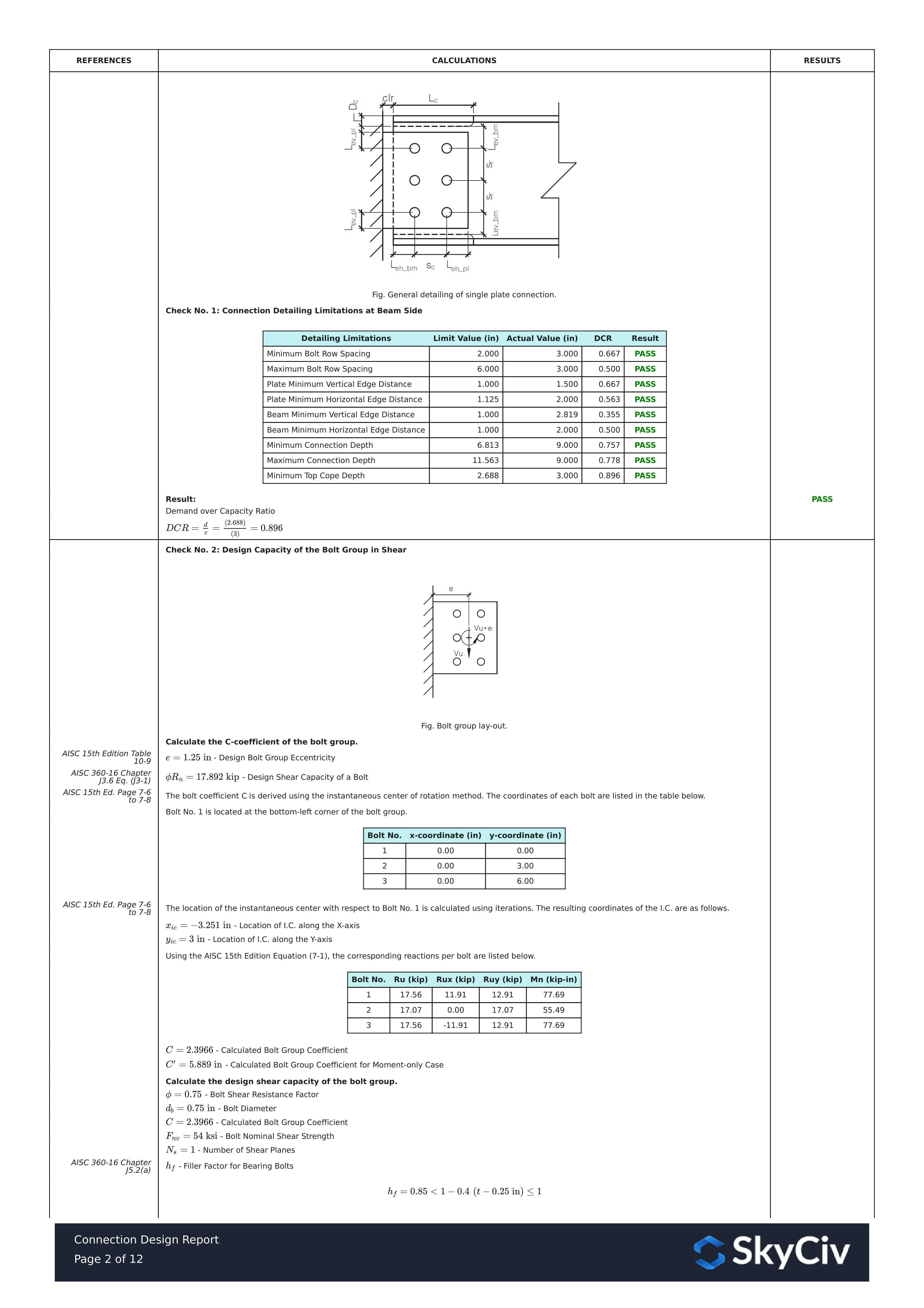
Single plate calculation report extract

That is an extract from the report. Each check carries its reference to the AISC manual or specification, and the working follows the order the specification uses, so a reviewing engineer can read it line by line instead of reverse-engineering a number.

这是完整详细计算报告的 PDF 副本: 连接设计报告.

Try It Yourself

Pick the single plate, 输入您的部分, plate and shear, and see every check with its code reference. 它在浏览器中运行, 无需安装任何东西.

See also the single plate connection calculator, 的 double angle calculator, 和 剪力连接 overview.

我们能帮你什么吗?

×

回到顶部