SkyCiv文档

SkyCiv 软件指南 — 教程, 使用指南和技术文章

螺栓和螺栓连接

结构钢构件通过填充元件或连接件相互连接,这些填充元件或连接件可以是角钢, plates or even parallel flange channels (全氟辛烷磺酸). 这些是工作现场采用的一些常见配置, 特别是当主要使用螺栓或螺栓连接时. For welded connections, 构件有时直接相互连接,无需任何填充元件或中间连接器. In this article we focus on bolts, 六角头和沉头, 以及一些常用的螺栓连接.

六角和沉头螺栓

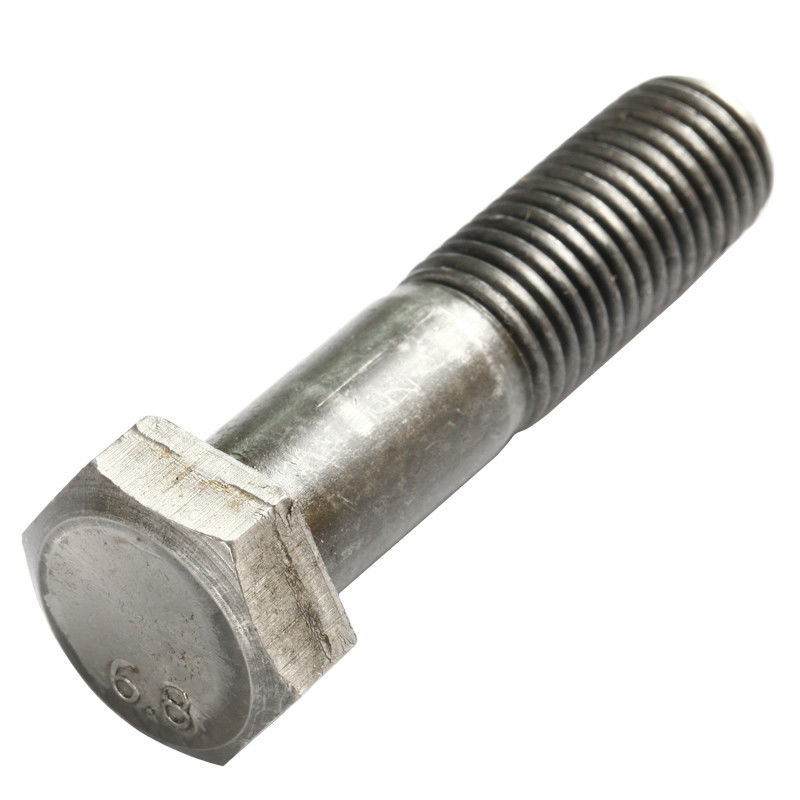
Hexagonal head structural bolt Countersunk bolt with a tapered head

The hexagonal head bolt on the left is the normal structural fastener. The countersunk bolt on the right has a tapered head that sits flush with the surface of the ply, which matters where a protruding head would foul a bearing surface or a moving part. That taper is also what reduces its bearing capacity, as covered below.

美国钢结构学会 (AISC)

AISC 主要使用英制单位 (英寸, 磅) although the SI counterpart is also supported and available. One thing to take note of is that the dimensions in the English system are usually in increments of one eighth of an inch (⅛”), 这可能与 SI 中的不完全匹配.

螺栓直径比较

½” –
⅝” M16
¾” M20
⅞” M22
1” M24
1 ⅛” M27
1 ¼” M30
1 ⅜” –
1 ½” M36

These are nearest practical equivalents, not interchangeable sizes. A ¾” bolt is 19.05 mm against 20 mm for an M20, so the hole sizes and edge distances differ and the two cannot be substituted for one another on a drawing.

高强度螺栓

Specifications for bolt materials are covered by the American Society for Testing and Materials (ASTM), and AISC sorts them into two groups by strength:

A组—— ASTM F3125 Grades A325, A325M and F1852; ASTM A354 Grade BC; ASTM A449

B组—— ASTM F3125 Grades A490, A490M and F2280; ASTM A354 Grade BD

ASTM F3125 is a consolidated specification that absorbed the older standalone A325, A490, F1852 and F2280 documents, which is why those now appear as grades within it rather than as specifications in their own right. Older drawings and calculations still call them out the old way.

Besides differences in strength and other properties, these groups have different requirements for minimum pretension depending on bolt diameter.


EUROCODE 3 (英国国家附件)

The Eurocode is entirely in SI units, so bolts are designated in millimetres with the size prefixed by “m”, for example M16 meaning a 16 mm diameter bolt.

M12
M16
M20
M24
M30

Bolt Classes and Strengths

Eurocode bolts are classified by a two-part designation that encodes both strengths. For a class written as a.b, the ultimate tensile strength is 一个 × 100 兆帕, and the yield strength is b/10 of that value. So Class 4.6 has an ultimate tensile strength of 400 MPa and a yield of 240 兆帕, while Class 8.8 has 800 MPa ultimate and 640 MPa yield.

Getting these two the right way round matters, because the bolt resistance formulas take the ultimate value. In calculating actual bolt resistances, the capacity is also affected by the preload, called pretension in AISC terms, which in certain cases increases the bolt carrying capacity if the right amount of tension is applied.

班级 拉伸, fub (兆帕) 屈服, fyb (兆帕) Diameter range
4.6 400 240 M5 – M36
4.8 400 320 M1.6 – M16
5.8 500 400 M5 – M24
8.8 800 640 M1.6 – M36
9.8 900 720 M1.6 – M16
10.9 1000 900 M5 – M36
12.9 1200 1080 M1.6 – M36


六角螺栓和沉头螺栓的注意事项

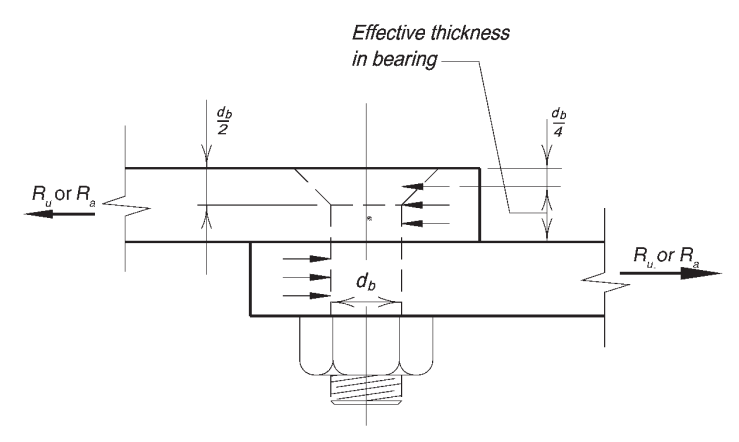
The differences in geometry between hexagonal and countersunk bolts affect the bearing capacity, because the tapered head removes material from the ply it sits in. The effective thickness in bearing is the ply thickness less the depth of the countersink, which is what the figure below shows. (See AISC Manual 14th edn, 图. 7-10.)

Effective thickness in bearing of a countersunk bolt

数字 1. 沉头螺栓轴承的有效厚度


连接规格和螺栓孔

螺栓连接可以指定为紧密拧紧, 预张紧或滑动临界. These conditions play a large role in the choice of bolt hole used. Hole types are standard (普通的, in EN terms), oversized, or slotted short or long, and they are adopted according to the connection specification. The RCSC specification sets out the requirements for the snug-tight condition. If the connection is designed for anything other than snug-tight, that condition must be clearly identified on the drawings, whether it is an AISC pretension or an EN preloading requirement.

The distinction is not paperwork. A snug-tight bolt resists load by bearing once it has slipped into contact, while a slip-critical connection is designed so that the clamping force stops the plies moving at all.

Slip-critical connections matter wherever slip has to be prevented, and different factors are applied in the calculation of slip resistance depending on the hole type, since an oversized or slotted hole gives the ply more room to move before it bears. 在大多数情况下, standard or normal bolt holes are adopted together with a specified level of pretension or preload. These variables can be modelled and analysed using tools like SkyCiv钢结构分析与设计, which helps engineers account for connection behaviour in the wider structural system.

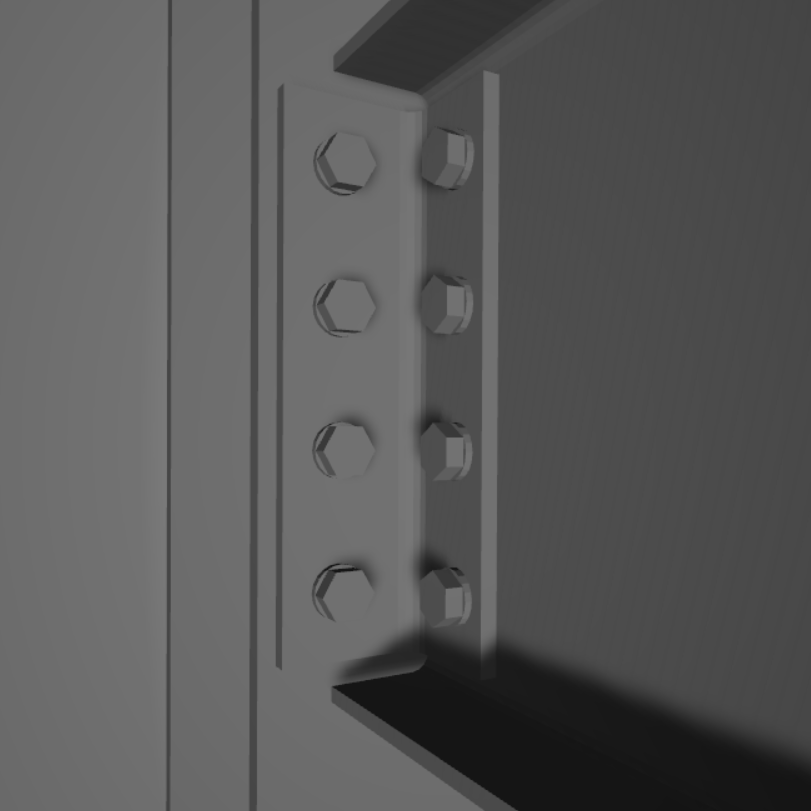
Bolted angle connection, a type of shear connection

数字 2. 螺栓角, 一种剪力连接


螺栓连接

Bolted connections can be used both in shear plate connectors such as web plates, 三通, and web and seat angles, and in moment connections (死板的, 完全克制) 哪些常用填充物, 连续性和拼接板. Using bolts means adding an intermediate connector or connecting element of the kind just mentioned.

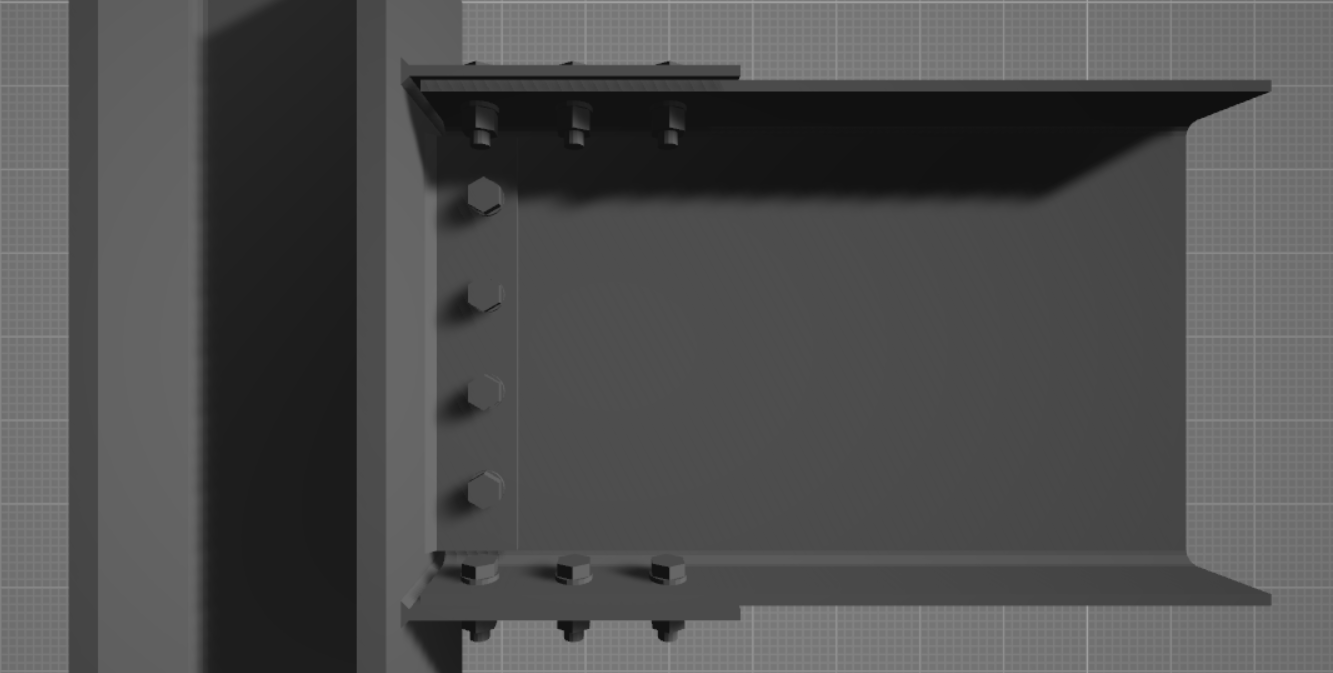
Bolted flange plate moment connection

数字 3. 螺栓法兰盘连接


In theory there are many ways to combine connection configurations. 在实践中, buildability and fabrication cost mean certain connection types are favoured over others and are therefore more widely adopted. Here are some of the common connection types that use bolts, with brief descriptions.


剪力 (简单) 连接数

  1. 单/双板 (tab or fin) uses a plate or plates to connect a beam web to the supporting member, a girder or a column. One side usually needs a weld at the edge of the plate, while bolts connect it in lap to the beam web.
  2. 单身的/双角 is similar to plates, except that angles can be bolted on both sides of the connection.
  3. 座椅角度, 顾名思义, uses an angle section to bear the flange of the supported member (or the flat wall for a closed section) so the beam can sit on it. Bolts can be used throughout this connection type.

时刻 (克制) 连接数

  1. 法兰盘, used alongside a shear connection, provide continuity to flanges framing into the columns of a moment-resisting frame, or more generally in member splices.
  2. Collar and Through Plates are found on HSS columns (RHS 或 CHS) forming part of a moment-resisting frame. A through plate cuts through the column, while a collar plate is fitted around it, worn much like a collar on a shirt. Both are expensive to fabricate because of the cutting and fitting involved.

请访问我们的文章 钢结构连接的类型 了解更多, compare fasteners in bolts vs welds vs rivets, or try our 螺栓抗剪强度计算器. 的 bolts documentation covers how bolt grades, hole types and pretension are entered in the connection design module.

Try it now

Pick a bolted connection, set the bolt grade, diameter and hole type, and every bolt check comes back with its utilization ratio and the clause behind it. 它在浏览器中运行, 无需安装任何东西.

参考资料

[1] 美国钢结构学会 (AISC). (2016). 钢结构建筑规范. 芝加哥, 的 60601-6204

[2] 美国钢结构学会 (AISC). (2011). 钢结构手册. 14第三版. 芝加哥, 的 60601-6204

[3] 钢结构协会和英国钢结构协会. (2014). 钢结构中的接头 符合欧洲规范的简单接头 3. 阿斯科特 SL5 7QN; 伦敦 SW1A 2ES, 英国

[4] 钢结构协会和英国钢结构协会. (2014). 符合欧洲规范的钢结构抗弯接头中的接头 3. 阿斯科特 SL5 7QN; 伦敦 SW1A 2ES, 英国

我们能帮你什么吗?

×

回到顶部