
Вероятно, вы здесь, потому что спроектировали крепление с помощью инженерного программного обеспечения., одна или несколько проверок не удались, и вы не были уверены, что изменить дальше.
Это руководство написано для новых инженеров и студентов инженерных специальностей, которые хотят понять режимы отказа якоря согласно ACI 318-19 и как логически скорректировать дизайн. Это не замена кода. Полные положения и требования, всегда обращайтесь к Аси 318-19 глава 17.
Цель здесь — помочь вам распознать что не получается, почему это терпит неудачу, и какие конструктивные параметры действительно увеличивают мощность, вместо случайного изменения входных данных.
Если вы хотите увидеть, как эти проверки применяются шаг за шагом в рабочем процессе проектирования, вы также можете обратиться к Программное обеспечение SkyCiv для проектирования опорной плиты, который сообщает обо всех проверках привязки ACI с полными расчетами.
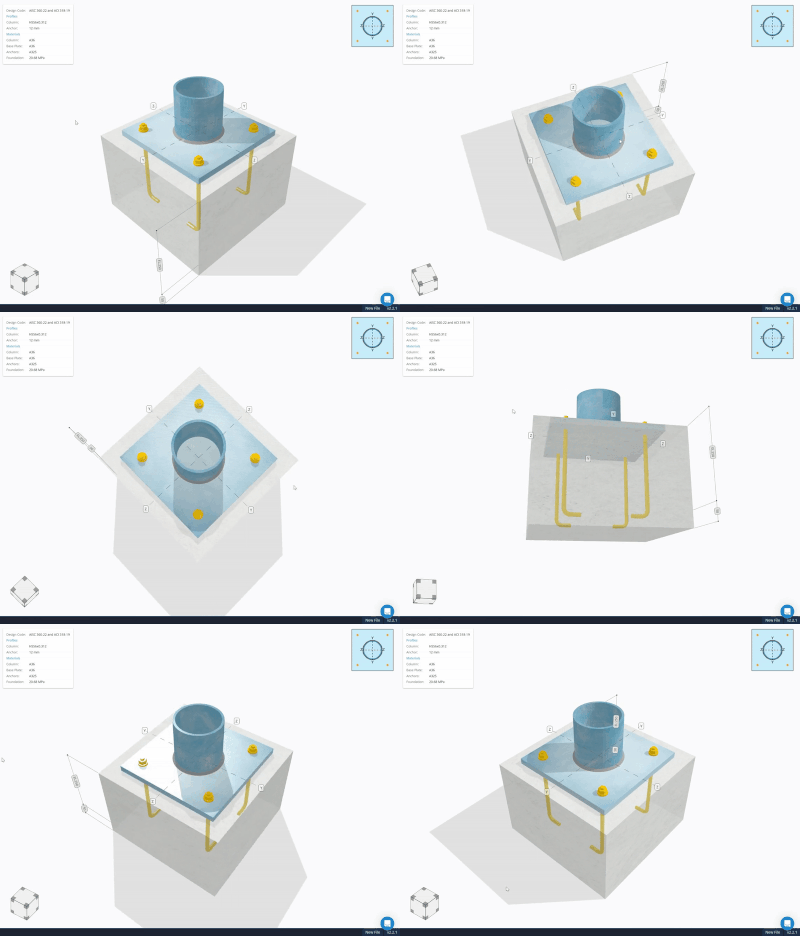
Что такое якорь?
Анкер обычно представляет собой стальной стержень, заделанный в бетон для соединения другого элемента конструкции., чаще всего стальная опорная пластина. Якоря передают напряжение, сдвиг, или объединенные силы стали в бетонную опору.
Анкеры обычно классифицируются по способу установки..
Литые анкеры
Залитые анкеры устанавливаются до заливки бетона и закрепляются по мере затвердевания бетона..
Постустановленные анкеры
Установленные после установки анкеры устанавливаются в затвердевший бетон путем сверления отверстий и закрепления анкера с помощью:
- Механическое расширение
- Клеевое или химическое соединение.
Какой из них лучше?
Ни один из типов якорей по своей сути не является лучшим. Выбор зависит от конструктивности., ограничения проекта, и доступность. Например, если стальная колонна добавляется к существующей плите или фундаменту, залитые анкеры больше не являются вариантом, и обычно используются анкеры, установленные после установки..
Наличие также имеет значение, как типы якорей, размеры, и пределы установки зависят от поставки производителя. К распространенным производителям якорей относятся Хилти, ДеВальт, и Фишер, каждая из них предлагает различные механические и клеевые системы крепления с учетом конкретных конструктивных данных и требований к установке..
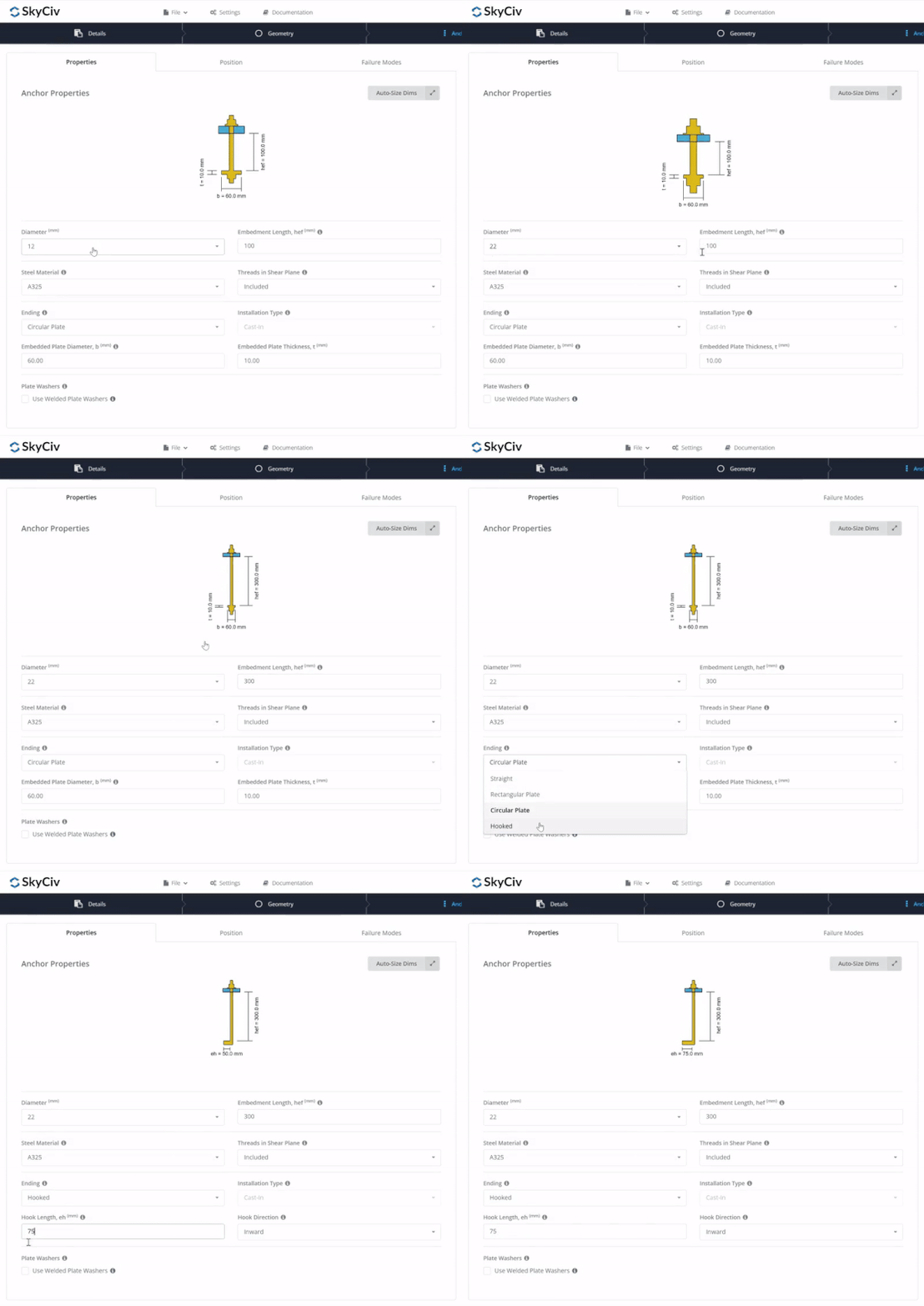
Одиночные якоря против якорных групп
Когда проверка привязки не удалась, отказ не всегда происходит только на одном якоре. В зависимости от планировки, отказ может произойти в одном якоре или в группе якорей, действующих вместе. Аси 318 делает это различие, потому что основной вид отказа и мощность могут сильно различаться..
оценивается ли неудача как выход из строя одного якоря или сбой группы привязки зависит, прежде всего, от перекрытие прогнозируемых поверхностей разрушения. Это перекрытие обычно контролируется расстоянием между анкерами., глубина заделки, и краевое расстояние.
Чтобы визуализировать это поведение во время проектирования, такие инструменты, как Программное обеспечение SkyCiv для проектирования опорной плиты отображать прогнозируемые области отказа и автоматически определять, оцениваются ли анкеры индивидуально или как группа на основе геометрии.
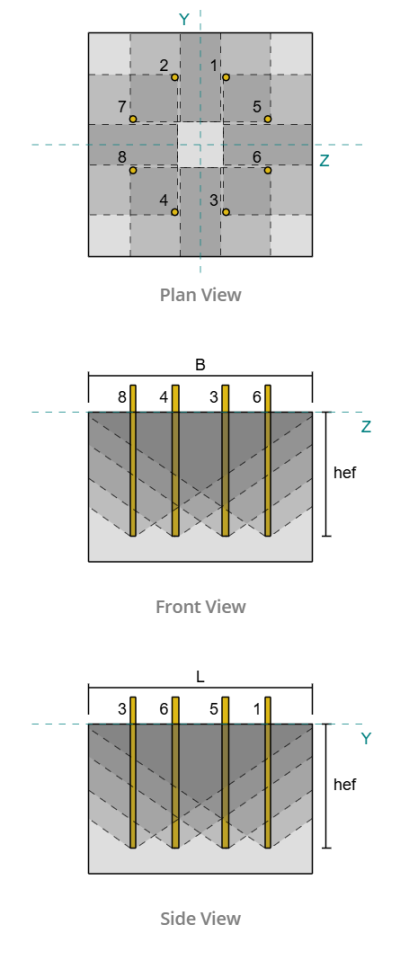
Одиночные якоря
Если анкеры расположены на большом расстоянии друг от друга или имеют небольшую глубину установки., их прогнозируемые зоны отказа не перекрываются. В таком случае, отказ оценивается на уровне отдельного якоря. Один якорь может достичь своего предела без существенного вклада соседних якорей..
Якорные группы
Когда анкеры расположены ближе друг к другу при достаточной глубине заделки, их прогнозируемые поверхности разрушения перекрываются. В таком случае, бетон ограничивает возможности всей группы, и отказ происходит, когда объединенная прогнозируемая зона отказа достигает своего предела.. Групповая емкость не равна сумме индивидуальных мощностей якоря..
Это различие имеет решающее значение, поскольку несколько проверок на растяжение и сдвиг ACI явно изменяются в зависимости от того, определяется ли разрушение одним анкером или группой анкеров.. Неправильная идентификация основного типа отказа может привести к неконсервативным или чрезмерно консервативным проектам..
Примеры дизайна
Примеры дизайна, иллюстрирующие отказы одного якоря и группы якорей можно найти в ресурсах по проектированию опорных плит SkyCiv.. Вот примерный набор проверок проектирования, выполняемых Программное обеспечение SkyCiv для проектирования опорной плиты.
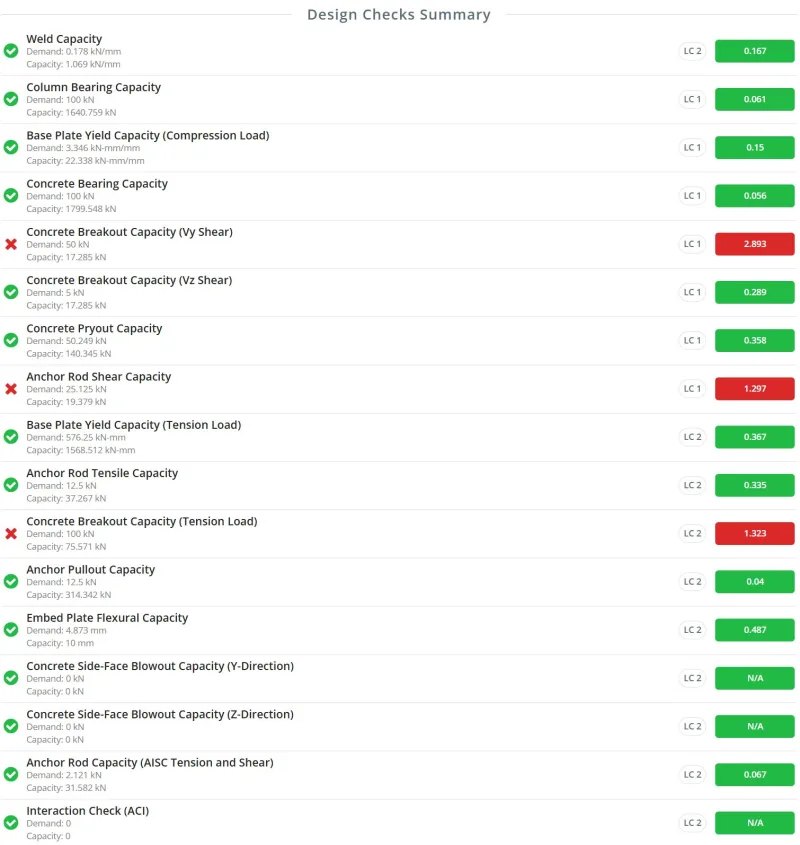
Проверка натяжения анкеров согласно ACI 318-19
Когда анкеры подвергаются натяжению, Аси 318-19 требует нескольких проверок. Каждая проверка соответствует отдельному механизму физического отказа.. Как только вы поймете механизм, корректировать дизайн становится гораздо проще.
Прочность стали при растяжении
Проверка анкерной стали учитывает текучесть и разрыв анкерной стали..
Как увеличить предел прочности стали
Выбирайте анкер большего диаметра
Больший диаметр обеспечивает большую площадь растяжения.. Для выбора диаметра, многие инженеры начинают с диапазона 1/2 дюйм до 3/4 дюйм. Если спрос выше ожидаемого, увеличить диаметр. Это суждение улучшается с опытом.
Увеличение прочности анкерного материала
Более высокие марки материалов увеличивают производительность, но также увеличивают стоимость. Обычные анкерные материалы включают в себя: АСТМ Ф1554. Практический подход к проектированию состоит в том, чтобы начать с более низких оценок, таких как Оценка 36, затем увеличьте до уровня 55 или Оценка 105 только если этого требует спрос.
Предоставьте больше якорей
Если диаметр анкера и марка материала уже максимальны, а проверка натяжения стали по-прежнему имеет решающее значение., добавление дополнительных привязок в одной строке может быть вариантом. Обычно для этого требуется отрегулировать интервал, краевые расстояния, или размеры опорной плиты. Добавление дополнительных строк разрешено., но это меняет распределение нагрузки и должно быть тщательно оценен.
Уравнение емкости:
\( N_{к} = A_{я знаю,N} f_{ута} \)
Прочность бетона на разрыв при растяжении
Прорыв бетона происходит, когда конусообразная часть бетона отделяется от опоры.. В таком случае, анкерная сталь остается неповрежденной, но окружающий бетон не справляется.
Этот вид отказа применяется к анкерам с головкой., анкеры расширения, винтовые анкеры, и подрезать анкеры.
Как увеличить способность прорыва бетона
Увеличить глубину заделки
Конус прорыва идеализируется как простирающийся от заглубленного конца анкера до бетонной поверхности.. Увеличение глубины установки увеличивает конус и значительно увеличивает производительность.. Глубина заделки также напрямую увеличивает базовую прочность на прорыв, определенную ACI..
Увеличьте расстояние между анкерами
Близко расположенные анкеры ограничивают ширину прогнозируемой зоны разрушения.. Увеличение расстояния позволяет увеличить эффективную зону прорыва., особенно для якорных групп.
Увеличьте расстояние до края
Якоря, расположенные вблизи краев, не могут сформировать полный конус отрыва.. Увеличение расстояния до края часто приводит к заметному увеличению производительности..
Используйте бетон повышенной прочности.
Переход с бетона более низкой марки на бетон более высокой марки увеличивает базовую прочность на отрыв и часто эффективен, когда геометрия ограничена..
При необходимости следует исходить из того, что бетон не имеет трещин.
Бетон без трещин обеспечивает немного большую производительность.. Это предположение следует использовать только в случае обоснования., поскольку это меняет проектные предположения.
Обеспечьте усиление, предназначенное для выдерживания напряжения.
Когда арматура специально спроектирована и детализирована так, чтобы выдерживать силу натяжения анкера., от проверок прорыва бетона можно отказаться. Это должно быть намеренное дизайнерское решение., не предположение.
Уравнение мощности для одиночных анкеров:
\( N_{cb} = frac{A_{Nc}}{A_{Помнить}} \PSI_{ред,N} \PSI_{с,N} \PSI_{cp,N} N_b \)
Уравнение мощности для якорных групп:
\( N_{cbg} = frac{A_{Nc}}{A_{Помнить}} \PSI_{ec,N} \PSI_{ред,N} \PSI_{с,N} \PSI_{cp,N} N_b \)
Сила выдергивания анкера
Отказ при выдергивании происходит, когда анкер выдергивается из бетона без образования полного конуса вырыва.. Эта проверка применяется к залитым анкерам и некоторым механическим анкерам, установленным после установки, и оценивается для только отдельные якоря.
Для анкеров, установленных после установки, мощность определяется путем экспериментальных испытаний. Для закладных анкеров, грузоподъемность обычно зависит от размеров анкера.
На шпильках с литыми головками, производительность контролируется подшипником на закладном конце, находясь на зацепленных якорях, контролируется эффективной длиной крючка.
Как исправить ошибку при извлечении
Используйте более широкие или толстые закладные пластины или головки болтов большего размера. (Якоря с головой)
Для анкеров с закладными концами, увеличение площади подшипника повышает грузоподъемность. При использовании встроенной пластины, увеличить размеры или толщину пластины. Для анкеров с закладной головкой или гайкой, выбор головки или гайки большего размера на закладном конце увеличивает площадь подшипника.
Удлините анкерные крюки или увеличьте диаметр стержня. (Крючковые якоря)
Короткие крючки или маленькие анкерные стержни могут привести к выдергиванию., даже если бетонный конус не провалится. Более длинные крючки или более крупные стержни увеличивают грузоподъемность и снижают риск выдергивания..
Используйте бетон повышенной прочности.
Переход с бетона более низкой марки на бетон более высокой марки увеличивает прочность на выдергивание и часто эффективен, когда геометрия ограничена..
При необходимости используйте нерастрескивающийся бетон.
Бетон без трещин обеспечивает лучшее сопротивление выдергиванию.. Это следует предполагать только в том случае, если это оправдано проектными условиями..
Неисправности при выдергивании обычно устраняются улучшением состояния подшипников, а не изменением промежутков или краевых расстояний..
Уравнение мощности для возглавляемого:
\( N_{пн} = Пси_{с,п} Н_п \)
где,
\( Н_п = 8А_{brg}е_с’ \)
Уравнение емкости для подключенного:
\( N_{пн} = Пси_{с,п} Н_п \)
где,
\( N_p = 0,9f_c’e_h d_a \)
Прочность бетона на выброс с боковой стороны
Боковой выброс происходит, когда анкер с относительно глубокой заделкой располагается слишком близко к свободному краю.. Вместо формирования конуса прорыва вверх, конус простирается в сторону, вызывая разрушение и выдувание боковой поверхности бетона.
Этот вид отказа определяется соотношением между глубиной заделки и краевым расстоянием.. Когда эти параметры определяются определенным образом, этот механизм отказа может не применяться.
Поскольку бетонные конусы могут перекрываться, должны быть проверены как отдельные якоря, так и группы якорей.
Как исправить боковой выброс
Увеличьте расстояние до края
Увеличение краевого расстояния повышает номинальную прочность.. Также, гораздо большее расстояние до края, т.е.( ca_1 > \гидроразрыва{час_{ef}}{2.5 }\) делает этот отказ неприменимым.
Отрегулируйте расстояние между привязками для групп привязок
В якорных группах, несколько анкеров могут вызвать одновременный боковой выброс. Расстояние между якорями дальше друг от друга, при этом допуская некоторое перекрытие конуса, увеличивает эффективный размер и мощность бетонного конуса.
Уменьшить глубину установки анкерного стержня
Очень длинные анкерные стержни вблизи краев увеличивают вероятность выброса.. Использование более коротких стержней относительно краевого расстояния может сделать эту проверку неприменимой..
Используйте бетон повышенной прочности.
Переход от бетона более низкого класса к бетону более высокого класса увеличивает прочность на боковой выброс и часто эффективен, когда геометрия ограничена..
Уравнение мощности для одиночных анкеров:
\( N_{сб} = 160c_{а1}\SQRT{A_{brg}}\lambda_a\sqrt{f’_c} \)
Уравнение мощности для якорных групп:
\( N_{как} = слева(1 + \гидроразрыва{s}{6c_{а1}}\право) N_{сб} \)
Прочность сцепления клеевых анкеров
Для послеустановленных клеевых анкеров, прочность соединения проверяется под действием растягивающих усилий. Емкость рассчитывается на основе площади влияния приклеенного анкера и характерного напряжения сцепления.. Характеристические значения напряжения сцепления получены в результате экспериментальных испытаний., и если тестовые данные недоступны, консервативные значения от ACI 318-19 Стол 17.6.2.5 может быть использован.
Поскольку зоны влияния могут перекрываться, должны оцениваться как отдельные якоря, так и группы якорей.
Емкость облигаций уже составляет:
-
Связь между анкером и клеем
-
Связь между клеем и бетоном
Как увеличить емкость облигаций
Увеличьте диаметр анкера
Больший диаметр анкера увеличивает базовую прочность соединения., а также зона влияния. На геометрию зоны влияния большое влияние оказывает диаметр.
Увеличить глубину заделки
Более глубокая установка увеличивает базовую прочность клеевого анкера..
Увеличьте расстояние и краевые расстояния.
Для групп анкеров или отдельных анкеров, расположенных близко к краю., регулировка интервалов и краевых расстояний снимает ограничение на общую зону влияния.
Используйте клей с более высоким характеристическим напряжением сцепления.
Выбор клея с более высокой прочностью сцепления повышает производительность.. Большее характеристическое напряжение сцепления означает большую зону влияния., тем самым увеличивая емкость.
Уравнение мощности для одиночных анкеров:
\( N_a = frac{A_{Уже}}{A_{Нао}} \PSI_{ред,Уже} \PSI_{cp,Уже} N_{ба} \)
Уравнение мощности для якорных групп:
\( N_{аг} = frac{A_{Уже}}{A_{Нао}} \PSI_{ec,Уже} \PSI_{ред,Уже} \PSI_{cp,Уже} N_{ба} \)
Проверка анкера на сдвиг согласно ACI 318-19
Предел прочности на сдвиг анкерного стержня
Аналогично растягивающей способности анкерных стержней., проверка стали анкера учитывает текучесть и разрушение стали анкера из-за приложенной сдвиговой нагрузки. Этот вид разрушения возникает, когда прочность стали анкерного стержня достигается до того, как окружающий бетон разрушается..
Прочность на сдвиг анкерных стержней в первую очередь зависит от диаметра анкера., прочность материала стали, и количество анкеров, сопротивляющихся приложенной нагрузке.
Как увеличить способность стали к сдвигу
Выберите больший диаметр анкера
Аналогично прочности на растяжение якоря, прочность анкеров на сдвиг зависит от их физических размеров.. Увеличение диаметра анкера увеличивает площадь поперечного сечения стали., что приводит к более высокой сдвиговой способности.
Увеличение прочности анкерного материала
Если увеличение диаметра невозможно из-за геометрических ограничений, можно рассмотреть возможность выбора более прочного анкерного материала. Распространенные марки анкерных стержней включают в себя класс 36, Оценка 55, и класс 105. Более высокие марки прочности обеспечивают большую устойчивость к силам сдвига..
Добавить больше якорей
Другой подход заключается в увеличении количества анкеров, сопротивляющихся нагрузке.. Добавление большего количества анкеров распределяет приложенную силу между дополнительными элементами и снижает потребность в сдвиге на каждый отдельный анкер..
Уравнение несущей способности для анкера с залитой головкой:
\( V_{к} = A_{я знаю,V} f_{ута} \)
Уравнение несущей способности для болта с залитой головкой и анкера с крюком:
\( V_{к} = 0,6 А_{я знаю,V} f_{ута} \)
Если имеются наросты для затирки, прочность на сдвиг анкерных стержней снижается на 80 проценты согласно положениям ACI.
Разрушение бетона из-за сдвига
Прочность бетона на сдвиг при сдвиге возникает, когда конусообразная часть бетона отделяется от опоры из-за приложенных сил сдвига.. Этот отказ может произойти, когда сдвиг действует параллельно краю бетона или перпендикулярно краю..
Положения ACI указывают, что способность к сдвигу параллельно краю обычно больше, чем способность к сдвигу, действующему перпендикулярно краю.. тем не мение, по-прежнему рекомендуется проверять оба направления, как это реализовано в Программное обеспечение SkyCiv для проектирования опорной плиты.
Как увеличить способность прорыва бетона
Увеличьте расстояние до края
Увеличение краевого расстояния анкеров от края бетона позволяет получить больший конус отрыва.. Чем дальше анкеры расположены от края, тем больше становится прогнозируемая поверхность разрушения. Базовая прочность бетона на сдвиг также напрямую связана с краевым расстоянием..
Увеличьте расстояние между анками
Увеличение расстояния между якорями позволяет расширить предполагаемую зону прорыва группы якорей.. Близко расположенные анкеры ограничивают развитие конуса прорыва., в то время как большее расстояние позволяет сформировать большую поверхность разрушения.
Увеличение толщины
Конус прорыва может быть ограничен толщиной бетонной опоры.. Если конец анкера расположен слишком близко к нижней части опоры, конус прорыва не может полностью развиться. Увеличение толщины бетонной опоры позволяет обеспечить более полную проекцию прорыва..
Увеличьте длину якоря
Базовая прочность бетона на сдвиг частично определяется несущей длиной анкера.. Для анкеров постоянной жесткости, эта длина обычно равна глубине установки анкера. Для распорных анкеров с регулируемым крутящим моментом, несущая длина обычно принимается равной удвоенному диаметру анкера. В любом случае, эта длина не должна превышать восьмикратный диаметр анкера.
Увеличьте диаметр анкера
Увеличение диаметра анкера также увеличивает базовую прочность бетона на прорыв..
Используйте бетон повышенной прочности
Использование более прочного бетона увеличивает базовую прочность на прорыв.. Этот подход часто эффективен, когда геометрические параметры, такие как расстояние или расстояние до края, невозможно легко увеличить..
При необходимости используйте бетон без трещин
Способность прорыва бетона немного выше, если предполагается, что бетон не имеет трещин.. Это допущение следует использовать только в том случае, если оно оправдано проектными условиями..
Обеспечьте подкрепление, предназначенное для выдерживания напряжения
Если арматура специально спроектирована и детализирована с учетом анкерных сил., прорыв бетона может быть предотвращен. При наличии правильно спроектированного армирования, ACI позволяет отказаться от проверки на прорыв.
Уравнение несущей способности для одиночных анкеров:
\( V_{cb} = frac{A_{U}}{A_{Vco}} \psi_{ред,V} \psi_{с,V} \psi_{час,V} V_B \)
Уравнение емкости для якорных групп:
\( V_{cbg} = frac{A_{U}}{A_{Vco}} \psi_{ec,V} \psi_{ред,V} \psi_{с,V} \psi_{час,V} V_B \)
Разрыв бетона из-за сдвига
Вырыв бетона — еще один вид отказа, связанный с анкерами, подвергающимися сдвигу.. Этот отказ происходит, когда анкер тянет клиновидную часть бетона вверх из-за приложенной силы сдвига..
Согласно положениям ACI, прочность бетона на отрыв связана с прочностью бетона на отрыв при растяжении. Этот вид отказа применим к нескольким типам анкеров, включая анкеры с головкой., анкеры расширения, винтовые анкеры, и подрезать анкеры.
Как увеличить пропускную способность бетона
Увеличение глубины заделки
Конус прорыва идеализируется как простирающийся от заглубленного конца анкера до бетонной поверхности.. Увеличение глубины установки увеличивает этот конус и значительно увеличивает способность отрыва.. Глубина заделки также увеличивает базовую прочность на прорыв, определенную ACI.. К тому же, большая глубина заделки приводит к большему ККП коэффициент, используемый при расчете прочности на отрыв, что еще больше увеличивает мощность извлечения.
Увеличьте расстояние между анками
Близко расположенные анкеры ограничивают прогнозируемую зону прорыва.. Увеличение расстояния между анкерами позволяет создать большую эффективную зону прорыва., специально для якорных групп.
Увеличьте расстояние до края
Якоря, расположенные вблизи краев, не могут сформировать полный конус отрыва.. Увеличение расстояния до края позволяет расширить поверхность отрыва и улучшить способность отрыва..
Используйте бетон повышенной прочности
Использование более прочного бетона увеличивает базовую прочность на отрыв и может улучшить способность отрыва, когда геометрические параметры не могут быть изменены..
При необходимости используйте бетон без трещин
Бетон без трещин обеспечивает немного большую производительность.. Это допущение следует использовать только в том случае, если оно оправдано проектными условиями..
Уравнение несущей способности для одиночных анкеров:
\( V_{cp} = к_{cp} N_{cp} \)
Уравнение емкости для якорных групп:
\( V_{КПГ} = к_{cp} N_{КПГ} \)
Проверка взаимодействия анкеров на растяжение и сдвиг согласно ACI 318-19
Этот раздел скоро будет опубликован.