
A vertical brace carries lateral load down through a braced bay as axial force, rather than by bending the frame. At each end the brace force has to be resolved into the beam and the column, and that is the job of the gusset plate. The connection is therefore three interfaces working together: brace to gusset, gusset to beam, and gusset to column.
SkyCiv Connection Design checks the vertical brace connection to AISC 360-16 en TSA ou LRFD. It resolves the gusset interface forces by the Uniform Force Method, then returns every check with its utilization ratio and the clause behind it.
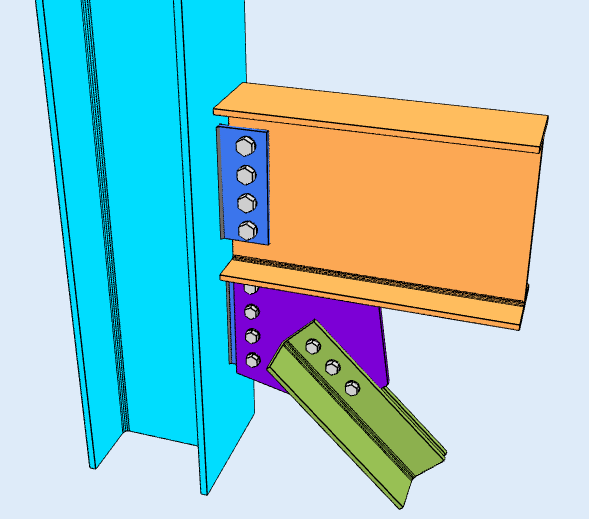
Braced Frames Against Moment Frames
A braced frame resists lateral load axially. The members work in tension and compression, so they stay light, and the connections are mostly bolted shear and bearing work that a fabricator can produce without special procedures. A moment frame resists the same load in flexure, which needs heavier members and connections stiff enough to transfer moment, often with complete joint penetration welds at the flanges. For the same drift limit, the braced frame is usually the cheaper structure.
What the braced frame costs is the bay itself. A diagonal running corner to corner blocks that bay for doors, glazing and services, and the architect has to plan around it. A moment frame leaves the bay clear, which is why it survives in frontages and open floor plates despite costing more. Bracing saves steel; it constrains the layout rather than freeing it.
Where a full diagonal will not fit, the usual answers are a renfort à chevrons, which frees the centre of the bay for an opening, ou un genouillère, which sits in the corner.
The module designs these connections to AISC 360-16. Seismic force-resisting detailing, the ductility and capacity-design rules in AISC 341, is not covered. If the brace is part of a seismic force-resisting system, the demands you enter have to come from that assessment.
Designing a Vertical Brace Connection in SkyCiv
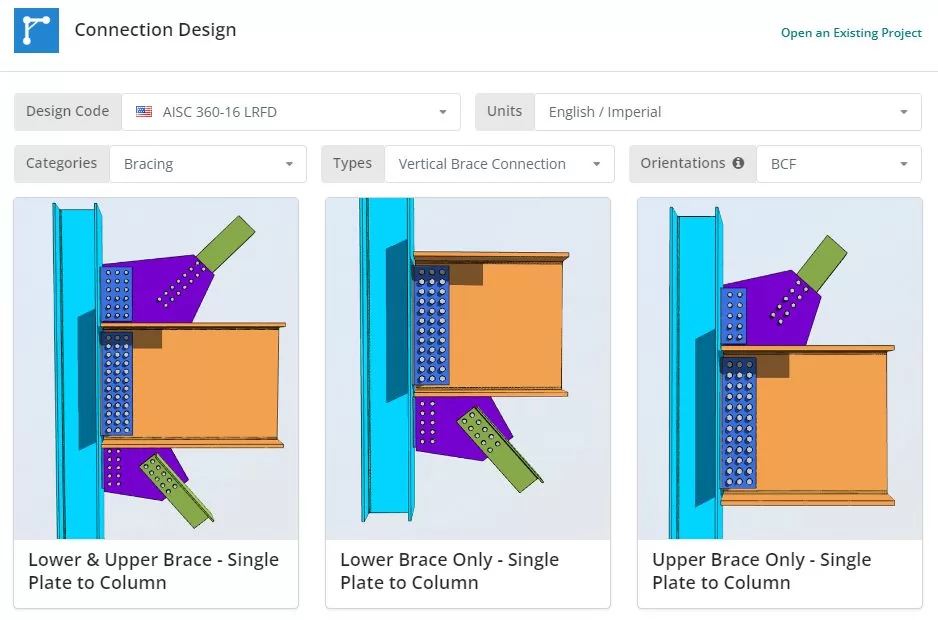
Le code de conception peut être AISC 360-16 ASD ou LRFD, et unités anglais/impérial ou SI/métrique. Le contreventement est disponible sous AISC uniquement; it is not offered under AS 4100.
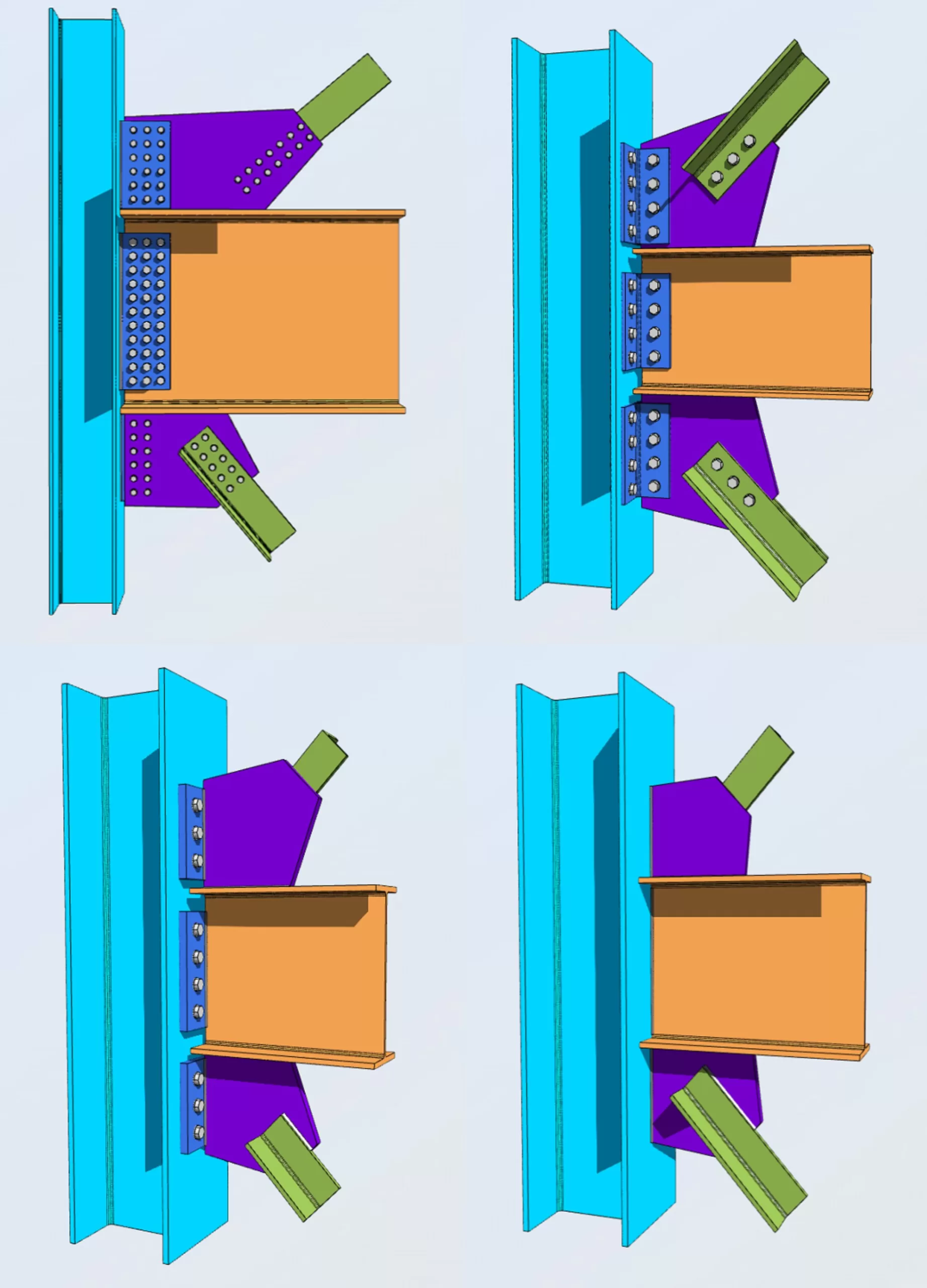
Click any tile to start. There are four connections to the column, plaque unique, double angle, plaque d'extrémité and directly welded, and each comes in a lower brace only, upper brace only, or lower and upper variant. The choice sets both the beam to column connection and the gusset to column connection. Each configuration can frame to the column flange or the column web.
Détails Onglet
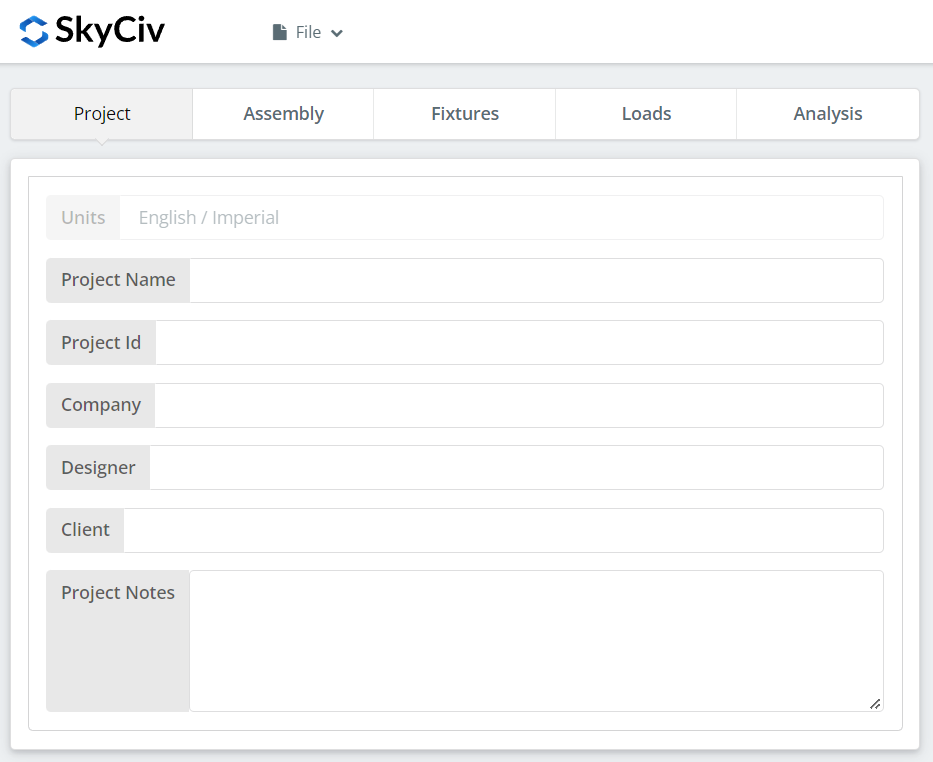
Enregistrez les détails du projet ici. Rien de tout cela ne change les calculs, mais cela se reflète dans le rapport.
Onglet Assemblage
The tabs under Assembly are the Column, the Beam, the Brace or Braces, et la connexion, which holds the gusset plate and any angle. A configuration with both an upper and a lower brace has a tab for each, so the count is four or five depending on the tile you picked.
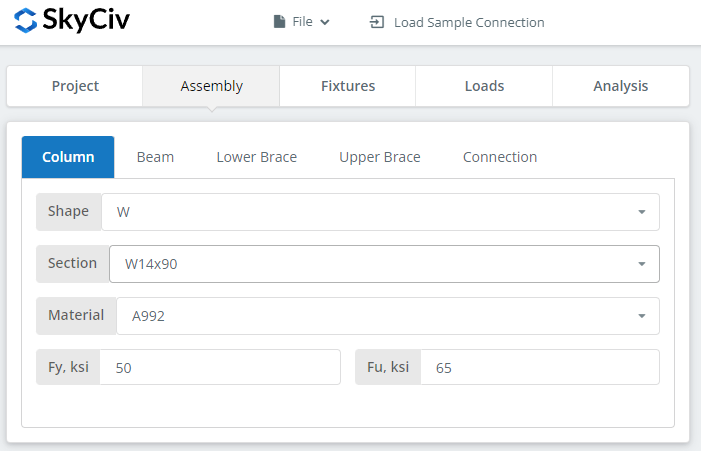
Onglet Colonne
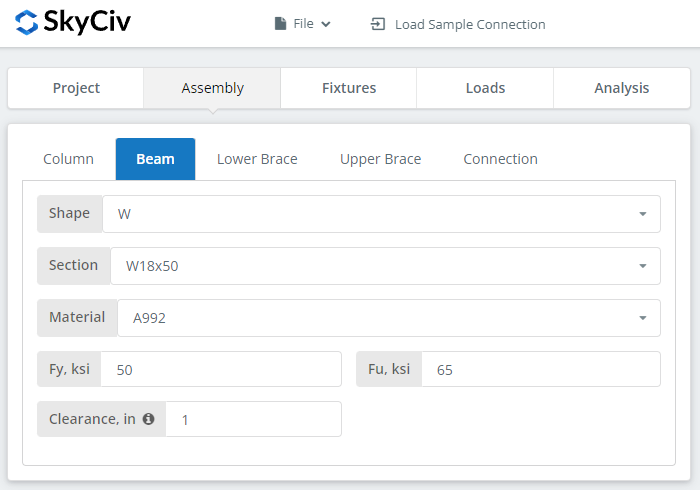
Onglet Faisceau
Onglet de renfort inférieur ou supérieur
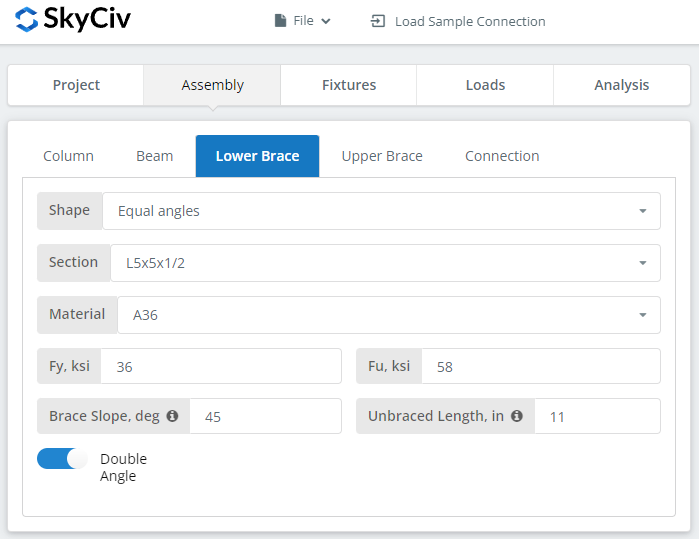
L'accolade peut être un seul angle, un double angle, un HSS carré ou rectangulaire, ou une section WT. The shape drives how the brace meets the gusset. An angle connects through one leg, which puts the load off the brace centreline and brings shear lag into the net section check. An HSS is normally slotted over the plate and welded each side, which keeps the load concentric but needs the slot end checked.
The brace angle matters as much as the section. It sets how the brace force splits into the horizontal and vertical components that the gusset has to deliver, so a shallow brace drives the beam interface and a steep one drives the column interface.
Onglet Connexion
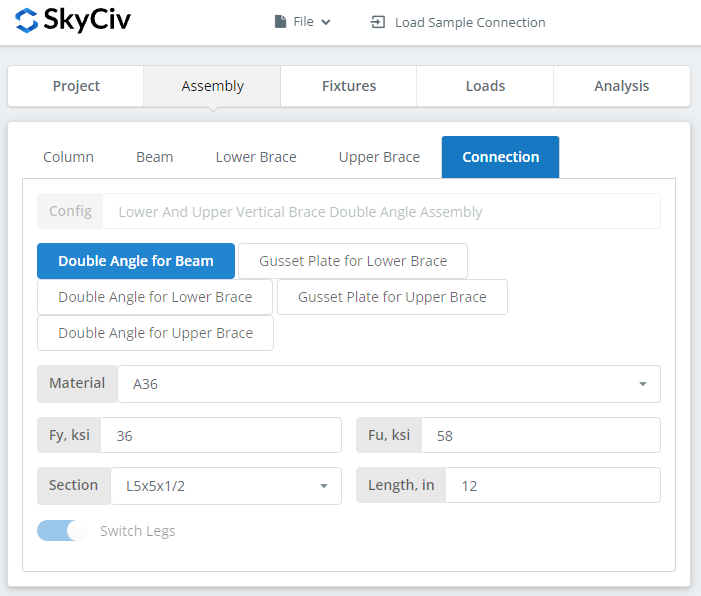
Set the gusset plate and angle properties here. For this example we selected the “Renfort inférieur et supérieur – Double angle vers la colonne” tuile.
The gusset has to be deep enough to develop the brace connection and still reach both the beam and the column, alors surveillez le moteur de rendu 3D pendant que vous le dimensionnez. Its proportions are not free: the Uniform Force Method sets the interface forces from the gusset geometry, so changing the plate dimensions changes the load split, not just the capacity.
Onglet Calendrier
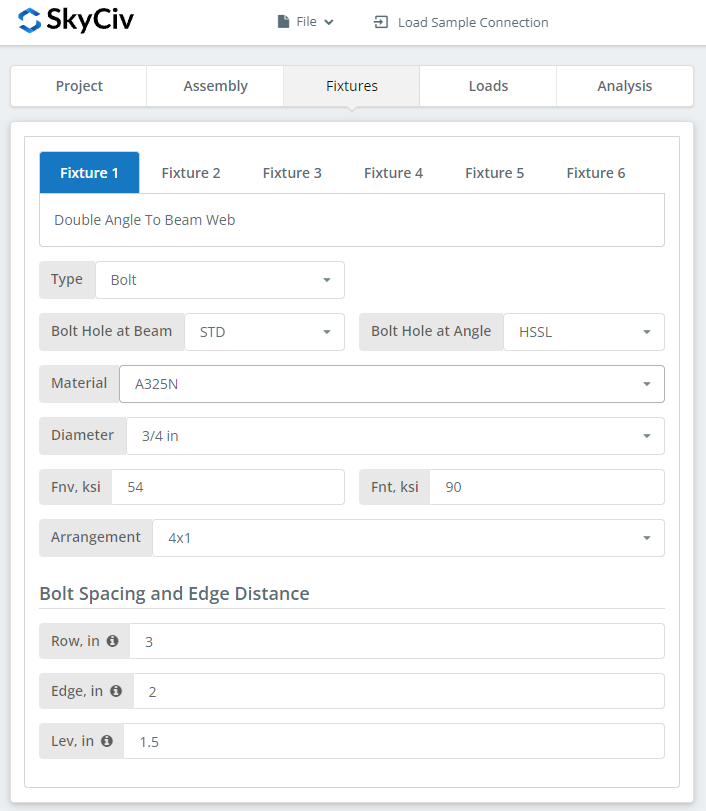
Four interfaces are set here: poutre à colonne, brace to gusset, gusset to beam, and gusset to column. Chacun peut être boulonné ou soudé, and each is checked separately.
Where an interface is bolted, les qualités de boulons sont A307, A325, A490 ou personnalisé. A325 et A490 sont des qualités conformes à la norme ASTM F3125, qui a consolidé les anciennes spécifications autonomes. Où il est soudé, spécifier le matériau de soudure, ou "Personnalisé’ avec votre propre Fnw, et la taille de la soudure.
Pour en savoir plus côté fixations, voir la documentation sur boulons et soudures.
Onglet Charges
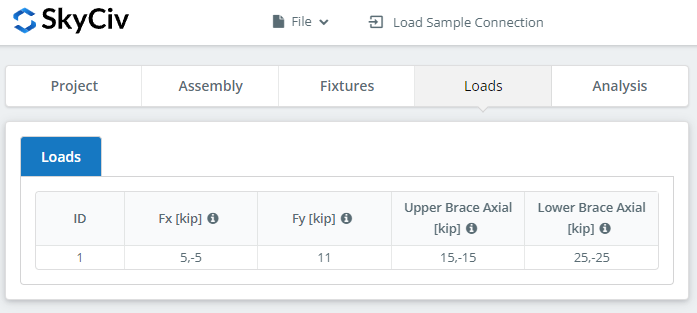
Enter the brace loads and the beam reaction here. Survolez les info-bulles pour connaître la convention de signe et la direction de chacun.
Faites correspondre les charges à la méthode de conception que vous avez choisie au départ. LRFD prend des charges pondérées par rapport à la résistance de conception; ASD supporte les charges de service par rapport à la résistance autorisée. Le logiciel ne peut pas savoir ce que vous avez tapé. Check the brace in compression as well as tension, because the compression case governs the gusset buckling check and often the plate thickness with it.
Onglet Résultats
Cliquez sur “Exécuter des vérifications de conception”. Tout ce qui manque dans les onglets précédents est signalé ici plutôt que par défaut..
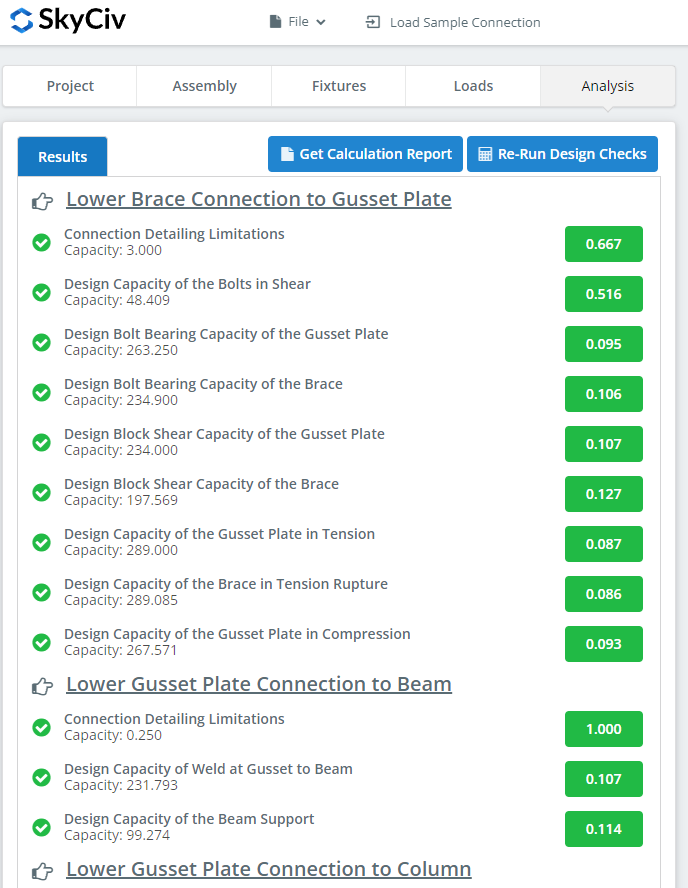
Le résumé montre si la connexion a réussi, avec un taux d'utilisation pour chaque chèque. Across the four interfaces that covers gusset buckling and tension, cisaillement de bloc, cisaillement des boulons, bearing and tearout, prying, capacité de soudure, shear and moment interaction, and the detailing limits on plate thickness and edge distance.
S'il a échoué, modifiez les entrées dans les onglets précédents et cliquez sur “Réexécuter les vérifications de conception”. Quand ça passe, survoler “rapport” et choisissez “Rapport sommaire” ou “Rapport complet”.
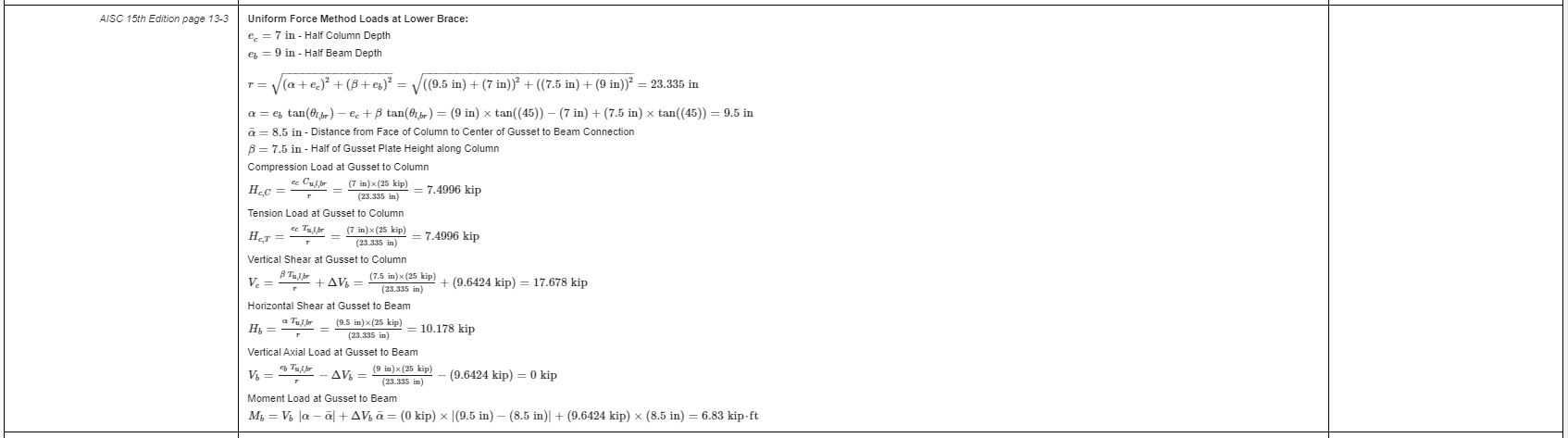
C'est un extrait du rapport complet. Chaque contrôle porte sa référence au manuel ou à la spécification AISC, et le fonctionnement suit l'ordre utilisé par la spécification, afin qu'un ingénieur réviseur puisse le lire ligne par ligne au lieu de procéder à une ingénierie inverse d'un nombre.
IciIl s'agit d'une copie PDF du rapport de calcul détaillé complet.
Essayez-le vous-même
Pick the vertical brace, entrez votre corset, gousset et charges, et voir chaque chèque avec sa référence de code. Il s'exécute dans le navigateur, avec rien à installer.
Voir aussi le vertical bracing connection calculator, et la renfort à chevrons et genouillère calculateurs pour les autres configurations de contreventement.
