
Çelik bağlantı tasarımında, cıvatalar genellikle belirli bir yüke direnmek için tek bir gövde gibi davranan bir cıvata grubu olarak tasarlanır. Bir cıvata grubunun gücü normalde en kritik cıvatanın kontrol gücü tarafından belirlenir.. Doğrudan yükler, toplam cıvata sayısı arasında dağıtılır, yükün dışmerkezliğinden dolayı indüklenen moment, cıvata grubunun eylemsizlik momentine ve ağırlık merkezine olan uzaklığa bağlı olarak dağıtılır.. Buna elastik analiz denir. Yük dağılımına ilişkin basitleştirilmiş ve ihtiyatlı varsayımlar nedeniyle, genellikle aşırı tasarlanmış cıvatalı bağlantılar verir.
Değer mühendisliği ve ekonomik tasarımlardan bahsederken, esnek olmayan yaklaşım çoğu imalatçı tarafından tercih edilmektedir. Aynı büyüklükteki yük için daha az cıvata gerekir. Esnek olmayan yaklaşımı yapmak için, anlık dönme merkezi (ICOR) yinelemeleri kullanan yöntem en iyi yoldur.
Bu makalede, Bir kuvvetin nasıl hesaplanacağını gösteriyoruz civatalı bağlantı ICOR yöntemini kullanarak. Cıvata başına reaksiyonlar Denklem kullanılarak hesaplanır (7-1) sayfada 7-7 AISC 15. Baskı Kılavuzunun. Bu daha sonra cıvata grubunun anlık merkezinin varsayılan konumunun doğru olup olmadığını kontrol etmek için kullanılır.. En sonunda, doğru IC konumuna sahip olduğumuzda, gücünü belirlemek için cıvata grubu katsayısı C'yi hesaplıyoruz.
Elle çalıştı, ICOR yöntemi uzun bir süreçtir, çünkü Anlık Merkezi bulmak (IC) deneme yanılmadır. Bir bilgisayar çözücüyle bir cıvata grubunun IC'si bunun yerine programlanmış yinelemelerle bulunur. NS SkyCiv Cıvata Grubu Çözücü IC konumunu ve cıvata grubu katsayısını saniyeler içinde belirlemek için hızlı bir yineleme yöntemi kullanır. Hem AISC hem de AS tarafından kullanılır. 4100 bağlantı modülleri.
Aşağıdaki çalışılmış örnek, çözücünün gerçekleştirdiği hesaplamanın aynısıdır, ne yaptığını takip edebilmeniz için uzun el gösterilir.
Cıvata Grubu Özelliklerini Alma
Eksantrik düşey kesme yüküyle yüklenen dört cıvatadan oluşan bir cıvata grubunun basit bir analiziyle başlayalım. 10 kips . Yükün x ekseni boyunca dışmerkezliği 4 Cıvata grubunun sağında inç. Dikeyden açı sıfırdır ve y ekseni boyunca dışmerkezlik sıfırdır.
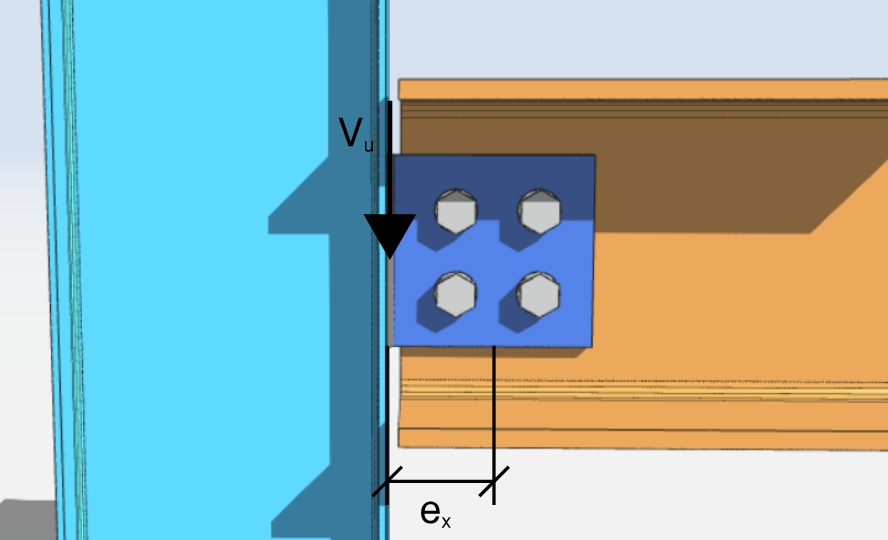
[math] V_{u} = 10\,kips [math]
[math] \theta = 0\,deg [math]
[math] e_{x} = 4\,in [math]
[math] e_{y} = 0\,in [math]
Yapılacak ilk şey gruptaki tüm cıvataların koordinatlarını almaktır.. Görsel kılavuzlar ve tablolar şiddetle tavsiye edilir.
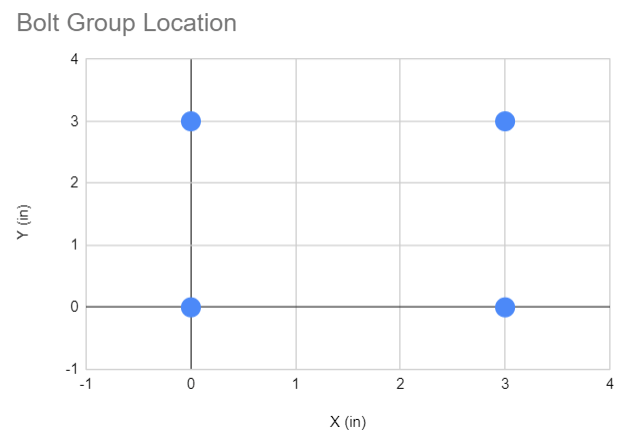
| Mağaza kimliği | X (içinde) | Y (içinde) |
| 1 | 0 | 0 |
| 2 | 0 | 3 |
| 3 | 3 | 0 |
| 4 | 3 | 3 |
Cıvata grubunun ağırlık merkezini x ve y eksenleri boyunca elde etmek için, aşağıdaki formüle ihtiyacımız var.
İzin Vermek [mathin] n [mathin] = toplam cıvata sayısı
[math] X_{CG} = \frac{\sum X}{n} [math]
[math] Y_{CG} = \frac{\sum Y}{n} [math]
Sonra, bizim çözümümüz:
[math] X_{CG} = \frac{\sum X}{n} = \frac{0\,in + 0\,in + 3\,in + 3\,in}{4} = 1.5\,in [math]
[math] Y_{CG} = \frac{\sum Y}{n} = \frac{0\,in + 3\,in + 0\,in + 3\,in}{4} = 1.5\,in [math]
IC'nin yerini varsayın.
merkezini aldıktan sonra, anlık merkezin yerini varsayıyoruz (IC). İlk deneme olarak, IC'nin cıvata grubunun geometrik merkezinde oturduğunu varsayabiliriz.
Yani, farz etmek
[math] X_{IC} = X_{CG} = 1.5\,in [math]
[math] Y_{IC} = Y_{CG} = 1.5\,in [math]
Daha sonra her cıvatanın IC'den yer değiştirmesini tablolaştırıyoruz. Önce x boyunca mesafeyi ve y boyunca mesafeyi alın, o zaman sonuçta ortaya çıkan yer değiştirme.
| Mağaza kimliği | cx (içinde) | cy (içinde) | c (içinde) |
| 1 | -1.5 | -1.5 | 2.121 |
| 2 | -1.5 | 1.5 | 2.121 |
| 3 | 1.5 | -1.5 | 2.121 |
| 4 | 1.5 | 1.5 | 2.121 |
Nerede,
[math] c_{x} = X_{i} – X_{IC} [math]
[math] c_{y} = Y_{i} – Y_{IC} [math]
[math] c = \sqrt{ {\left( c_{x} \right)}^{2} + {\left( c_{y} \right)}^{2} } [math]
Cıvata Hayır için. 1, bizim çözümümüz
[math] c_{x} = 0\,in – 1.5\,in = -1.5\,in [math]
[math] c_{y} = 0\,in – 1.5\,in = -1.5\,in [math]
[math] c = \sqrt{ {\left( -1.5\,in \right)}^{2} + {\left( -1.5\,in \right)}^{2} } = 2.121\,in [math]
IC'den cıvata wrt mesafesi başına deformasyonu hesaplayın
Varsayılan IC konumundan cıvata mesafelerini aldıktan sonra, her cıvatanın deformasyonunu mesafesinin bir fonksiyonu olarak hesaplıyoruz.
Cıvata başına maksimum deformasyon, [mathin] \Delta_{max} = 0.34\,in [mathin], AISC sayfasında açıklandığı gibi bir ASTM cıvatası için deneysel verilere dayanmaktadır 7-8. Doğrusal orana göre, ve ayar [mathin] \Delta_{max} = 0.34\,in [mathin], tek bir cıvatanın deformasyonunu maksimum mesafedeki payına göre hesaplayabiliriz [mathin] c_{max} [mathin]. elde etmek için denklem [mathin] \Delta [mathin] = olarak tanımlanan üst veya alt çatının karakteristik uzunluğu.
[math] \Delta_{1} = 0.34\,in \times \left( \frac{c}{c_{max}} \right) [math]
Cıvata Hayır için. 1, deformasyon
[math] \Delta_{1} = 0.34\,in \times \left( \frac{2.121\,in}{2.121\,in} \right) = 0.34\,in [math]
Çünkü IC'nin merkezde olduğu varsayıldı, dört cıvatanın tümü ondan aynı uzaklıkta, yani dördü de aynı deformasyona ulaşıyor. Hesaplanan deformasyonlar aşağıda tablo halinde verilmiştir..
| Mağaza kimliği | [mathin] \Delta [mathin] (içinde) |
| 1 | 0.34 |
| 2 | 0.34 |
| 3 | 0.34 |
| 4 | 0.34 |
Cıvata başına reaksiyonları alın
Cıvata başına deformasyona sahip olduğumuzda, AISC 15. Ed'i kullanıyoruz. Eşitlik (7-1) cıvata başına reaksiyonları almak için.
[math] R = R_{ult} \left( 1 – e^{-10\Delta} \right)^{0.55} [math]
NS [mathin] R_{ult} [mathin] denklemde bir cıvata üzerindeki varsayılan nihai yük, cıvata kesme kuvveti olarak ayarlayabileceğimiz.
[math] R_{ult} = \phi R_{n} [math]
Örneğimiz için, cıvata kesme mukavemetini kullanıyoruz [mathin] 24.4\,kip [mathin]. Başka bir değer eşit derecede geçerlidir, çünkü cıvata grubu katsayısını hesapladığımızda bu iptal olur [mathin] C [mathin] daha sonra.
Cıvata Hayır için. 1, hesaplanan reaksiyon
[math] R = R_{ult} \left( 1 – e^{-10\Delta} \right)^{0.55} [math]
[math] R = 24.4\,kip \left( 1 – e^{-10 \times \left( 0.34\,in \right)} \right)^{0.55} [math]
[math] R = 23.949\,kip [math]
Cıvataların geri kalanı için, hesaplanan reaksiyonlar aşağıdaki gibidir. Cıvata reaksiyonunun bileşenleri [mathin] R [mathin] x ve y boyunca da gösterilir.
| Mağaza kimliği | R (kip) | Rx (kip) | Ry (kip) |
| 1 | 23.949 | 16.937 | -16.937 |
| 2 | 23.949 | -16.937 | -16.937 |
| 3 | 23.949 | 16.937 | 16.937 |
| 4 | 23.949 | -16.937 | 16.937 |
| ⅀Rx = 0 | ⅀Ry = 0 |
Her cıvata kuvveti, o cıvatayı IC'ye birleştiren çizgiye dik olarak etki eder, iki bileşeninin işaretini belirleyen şey budur. Cıvata No.1 için, x ve y bileşenlerinin çözümleri aşağıda gösterilmiştir.
[math] R_{x} = -R \left( \frac{c_{y}}{c} \right) = -23.949 \times \left( \frac{-1.5\,in}{2.121\,in} \right) = 16.937\,kip [math]
[math] R_{y} = R \left( \frac{c_{x}}{c} \right) = 23.949 \times \left( \frac{-1.5\,in}{2.121\,in} \right) = -16.937\,kip [math]
Daha sonra her cıvata reaksiyonunun IC hakkında ürettiği ana ihtiyacımız var.. Bileşenleri kullanın [mathin] R_{x} [mathin] ve [mathin] R_{y} [mathin] kaldıraç kolları ile [mathin] c_{y} [mathin] ve [mathin] c_{x} [mathin].
[math] M_{r} = -R_{x} c_{y} + R_{y} c_{x} [math]
Cıvata No.1 için, IC ile ilgili moment reaksiyonu
[math] M_{r} = -16.937\,kip \times \left( -1.5\,in \right) + \left( -16.937\,kip \right) \times \left( -1.5\,in \right) [math]
[math] M_{r} = 50.811\,kip\text{-}in [math]
Çek olarak, aynı an [mathin] R \times c = 23.949 \times 2.121 = 50.8\,kip\text{-}in [mathin], Çünkü kuvvet yarıçapa diktir.
Buradaki her cıvata, varsayılan IC'den aynı uzaklıkta duruyor ve aynı kuvveti taşıyor, yani her cıvata aynı anda geri döner. Moment reaksiyonları aşağıda tablo halinde verilmiştir..
| Mağaza kimliği | Bay (tavuklu) |
| 1 | 50.811 |
| 2 | 50.811 |
| 3 | 50.811 |
| 4 | 50.811 |
| ⅀Bay = 203.244 |
IC konumunu doğrulama
Artık cıvata başına kesme ve moment reaksiyonlarına sahip olduğumuza göre, bunları bu cıvata grubunun dayandığı yükü belirlemek için kullanırız. x boyunca tüm reaksiyonların toplamının ve y boyunca tüm reaksiyonların toplamının sonucunu alın.
Bir önceki bölümden, bunu hesapladık
[math] \sum R_{x} = 0\,kip [math]
ve
[math] \sum R_{y} = 0\,kip [math]
Yani,
[math] P_{u} = \sqrt{ {\left( \sum R_{x} \right)}^{2} + {\left( \sum R_{y} \right)}^{2} } = 0\,kip [math]
Ortaya çıkan yük [mathin] P_{u} = 0\,kip [mathin]. Kendi ağırlık merkezi etrafında dönen bir cıvata grubu saf moment taşır ve net kuvvet taşımaz, dolayısıyla uygulanan kesme kuvvetine karşı koyamaz. Bu zaten bize ilk varsayılan IC konumunun yanlış olduğunu söylüyor, ve burada durabiliriz. Bu tartışmanın amacı doğrultusunda, kalan adımlarla devam edeceğiz.
[math] P_{ux} = -P_{u}\sin\left( \theta \right) = 0\,kip [math]
[math] P_{uy} = -P_{u}\cos\left( \theta \right) = 0\,kip [math]
[math] M_{u} = -P_{ux}\left( Y_{CG} + e_{y} – Y_{IC} \right) + P_{uy} \left( X_{CG} + e_{x} – X_{IC} \right) = 0\,kip\text{-}in [math]
Dan beri,
[math] P_{ux} \neq \sum R_{x} [math]
[math] P_{uy} \neq \sum R_{y} [math]
[math] M_{u} \neq \sum M_{r} [math]
Cıvata reaksiyonlarının toplamı şu şekilde iken uygulanan moment sıfırdır: 203.244 tavuklu, yani denge sağlanmadı. IC'nin varsayılan konumu. yanlış, ve bir sonraki varsayılan konuma geçiyoruz.
SkyCiv, bağlantı tasarım modüllerinde yerleşik cıvata grubu hesaplamasına sahiptir. Bağlantı tasarımı yazılımımızı denemek ister misiniz??
İkinci Yineleme
İkinci tekrarımız için, IC'yi varsayalım. aşağıda gösterilen koordinatlarda bulunur. Çünkü yük grubun sağına uygulanan aşağı doğru bir kesme kuvvetidir., gerçek IC merkezin solunda yer alır, yani dava bu yönde ilerliyor.
Farz etmek
[math] X_{IC} = 0.062\,in [math]
[math] Y_{IC} = 1.5\,in [math]
Daha sonra ilk yinelemeden itibaren adımları tekrarlayın.. Aşağıdaki tablo koordinatları göstermektedir, her bir cıvatanın varsayılan IC'den uzaklığı, ve bu mesafeye göre karşılık gelen deformasyon.
| Mağaza kimliği | X (içinde) | Y (içinde) | cx (içinde) | cy (içinde) | c (içinde) | [mathin] \Delta [mathin] (içinde) |
| 1 | 0 | 0 | -0.062 | -1.5 | 1.501 | 0.155 |
| 2 | 0 | 3 | -0.062 | 1.5 | 1.501 | 0.155 |
| 3 | 3 | 0 | 2.938 | -1.5 | 3.299 | 0.34 |
| 4 | 3 | 3 | 2.938 | 1.5 | 3.299 | 0.34 |
Bu sefer cıvataların hepsi IC'den aynı uzaklıkta değil, yani sadece uzaktaki çift ulaşır 0.34 sınırda. Yakın çift daha az deforme olur ve bu nedenle daha az yük taşır.
Hesaplanan ağırlık merkezinin cıvata grubu değişmedi, cıvata koordinatları hareket etmediğinden.
[math] X_{CG} = 1.5\,in [math]
[math] Y_{CG} = 1.5\,in [math]
Daha sonra x boyunca reaksiyonları hesaplıyoruz, y boyunca reaksiyonlar, ve karşılık gelen an. Değerler aşağıda tablolaştırılmıştır.
| Mağaza kimliği | R (kip) | Rx (kip) | Ry (kip) | Bay (tavuklu) |
| 1 | 21.4 | 21.4 | -0.9 | 32.1 |
| 2 | 21.4 | -21.4 | -0.9 | 32.1 |
| 3 | 23.9 | 10.9 | 21.3 | 79.0 |
| 4 | 23.9 | -10.9 | 21.3 | 79.0 |
| ⅀Rx = 0 | ⅀Ry = 41 | ⅀Bay = 222 |
Sonraki, x ve y boyunca tüm reaksiyonların sonuçtaki yükünü belirleriz.
[math] P_{u} = \sqrt{ {\left( \sum R_{x} \right)}^{2} + {\left( \sum R_{y} \right)}^{2} } [math]
[math] P_{u} = \sqrt{ {\left( 0\,kip \right)}^{2} + {\left( 40.703\,kip \right)}^{2} } [math]
[math] P_{u} = 40.703\,kip [math]
Daha sonra ortaya çıkan yükün bileşenleri, verilenlere dayanarak [mathin] \theta [mathin], aşağıda gösterilmiştir.
[math] P_{ux} = -P_{u}\sin\left( \theta \right) = -41\,kip \times \sin\left( 0\,deg \right) = 0\,kip [math]
[math] P_{uy} = -P_{u}\cos\left( \theta \right) = -41\,kip \times \cos\left( 0\,deg \right) = -41\,kip [math]
Daha sonra bu bileşenleri, varsayılan IC ile ilgili moment yükünü çözmek için kullanırız..
[math] M_{u} = -P_{ux} \left( Y_{CG} + e_{y} – Y_{IC} \right) + P_{uy} \left( X_{CG} + e_{x} – X_{IC} \right) [math]
[math] M_{u} = -0\,kip \left( 1.5\,in + 0\,in – 1.5\,in \right) + \left( -41\,kip \right) \left( 1.5\,in + 4\,in – 0.062\,in \right) [math]
[math] M_{u} = -222\,kip\text{-}in [math]
Sonraki, hesaplananları karşılaştıralım [mathin] P_{ux} [mathin], [mathin] P_{uy} [mathin] ve [mathin] M_{u} [mathin] cıvata grubunun reaksiyonlarına karşı.
[math] P_{ux} \approx -\sum R_{x} [math]
[math] P_{uy} \approx -\sum R_{y} [math]
[math] M_{u} \approx -\sum M_{r} [math]
Sayısal olarak yani 0 aykırı 0, -41 karşı çıkmak -41 kip, ve -222 karşı vuruş -222 tavuklu. Sol taraf, entegre devrenin varsayılan konumunu alabileceğimiz kadar sağ tarafa yeterince yakındır.. doğru olarak.
Uygulamada çözücü, bu üç artık belirli bir tolerans aralığına düşene kadar deneme IC'sini hareket ettirmeye devam eder., görsel bir eşleşmeyi durdurmak yerine.
C katsayısı için çözme
I.C bir kez. konum belirlenir, aşağıdaki formülle cıvata grubu katsayısı C'yi bulabiliriz.
[math] C = \frac{P_{u}}{\phi R_{n}} = \frac{40.703\,kip}{24.4\,kip} = 1.668 [math]
Katsayı, grubun taşıdığı anlamına gelir 1.668 tek bir cıvatanın kuvvetinin katı. Bunun mevcut dört cıvatanın oldukça altında olduğuna dikkat edin., çünkü eksantriklik gruba nominal kapasitesinin büyük bir kısmına mal oluyor. Aynı zamanda seçimin yapıldığı yer [mathin] R_{ult} [mathin] iptal eder, bu nedenle başlangıçta herhangi bir tutarlı değer kullanılabilir.
Ücretsiz Cıvata Grubu Hesaplayıcı
Bağlantı tasarımı modülünde cıvatalı bağlantılarımızı bu yaklaşımla nasıl tasarladığımızı görün. Cıvatalı bir bağlantı seçin, cıvata düzenini ve eksantrikliği ayarlayın, ve rapor, tüm diğer kontrollerle birlikte IC konumunu ve C katsayısını verir. Tarayıcıda çalışır, kurulacak hiçbir şey olmadan.
Daha fazla işlevsellik için, dosyalarınızı kaydetme ve yeniden yükleme dahil, ücretsiz bir hesaba kaydolun.
