
Eksantrik Temel Nedir?
Bazı durumlarda, sütunlar, temelin merkezine eksantrik uzanır. Footings that are not concentrically loaded are known as "Eccentric Footings". Ek olarak, when footings are subjected to an axial load "P" and a bending moment "M" or a lateral force "H", the footing experiences an unbalanced stress distribution along its base. The same effect is produced by an axial load acting at an eccentricity "e" temelin merkezinden.
Bir an, a lateral force acting at a height h above the base of the footing, or a column offset from the center of the footing can all be converted to an equivalent eccentricity of the axial load:
[math] e = \frac{M + H \, h}{P} [math]
Sonuç olarak, the total combined stress at the base of the footing is equal to the sum of the stress due to the axial load over the footing area (P/A) and the bending moment over the section modulus "S" of the footing (HANIM). For a rectangular footing of length L (in the direction of the eccentricity) and width B:
[math] q = \frac{P}{A} \pm \frac{M}{S} = \frac{P}{B \, L} \left( 1 \pm \frac{6 \, e}{L} \right) \quad \text{with} \quad A = B \, L, \quad S = \frac{B \, L^{2}}{6} [math]
Basıncın lineer olarak değiştiği varsayılır, Şekilde gösterildiği gibi 1. Bu dağılım, eksenel yükün temel alanının kern içine düştüğü durumlarda geçerlidir., yani, where the eccentricity "e" is not more than L/6. The following equations for soil pressure (q) can be used to determine the minimum and maximum pressures at the extreme edges of the footing (1).
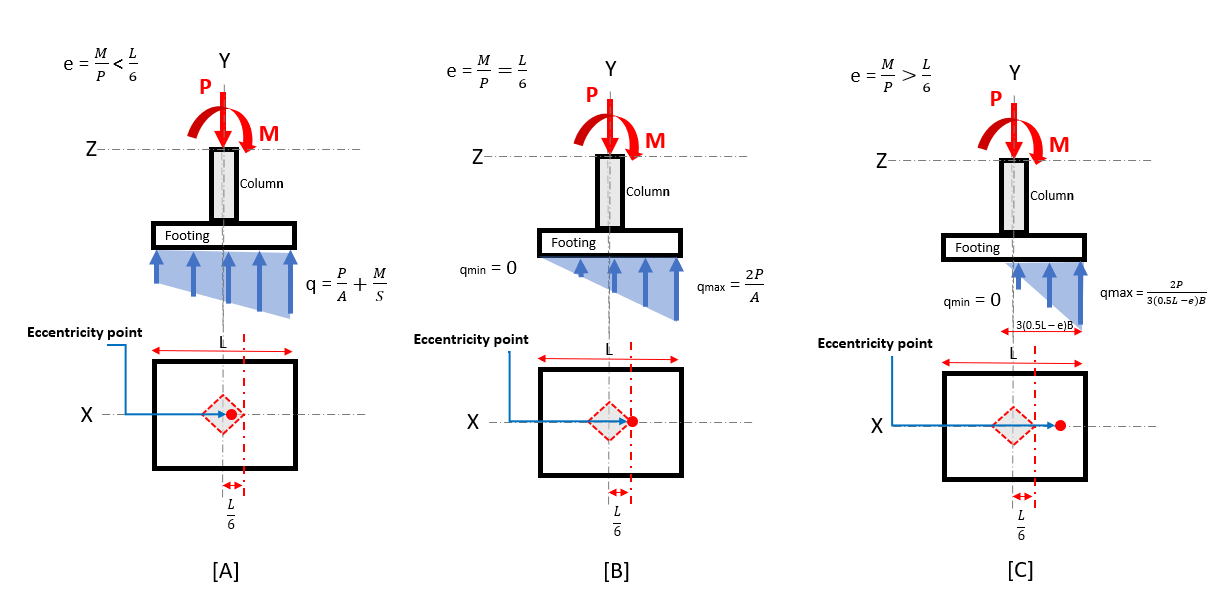
Figür 1. Eksantrik temelin zemin basıncı dağılımı
(a) çekirdek sınırı içinde eksantrik (b) eccentric at the kern boundary (c) çekirdek sınırı dışında eksantrik
Figure 1A depicts the footing when the eccentricity is located inside the kern boundary (e < L/6). The entire footing is in compression and the soil pressure has a trapezoidal distribution where:
[math] q_{max} = \frac{P}{A} + \frac{M}{S} \qquad q_{min} = \frac{P}{A} – \frac{M}{S} [math]
Şekil 1B, eksantriklik çekirdek sınırında olduğunda temeli göstermektedir. (e = L/6). The entire footing is still in contact with the soil, but the soil pressure now has a triangular distribution, dropping to zero at the far edge:
[math] q_{max} = \frac{2 \, P}{A} \qquad q_{min} = 0 [math]
Şekil 1C, eksantriklik çekirdek sınırının dışında bulunduğunda temeli gösterir. (e > L/6). The soil cannot resist tension, so part of the footing lifts off the soil and the pressure is only distributed over a contact length of 3(L/2 – e) measured from the most compressed edge. The soil pressure still has a triangular distribution, and the equation P/A + M/S no longer applies. Yerine:
[math] q_{max} = \frac{2 \, P}{3 \, B \left( \frac{L}{2} – e \right)} [math]
When the load is eccentric in both directions (biaxial eccentricity e_x and e_z on a footing of dimensions L_x and L_z), the whole base stays in compression only when the load falls inside the rhombus-shaped kern:
[math] \frac{6 \, e_{x}}{L_{x}} + \frac{6 \, e_{z}}{L_{z}} \leq 1 [math]
Outside of it, only part of the base is in contact with the soil and the pressure at the most loaded corner rises quickly. Konuyla ilgili daha ayrıntılı bir makale için bu bağlantıya bakın toprak basıncı dağılımı.
Eccentric Footings in the SkyCiv Foundation Design Module
SkyCiv’s Foundation Design Module does not use the kern equations above to design the footing. It is integrated with Finite Element Analysis (ÇİRKİN): the footing is meshed into plate elements supported on compression-only soil springs, whose stiffness comes from the Zemin Reaksiyonu Modülü you enter in the soil properties. Because the springs cannot take tension, the part of the footing that would lift off the soil is detected by the analysis itself, so the same model covers loads inside and outside the kern, in one or both directions.
Modeling the eccentricity
Eccentricity enters the model in three ways:
- Sütun yükleri: içinde Column Loads tablo, each load has an axial force P, shears vx ve Vz, ve anlar Mx ve Mz. The axial force is applied as a uniform pressure over the column footprint, and the moments as a linearly varying pressure over it.
- Lateral forces: the shears Vx and Vz are converted into additional moments at the footing, using a lever arm equal to the column Yükseklik plus half of the footing thickness.
- Column position: for isolated footings, NS X-offset ve Z-offset of Sütun (center-to-center distance between the column and the footing, a PRO feature) place the column off the center of the footing. For combined footings, each column is positioned with its X-edge Distance ve Z-offset. The axial load then acts eccentrically on the footing without needing an extra moment.
Loads and moments can be applied in either direction, and their signs are kept, so moments that add to or cancel the effect of a column offset are both handled.
Soil pressure results
The FEA gives the soil pressure at every node of the mesh, which shows the real, non-linear distribution under the flexible footing rather than the linear distribution assumed above.
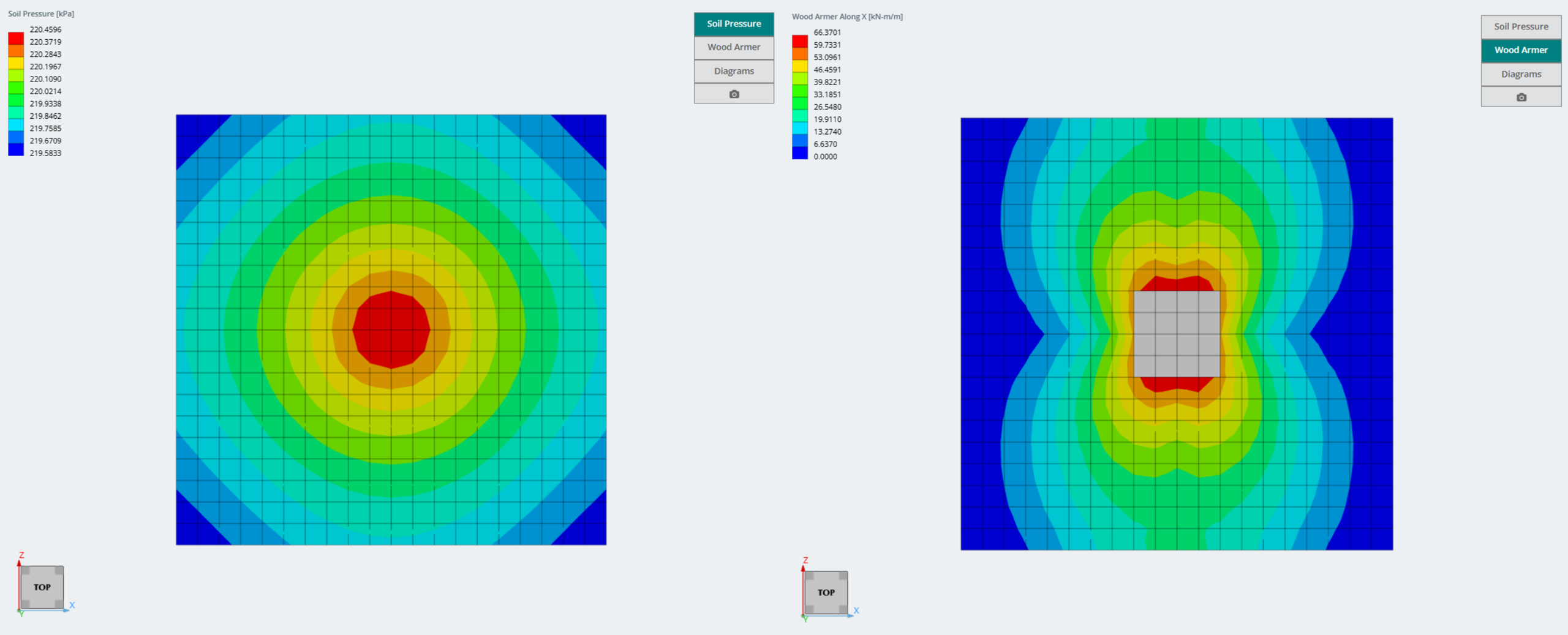
bu Sonlu elemanlar analizi – Zemin Basıncı section of the report shows the service and ultimate soil pressure contours, and a table of the maximum and minimum soil pressures with the (x, ile) coordinates where they occur, measured from the upper left corner of the foundation plan. The results are based on the envelope of the load combinations, or on the service and ultimate loads you enter when Custom Load is turned on.
The maximum service soil pressure is then checked against the İzin Verilen Brüt Zemin Taşıma Kapasitesi. AS için 3600, you can also turn on Perform ULS soil bearing check to compare the maximum ultimate soil pressure against the Ultimate Soil Bearing Capacity multiplied by the geotechnical reduction factor. The overturning, sliding and uplift checks of the report complete the stability checks of an eccentric footing.
Moment demand for flexure
The moments used for the flexural design come from the same FEA results. İçinde Tasarım Ayarları, altında Flexure Check, NS Moment Demand Calculation setting has two options:
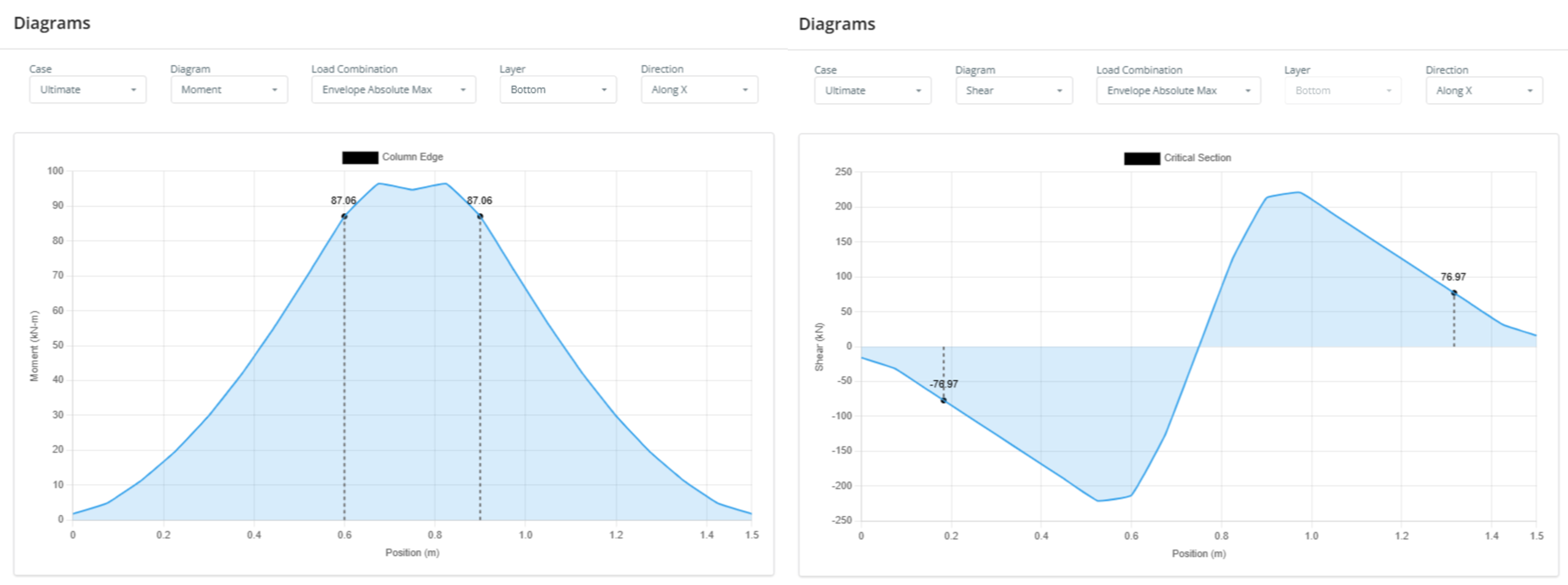
- Strip average method (varsayılan): the footing is divided into strips, and the moments are calculated as if each strip acts as a beam in its direction. Shear and moment diagrams are generated from the FEA results with this method, giving a clearer picture of the internal forces across the footing.
- Peak wood-armer method: uses the maximum Wood-Armer moments of the plates, for a conservative design. It is the default for ACI 318-14.
SkyCiv’in Temel Tasarım yazılımını denemek ister misiniz?? Ücretsiz aracımız kullanıcıların aşağıdaki işlemleri gerçekleştirmesine olanak tanır: beton temel hesaplamaları herhangi bir indirme veya kurulum gerekmeden!
Referanslar
- Betonarme Yapılar: Analiz ve Tasarım, İkinci baskı. McGraw-Hill Profesyonel.
