
Every bolt in a shear connection pushes on the side of its hole. Bolt bearing and tearout are the two ways the plate around that hole can fail: the material can crush and stretch in front of the bolt (consequência), or the bolt can tear a strip of plate out towards the edge or the next hole (arrancar). AISC 360-16 Section J3.10 checks both. This article explains the check, how it combines with bolt shear, and works it with the numbers from a real double plate connection solved in SkyCiv Connection Design.
What are bolt bearing and tearout?
Bearing is the limit on the pressure a bolt can put on the wall of its hole before the hole elongates too much. It depends on the bolt diameter and the thickness and strength of the connected part. Tearout is the limit on the strip of material between the hole and the edge, or between two holes, in the direction of the load: if that strip is short, it shears out before bearing is reached. AISC 360-16 takes the smaller of the two for each bolt, so a bolt near an edge is usually limited by tearout, and a bolt with plenty of material in front of it is limited by bearing.
Bearing and tearout tend to govern when the connected part is thin compared with the bolt, for example a light beam web or a thin shear tab with large bolts, and when the edge distance in the direction of the load is short. In double shear connections they often govern over bolt shear, because double shear doubles the bolt strength but each ply still has to carry its share through bearing.
O AISC 360-16 equações (J3.10)
For a bolt in a standard, oversized or short-slotted hole, where deformation at the bolt hole at service load is a design consideration:
[math] R_{n} = 2.4 d_{b} t F_{u} \quad \text{(bearing, Eq. J3-6a)} [math]
[math] R_{n} = 1.2 l_{c} t F_{u} \quad \text{(tearout, Eq. J3-6c)} [math]
SkyCiv writes the two together for each bolt as:
[math] \phi r_{n} = \phi \min\left( 1.2 l_{c},\ 2.4 d_{b} \right) t F_{u} [math]
onde:
- [mathin] \phi = 0.75 [mathin] is the resistance factor (LRFD)
- [mathin] d_{b} [mathin] is the bolt diameter
- [mathin] t [mathin] is the thickness of the connected part, e [mathin] F_{u} [mathin] its tensile stress
- [mathin] l_{c} [mathin] is the clear distance, na direção da força, from the edge of the hole to the edge of the part or to the edge of the next hole
For an edge bolt [mathin] l_{c1} = L_{ev} – d_{h}/2 [mathin], and for the other bolts [mathin] l_{c2} = s_{r} – d_{h} [mathin], onde [mathin] L_{ev} [mathin] is the edge distance, [mathin] s_{r} [mathin] the bolt pitch and [mathin] d_{h} [mathin] the hole size. Tearout governs whenever [mathin] 1.2 l_{c} [mathin] for menor que [mathin] 2.4 d_{b} [mathin].
For an eccentric bolt group, SkyCiv scales the sum of the bolt strengths by [mathin] C/n_{r} [mathin], onde [mathin] C [mathin] is the bolt group coefficient from the instantaneous center of rotation method and [mathin] n_{r} [mathin] the number of bolts in the line. Ver Cálculo do grupo de parafusos usando ICOR for how [mathin] C [mathin] is found.
Worked example: a double plate on a light beam web
This example is Checks 5 para 7 do double plate connection design example: a coped W12x14 beam ([mathin] t_{wb} = 0.2\ \text{in} [mathin], [mathin] F_{ub} = 65\ \text{ksi} [mathin]) between two 3/8 em placas A36 ([mathin] 2t_{p} = 0.75\ \text{in} [mathin], [mathin] F_{up} = 58\ \text{ksi} [mathin]), with two 3/4 in A325-N bolts in double shear in standard holes. The shear is [mathin] V_{u} = 12\ \text{kip} [mathin] e o coeficiente do grupo de parafusos é [mathin] C = 1.18 [mathin]. It was solved again on the current release and the numbers are the same as on the published example.
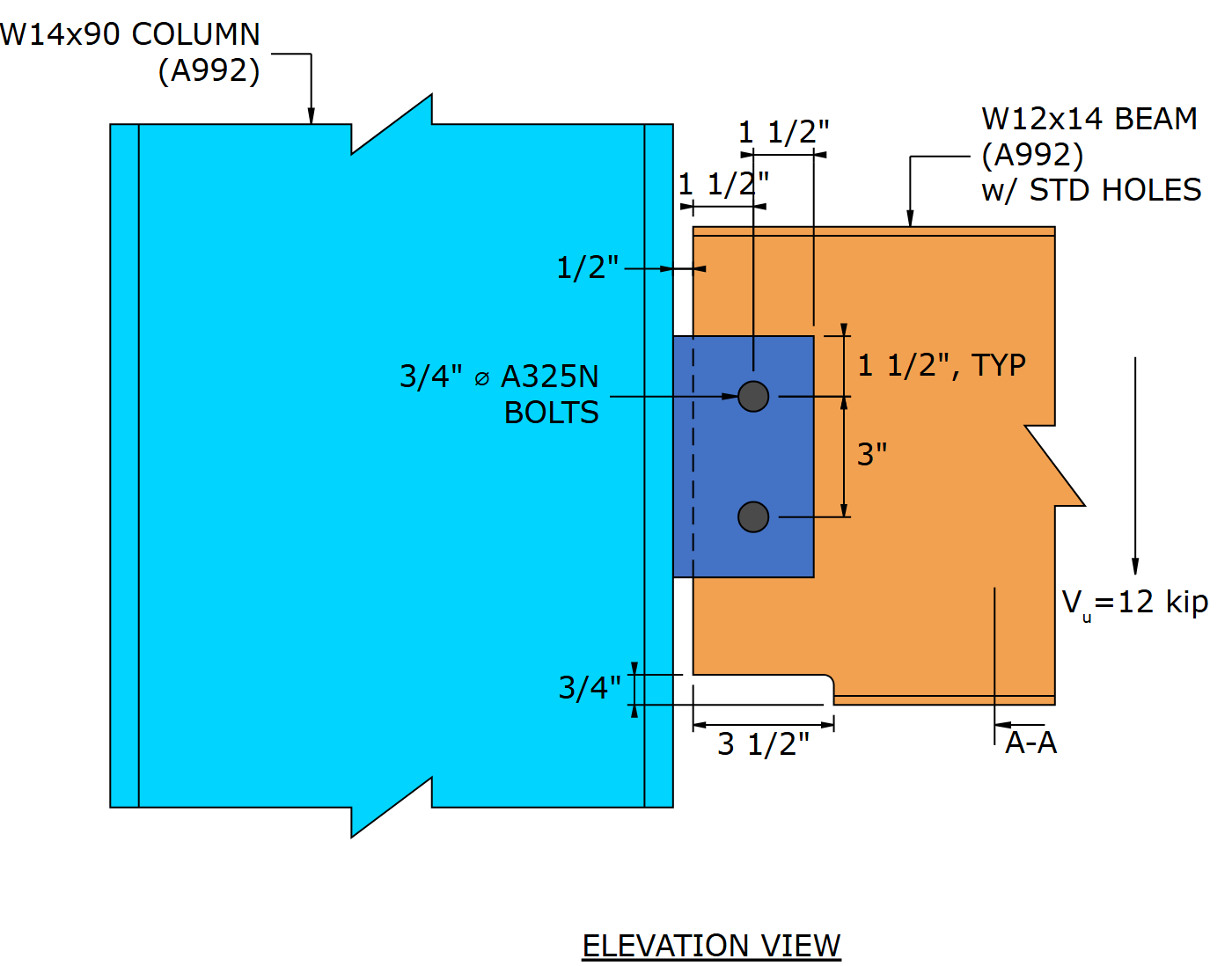
Elevação. Two bolts at a 3 in pitch with 1 1/2 in edge distances on the plates. A 0.2 in beam web is much thinner than the two plates together.
Clear distances
Com [mathin] L_{ev} = 1.5\ \text{in} [mathin], [mathin] s_{r} = 3\ \text{in} [mathin] e [mathin] d_{h} = 0.8125\ \text{in} [mathin]:
[math] l_{c1} = L_{ev} – \frac{d_{h}}{2} = 1.5 – \frac{0.8125}{2} = 1.0938\ \text{in} [math]
[math] l_{c2} = s_{r} – d_{h} = 3 – 0.8125 = 2.1875\ \text{in} [math]
The bearing limit is [mathin] 2.4 d_{b} = 1.8\ \text{in} [mathin]. For the edge bolt [mathin] 1.2 l_{c1} = 1.3125\ \text{in} [mathin] is smaller, so tearout governs. Para o parafuso interno [mathin] 1.2 l_{c2} = 2.625\ \text{in} [mathin] is larger, so bearing governs.
No prato duplo (Verificar 5)
[math] \phi R_{n} = \phi \left[ \min\left( 1.2 l_{c1},\ 2.4 d_{b} \right) (2t_{p}) F_{up} + \min\left( 1.2 l_{c2},\ 2.4 d_{b} \right) (2t_{p}) F_{up} \left( n_{r} – 1 \right) \right] \left( \frac{C}{n_{r}} \right) [math]
[math] \phi R_{n} = 0.75 \times \left[ 1.3125 \times 0.75 \times 58 + 1.8 \times 0.75 \times 58 \times 1 \right] \times \frac{1.18}{2} = 59.912\ \text{kip} [math]
[math] DCR = \frac{12}{59.912} = 0.20029 [math]
Na web do feixe (Verificar 6)
On the beam web the report uses the inner clear distance [mathin] l_{c2} [mathin] for both bolts, and bearing governs:
[math] \phi R_{n} = \phi \min\left( 1.2 l_{c2},\ 2.4 d_{b} \right) t_{wb} F_{ub} C = 0.75 \times \min\left( 2.625,\ 1.8 \right) \times 0.2 \times 65 \times 1.18 = 20.709\ \text{kip} [math]
[math] DCR = \frac{12}{20.709} = 0.57946 [math]
This is the lowest bolt capacity in the connection, and the highest strength DCR of the bolt checks. A teia do feixe é 0.2 em grosso, contra 0.75 in for the two plates, so it carries far less in bearing even though its [mathin] F_{u} [mathin] é mais alto.
Effective strength per bolt (Verificar 7)
O AISC 360-16 Commentary to J3.6 says each bolt’s strength is the smallest of its shear strength and its bearing or tearout strength in every ply it passes through. SkyCiv works this out bolt by bolt. One bolt in double shear has:
[math] \phi r_{v} = \phi F_{nv} \frac{\pi}{4} d_{b}^{2} N_{s} = 0.75 \times 54 \times \frac{\pi}{4} \times 0.75^{2} \times 2 = 35.785\ \text{kip} [math]
On the plates, the edge bolt has [mathin] \phi r_{n1e} = 42.82\ \text{kip} [mathin] (arrancar) and the inner bolt [mathin] \phi r_{n1i} = 58.725\ \text{kip} [mathin] (consequência). On the beam web each bolt has [mathin] \phi r_{n2} = 17.55\ \text{kip} [mathin]. So for both bolts:
[math] \phi r_{eff} = \min\left( 35.785,\ 42.82 \text{ or } 58.725,\ 17.55 \right) = 17.55\ \text{kip} [math]
[math] \phi R_{n,eff} = \left( \frac{C}{n_{r}} \right) \Sigma \phi r_{eff} = \frac{1.18}{2} \times 35.1 = 20.709\ \text{kip}, \quad DCR = 0.57946 [math]
Every bolt is limited by the beam web, so the per bolt result equals Check 6. Bolt shear on its own would give [mathin] 1.18 \times 35.785 = 42.226\ \text{kip} [mathin], about twice as much: in this connection the web, não os parafusos, sets the strength.
How SkyCiv Connection Design reports it
Bearing and tearout appear in the summary of checks once for each ply, for example "Design Capacity of the Bolt Group in Bearing and Tear-out on Double Plate" and "… on Beam Web", followed by "Design Effective Strength of the Bolt Group (Cisalhamento, Bearing and Tear-out per Bolt)". Each row links to its calculation, which shows the clear distances, then Eq. J3-6a and J3-6c with the numbers substituted and the bolt group coefficient applied. The effective strength check adds a table with each bolt’s shear, bearing or tearout on each ply, and its effective strength, so you can see which ply limits which bolt.
What to change if it fails
- Thicken the governing ply: bearing and tearout scale with [mathin] t [mathin]. For a thin beam web, that means a beam with a thicker web.
- Increase the edge distance if the edge bolts are limited by tearout: [mathin] l_{c1} [mathin] grows with [mathin] L_{ev} [mathin], up to the point where bearing takes over.
- Increase the bolt pitch if the inner bolts are limited by tearout.
- Use a larger bolt: it raises the bearing limit [mathin] 2.4 d_{b} [mathin], but a larger hole slightly reduces [mathin] l_{c} [mathin].
- Add bolts: more bolts share the load and usually raise [mathin] C [mathin].
- Use a stronger material for the plate or angles; the beam grade is usually fixed.
Perguntas frequentes
What is the difference between bearing and tearout?
Bearing is the hole wall crushing and elongating in front of the bolt, limited by [mathin] 2.4 d_{b} t F_{u} [mathin]. Tearout is a strip of material between the hole and an edge, or the next hole, shearing out, limited by [mathin] 1.2 l_{c} t F_{u} [mathin]. AISC 360-16 uses the smaller of the two for each bolt. In this example the edge bolt on the plates is limited by tearout and every other case by bearing.
Why is bolt bearing checked on each ply separately?
Each part the bolt passes through has its own thickness, strength and edge distances. Here the two plates together are 0.75 in thick in A36 and the beam web is 0.2 in thick in A992, so their bearing strengths differ by a factor of more than three. The weakest ply governs, and checking each ply shows which one it is.
Why use the effective strength per bolt instead of the group checks?
The group checks treat shear, bearing on the plates and bearing on the web separately. The Commentary to J3.6 adds the case where different bolts are limited by different things, for example an edge bolt by tearout and an inner bolt by shear. Taking the smallest limit for each bolt and adding them up covers that mix. When one ply limits every bolt, as here, it gives the same answer as the group check for that ply.
Does this use the 2.4 d t Fu or the 3.0 d t Fu bearing equation?
A 2.4 equação, Eq. J3-6a, with tearout from Eq. J3-6c. AISC 360-16 uses these when deformation at the bolt hole at service load is a design consideration, which is the usual case for connection design.
Check bolt bearing in your own connection
Choose a shear connection in the calculadora de design de conexão gratuita, insira seus membros, parafusos e cargas, and the bearing and tearout checks are run on every ply.
O módulo SkyCiv Connection Design fornece o relatório de cálculo completo com cada equação e seus números nele, para AISC 360-22 e AISC 360-16 (LRFD e ASD) e a norma AS 4100:2020. A calculadora de parafuso covers bolt groups on their own, quanto pelo Etapas para projetar page lists the connection types where bearing is checked. For bolt grades and hole types, Veja Bolts used in bolted connections.
Referências
- AISC 360-16, Especificação para Edifícios de Aço Estrutural: J3.6 (Eq. J3-1) e Comentário, J3.10 (Eq. J3-6a, J3-6c).
- Manual de construção em aço AISC, 15ª edição: Parte 7, eccentrically loaded bolt groups.
- Double plate connection design example
- Dimensionamento de ligações metálicas utilizando AISC 360-16

Harold Munalem
gerente de produto, Connection Design
10+ anos em projetos de conexões de aço
LinkedIn
