
A bolt in a shear connection designed to AS 4100:2020 is checked twice: once for the bolt itself shearing through (Cláusula 9.2.2.1) and once for the plies it passes through, which can bear or tear out at the holes (Cláusula 9.2.2.4). If the bolts are fully tensioned friction-type bolts (8.8/TF or 10.9/TF), a third check under Clause 9.2.3.1 makes sure the joint does not slip in service.
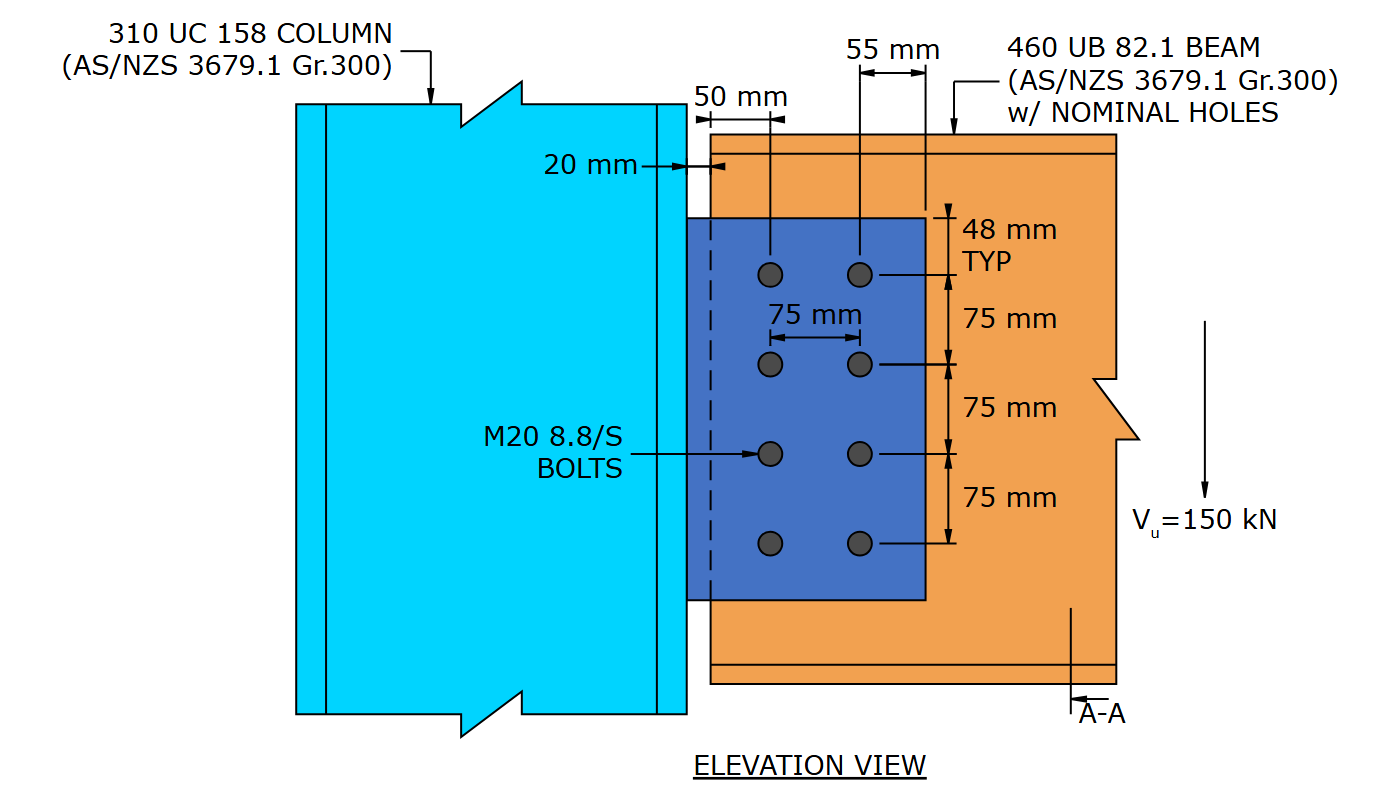
This page explains each of these checks and works them through with the same connection as our web side plate design example: eight M20 8.8/S bolts carrying 150 kN from a 460 Você pode encontrar uma variedade de tipos de conexão que atendem às suas necessidades sem lidar com sistemas de interface do usuário confusos que exigem uma curva de aprendizado íngreme até mesmo para começar 82.1 beam into a 10 placa mm. Every number comes from the calculation report that SkyCiv Connection Design produces for that connection.
Which bolt checks does AS 4100 require in shear?
| Verificar | Cláusula | Applies to |
|---|---|---|
| Parafuso em cisalhamento, [mathin]\phi V_{f}[mathin] | 9.2.2.1 | Every bolt category (4.6/S, 8.8/S, 8.8/TB, 8.8/TF and the 10.9 ones) |
| Ply em rolamento, [mathin]\phi V_{b}[mathin] | 9.2.2.4 | Every ply the bolt passes through: the plate, the beam web, the support |
| Friction-type joint in service, [mathin]\phi V_{sf}[mathin] | 9.2.3.1 | 8.8/TF and 10.9/TF bolts |
In a connection where the load is eccentric to the bolt group, the program finds the share of each bolt with the instantaneous centre of rotation method (Cláusula 9.3.1) and turns it into a bolt group coefficient C. The single-bolt capacities on this page are then multiplied by C. How C is found is covered step by step in cálculo de grupo de parafusos usando ICOR.
Design inputs for the example
| Item | Símbolo | Valor |
|---|---|---|
| Cisalhamento de projeto | [mathin]V^{*}[mathin] | 150 kN |
| Parafusos | 8 x M20 8.8/S, 4 linhas x 2 colunas | |
| Diâmetro do parafuso / hole diameter | [mathin]d_{f},\ d_{h}[mathin] | 20 milímetros / 22 milímetros |
| Bolt minimum tensile strength | [mathin]f_{uf}[mathin] | 830 MPa |
| Core area / área da haste | [mathin]A_{c},\ A_{o}[mathin] | 225 milímetros2 / 314.16 milímetros2 |
| Passo / medidor | [mathin]s_{p},\ s_{g}[mathin] | 75 milímetros / 75 milímetros |
| Excentricidade do grupo de parafusos | [mathin]e_{b}[mathin] | 107.5 milímetros |
| Prato | [mathin]t_{i},\ f_{up}[mathin] | 10 milímetro Gr.250, 410 MPa |
| Distâncias da borda da placa, vertical / horizontal | [mathin]l_{ev\_wp},\ l_{eh\_wp}[mathin] | 47.5 milímetros / 55 milímetros |
| Teia de feixe | [mathin]t_{wb},\ f_{ub}[mathin] | 9.9 mm Gr.300, 440 MPa |
| Distância da borda horizontal da alma do feixe | [mathin]l_{eh\_w}[mathin] | 50 milímetros |
Bolt shear capacity (Cláusula 9.2.2.1)
The design shear capacity of one bolt is:
[math]\phi V_{f} = \phi \times 0.62 \times f_{uf} \times k_{rd} \times k_{r} \times \left( n_{n} A_{c} + n_{x} A_{o} \right)[math]
com [mathin]\phi = 0.8[mathin] for a bolt in shear. The terms that change from one connection to another are:
- Threads in the shear plane, [mathin]n_{n}[mathin] e [mathin]n_{x}[mathin]. A shear plane through the threads uses the core area [mathin]A_{c}[mathin]; a plane through the plain shank uses the shank area [mathin]A_{o}[mathin]. For an M20 bolt that is 225 milímetros2 contra 314.16 milímetros2, so excluding the threads is worth 40% more capacity. The program accepts "threads excluded" only when a standard bolt length leaves the threads clear of the shear plane for the plies entered, and never for 4.6 parafusos. Otherwise it designs with threads included.
- Ductility factor [mathin]k_{rd}[mathin]. The program takes 0.83 pra 10.9 bolts with threads included in the shear plane, e 1.0 for every other case.
- Lap length factor [mathin]k_{r}[mathin]. Long bolted lap joints lose capacity because the end bolts take more than their share. The program works out the joint length as [mathin]l_{j} = (n_{rows} – 1) s_{p}[mathin] along the force and applies:
| Joint length | [mathin]k_{r}[mathin] |
|---|---|
| [mathin]l_{j} \lt 300[mathin] milímetros | 1.0 |
| 300 mm para 1300 milímetros | [mathin]1.075 – l_{j}/4000[mathin] |
| [mathin]l_{j} \gt 1300[mathin] milímetros | 0.75 |
The lap reduction is applied in flange plate connections and splices, where the force runs along a line of bolts. In beam shear connections such as the web side plate, the report shows [mathin]k_{r,bolt} = 1[mathin].
Passo 1: Capacidade de cisalhamento calculada de um parafuso
The 8.8/S bolts in the example have the threads in the single shear plane, então [mathin]n_{n} = 1[mathin] e [mathin]n_{x} = 0[mathin]:
[math]\phi V_{f} = 0.8 \times 0.62 \times 830 \times 1 \times 1 \times \left( 1 \times 225 + 0 \times 314.16 \right) = 92.628\ \text{kN}[math]
Passo 2: Grupo de parafusos em cisalhamento (Cláusula 9.3.1)
A 150 kN shear acts 107.5 mm from the centroid of the bolt group. The ICOR iteration places the instantaneous centre at [mathin]x_{ic} = -30.727\ \text{mm}[mathin] e [mathin]y_{ic} = 112.5\ \text{mm}[mathin] from Bolt No. 1 (bottom left). The vertical reactions of the eight bolts, each at its [mathin]\phi V_{f}[mathin] limite, add up to:
[math]\phi V_{df} = \sum R_{y} = 430.69\ \text{kN}, \qquad C = \frac{\phi V_{df}}{\phi V_{f}} = \frac{430.69}{92.628} = 4.6497[math]
DCR = 150 kN / 430.69 kN = 0.348 ≤ 1.0, OK
Passo 3: The same bolts with threads excluded
Switching the same input to threads excluded from the shear plane gives [mathin]n_{n} = 0[mathin] e [mathin]n_{x} = 1[mathin]:
[math]\phi V_{f} = 0.8 \times 0.62 \times 830 \times 1 \times 1 \times \left( 0 \times 225 + 1 \times 314.16 \right) = 129.33\ \text{kN}[math]
The bolt group capacity rises to [mathin]\phi V_{df} = 601.36\ \text{kN}[mathin], and the DCR drops from 0.348 para 0.249. The bearing checks below do not change, because they do not depend on the threads.
Ply bearing capacity (Cláusula 9.2.2.4)
A ply can fail at a bolt hole in two ways: the bolt crushes the material in front of it (consequência), or the bolt tears out through the edge of the ply or into the next hole (arrancar). The program takes the smaller of the two:
[math]\phi V_{b} = \phi \times \min\left( 3.2\, d_{f}\, t_{p}\, f_{up},\ a_{e}\, t_{p}\, f_{up} \right)[math]
com [mathin]\phi = 0.9[mathin] for a ply in bearing. [mathin]a_{e}[mathin] é a distância da borda do furo até a borda da camada, mais metade do diâmetro do parafuso, measured in the direction of the force:
- to a free edge: [mathin]a_{e} = l_{e} – 0.5\, d_{h} + 0.5\, d_{f}[mathin]
- to the next hole: [mathin]a_{e} = s – d_{h} + 0.5\, d_{f}[mathin]
When the bolt forces come from an ICOR analysis they act in different directions, so the program takes the least [mathin]a_{e}[mathin] in either direction for each ply.
Passo 4: Rolamento na placa lateral da alma
[math]a_{e1} = 47.5 – 0.5 \times 22 + 0.5 \times 20 = 46.5\ \text{mm} \qquad a_{e2} = 75 – 22 + 0.5 \times 20 = 63\ \text{mm}[math]
[math]a_{e3} = 55 – 0.5 \times 22 + 0.5 \times 20 = 54\ \text{mm} \qquad a_{e4} = 75 – 22 + 0.5 \times 20 = 63\ \text{mm}[math]
The vertical edge distance governs, [mathin]a_{e} = 46.5\ \text{mm}[mathin]:
[math]\phi V_{b,pl} = 0.9 \times \min\left( 3.2 \times 20 \times 10 \times 410,\ 46.5 \times 10 \times 410 \right) = 171.59\ \text{kN}[math]
Tear-out governs here: [mathin]3.2 d_{f} = 64\ \text{mm}[mathin] is more than the 46.5 mm available.
Passo 5: Rolamento na teia da viga
The beam web has no vertical free edge near the bolts, so only the pitch, the horizontal edge and the gauge count:
[math]a_{e5} = 75 – 22 + 0.5 \times 20 = 63\ \text{mm} \qquad a_{e6} = 50 – 0.5 \times 22 + 0.5 \times 20 = 49\ \text{mm} \qquad a_{e7} = 63\ \text{mm}[math]
[math]\phi V_{b,beam} = 0.9 \times \min\left( 3.2 \times 20 \times 9.9 \times 440,\ 49 \times 9.9 \times 440 \right) = 192.1\ \text{kN}[math]
Passo 6: Bolt group in bearing
The weaker ply governs, and the same coefficient C spreads it over the group:
[math]\phi V_{b} = \min\left( 171.59,\ 192.1 \right) \times 4.6497 = 797.82\ \text{kN}[math]
DCR = 150 kN / 797.82 kN = 0.188 ≤ 1.0, OK
Bolt shear governs this connection by a wide margin (0.348 contra 0.188). That is typical for 8.8 bolts in 10 mm plates; bearing tends to govern with thin plies, short edge distances or 10.9 parafusos.
Friction-type bolts: facilidade de manutenção (Cláusula 9.2.3.1)
With 8.8/TF bolts the joint is meant not to slip at the serviceability limit state. The report adds a check of the slip capacity of the bolt group:
[math]\phi V_{sf} = \phi\, \mu\, n_{ei}\, N_{ti}\, k_{h}\, C[math]
com [mathin]\phi = 0.7[mathin], the slip factor [mathin]\mu = 0.35[mathin], [mathin]n_{ei}[mathin] the number of effective interfaces, [mathin]N_{ti}[mathin] the minimum bolt tension at installation (Tabela 15.2.2.2) e [mathin]k_{h}[mathin] the hole type factor, 1.0 for standard holes and 0.85 for oversize or short slotted holes. Changing the example’s bolts to M20 8.8/TF:
[math]\phi V_{sf} = 0.7 \times 0.35 \times 1 \times 145 \times 1 \times 4.6497 = 165.18\ \text{kN}[math]
DCR = 150 kN / 165.18 kN = 0.908 ≤ 1.0, OK
The strength checks of Steps 1 para 6 still apply to TF bolts unchanged. The serviceability check uses the design shear entered for the connection, so if your serviceability shear is lower than the strength one, the DCR shown is on the safe side.
Summary of the bolt checks
| Caso | Verificar | Capacidade | DCR |
|---|---|---|---|
| 8.8/S, tópicos incluídos | Grupo de parafusos em cisalhamento | 430.69 kN | 0.348 |
| 8.8/S, tópicos excluídos | Grupo de parafusos em cisalhamento | 601.36 kN | 0.249 |
| Qualquer | Bolt group in bearing (plate governs) | 797.82 kN | 0.188 |
| 8.8/TF | Slip in service | 165.18 kN | 0.908 |
What to change if a bolt check fails
- Cisalhamento de parafuso: adicione uma linha de parafusos (it raises C), use M24 bolts or a 10.9 grau, keep the threads out of the shear plane if the bolt length allows, or move the bolts closer to the support to cut the eccentricity.
- Bearing on a ply: increase the edge distance in the direction of the force, increase the pitch, or use a thicker ply. Se a teia do feixe governa, adicione parafusos ou use um parafuso maior.
- Slip of TF bolts: adicionar parafusos, use a larger bolt for a higher [mathin]N_{ti}[mathin], or use standard holes rather than oversize or slotted ones.
For web side plates, flexible end plates, single and double angle cleats, flange plates and beam and column splices with flange and web plates, Projeto Automático will try these changes for you and return a layout that passes.
Perguntas frequentes
Why is the shear on one bolt not just V* divided by the number of bolts?
Because the load is eccentric to the group. A 107.5 mm lever arm adds a moment that the bolts farthest from the instantaneous centre resist most, so the group is worth C = 4.6497 single bolts, not eight.
Does the bearing check depend on the bolt grade?
Não. Cláusula 9.2.2.4 uses the ply’s tensile strength [mathin]f_{up}[mathin], its thickness and the bolt diameter. The bolt grade only enters the bolt shear check.
Why does the plate govern bearing when the beam web is thinner?
The plate’s tensile strength is lower (410 MPa against 440 MPa) and its vertical edge distance gives [mathin]a_{e} = 46.5\ \text{mm}[mathin], menos que o 49 mm that governs the beam web.
Are TF bolts checked for slip at the strength limit state?
Não. Cláusula 9.2.3.1 is a serviceability check. At the strength limit state a TF bolt is designed as a bearing bolt, with the same shear and ply bearing checks as an S bolt.
Check your own bolts for free
Escolha COMO 4100:2020 and a bolted connection, set the bolt category, size and hole type, and every bolt check above comes back with its DCR and clause. Não há nada para instalar.
O módulo SkyCiv Connection Design fornece o relatório de cálculo completo com cada equação e seus números nele, para AS 4100:2020 Etapas para projetar, conexões e emendas de momento. A calculadora de parafuso is a quick way to check a single bolt group.
Referências
- AS 4100:2020, Estruturas de aço: Cláusulas 9.2.2.1, 9.2.2.4, 9.2.3.1, 9.3.1; Tabela 15.2.2.2.
- Web side plate connection design example to AS 4100
- Cálculo do grupo de parafusos usando ICOR
- Dimensionamento de ligações metálicas utilizando AS 4100:2020

Harold Munalem
gerente de produto, Connection Design
10+ anos em projetos de conexões de aço
LinkedIn
