
O que é uma conexão momentânea?
Uma conexão de momento é uma junta que transfere momentos de flexão entre uma coluna e uma viga, ou entre quaisquer dois membros. Se uma viga sofre um momento interno em sua extremidade, a conexão tem que transmitir esse momento através da junta, em vez de deixar a extremidade girar livremente.
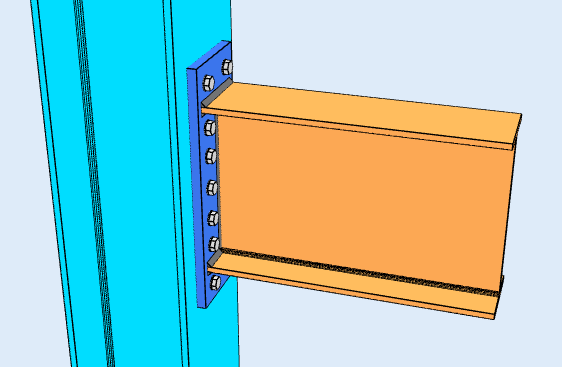
Conexão estendida da placa final, um exemplo de conexão momentânea. Os parafusos fora do flange de tensão proporcionam ao par um braço de alavanca mais longo.
O objetivo de um conexão de momento é segurar a rotação final, que em termos de análise é o Uma conexão de momento em engenharia estrutural é uma junta que permite a transferência de forças de momento fletor entre um pilar e uma viga FFFFFF: contido em todas as três translações e todas as três rotações. É por isso que as conexões de momento também são chamadas de conexões rígidas.
AISC 360-16 A seção B3.4 é mais precisa sobre isso, e a distinção é importante quando você modela o quadro. Uma conexão momentânea é totalmente contido (você teria uma boa noção de como as conexões simples são projetadas sob o AISC), que mantém o ângulo entre os membros e justifica a suposição FFFFFF, ou parcialmente contido (RP), que transfere o momento, mas gira o suficiente para que a análise tenha que levar em conta a rigidez real da junta. Tratar uma junta PR como totalmente rígida exagera a rigidez do quadro e subestima o seu desvio.
Onde um conexão de cisalhamento funciona principalmente através da teia de feixe, uma conexão momentânea deve engatar os flanges, porque é aí que a tensão de flexão está. Placas de flange, flanges soldadas ou uma placa final fazem o mesmo trabalho: eles transformam o momento da viga em uma força de tração em um banzo e uma força de compressão no outro, e leve esse casal para a coluna.
soldas ou outros acessórios que fortalecem e aumentam a rigidez da conexão entre os membros
As conexões de momento suportam muito mais momento do que uma conexão de cisalhamento, e eles custam mais para fazer: mais materiais, mais soldagem, mais ajuste e mais inspeção. A maioria das estruturas os utiliza apenas onde a estrutura depende da ação da estrutura para estabilidade lateral, e use conexões de cisalhamento em qualquer outro lugar.
Quais configurações estão disponíveis dependem do código de projeto e do que as estruturas de vigas estão inseridas..
Viga para coluna de seção I (AISC 360-16)
Quatro configurações, enquadramento ao banzo do pilar ou à alma do pilar.
Placa de flange
As placas passam pelos flanges superior e inferior da viga, aparafusado ou soldado à viga e ao pilar. À medida que a viga se curva, uma placa entra em tensão e a outra em compressão, e esse casal carrega o momento. A alma da viga é geralmente sustentada por uma placa de cisalhamento separada, então a conexão divide o trabalho: flanges aproveitam o momento, teia leva o cisalhamento.
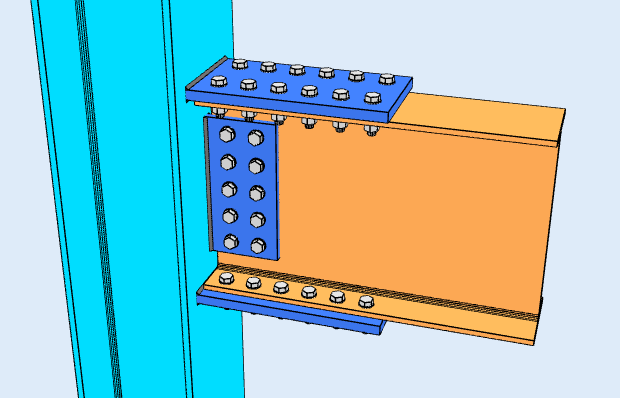
Flanges Soldados
Os banzos da viga são soldados diretamente ao banzo da coluna, sem placa intermediária, e a alma é aparafusada a uma aba de cisalhamento. Isto proporciona a junta mais rígida do grupo e o caminho de carga mais limpo, mas é a soldagem em campo em um membro que deve caber dentro da tolerância, então carrega pré-aquecimento, custos de acesso e inspeção que um detalhe aparafusado não.
Placa final nivelada
Uma placa soldada na extremidade da viga e aparafusada ao pilar, com a placa terminando nivelada com os flanges da viga e todos os parafusos colocados entre eles. Adapta-se aos momentos mais baixos, porque o braço de alavanca do grupo de parafusos é limitado pela profundidade da viga.
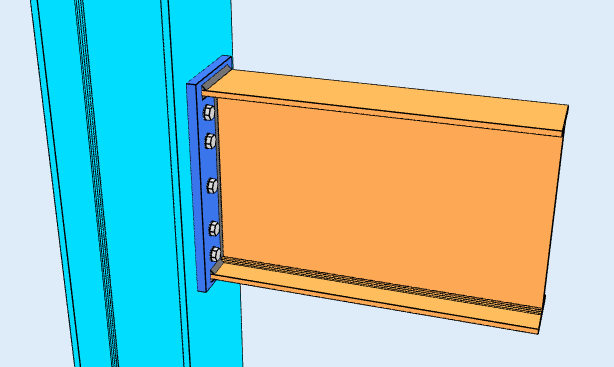
Placa final estendida
A mesma ideia, com a placa estendida além do flange de tensão para que os parafusos possam ficar fora dela. Esses parafusos externos têm um braço de alavanca mais longo em torno do flange de compressão, que é o que compra a capacidade de momento extra. A ação curiosa na parte estendida torna-se uma verificação governante. É a configuração mostrada no topo desta página.
Ambas as configurações de placa final são cobertas pelo calculadora de conexão de momento.
Transmitir para coluna HSS (AISC 360-16)
Enquadrar uma conexão de momento em uma seção oca é mais difícil, porque não há flange para aparafusar e nenhum acesso ao outro lado. Uma configuração está disponível: uma placa de flange soldado à face do HSS, sem reforços.
AS 4100:2020
AS 4100 a cobertura no SkyCiv Connection Design é apenas conexões de cisalhamento, viga de enquadramento para pilar de seção I ou viga a viga. Conexões de momento com AS 4100 não estão disponíveis. Para design de momento, usar AISC 360-16.
O que o software verifica?
O detalhamento é executado primeiro: distâncias da borda do parafuso, espaçamento do parafuso (pitch e medidor), folgas da ferramenta, dimensões mínimas e máximas da placa, e detecção de choque entre placas, reforços, parafusos e soldas. Uma conexão que não pode ser construída não chega à solução.
As verificações de resistência seguem o par através da junta. No lado do flange isso significa a placa em tração e em compressão, tesoura de parafuso, rolamento de parafuso e destacável, bloquear ruptura por cisalhamento, ação curiosa nos parafusos, e estresse na garganta da solda. No membro de suporte significa flexão local do flange, rendimento local da web e paralisação da web, quais são os estados limites que decidem se o pilar precisa de reforços ou de uma placa duplicadora.
Cada fórmula, verificação de projeto e referência de código são mostradas na íntegra, com números de cláusulas do AISC 360-16, para que você possa seguir o cálculo em vez de confiar nele.
Conexão de Momento vs Conexão de Cisalhamento: a diferença
A diferença é o que acontece com o ângulo entre os dois membros. Em uma conexão de momento esse ângulo é mantido, então dobrar um membro leva ao outro. Em uma conexão de cisalhamento a junta pode girar livremente, então a extremidade da viga gira e nenhum momento significativo cruza a junta.
| Conexão de Momento | Conexão de cisalhamento | |
|---|---|---|
| Forças Transferidas | Cisalhamento e momento | então isso não acontece |
| Nomes alternativos | Rígido, Fixo, Resistente ao momento | Articulado, Dobradiça, Simples |
| AISC 360-16 prazo | Conexão de momento FR ou PR | Conexão simples |
| Rotação | Restringe a rotação | Livre para girar |
| Código de Fixidade de Software | FFFFFF | FFFFFR |
Software de design de conexão SkyCiv
Os modelos e verificações acima são de Projeto de conexões SkyCiv. Ele cobre 80+ tipos de conexão pré-configurados, projetos para AISC 360-16 em LRFD e ASD e para AS 4100:2020, e mostra todas as fórmulas, verificação de projeto e referência de código completa.
Você pode modelar a conexão em 3D, trocar parafusos, soldas ou placas sem perder seus dados de carga, produza folhas de desenho de detalhes 2D no CloudCAD, e exporte a geometria 3D para IFC para coordenação no Revit, Tekla ou Navisworks.
Funciona inteiramente no navegador, sem downloads, atualizações ou configuração de TI.
