什么是瞬间连接?
A moment connection is a joint that transfers 弯矩 between a column and a beam, 或任意两个成员之间. If a beam carries internal moment at its end, the connection has to carry that moment across the joint rather than letting the end rotate freely.

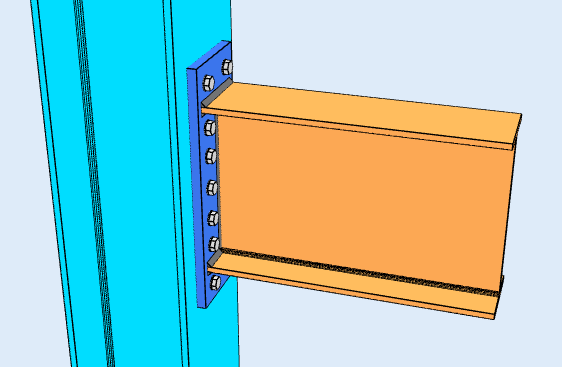
Extended end plate connection, one example of a moment connection. The bolts outside the tension flange give the couple a longer lever arm.
The aim of a 矩连接 is to hold the end rotation, which in analysis terms is the 固定码 FFFFFF: restrained in all three translations and all three rotations. That is why moment connections are also called rigid connections.
AISC 360-16 Section B3.4 is more precise about it, and the distinction matters when you model the frame. A moment connection is either fully restrained (阻燃剂), which holds the angle between the members and justifies the FFFFFF assumption, 要么 partially restrained (公关), which transfers moment but rotates enough that the analysis has to account for the joint’s real stiffness. Treating a PR joint as fully rigid overstates the frame’s stiffness and understates its drift.
Where a 剪力连接 works mostly through the beam web, a moment connection has to engage the flanges, because that is where the bending stress is. 法兰板, welded flanges or an end plate all do the same job: they turn the beam’s moment into a tension force in one flange and a compression force in the other, and carry that couple into the column.
力矩连接类型
Moment connections carry far more moment than a shear connection, and they cost more to make: more material, more welding, more fit-up and more inspection. Most frames use them only where the structure relies on frame action for lateral stability, and use shear connections everywhere else.
Which configurations are available depends on the design code and on what the beam frames into.
梁到工字形柱 (AISC 360-16)
Four configurations, framing to the column flange or to the column web.
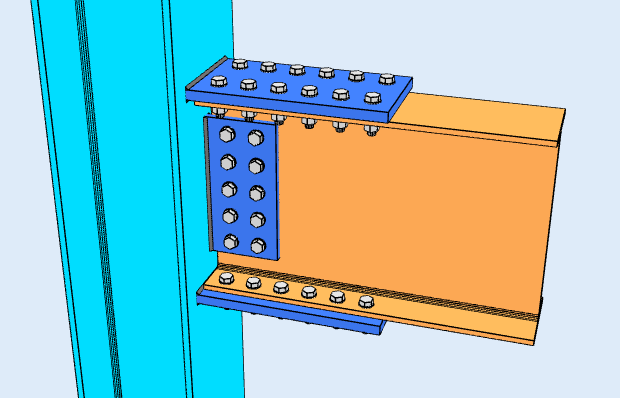
法兰盘
Plates run across the top and bottom flanges of the beam, bolted or welded to the beam and to the column. 当梁弯曲时, one plate goes into tension and the other into compression, and that couple carries the moment. The beam web is usually carried by a separate shear plate, so the connection splits the job: flanges take the moment, web takes the shear.

焊接法兰
The beam flanges are welded straight to the column flange, with no intermediate plate, and the web is bolted to a shear tab. This gives the stiffest joint of the group and the cleanest load path, but it is field welding on a member that has to fit within tolerance, so it carries preheat, access and inspection costs that a bolted detail does not.
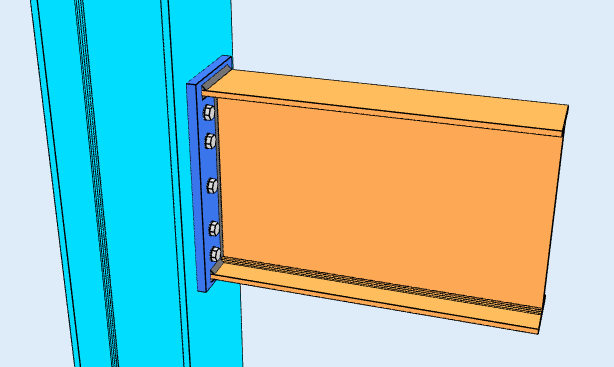
齐平端板
A plate welded to the end of the beam and bolted to the column, with the plate finishing flush with the beam flanges and all bolts sitting between them. It suits lower moments, because the bolt group’s lever arm is limited by the beam depth.

加长端板
The same idea, with the plate extended past the tension flange so bolts can sit outside it. Those outer bolts have a longer lever arm about the compression flange, which is what buys the extra moment capacity. Prying action on the extended part becomes a governing check. It is the configuration shown at the top of this page.
Both end plate configurations are covered by the moment connection calculator.
横梁至 HSS 立柱 (AISC 360-16)
Framing a moment connection into a hollow section is harder, because there is no flange to bolt through and no access to the far side. One configuration is available: 一个 法兰盘 welded to the face of the HSS, without stiffeners.
作为 4100:2020
作为 4100 coverage in SkyCiv Connection Design is shear connections only, framing beam to I-section column or beam to beam. Moment connections to AS 4100 are not available. For moment design, use AISC 360-16.
软件检查什么?
Detailing runs first: 螺栓边缘距离, 螺栓间距 (间距和规格), 刀具间隙, minimum and maximum plate dimensions, and clash detection between plates, 加强筋, 螺栓和焊缝. A connection that cannot be built does not reach the solve.
The strength checks then follow the couple through the joint. On the flange side that means the plate in tension and in compression, 螺栓剪, 螺栓轴承和撕裂, 块体剪切破裂, prying action on the bolts, and weld throat stress. On the supporting member it means local flange bending, web local yielding and web crippling, which are the limit states that decide whether the column needs stiffeners or a doubler plate.
每个公式, 完整显示设计检查和代码参考, with clause numbers from AISC 360-16, 这样你就可以遵循计算而不是相信它.
弯矩连接与剪切连接: 区别
The difference is what happens to the angle between the two members. In a moment connection that angle is held, so bending in one member carries into the other. In a shear connection the joint is free to rotate, so the beam end turns and no meaningful moment crosses the joint.
| 瞬间连接 | 剪力连接 | |
|---|---|---|
| 部队转移 | 剪切和力矩 | 仅剪切 |
| 替代名称 | 死板的, 固定, 抗力矩 | 固定, 合页, 简单 |
| AISC 360-16 学期 | FR 或 PR 力矩连接 | 连接简单 |
| 回转 | Restrains rotation | Free to rotate |
| 软件修复代码 | FFFFFF | FFFFFR |
SkyCiv连接设计软件
以上模型和检查均来自 SkyCiv连接设计. 它覆盖了 80+ 预配置的连接类型, designs to AISC 360-16 in LRFD and ASD and to 作为 4100:2020, 并显示每个公式, 完整的设计检查和代码参考.
您可以对连接进行 3D 建模, 更换螺栓, 焊缝或板材,不会丢失负载数据, 在 CloudCAD 中生成 2D 详细图纸, 并将 3D 几何图形导出到 IFC 以在 Revit 中进行协调, Tekla 或 Navisworks.
它完全在浏览器中运行, 没有下载, 更新或 IT 设置.