
A cope is a notch cut out of a beam flange and part of its web, so the beam can clear the flange of the girder or column it frames into. The cut removes the flange that would normally carry bending, leaving a short length of web that has to carry the beam reaction in shear and bending, and that can buckle locally. The AISC Steel Construction Manual, 部分 9, gives a procedure for the flexural yielding and local buckling of coped beams. This article explains it and works it with the numbers from a real coped channel connection solved in SkyCiv Connection Design.
What are the coped beam checks?
The beam reaction enters the beam at the connection, but the full section only starts at the end of the cope. Over the length of the cope, the reduced section carries the reaction as a shear and a moment equal to the reaction times the distance to the end of the cope. Three things can fail there: the reduced web in shear (AISC 360-16 J4.2), the reduced section in bending, by yielding or by local buckling of the web where the flange has been cut away, and block shear through the bolt holes (J4.3). The Manual Part 9 procedure covers the bending part, and checks yielding and buckling with one set of equations.
Coped beam flexure governs when the cope is long, because the moment grows with the cope length, and when the cope is deep, because less web is left. Local buckling becomes important when the remaining web is slender, that is when the depth left at the cope is large compared with the web thickness. With short copes and stocky webs, as in the example below, the section reaches its full plastic moment and shear or block shear usually governs instead.
The AISC Manual Part 9 程序 (beam coped at one flange)
The web slenderness at the cope is:
[math] \lambda = \frac{h_{o}}{t_{w}} \quad \text{(Manual Eq. 9-11)} [math]
哪里 [mathin] h_{o} [mathin] is the depth of the web left at the cope and [mathin] t_{w} [mathin] the web thickness. The limiting slenderness for a compact web is:
[math] \lambda_{p} = 0.475 \sqrt{ \frac{k_{1} E}{F_{y}} }, \quad k_{1} = f k \geq 1.61 \quad \text{(Manual Eq. 9-12)} [math]
with the buckling adjustment factor and the plate buckling coefficient, for a cope length [mathin] c [mathin] and beam depth [mathin] d [mathin]:
[math] f = \frac{2c}{d} \ \text{ for } \frac{c}{d} \leq 1 \quad \text{(Eq. 9-14a)}, \qquad f = 1 + \frac{c}{d} \ \text{ for } \frac{c}{d} > 1 \quad \text{(Eq. 9-14b)} [math]
[math] k = 2.2 \left( \frac{h_{o}}{c} \right)^{1.65} \ \text{ for } \frac{c}{h_{o}} \leq 1 \quad \text{(Eq. 9-13a)}, \qquad k = \frac{2.2 h_{o}}{c} \ \text{ for } \frac{c}{h_{o}} > 1 \quad \text{(Eq. 9-13b)} [math]
The nominal flexural strength of the coped section then depends on [mathin] \lambda [mathin]:
[math] \lambda \leq \lambda_{p}: \quad M_{n} = F_{y} Z_{net} \quad \text{(Eq. 9-6)} [math]
[math] \lambda_{p} \lt \lambda \leq 2\lambda_{p}: \quad M_{n} = F_{y} Z_{net} – \left( F_{y} Z_{net} – F_{y} S_{net} \right) \left( \frac{\lambda}{\lambda_{p}} – 1 \right) \quad \text{(Eq. 9-7)} [math]
[math] \lambda \gt 2\lambda_{p}: \quad M_{n} = F_{cr} S_{net}, \quad F_{cr} = \frac{0.903 E k_{1}}{\lambda^{2}} \quad \text{(Eq. 9-8, 9-9)} [math]
哪里 [mathin] Z_{net} [mathin] 和 [mathin] S_{net} [mathin] are the plastic and elastic section moduli of the coped section. The first case is flexural yielding, the last is elastic local buckling of the web, and the middle one is a straight line between them. 和 [mathin] \phi = 0.90 [mathin], SkyCiv turns the moment into an equivalent shear by dividing by the cope eccentricity [mathin] e_{c} [mathin]:
[math] \phi V_{n} = \frac{\phi M_{n}}{e_{c}} [math]
Worked example: a coped channel beam
This example is Checks 13 和 14 的 channel to channel single plate connection design example: a C15x33.9 A36 beam ([mathin] d = 15\ \text{in} [mathin], [mathin] t_{wb} = 0.4\ \text{in} [mathin], [mathin] F_{yb} = 36\ \text{ksi} [mathin], [mathin] F_{ub} = 58\ \text{ksi} [mathin]) 应对顶部法兰, [mathin] D_{ct} = 1.5\ \text{in} [mathin] deep and [mathin] L_{ct} = 3\ \text{in} [mathin] 长, and bolted with three 3/4 in A325-N bolts to a single plate on a C15x50 girder. The shear is [mathin] V_{u} = 30\ \text{kip} [mathin]. It was solved again on the current release and the numbers are the same as on the published example.
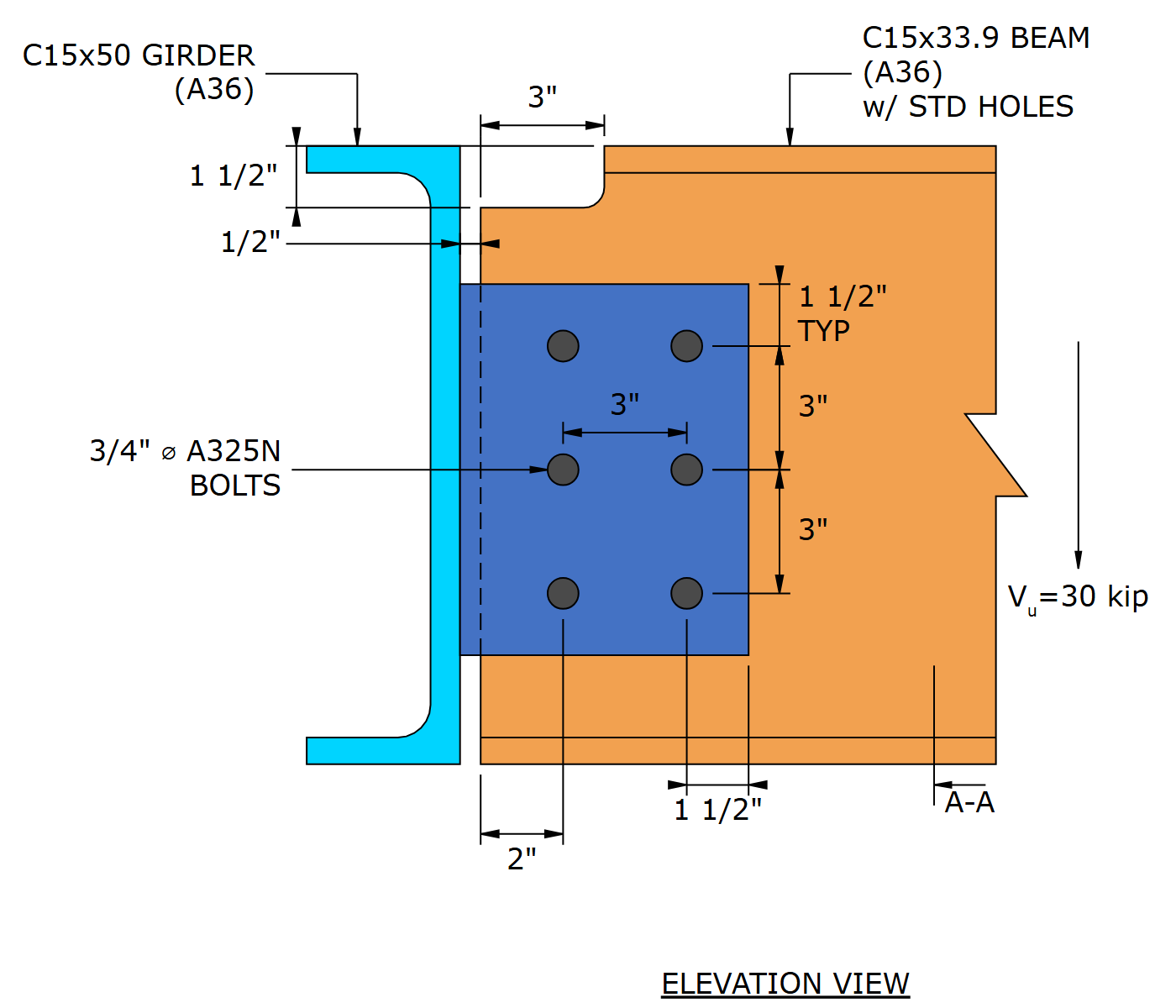
海拔. The top cope is 1 1/2 in deep and 3 长, so the beam clears the girder flange. 梁端位于 1/2 in from the girder web.
Shear on the coped section (验算 13)
The web left at the cope is [mathin] d_{coped} = 15 – 1.5 = 13.5\ \text{in} [mathin] deep:
[math] \phi R_{n,sy} = \phi\ 0.6 F_{yb} A_{gv} = 1.0 \times 0.6 \times 36 \times \left( 13.5 \times 0.4 \right) = 116.64\ \text{kip} [math]
[math] A_{nv} = t_{wb} \left[ d_{coped} – n_{r} \left( d_{h} + 0.0625 \right) \right] = 0.4 \times \left[ 13.5 – 3 \times 0.875 \right] = 4.35\ \text{in}^{2} [math]
[math] \phi R_{n,sr} = \phi\ 0.6 F_{ub} A_{nv} = 0.75 \times 0.6 \times 58 \times 4.35 = 113.53\ \text{kip} [math]
[math] DCR = \frac{30}{\min\left( 116.64,\ 113.53 \right)} = \frac{30}{113.53} = 0.26424 [math]
Flexural yielding and local buckling (验算 14)
和 [mathin] h_{o} = 13.5\ \text{in} [mathin] 和 [mathin] c = L_{ct} = 3\ \text{in} [mathin]:
[math] \lambda = \frac{h_{o}}{t_{wb}} = \frac{13.5}{0.4} = 33.75 [math]
这里 [mathin] c/d = 0.2 [mathin] 和 [mathin] c/h_{o} = 0.222 [mathin], both below 1, 所以 [mathin] f = 2 \times 3/15 = 0.4 [mathin] 和 [mathin] k = 2.2 \times \left( 13.5/3 \right)^{1.65} = 26.316 [mathin]. Their product, 10.526, is above the 1.61 地面:
[math] \lambda_{p} = 0.475 \sqrt{ \frac{\left( 0.4 \times 26.316 \geq 1.61 \right) \times 29000}{36} } = 43.74 [math]
以来 [mathin] \lambda = 33.75 \leq \lambda_{p} = 43.74 [mathin], the web is compact at the cope: local buckling does not reduce the strength, and the section reaches its plastic moment. The plastic section modulus of the coped channel is [mathin] Z_{x} = 28.377\ \text{in}^{3} [mathin]:
[math] \phi M_{n} = \phi F_{yb} Z_{x} = 0.9 \times 36 \times 28.377 = 76.618\ \text{kip-ft} [math]
The report uses a cope eccentricity of [mathin] e_{c} = 3.5\ \text{in} [mathin], which in the elevation is the 1/2 in gap to the girder web plus the 3 in cope length. Converting the moment to kip-in:
[math] \phi V_{n} = \frac{\phi M_{n}}{e_{c}} = \frac{76.618\ \text{kip-ft}}{3.5\ \text{in}} = 262.69\ \text{kip} [math]
[math] DCR = \frac{V_{u}}{\phi V_{n}} = \frac{30}{262.69} = 0.1142 [math]
The short, shallow cope leaves plenty of bending strength. In this beam the coped section is more critical in shear (0.26424) and in block shear (0.331118 in the report summary) than in bending.
How SkyCiv Connection Design reports it
The coped beam appears in the summary of checks as three rows: "Design Capacity of Coped Beam in Block Shear", "Design Capacity of Coped Beam in Shear" and "Design Capacity of Coped Beam in Flexure". The flexure row links to the calculation, which lists the cope depth and length at the top and bottom, the coped section modulus, the web slenderness and the limiting slenderness with the numbers substituted, then states which slenderness range applies and uses the matching Manual equation, 9-6, 9-7 要么 9-8. It ends with the equivalent shear [mathin] \phi M_{n}/e_{c} [mathin], PASS or FAIL and the DCR. The shear row shows Eq. J4-3 and J4-4 on the gross and net coped web.
What to change if it fails
- Shorten the cope: the moment at the cope is proportional to [mathin] e_{c} [mathin], and a shorter cope also raises the product [mathin] f k [mathin] and with it [mathin] \lambda_{p} [mathin].
- Make the cope shallower: more web left at the cope raises [mathin] Z_{net} [mathin] and the shear area. Cope only as deep as the girder flange clearance needs.
- Reduce the gap to the support where the detail allows, which shortens [mathin] e_{c} [mathin].
- Use a beam with a thicker web: a thicker web lowers [mathin] \lambda [mathin] and raises every capacity on the coped section.
常见问题
What is the difference between flexural yielding and local buckling at a cope?
Flexural yielding is the coped section reaching its plastic moment, [mathin] F_{y} Z_{net} [mathin]. Local buckling is the free edge of the web at the cope buckling sideways before that, because the flange that would brace it has been removed. Which one governs depends on the web slenderness [mathin] \lambda [mathin] compared with [mathin] \lambda_{p} [mathin]. 在这个例子中 [mathin] \lambda [mathin] is below [mathin] \lambda_{p} [mathin], so yielding governs.
What are the f and k factors?
[mathin] f [mathin] is the buckling adjustment factor and [mathin] k [mathin] the plate buckling coefficient. Both come from the cope geometry: [mathin] f [mathin] from the cope length against the beam depth, 和 [mathin] k [mathin] from the remaining depth against the cope length. A short cope gives a large [mathin] k [mathin], 这里 26.316, which raises [mathin] \lambda_{p} [mathin] and makes buckling less likely.
Does the procedure apply to channels as well as W-shapes?
In SkyCiv the same coped beam checks run for a channel beam, as in this example, with the section moduli of the coped channel. The cope depth, cope length, web thickness and coped section modulus are listed in the report so you can follow every value.
Why is the flexure result given as a shear?
The connection is designed for the beam reaction, so SkyCiv converts the moment strength of the coped section into the reaction that would cause it: [mathin] \phi V_{n} = \phi M_{n}/e_{c} [mathin]. That lets the flexure check be compared with the same 30 kip demand as the shear and block shear checks, and the three DCRs can be read side by side in the summary.
Check a coped beam in your own connection
Choose a beam to girder shear connection in the 免费连接设计计算器, enter the cope depth and length with your members, 螺栓和负载, and the coped beam checks are run for you.
SkyCiv 连接设计模块为您提供完整的计算报告,其中包含每个方程和您的数字, 对于AISC 360-22 和AISC 360-16 (LRFD 和 ASD) 并作为 4100:2020. 该 单板连接计算器 和 剪力连接 page cover the connection types where the beam is often coped. For the bolts in the same connection, 看到 使用 ICOR 计算螺栓组 和 Bolts used in bolted connections.
参考资料
- AISC 360-16, 钢结构建筑规范: J4.2 (情商. J4-3, J4-4), J4.3.
- AISC 钢结构手册, 15第版: 部分 9, coped beams, 情商. 9-6 至 9-9, 9-11 至 9-14.
- Channel to channel single plate connection design example
- 使用 AISC 进行钢连接设计 360-16

哈罗德穆纳勒姆
产品经理, 连接设计
10+ 从事钢结构连接设计多年
领英
