
When a beam framing into an HSS column also carries an axial force, for a drag strut, a collector or a braced bay, the single plate has to pass that force into the tube wall as well as the end shear. To AISC 360-16 this adds a set of checks to the shear tab design: bearing and tear-out in the axial direction, block shear under axial load, 板的拉伸和压缩, combined interaction, beam web block shear and beam tension rupture, 和, most important, the strength of the HSS wall under a force pulling or pushing straight on it.
This page works through one example: a W18x35 beam into the 6 在 HSS8x6x1/2 柱的墙壁中, 与 32 基普剪切和 93 轴向跳动 (张力和压缩) under LRFD, 十 1 in A490-SC bolts in two columns and a 3/4 in Grade 50 盘子. The shear-only version of this connection is covered in Single Plate to HSS Column Connection Design, so here the shear checks are kept short and the page concentrates on what the axial force adds. Every number comes from the SkyCiv Connection Design calc sheet.
What does the axial force change in a single plate to HSS connection?
A shear tab on its own is a simple 剪力连接 and the HSS wall only sees an eccentric vertical load. An axial force acts at right angles to the wall. In tension it pulls the plate away from the tube and the wall bends like a plate between the corners; in compression it pushes the plate in. Because a tube wall is thin and flexible out of its plane, this is usually where a shear and axial tab on an HSS runs out of strength, long before the bolts or plate do.
The axial force also changes which way the bolts bear. In tension they bear toward the free ends, the end of the plate and the end of the beam; in compression they bear toward the support and the span. The software checks both directions and combines each with the shear. You can run the connection in the 单板连接计算器.
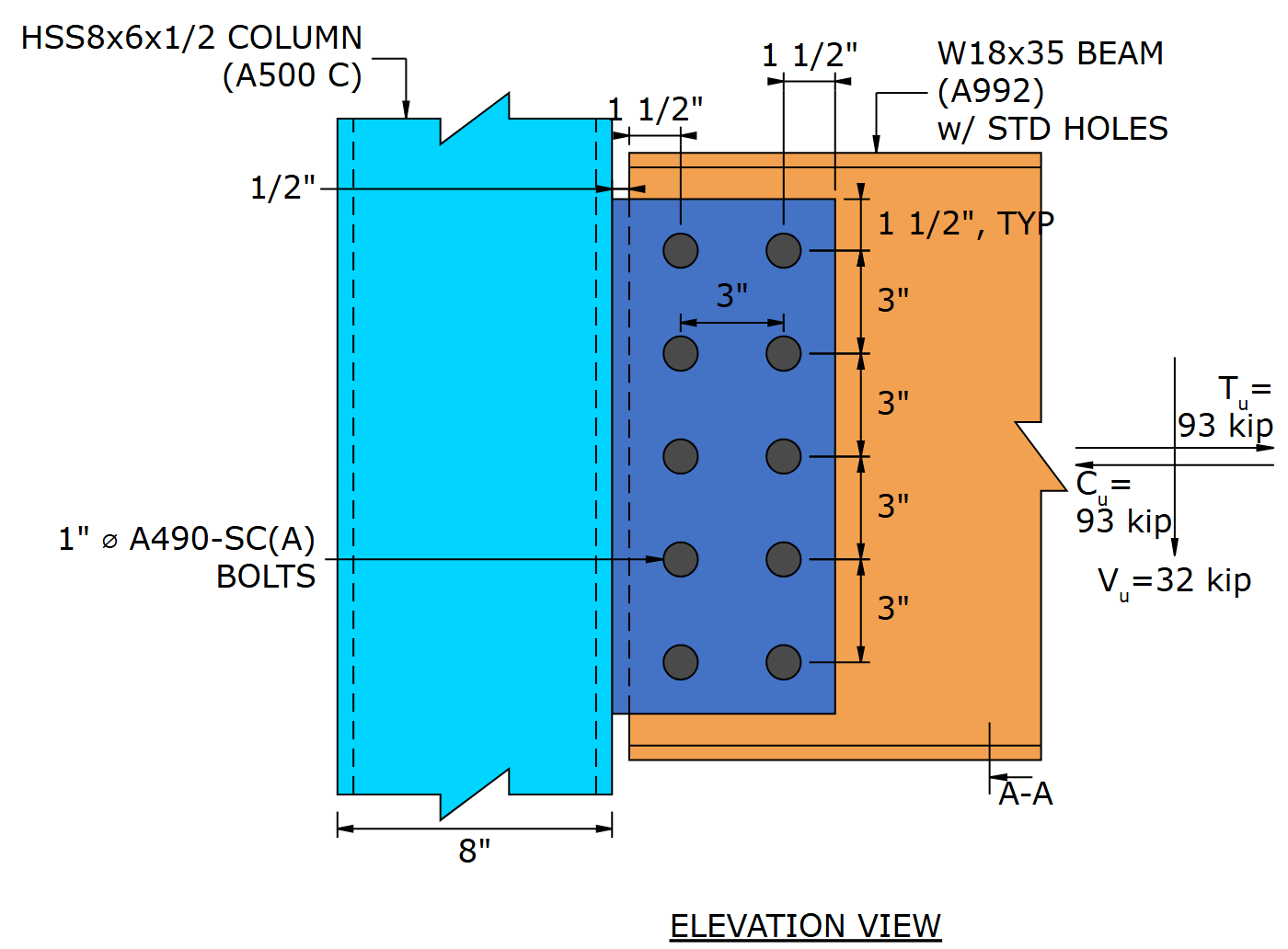
示例连接的标高, with the shear and the axial tension and compression acting at the bolt group.
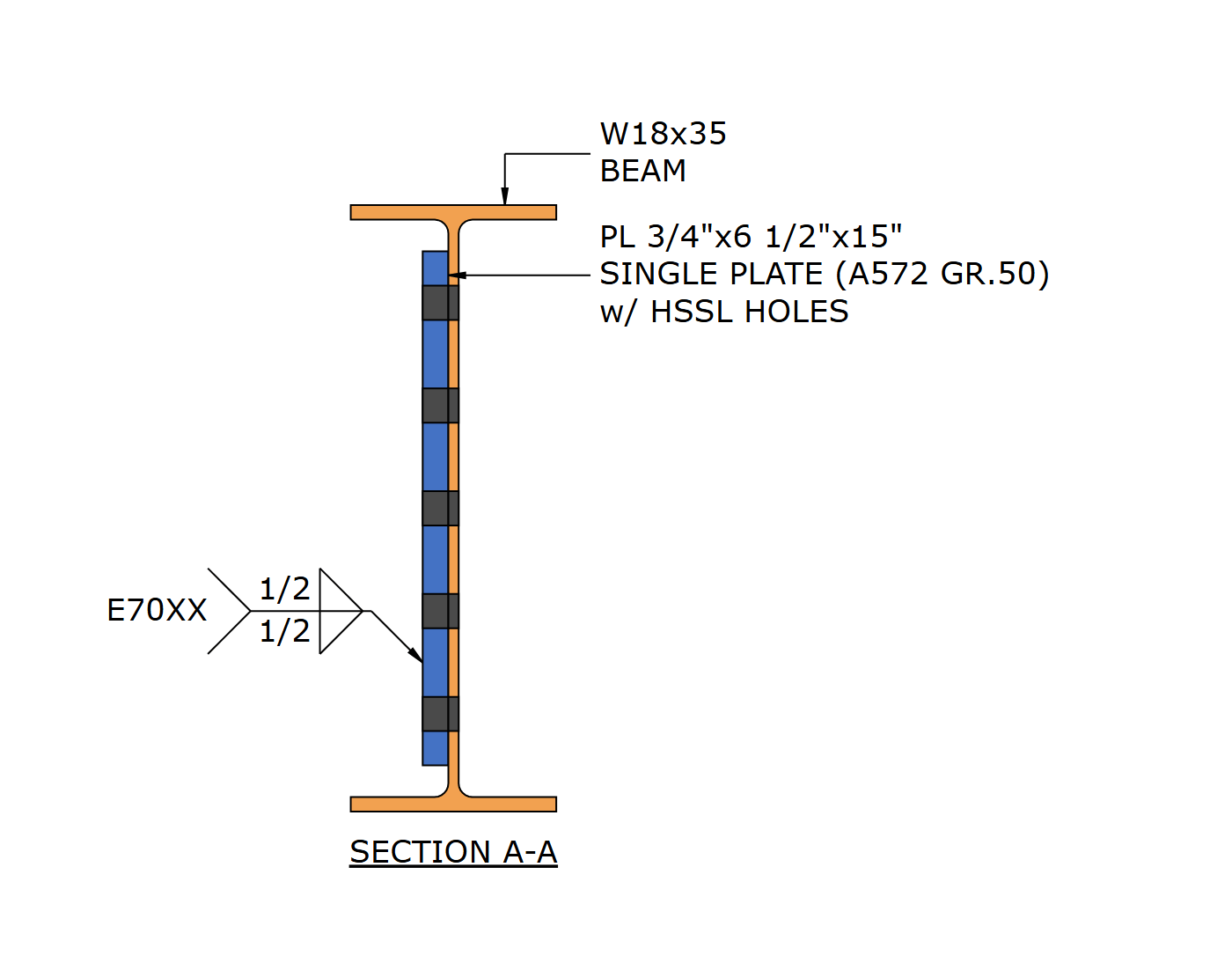
A-A部分. 板上有水平短槽孔和 1/2 两侧角焊缝.
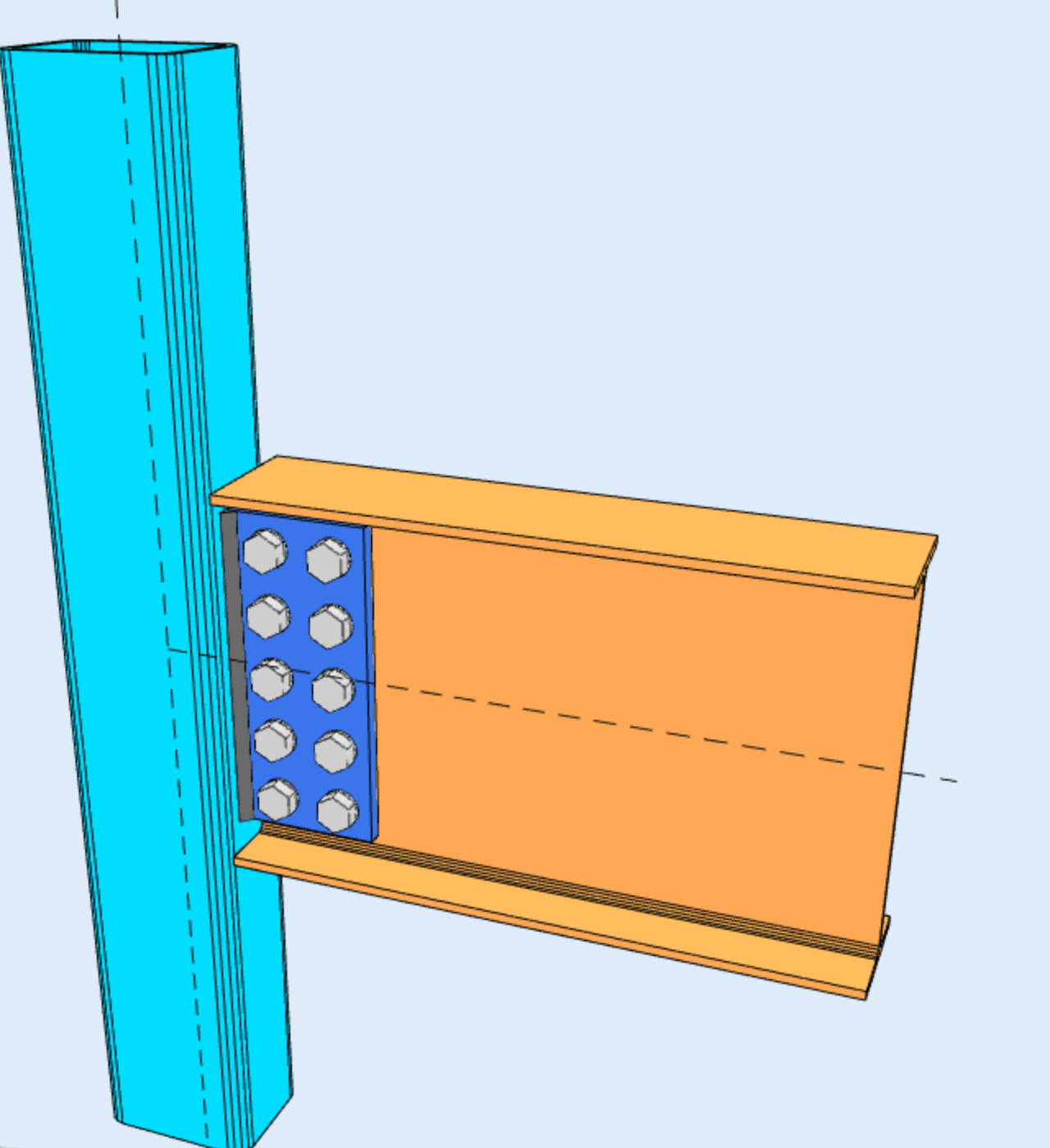
3SkyCiv 连接设计中连接的 D 视图.
步骤一览
The report runs 28 支票. The ones in bold are added, or changed, by the axial force:
- Detailing limits at the beam.
- Bolt group in slip, under the resultant of shear and axial.
- 板材延展性.
- Bearing and tear-out on the plate, 剪力.
- Bearing and tear-out on the plate, 轴向拉力.
- Bearing and tear-out on the plate, 轴向压缩.
- Shear and axial interaction, 板轴承.
- Bearing and tear-out on the beam web, 剪力.
- Bearing and tear-out on the beam web, 轴向拉力.
- Bearing and tear-out on the beam web, 轴向压缩.
- Shear and axial interaction, beam web bearing.
- Block shear of the plate, 剪力.
- Block shear of the plate, 轴向的.
- Shear and axial interaction, plate block shear.
- Shear yielding and rupture of the plate.
- 板挠曲.
- Plate tension yielding and rupture.
- 剪力, tension and flexure interaction, 屈服.
- 剪力, tension and flexure interaction, 破裂.
- 板压缩.
- 剪力, compression and flexure interaction.
- 梁腹板的块剪, 轴向的.
- 梁拉力断裂.
- HSS 墙的详细限制.
- 焊接显影板.
- Weld to the HSS wall, under the resultant.
- 高速钢壁冲孔.
- HSS wall under the axial force.
本示例的设计输入
设计代码为AISC 360-16 LRFD. The beam and column are the same as in the shear-only example; 螺栓, plate and weld are larger to carry the axial force. How the loads are entered is explained in 载荷和载荷组合.
| 物品 | 象征 | 值 |
|---|---|---|
| 因式剪切 | [mathin] V_{u} [mathin] | 32 kip |
| 轴向拉力系数 | [mathin] T_{u} [mathin] | 93 kip |
| 轴向压缩系数 | [mathin] C_{u} [mathin] | 93 kip |
| Beam | 宽18x35, ASTM A992 (d = 17.7 在, tw = 0.3 在, 一个= 10.3 英寸², 飞云 / Fu = 50 / 65 KSI) | |
| 柱 | 高速钢8x6x1/2, ASTM A500 组. C (飞云 / Fu = 50 / 62 KSI) | |
| HSS wall width / design thickness / workable flat | [mathin] b,\ t,\ W_{flat} [mathin] | 6 在 / 0.465 在 / 4.875 在 |
| 物品 | 象征 | 值 |
|---|---|---|
| 单板 | PL 3/4 X 6 1/2 X 15, ASTM A572 Gr. 50 (飞云 / Fu = 50 / 65 KSI) | |
| 螺栓 | 1 在 A490-SC 中, Class A faying surface | |
| Bolt shear stress / 拉应力 | [mathin] F_{nv},\ F_{nt} [mathin] | 68 KSI / 113 KSI |
| 洞 | 盘子: 水平短槽 (高速SSL). 梁网: 标准 (性病) | |
| 焊接到 HSS 壁上 | 1/2 在两侧的圆角处, E70XX | |
| 螺栓排 / 行距 | [mathin] n_{r},\ s_{r} [mathin] | 5 / 3 在 |
| 螺栓柱 / 列间距 | [mathin] n_{c},\ s_{c} [mathin] | 2 / 3 在 |
| Weld line to first bolt line | [mathin] a [mathin] | 2 在 |
| Edge distances, plate and beam | 1.5 在 | |
| 设计偏心率 (手动表 10-9) | [mathin] e [mathin] | 3.5 在 |
步骤 1: 梁侧的详细限制 (AISC 360-16 J3.3, J3.4)
The same limits as for the shear-only connection, now for a 1 在螺栓中: 2.667 in minimum spacing, 1.25 in minimum edge from Table J3.4, 和 1.375 in at the plate’s slotted horizontal edge.
| 详细限制 | 限制 (在) | 实际的 (在) | 直流电 | 结果 |
|---|---|---|---|---|
| Minimum bolt row / 列间距 | 2.667 | 3.000 | 0.889 | 通过 |
| Maximum bolt row / 列间距 | 6.000 | 3.000 | 0.500 | 通过 |
| 板材最小垂直边距 | 1.250 | 1.500 | 0.833 | 通过 |
| 板材最小水平边距 | 1.375 | 1.500 | 0.917 | 通过 |
| 梁最小水平边距 | 1.250 | 1.500 | 0.833 | 通过 |
| 最小连接深度 | 7.750 | 15.000 | 0.517 | 通过 |
| 最大连接深度 | 16.000 | 15.000 | 0.938 | 通过 |
[math] DCR = \frac{15\,in}{16\,in} = 0.938 [math]
DCR = 0.938 < 1.0, 行
步骤 2: Bolt group in slip under shear and axial (AISC 360-16 J3.8)
With slip-critical bolts the group is designed against slip, 情商. J3-4, for the resultant of the shear and the axial force. 偏心率是 3.5 in from Manual Table 10-9, and the ICOR coefficient for the inclined load on the 2 X 5 group is C = 8.41 (the IC converges at x = -0.78739 在, y = 13.997 在).
| 螺栓 | [R (kip) | 接收 (kip) | 瑞 (kip) | 锰 (小鸡) |
|---|---|---|---|---|
| 1 | 18.06 | 18.03 | 1.01 | 253.19 |
| 2 | 17.66 | 17.62 | 1.26 | 194.75 |
| 3 | 16.84 | 16.76 | 1.65 | 135.35 |
| 4 | 15.09 | 14.91 | 2.35 | 76.35 |
| 5 | 11.07 | 10.30 | 4.06 | 23.76 |
| 6 | 18.10 | 17.47 | 4.73 | 262.47 |
| 7 | 17.77 | 16.80 | 5.79 | 206.67 |
| 8 | 17.13 | 15.48 | 7.33 | 151.58 |
| 9 | 15.97 | 12.73 | 9.65 | 100.15 |
| 10 | 14.35 | 6.69 | 12.69 | 61.43 |
[math] R_{u} = \sqrt{V_{u}^{2} + T_{u}^{2}} = \sqrt{32^{2} + 93^{2}} = 98.351\,kip [math]
[math] \phi R_{n} = \phi\, \mu\, D_{u}\, h_{f}\, T_{b}\, N_{s}\, C = (0.85) \times (0.3) \times (1.13) \times (1) \times (64\,kip) \times (1) \times (8.41) = 155.09\,kip [math]
DCR = 98.351 kip / 155.09 基普= 0.634 < 1.0, 行
步骤 3: 板材延展性 (AISC 手册页 10-89)
Unlike the shear-only example, this layout does need the check. The moment coefficient of the group is C’ = 38.669 在:
[math] M_{max} = \frac{F_{nv}}{0.9}\, \frac{\pi}{4} d_{b}^{2}\, C’ = \frac{68\,ksi}{0.9} \times \frac{\pi}{4} (1\,in)^{2} \times (38.669\,in) = 191.22\,kip\text{-}ft [math]
[math] t_{max} = \frac{6 M_{max}}{F_{yp} d_{p}^{2}} = \frac{6 \times (191.22\,kip\text{-}ft)}{(50\,ksi) \times (15\,in)^{2}} = 1.2238\,in [math]
DCR = 0.75 在 / 1.2238 在 = 0.613 < 1.0, 行
步骤 4: Plate bearing and tear-out under shear (AISC 360-16 J3.10)
As in the shear-only example, 与 [mathin] d_{h} = 1.125\,in [mathin], an edge clear distance of 0.9375 在和 1.875 in between bolts, scaled by C over the five bolts in a line:
[math] \phi R_{n} = (0.75) \left[ \min(1.2 \times 0.9375, 2.4) \times 0.75 \times 65 + \min(1.2 \times 1.875, 2.4) \times 0.75 \times 65 \times 4 \right] \times \frac{8.41}{5} = 622.67\,kip [math]
DCR = 32 kip / 622.67 基普= 0.051 < 1.0, 行
步骤 5: Plate bearing and tear-out under axial tension (AISC 360-16 J3.10)
Under tension the bolts bear on the plate toward its free end. The hole dimension along the slot is [mathin] d_{h} = 1.3125\,in [mathin], so the clear distances are:
[math] l_{c1} = L_{eh\_pl} – \frac{d_{h}}{2} = 1.5 – 0.65625 = 0.84375\,in, \qquad l_{c2} = s_{c} – d_{h} = 1.6875\,in [math]
Along the axial direction there are two bolts in each row, the outer one at the edge and the inner one behind it. The sum is scaled by C over the two bolt columns:
[math] \phi R_{n} = (0.75) \left[ \min(1.2 \times 0.84375, 2.4) \times 0.75 \times 65 + \min(1.2 \times 1.6875, 2.4) \times 0.75 \times 65 \times (2 – 1) \right] \times \frac{8.41}{2} = 467\,kip [math]
DCR = 93 kip / 467 基普= 0.199 < 1.0, 行
步骤 6: Plate bearing and tear-out under axial compression (AISC 360-16 J3.10)
Under compression the bolts bear on the plate toward the support. The edge distance for the bolt nearest the wall is the 2 焊缝到螺栓的距离:
[math] l_{c1} = a – \frac{d_{h}}{2} = 2 – 0.65625 = 1.3438\,in, \qquad l_{c2} = 1.6875\,in [math]
[math] \phi R_{n} = (0.75) \left[ \min(1.2 \times 1.3438, 2.4) \times 0.75 \times 65 + \min(1.2 \times 1.6875, 2.4) \times 0.75 \times 65 \times (2 – 1) \right] \times \frac{8.41}{2} = 559.25\,kip [math]
DCR = 93 kip / 559.25 基普= 0.166 < 1.0, 行
步骤 7: Shear and axial interaction of plate bearing
The axial direction with the larger ratio of load to bearing strength is used, here tension:
[math] \left( \frac{V_{u}}{\phi R_{n,V}} \right)^{2} + \left( \frac{T_{u}}{\phi R_{n,T}} \right)^{2} = \left( \frac{32}{622.67} \right)^{2} + \left( \frac{93}{467} \right)^{2} = 0.042299 [math]
DCR = 0.042 < 1.0, 行
步骤 8: Beam web bearing and tear-out under shear (AISC 360-16 J3.10)
[math] \phi R_{n} = (0.75) \times \min(1.2 \times 1.875, 2.4) \times (0.3\,in) \times (65\,ksi) \times (8.41) = 276.74\,kip [math]
DCR = 32 kip / 276.74 基普= 0.116 < 1.0, 行
步骤 9: Beam web bearing and tear-out under axial tension (AISC 360-16 J3.10)
Under tension the bolts bear on the beam web toward the end of the beam, so the edge bolt uses the 1.5 in beam horizontal edge distance:
[math] l_{c1} = 1.5 – \frac{1.125}{2} = 0.9375\,in, \qquad l_{c2} = 3 – 1.125 = 1.875\,in [math]
[math] \phi R_{n} = (0.75) \left[ \min(1.2 \times 0.9375, 2.4) \times 0.3 \times 65 + \min(1.2 \times 1.875, 2.4) \times 0.3 \times 65 \times (2 – 1) \right] \times \frac{8.41}{2} = 207.56\,kip [math]
DCR = 93 kip / 207.56 基普= 0.448 < 1.0, 行
步骤 10: Beam web bearing and tear-out under axial compression (AISC 360-16 J3.10)
Under compression the bolts bear toward the span, where the web is continuous. The farthest bolt has no edge beyond it, so it takes full bearing, 2.4 螺栓的剪切强度:
[math] \phi R_{n} = (0.75) \left[ 2.4 \times 1 \times 0.3 \times 65 + \min(1.2 \times 1.875, 2.4) \times 0.3 \times 65 \times (2 – 1) \right] \times \frac{8.41}{2} = 285.97\,kip [math]
DCR = 93 kip / 285.97 基普= 0.325 < 1.0, 行
步骤 11: Shear and axial interaction of beam web bearing
Tension governs again:
[math] \left( \frac{32}{276.74} \right)^{2} + \left( \frac{93}{207.56} \right)^{2} = 0.21414 [math]
DCR = 0.214 < 1.0, 行
步骤 12: Plate block shear under shear (AISC 360-16 J4.3)
The block runs down the two bolt lines and out to the free edge. The report takes [mathin] U_{bs} = 0.5 [mathin] for this two-column layout:
[math] A_{nt} = 1.8281\,in^{2}, \quad A_{gv} = 10.125\,in^{2}, \quad A_{nv} = 6.1172\,in^{2} [math]
[math] \phi R_{n} = 0.75 \left( 0.6 \times 65 \times 6.1172 + 0.5 \times 65 \times 1.8281 \le 0.6 \times 50 \times 10.125 + 0.5 \times 65 \times 1.8281 \right) = 223.49\,kip [math]
DCR = 32 kip / 223.49 基普= 0.143 < 1.0, 行
步骤 13: Plate block shear under axial load (AISC 360-16 J4.3)
Under the axial force the block tears out in the other direction: tension across the bolt rows to one plate edge, and shear along the outer bolt row to the plate end.
[math] A_{nt} = 0.75 \left[ (5 – 1) \times 3 + 1.5 – 4.5 \times (1.1875) \right] = 6.1172\,in^{2} [math]
[math] A_{gv} = 0.75 \left[ 1.5 + (2 – 1) \times 3 \right] = 3.375\,in^{2} [math]
[math] A_{nv} = 0.75 \left[ 6.5 – 2 – 1.5 \times (1.3125 + 0.0625) \right] = 1.8281\,in^{2} [math]
[math] \phi R_{n} = 0.75 \left( 0.6 \times 65 \times 1.8281 + 65 \times 6.1172 \le 0.6 \times 50 \times 3.375 + 65 \times 6.1172 \right) = 351.69\,kip [math]
DCR = 93 kip / 351.69 基普= 0.264 < 1.0, 行
步骤 14: Shear and axial interaction of plate block shear
[math] \left( \frac{32}{223.49} \right)^{2} + \left( \frac{93}{351.69} \right)^{2} = 0.090431 [math]
DCR = 0.090 < 1.0, 行
步骤 15: Plate shear yielding and rupture (AISC 360-16 J4.2)
[math] \phi R_{n\_sy} = 1.0 \times 0.6 \times 50 \times 11.25 = 337.5\,kip, \qquad \phi R_{n\_sr} = 0.75 \times 0.6 \times 65 \times 6.7969 = 198.81\,kip [math]
DCR = 32 kip / 198.81 基普= 0.161 < 1.0, 行
步骤 16: 使用双内盖梁程序进行板弯曲 (AISC 360-16 F11.2)
The same procedure as the shear-only example, 超过 2 从焊缝到螺栓线. With Lb d / t² = 53.333, 之间 46.4 和 1102, 情商. F11-2 applies and the plate reaches its plastic moment:
[math] \phi M_{n} = 0.9 \times \min\left[ C_{b} \left( 1.52 – 0.274 \times 53.333 \times \frac{50}{29000} \right) \times 50 \times 28.125,\; 50 \times 42.188 \right] = 158.2\,kip\text{-}ft \;\Rightarrow\; \phi V_{n} = 949.22\,kip [math]
[math] Z_{net} = 25.892\,in^{3}, \qquad \phi M_{n} = 0.75 \times 65 \times 25.892 = 105.19\,kip\text{-}ft \;\Rightarrow\; \phi V_{n} = 631.11\,kip [math]
DCR = 32 kip / 631.11 基普= 0.051 < 1.0, 行
步骤 17: Plate tension yielding and rupture (AISC 360-16 J4.1)
The plate is a tension member for the axial force, checked on its full 15 深入:
[math] \phi R_{n\_ty} = 0.9 \times F_{yp}\, t_{p}\, d_{p} = 0.9 \times 50 \times 0.75 \times 15 = 506.25\,kip [math]
[math] \phi R_{n\_tr} = 0.75 \times F_{up}\, t_{p} \left[ d_{p} – n_{r} (d_{h} + 0.0625) \right] = 0.75 \times 65 \times 0.75 \left[ 15 – 5 \times (1.1875) \right] = 331.35\,kip [math]
DCR = 93 kip / 331.35 基普= 0.281 < 1.0, 行
步骤 18: 剪力, tension and flexure interaction, 屈服 (AISC手册部分 10)
[math] \left( \frac{T_{u}}{2 \phi R_{n\_ty}} + \frac{V_{u}}{\phi V_{n}} \right)^{2} + \left( \frac{V_{u}}{\phi R_{n\_sy}} \right)^{2} = \left( \frac{93}{2 \times 506.25} + \frac{32}{949.22} \right)^{2} + \left( \frac{32}{337.5} \right)^{2} = 0.024756 [math]
DCR = 0.025 < 1.0, 行
步骤 19: 剪力, tension and flexure interaction, 破裂 (AISC手册部分 10)
[math] \left( \frac{T_{u}}{\phi R_{n\_tr}} + \frac{8 V_{u}}{9 \phi V_{n}} \right)^{2} + \left( \frac{V_{u}}{\phi R_{n\_sr}} \right)^{2} = \left( \frac{93}{331.35} + \frac{8 \times 32}{9 \times 631.11} \right)^{2} + \left( \frac{32}{198.81} \right)^{2} = 0.13202 [math]
DCR = 0.132 < 1.0, 行
步骤 20: 板压缩 (AISC 360-16 J4.4)
KL/r of the plate is no more than 25, 所以方程. J4-6 applies with no buckling reduction:
[math] \phi R_{n} = 0.9\, F_{yp}\, t_{p}\, d_{p} = 0.9 \times 50 \times 0.75 \times 15 = 506.25\,kip [math]
DCR = 93 kip / 506.25 基普= 0.184 < 1.0, 行
步骤 21: 剪力, compression and flexure interaction (AISC手册部分 10)
[math] \left( \frac{C_{u}}{2 \phi R_{n}} + \frac{V_{u}}{\phi V_{n}} \right)^{2} + \left( \frac{V_{u}}{\phi R_{n\_sy}} \right)^{2} = \left( \frac{93}{2 \times 506.25} + \frac{32}{949.22} \right)^{2} + \left( \frac{32}{337.5} \right)^{2} = 0.024756 [math]
DCR = 0.025 < 1.0, 行
步骤 22: Beam web block shear under axial load (AISC 360-16 J4.3)
The tension force can also tear a block out of the beam web: tension across the five bolt rows and shear along the top and bottom rows to the beam end.
[math] A_{nt} = 0.3 \left[ (5 – 1) \times 3 – (5 – 1) \times (1.1875) \right] = 2.175\,in^{2} [math]
[math] A_{gv} = 2 \times 0.3 \left[ 1.5 + 3 \right] = 2.7\,in^{2}, \qquad A_{nv} = 2 \times 0.3 \left[ 3 + 1.5 – 1.5 \times (1.1875) \right] = 1.6313\,in^{2} [math]
[math] \phi R_{n} = 0.75 \left( 0.6 \times 65 \times 1.6313 + 65 \times 2.175 \le 0.6 \times 50 \times 2.7 + 65 \times 2.175 \right) = 153.75\,kip [math]
DCR = 93 kip / 153.75 基普= 0.605 < 1.0, 行
步骤 23: 梁拉力断裂 (AISC 360-16 D3, J4.1)
仅用螺栓固定腹板, so shear lag reduces the effective net area of the beam. The report uses U = 0.73655 from Table D3.1 case 2:
[math] \phi R_{n\_tr} = 0.75 \times 65 \times 0.73655 \left[ 10.3 – 5 \times (1.125 + 0.0625) \times 0.3 \right] = 305.88\,kip [math]
DCR = 93 kip / 305.88 基普= 0.304 < 1.0, 行
步骤 24: HSS 墙的详细限制
The weld-on-flat and slenderness values are the module’s limits for a single plate on an HSS wall.
| 详细限制 | 限制 (在) | 实际的 (在) | 直流电 | 结果 |
|---|---|---|---|---|
| 每个梁间隙的最大角焊缝尺寸 | 0.500 | 0.500 | 1.000 | 通过 |
| 每个 HSS 工作平面的最大角焊缝尺寸 | 1.538 | 0.500 | 0.325 | 通过 |
| 最大高速钢壁长细比 b/t | 33.716 | 9.903 | 0.294 | 通过 |
该 1/2 in weld exactly fills the 1/2 光束间隙, 这是允许的:
[math] DCR = \frac{0.5\,in}{0.5\,in} = 1.000 [math]
DCR = 1.000, 行
步骤 25: 开发单板所需的焊接 (AISC 手册页 10-87)
[math] W_{duc} = \frac{5}{8} \times (0.75\,in) = 0.46875\,in [math]
DCR = 0.46875 在 / 0.5 在 = 0.938 < 1.0, 行
步骤 26: Fillet weld strength to the HSS wall under the resultant (AISC 360-16 J2.4)
The weld now carries the resultant of the shear and the axial force, at an angle to its axis. That angle earns the directional strength increase of Eq. J2-5, which a pure shear load on a vertical weld does not get:
[math] \theta = 71.012^{\circ}, \qquad D_{max} = \frac{(0.375)(65) \le (0.465)(62)}{3.09} = 7.8883, \qquad L_{w} = 2 \left[ 15 – 2 \times 0.5 \right] = 28\,in [math]
[math] \phi R_{n} = 0.75 \times 0.6 \times 70 \times \frac{\sqrt{2}}{2} \times \min\left(0.5, \frac{7.8883}{16}\right) \times \left[ 1 + 0.5 \sin^{1.5}(71.012) \right] \times 28 = 448.85\,kip [math]
DCR = 98.351 kip / 448.85 基普= 0.219 < 1.0, 行
步骤 27: 高速钢壁冲孔 (AISC 手动方程式. 10-7b, 页 10-153)
[math] \phi R_{n} = \frac{0.75 \times 62 \times 0.465 \times 15^{2}}{5 \times 3.5} = 278\,kip [math]
DCR = 32 kip / 278 基普= 0.115 < 1.0, 行
步骤 28: HSS wall under the axial force
This is the check the axial force exists for. The plate pulls (or pushes) on the middle of the tube wall, and the wall resists by forming a yield line pattern across its workable flat. The report uses the yield line expression it attributes to R. Kapp, which is the software’s method for this limit state:
[math] \phi R_{n} = 0.75 \left[ \frac{F_{ys}\, t^{2}\, d_{p}}{0.5 (W_{flat} – t_{p})} + 4 F_{ys}\, t^{2} \sqrt{1 + \frac{t_{p}}{W_{flat} – t_{p}}} \right] [math]
[math] \phi R_{n} = 0.75 \left[ \frac{50 \times 0.465^{2} \times 15}{0.5 \times (4.875 – 0.75)} + 4 \times 50 \times 0.465^{2} \times \sqrt{1 + \frac{0.75}{4.875 – 0.75}} \right] = 94.23\,kip [math]
DCR = 93 kip / 94.23 基普= 0.987 < 1.0, 行
The first term grows with the plate depth and falls as the workable flat gets wider, and both terms grow with the square of the wall thickness. That is why the wall, not the bolts or the plate, sets the axial capacity of this connection.
设计检查总结
| 设计检查 | 需求 | 容量 | 直流电 | 结果 |
|---|---|---|---|---|
| 梁侧细节 | 15 深入 | 16 最大 | 0.938 | 通过 |
| Bolt group in slip (结果) | 98.351 kip | 155.09 kip | 0.634 | 通过 |
| 板材延展性 | 0.75 在 | 1.2238 在 | 0.613 | 通过 |
| 板式轴承, 剪力 | 32 kip | 622.67 kip | 0.051 | 通过 |
| 板式轴承, 轴向拉力 | 93 kip | 467 kip | 0.199 | 通过 |
| 板式轴承, 轴向压缩 | 93 kip | 559.25 kip | 0.166 | 通过 |
| Plate bearing interaction | 0.042 | 通过 | ||
| 梁腹板轴承, 剪力 | 32 kip | 276.74 kip | 0.116 | 通过 |
| 梁腹板轴承, 轴向拉力 | 93 kip | 207.56 kip | 0.448 | 通过 |
| 梁腹板轴承, 轴向压缩 | 93 kip | 285.97 kip | 0.325 | 通过 |
| Beam web bearing interaction | 0.214 | 通过 | ||
| 板块剪切, 剪力 | 32 kip | 223.49 kip | 0.143 | 通过 |
| 板块剪切, 轴向的 | 93 kip | 351.69 kip | 0.264 | 通过 |
| Plate block shear interaction | 0.090 | 通过 | ||
| Plate shear yielding and rupture | 32 kip | 198.81 kip | 0.161 | 通过 |
| 板挠曲 | 32 kip | 631.11 kip | 0.051 | 通过 |
| Plate tension | 93 kip | 331.35 kip | 0.281 | 通过 |
| 相互作用, tension yielding | 0.025 | 通过 | ||
| 相互作用, tension rupture | 0.132 | 通过 | ||
| 板压缩 | 93 kip | 506.25 kip | 0.184 | 通过 |
| 相互作用, 压缩 | 0.025 | 通过 | ||
| 梁腹块剪, 轴向的 | 93 kip | 153.75 kip | 0.605 | 通过 |
| 梁拉力断裂 | 93 kip | 305.88 kip | 0.304 | 通过 |
| HSS 墙的细节 | 0.5 在焊缝中 | 0.5 最大 | 1.000 | 通过 |
| 焊接显影板 | 0.46875 在 | 0.5 在 | 0.938 | 通过 |
| 焊接到 HSS 壁上 (结果) | 98.351 kip | 448.85 kip | 0.219 | 通过 |
| 高速钢壁冲孔 | 32 kip | 278 kip | 0.115 | 通过 |
| HSS wall under axial | 93 kip | 94.23 kip | 0.987 | 通过 |
连接通过了每项检查. The HSS wall under the 93 kip axial force governs at 0.987, and the next strength checks are the bolt group in slip (0.634) and block shear of the beam web (0.605). Everything in the plate is lightly loaded. The two ratios at 0.938 和 1.000 are detailing and weld sizing rules, not load against capacity.
如果检查失败要更改什么
- HSS wall under axial: this is the usual limit. A thicker HSS wall helps most, because the strength grows with the square of the wall thickness. A deeper plate also helps. If neither can change, the axial force needs a different connection type.
- Bolt slip or bearing: add bolt rows or a bolt column, 或使用更大的螺栓. For bearing under tension, a larger edge distance to the free end helps.
- Beam web block shear or beam tension rupture: add bolt rows to lengthen the block and raise U, or use a beam with a thicker web.
- Plate tension, compression or block shear: make the plate deeper or thicker, while keeping the ductility check below 1.0.
- 焊接: a larger weld, as long as it fits within the beam clearance and on the workable flat.
Auto Design is available for the single plate connection to an HSS column with shear and axial load. 它改变了螺栓, 板材和焊接直到每项检查都通过, 并保留您输入的成员和负载. 见 汽车设计 其适用的首选项页面.
常见问题
Why are the bolts slip-critical in this example?
A beam carrying both shear and an axial force that reverses between tension and compression is a typical case for slip-critical bolts, so the joint does not slip back and forth through the hole clearance. The report then checks the group against slip with Eq. J3-4 under the resultant of the two forces.
Why does the report check bearing in two axial directions?
In tension the bolts bear toward the free end of the plate and the end of the beam, where the edge distance is short. In compression they bear toward the support and the span, where the plate edge is the weld line and the beam web is continuous. The two give different tear-out strengths, so both are checked, and the interaction uses the direction with the larger ratio.
Why is the weld stronger under the combined load than under shear alone?
A fillet weld loaded at an angle to its axis is stronger than one loaded along it, by the factor 1 + 0.5 sin^1.5 of the angle in Eq. J2-5. The resultant here is at 71 degrees to the weld, which raises the weld strength by about 46%.
How does the shear-only connection compare?
The shear-only example, 单板至高速钢立柱连接设计, uses three 3/4 in bolts and a 3/8 in plate on the same beam and tube, and is governed by bolt shear at 0.660. The axial force here needs ten 1 in bolts and a 3/4 在盘子里, and the tube wall becomes the limit.
Can the axial force be larger with this tube?
Not by much. 在 93 kip the HSS wall check is already at 0.987. For a larger axial force, 使用厚壁管或更深的板.
Design a shear and axial single plate to HSS column connection for free
此页上的每个数字都来自一个解决方案. 选择与 HSS 柱的单板连接, 输入你的光束, 管子, 螺栓, 剪切和轴向载荷, 并在浏览器中查看每项检查. 没有什么可安装的.
SkyCiv Connection Design 模块是本示例背后的连接设计软件. 它为您提供完整的计算报告,其中包含每个方程和您的数字, 就像上面的步骤一样, 加上每个容量和 DCR, 对于AISC 360-22 和AISC 360-16 (LRFD 和 ASD) 并作为 4100:2020. 该 螺栓计算器 和 焊接计算器 自行覆盖螺栓组和焊接检查.
参考资料
- AISC 360-16, 钢结构建筑规范: D3 (表D3.1), F11.2 (情商. F11-2), J2.4 (情商. J2-4, J2-5), J3.3, J3.4 (表J3.4), J3.5 (表 J3.5), J3.8 (情商. J3-4), J3.10 (情商. J3-6a, J3-6c), J4.1 (情商. J4-1, J4-2), J4.2 (情商. J4-3, J4-4), J4.3 (情商. J4-5), J4.4 (情商. J4-6).
- AISC 钢结构手册, 15第版: 部分 9, 情商. 9-2, 9-4 和 9-15; 部分 10, 桌子 10-9, 首先介绍你自己和你申请的职位 10-87 和 10-89 (情商. 10-3, 10-4), 情商. 10-7b (页 10-153); 部分 15, 桌子 15-3.
- HSS wall under axial load: yield line analysis by R. Kapp, as used in the report.
- 如何设计单板剪切连接 (W型柱)
- 使用 AISC 进行钢连接设计 360-16

哈罗德穆纳勒姆
产品经理, 连接设计
10+ 从事钢结构连接设计多年
领英
