
A shear end plate that also carries an axial force works much harder than one that only takes the beam reaction. The axial tension pulls the end plate away from the column, so to AISC 360 the bolts are checked in combined tension and shear, the end plate and the column flange are checked for prying, the web weld takes the resultant of both forces, and the column web is checked under the axial force as a concentrated load.
This page works through one real end plate shear and axial connection from start to finish: a W18x35 beam with a 3/4 in end plate welded to its web, bolted to the flange of a W14x90 column with six 3/4 在 A325-N 螺栓中, 携带一个 32 基普剪切和 93 轴向拉伸或压缩的 kip. 它是为 AISC 设计的 360-16 LRFD 和 AISC 手册第 15 版. 每个方程都用它的数字写出来, 按照与 AISC 计算表相同的顺序 SkyCiv Connection Design 模块为其生成.
What the axial force adds to an end plate shear connection
A shear end plate is a plate shop welded to the end of the beam web and bolted to the support on site. It stops short of the beam flanges, so it carries shear and axial force but not a moment. 该 shear-only end plate example covers the case with the beam reaction alone.
With an axial force, the plate is pushed onto the column flange in compression and pulled away from it in tension. In tension the bolts work in combined tension and shear, the plate bends between the bolts and the beam web, and the column flange bends between the bolts and the column web, so both are checked for prying. The web weld carries the resultant of the shear and the axial force. 该 端板连接计算器 covers both cases, and the other shear connection types are on the 剪力连接 页.
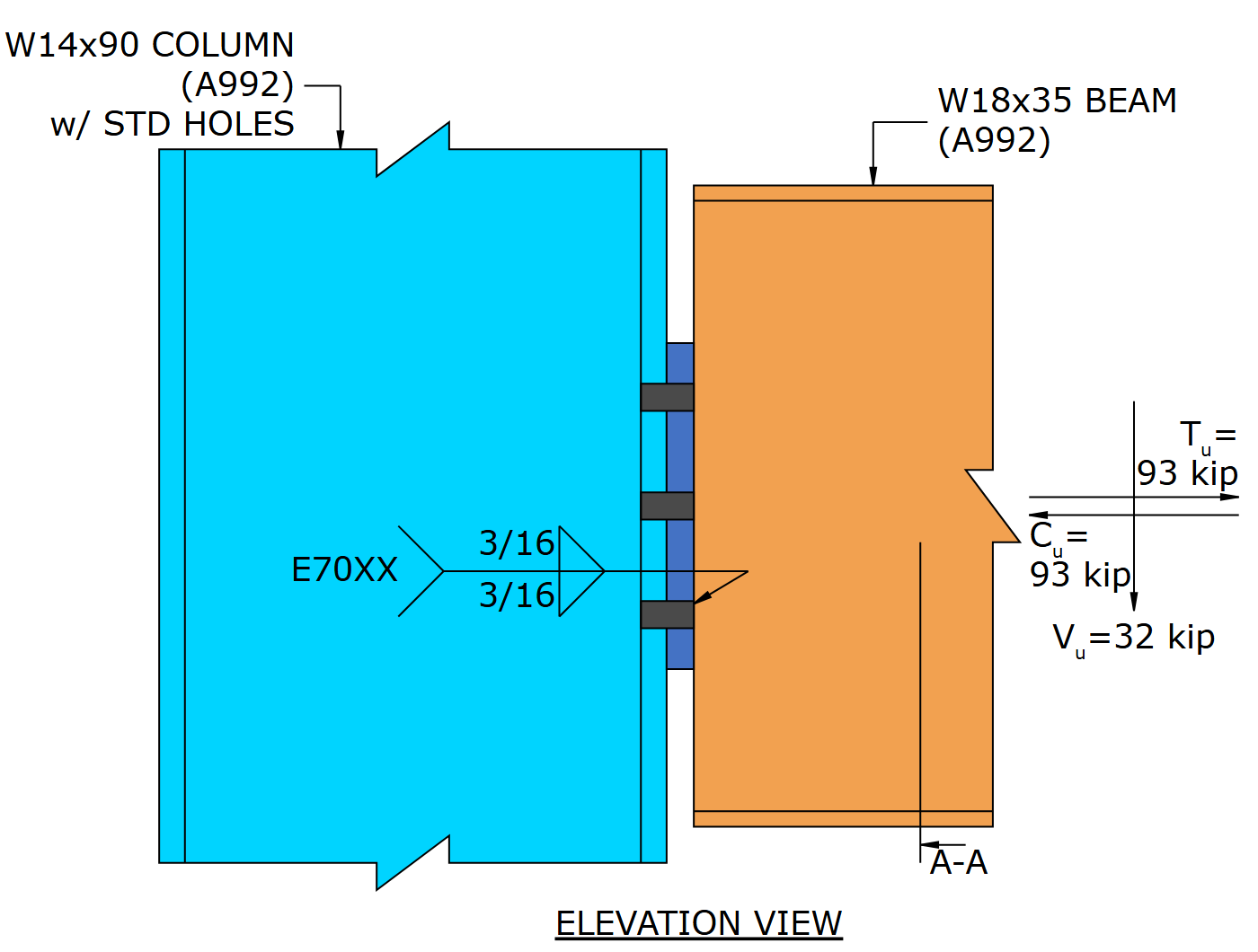
海拔. The end plate is welded to the W18x35 web with 3/16 in fillet welds on both sides and bolted to the W14x90 column flange.
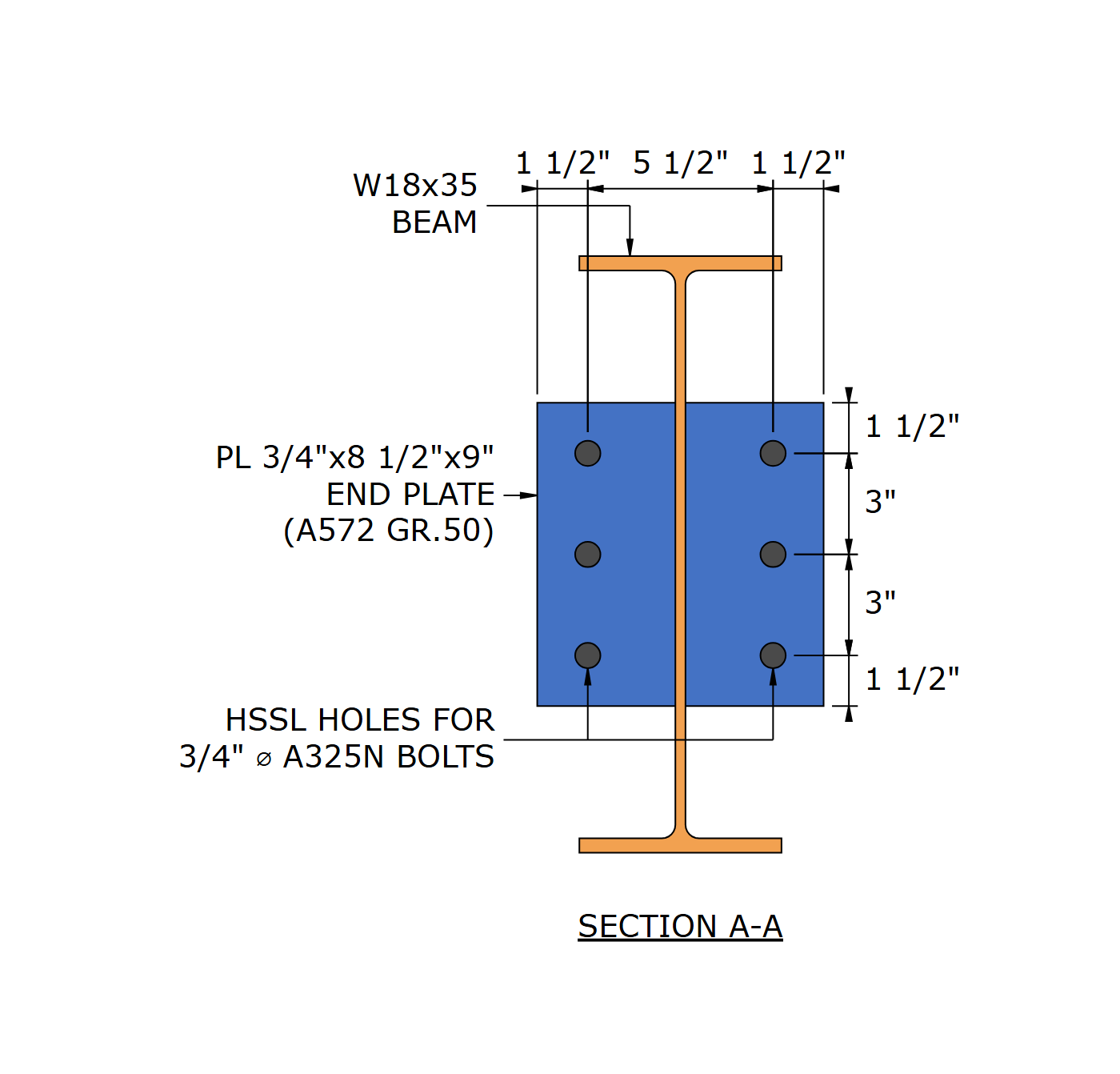
A-A部分. Three bolt rows at 3 in and a 5 1/2 在规格中, 与 1 1/2 in edge distances on the 8 1/2 在由 9 在盘子里.
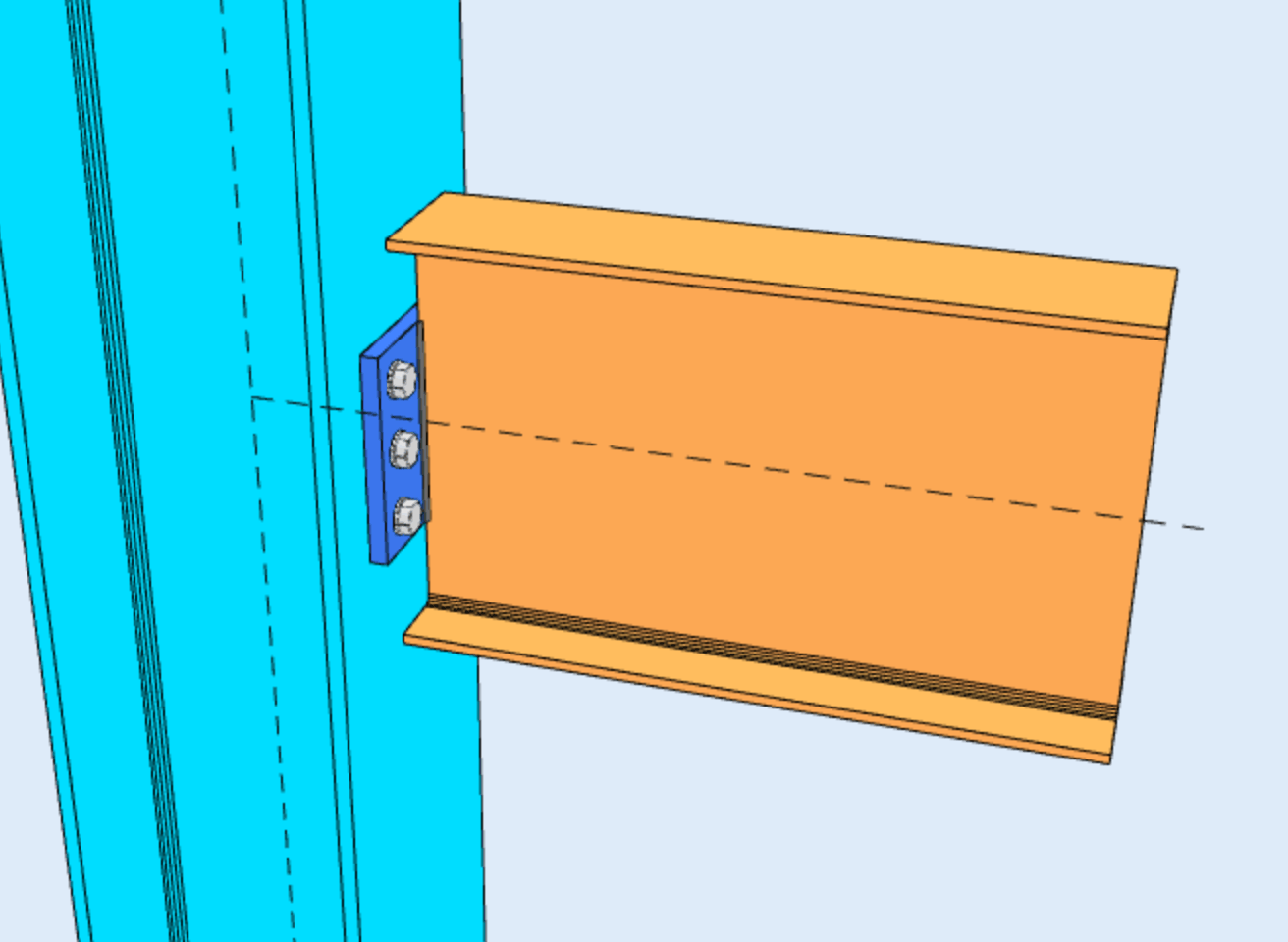
The same connection in the SkyCiv Connection Design 3D view.
End plate shear and axial design: 步骤一目了然
- 检查梁侧的细节限制.
- Check the fillet weld to the beam web for the resultant of the shear and axial force.
- 检查梁腹板的剪力.
- 检查支撑侧的详细限制.
- 检查螺栓是否处于剪切状态 (reduced for the tension), and bearing and tear-out on the end plate and the column flange.
- Check the end plate in block shear, 剪力, flexure and shear-flexure interaction.
- Check the bolts in tension, then prying of the end plate and of the column flange.
- Check the column web under the axial tension and the axial compression.
脚步 2, 5 和 12 至 16 below are where the axial force enters the design.
本示例的设计输入
设计代码为AISC 360-16 LRFD. 截面属性来自 AISC 手册. The beam’s T-dimension and kdet, used for the weld length, 是 15.5 在和 1.125 在. The column’s kdes, used in web local yielding, 是 1.31 在.
| 物品 | 象征 | 值 |
|---|---|---|
| 剪力 | [mathin] V_{u} [mathin] | 32 kip |
| 轴向张力 / 压缩 | [mathin] T_{u},\ C_{u} [mathin] | 93 kip / 93 kip |
| Beam | 宽18x35, A992 | |
| 波束深度 / 腹板厚度 | [mathin] d_{bm},\ t_{wb} [mathin] | 17.7 在 / 0.3 在 |
| 梁翼缘宽度 / 厚度 | [mathin] b_{fb},\ t_{fb} [mathin] | 6 在 / 0.425 在 |
| 光束产率 / 抗拉强度 | [mathin] F_{yb},\ F_{ub} [mathin] | 50 KSI / 65 KSI |
| 柱 | AISC 连接设计示例 | |
| 柱深 / 腹板厚度 | [mathin] d_{sup},\ t_{ws} [mathin] | 14 在 / 0.44 在 |
| 柱翼缘宽度 / 厚度 | [mathin] b_{fs},\ t_{fs} [mathin] | 14.5 在 / 0.71 在 |
| 柱产量 / 抗拉强度 | [mathin] F_{ys},\ F_{us} [mathin] | 50 KSI / 65 KSI |
| 弹性模量 | [mathin] E [mathin] | 29000 KSI |
| 物品 | 象征 | 值 |
|---|---|---|
| 端板 | PL 3/4 X 8 1/2 X 9, A572 Gr.50 | |
| 板宽 / 深度 / 厚度 | [mathin] b_{p},\ d_{p},\ t_{p} [mathin] | 8.5 在 / 9 在 / 0.75 在 |
| 板材产量 / 抗拉强度 | [mathin] F_{yp},\ F_{up} [mathin] | 50 KSI / 65 KSI |
| 螺栓 | 3/4 在A325N中, 包括线程 | |
| 螺栓直径 / 优势 | [mathin] d_{b},\ F_{nt},\ F_{nv} [mathin] | 0.75 在 / 90 KSI / 54 KSI |
| 洞 | 短槽卧式 (高速SSL) 在盘子里, standard in the column | |
| Weld to beam web | 3/16 in E70XX fillet, 双方 | |
| 焊缝尺寸 / 强度 | [mathin] W,\ F_{EXX} [mathin] | 0.1875 在 / 70 KSI |
| 几何 | 象征 | 值 |
|---|---|---|
| 螺栓排 / 行距 | [mathin] n_{r},\ s_{r} [mathin] | 3 / 3 在 |
| 螺栓柱 / 量具 | [mathin] n_{c},\ g [mathin] | 2 / 5.5 在 |
| Plate edge distances, 垂直 / 水平的 | [mathin] L_{ev},\ L_{eh} [mathin] | 1.5 在 / 1.5 在 |
| Column flange edge distance | [mathin] L_{eh\_sup} [mathin] | 4.5 在 |
步骤 1: 梁侧细部限制
该 9 in plate is deeper than the software’s 7.750 in minimum connection depth for the beam, a DCR of 0.86111.
步骤 2: Fillet weld to the beam web (AISC 360-16 J2.4, AISC 手动方程式. 9-2)
The weld carries the resultant of the shear and the axial force, [mathin] R_{u} = 98.351\ \text{kip} [mathin] (the square root of 32 squared plus 93 squared). The base metal limit uses half the beam web thickness, because the web is welded on both sides:
[math] D_{max} = \frac{\min(t_{p} F_{up},\ 0.5 t_{wb} F_{ub})}{3.09 \times F_{EXX}/F_{E70XX}} = \frac{\min(0.75 \times 65,\ 0.15 \times 65)}{3.09 \times 1} = 3.1553 [math]
The weld runs down both sides of the web, limited by the plate depth, the beam T-dimension and the web depth between the kdet zones, less twice the weld size at the ends:
[math] L_{w} = 2\left[\min(d_{p},\ T_{bm},\ d_{bm} – 2k_{det}) – 2W\right] = 2 \times \left[\min(9,\ 15.5,\ 17.7 – 1.125 – 1.125) – 2 \times 0.1875\right] = 17.25\ \text{in} [math]
The resultant acts at [mathin] \theta_{u} = 71.012^{\circ} [mathin] to the weld axis, so the directional strength increase applies. 该 3/16 in weld is smaller than [mathin] D_{max}/16 [mathin]:
[math] \phi R_{n} = \phi\ 0.6 F_{EXX} \frac{\sqrt{2}}{2} W \left[1 + 0.5 \sin^{1.5}\theta_{u}\right] L_{w} = 0.75 \times 0.6 \times 70 \times \frac{\sqrt{2}}{2} \times 0.1875 \times \left[1 + 0.5 \sin^{1.5}(71.012^{\circ})\right] \times 17.25 = 105.16\ \text{kip} [math]
[math] DCR = \frac{R_{u}}{\phi R_{n}} = \frac{98.351}{105.16} = 0.93522 [math]
这是管理检查. 薄的 0.3 in web limits the weld to 3/16 在, and the weld length is limited by the 9 在盘子里.
步骤 3: 梁腹板剪切屈服 (AISC 360-16 J4.2)
The full beam web gives [mathin] A_{gv} = d_{bm} t_{wb} = 17.7 imes 0.3 = 5.31\ \text{in}^{2} [mathin]:
[math] \phi R_{n} = \phi\ 0.6 F_{yb} A_{gv} = 1.0 \times 0.6 \times 50 \times 5.31 = 159.3\ \text{kip} [math]
[math] DCR = \frac{V_{u}}{\phi R_{n}} = \frac{32}{159.3} = 0.20088 [math]
步骤 4: 详细说明支持方的限制 (AISC 360-16 J3.3, J3.4, J3.5)
| 限制 | Limit value | 实际的 | 直流电 |
|---|---|---|---|
| 最小螺栓排间距 | 2.000 在 | 3.000 在 | 0.667 |
| 最大螺栓排间距 | 6.000 在 | 3.000 在 | 0.500 |
| 板材最小垂直边距 | 1.000 在 | 1.500 在 | 0.667 |
| 板材最小水平边距 | 1.125 在 | 1.500 在 | 0.750 |
| 支持最小水平边距 | 1.000 在 | 4.500 在 | 0.222 |
| 支撑处的最小螺栓规格 | 4.375 在 | 5.500 在 | 0.795 |
| 端板最小螺栓规格 | 2.175 在 | 5.500 在 | 0.395 |
The minimum gage at the support governs at 0.79545.
步骤 5: Bolt shear with tension (AISC 360-16 J3.7)
全部 [mathin] N_{T} = 6 [mathin] bolts share the 93 kip tension, which reduces their nominal shear stress:
[math] F’_{nv} = \min\left(1.3 F_{nv} – \frac{1.70 F_{nv} T_{u}}{F_{nt} N_{T} d_{b}^{2}},\ F_{nv}\right) = \min\left(1.3 \times 54 – \frac{1.70 \times 54 \times 93}{90 \times 6 \times 0.75^{2}},\ 54\right) = 42.093\ \text{ksi} [math]
[math] \phi R_{n} = \phi F’_{nv} \frac{\pi}{4} d_{b}^{2} N_{s} N_{V} h_{f} = 0.75 \times 42.093 \times \frac{\pi}{4} \times 0.75^{2} \times 1 \times 6 \times 1 = 83.683\ \text{kip} [math]
[math] DCR = \frac{V_{u}}{\phi R_{n}} = \frac{32}{83.683} = 0.38239 [math]
步骤 6: 端板上的螺栓轴承和撕裂口 (AISC 360-16 J3.10)
穿过槽的孔是 [mathin] d_{h} = 0.8125\ \text{in} [mathin], 所以 [mathin] l_{c1} = 1.5 – 0.8125/2 = 1.0938\ \text{in} [mathin] at the bottom bolt and [mathin] l_{c2} = 3 – 0.8125 = 2.1875\ \text{in} [mathin] between bolts:
[math] \phi R_{n} = \phi \left[\min(1.2 l_{c1}, 2.4 d_{b}) t_{p} F_{up} + \min(1.2 l_{c2}, 2.4 d_{b}) t_{p} F_{up} (n_{r} – 1)\right] \frac{N_{V}}{n_{r}} = 359.23\ \text{kip} [math]
[math] DCR = \frac{V_{u}}{\phi R_{n}} = \frac{32}{359.23} = 0.08908 [math]
步骤 7: 柱法兰上的螺栓轴承和撕裂 (AISC 360-16 J3.10)
[math] \phi R_{n} = \phi \min(1.2 l_{c2}, 2.4 d_{b}) t_{fs} F_{us} N_{V} = 0.75 \times \min(1.2 \times 2.1875,\ 1.8) \times 0.71 \times 65 \times 6 = 373.81\ \text{kip} [math]
[math] DCR = \frac{V_{u}}{\phi R_{n}} = \frac{32}{373.81} = 0.085604 [math]
步骤 8: 端板块剪 (AISC 360-16 J4.3)
Each half of the plate can tear out along its bolt line and across to the plate edge. For the tension plane the software uses the hole size along the member, [mathin] d_{h} = 1\ \text{in} [mathin]:
[math] A_{nt} = 2t_{p}\left[L_{eh} – 0.5(d_{h} + 0.0625)\right] = 1.5 \times (1.5 – 0.5 \times 1.0625) = 1.4531\ \text{in}^{2} [math]
[math] A_{gv} = 2t_{p}\left[L_{ev} + (n_{r} – 1) s_{r}\right] = 1.5 \times (1.5 + 2 \times 3) = 11.25\ \text{in}^{2} [math]
[math] A_{nv} = 2t_{p}\left[d_{p} – L_{ev} – (n_{r} – 0.5)(d_{h} + 0.0625)\right] = 1.5 \times (9 – 1.5 – 2.5 \times 0.875) = 7.9688\ \text{in}^{2} [math]
[math] \phi R_{n} = 0.75 \times \min(0.6 \times 65 \times 7.9688,\ 0.6 \times 50 \times 11.25) + 0.75 \times 1 \times 65 \times 1.4531 = 303.93\ \text{kip} [math]
[math] DCR = \frac{V_{u}}{\phi R_{n}} = \frac{32}{303.93} = 0.10529 [math]
步骤 9: 端板的剪切屈服和剪切断裂 (AISC 360-16 J4.2)
[math] \phi R_{n,sy} = \phi\ 0.6 F_{yp} (2 d_{p} t_{p}) = 1.0 \times 0.6 \times 50 \times 13.5 = 405\ \text{kip} [math]
[math] A_{nv} = 2t_{p}\left[d_{p} – n_{r}(d_{h} + 0.0625)\right] = 1.5 \times (9 – 3 \times 0.875) = 9.5625\ \text{in}^{2} [math]
[math] \phi R_{n,sr} = 0.75 \times 0.6 \times 65 \times 9.5625 = 279.7\ \text{kip} [math]
[math] DCR = \frac{V_{u}}{\min(405,\ 279.7)} = \frac{32}{279.7} = 0.11441 [math]
步骤 10: Flexure of the end plate, 双应对手术 (AISC 360-16 F11.1)
Each side of the plate spans [mathin] L_{b} = 2.6\ \text{in} [mathin] from the weld to the bolt line. 比率 [mathin] L_{b} d/t^{2} = 41.6 [mathin] is below [mathin] 0.08E/F_{y} = 46.4 [mathin], so the plate reaches its plastic moment, 与 [mathin] Z = 15.188\ \text{in}^{3} [mathin] 和 [mathin] S = 10.125\ \text{in}^{3} [mathin] for each side:
[math] \phi M_{n} = \phi \min(F_{yp} Z,\ 1.6 F_{yp} S) \times 2 = 0.9 \times \min(50 \times 15.188,\ 1.6 \times 50 \times 10.125) \times 2 = 113.91\ \text{kip-ft} [math]
[math] \phi V_{n} = \frac{\phi M_{n}}{L_{b}} = \frac{113.91 \times 12}{2.6} = 525.72\ \text{kip} [math]
[math] DCR = \frac{V_{u}}{\phi V_{n}} = \frac{32}{525.72} = 0.060869 [math]
步骤 11: 端板的剪切和力矩相互作用 (AISC 手动方程式. 10-5)
The moment is [mathin] M_{r} = V_{u} L_{b} = 32 \times 2.6 = 6.9333\ \text{kip-ft} [mathin]. With the shear yielding strength from Step 9:
[math] I_{nt} = \left(\frac{V_{r}}{\phi V_{n}}\right)^{2} + \left(\frac{M_{r}}{\phi M_{n}}\right)^{2} = \left(\frac{32}{405}\right)^{2} + \left(\frac{6.9333}{113.91}\right)^{2} = 0.009948 [math]
步骤 12: Bolts in tension with shear (AISC 360-16 J3.7)
The available tension per bolt, with the resistance factor included, is reduced for the shear the bolt carries at the same time:
[math] B = 0.589 d_{b}^{2} \min\left[1.3 F_{nt} – \frac{0.849 F_{nt} V_{u}}{F_{nv} n_{r} d_{b}^{2}},\ F_{nt}\right] = 0.589 \times 0.75^{2} \times \min\left[1.3 \times 90 – \frac{0.849 \times 90 \times 32}{54 \times 3 \times 0.75^{2}},\ 90\right] = 29.818\ \text{kip} [math]
[math] \phi R_{n} = 2 n_{r} B = 2 \times 3 \times 29.818 = 178.91\ \text{kip} [math]
[math] DCR = \frac{T_{u}}{\phi R_{n}} = \frac{93}{178.91} = 0.51982 [math]
步骤 13: Prying of the end plate (AISC 手动方程式. 9-19一个)
The end plate bends between the bolt line and the beam web. 和 [mathin] b = 2.6\ \text{in} [mathin], a tributary length of [mathin] \min(3.5b,\ s_{r}) = 3\ \text{in} [mathin] per bolt and the 1 in hole along the slot:
[math] \delta = 1 – \frac{d_{h}}{\min(3.5b,\ s_{r})} = 1 – \frac{1}{3} = 0.66667 [math]
[math] \beta = \frac{\min(L_{eh} + 0.5 d_{b},\ 1.25b + 0.5 d_{b})(2T_{u} – 4 B n_{r})}{T_{u}(d_{b} – 2b)} = 0.77844, \quad \alpha’ = \min\left[1,\ \left|\frac{1}{\delta}\left(\frac{\beta}{1 – \beta}\right)\right|\right] = 1 [math]
[math] t_{min} = \sqrt{\frac{2.22 T_{u} (b – 0.5 d_{b})}{\min(3.5b,\ s_{r}) F_{up} n_{r} (1 + \delta \alpha’)}} = \sqrt{\frac{2.22 \times 93 \times (2.6 – 0.375)}{3 \times 65 \times 3 \times (1 + 0.66667)}} = 0.68641\ \text{in} [math]
[math] DCR = \frac{t_{min}}{t_{p}} = \frac{0.68641}{0.75} = 0.91521 [math]
步骤 14: Prying of the column flange (AISC 手动方程式. 9-19一个)
The column flange bends between the bolt line and the column web. 和 [mathin] b = 2.53\ \text{in} [mathin], [mathin] L_{eh\_sup} = 4.5\ \text{in} [mathin] 和 0.8125 在标准孔中:
[math] \delta = 1 – \frac{0.8125}{3} = 0.72917, \quad \beta = 1.5164, \quad \alpha’ = 1 [math]
[math] t_{min} = \sqrt{\frac{2.22 \times 93 \times (2.53 – 0.375)}{3 \times 65 \times 3 \times (1 + 0.72917)}} = 0.6632\ \text{in} [math]
[math] DCR = \frac{t_{min}}{t_{fs}} = \frac{0.6632}{0.71} = 0.93409 [math]
This is only just below the weld check, so the W14x90 flange has little reserve left for more tension.
步骤 15: Column under the axial tension (AISC 360-16 J10.1, J10.2)
法兰局部弯曲 (J10.1) does not apply to a bolted connection of the end-plate type (Commentary J10.1): the column flange is checked for prying instead, in Step 14. Web local crippling is for compression only. That leaves web local yielding, 与 9 in plate depth as the bearing length:
[math] \phi R_{n,wly} = \phi F_{ys} t_{ws} (5 k_{des} + d_{p}) = 1.0 \times 50 \times 0.44 \times (5 \times 1.31 + 9) = 342.1\ \text{kip} [math]
[math] DCR = \frac{T_{u}}{\phi R_{n,wly}} = \frac{93}{342.1} = 0.27185 [math]
步骤 16: Column under the axial compression (AISC 360-16 J10.2, J10.3)
[math] \phi R_{n,wlc} = \phi\ 0.8 t_{ws}^{2} \left[1 + 3\left(\frac{d_{p}}{d_{sup}}\right)\left(\frac{t_{ws}}{t_{fs}}\right)^{1.5}\right] \sqrt{\frac{E F_{ys} t_{fs}}{t_{ws}}} Q_{f} = 0.75 \times 0.8 \times 0.44^{2} \times \left[1 + 3 \times \frac{9}{14} \times \left(\frac{0.44}{0.71}\right)^{1.5}\right] \times \sqrt{\frac{29000 \times 50 \times 0.71}{0.44}} \times 1 = 344.86\ \text{kip} [math]
Web local yielding is 342.1 kip as in Step 15 and is the lower of the two, so the compression check gives the same result as the tension check:
[math] DCR = \frac{C_{u}}{\min(344.86,\ 342.1)} = \frac{93}{342.1} = 0.27185 [math]
设计检查总结
| 设计检查 | 需求 | 容量 | 直流电 |
|---|---|---|---|
| 梁侧细部限制 | 7.75 在 | 9 在 | 0.861 |
| **梁侧焊缝 (治理)** | **98.351 kip** | **105.16 kip** | **0.935** |
| 受剪梁腹板 | 32 kip | 159.3 kip | 0.201 |
| 详细说明支持方的限制 | 4.375 在 | 5.5 在 | 0.795 |
| Bolt shear with tension | 32 kip | 83.683 kip | 0.382 |
| Bearing and tear-out on the end plate | 32 kip | 359.23 kip | 0.089 |
| Bearing and tear-out on the column flange | 32 kip | 373.81 kip | 0.086 |
| End plate in block shear | 32 kip | 303.93 kip | 0.105 |
| End plate in shear | 32 kip | 279.7 kip | 0.114 |
| End plate in flexure | 32 kip | 525.72 kip | 0.061 |
| Shear and moment interaction | 0.0099 | 1.0 | 0.010 |
| Bolts in tension | 93 kip | 178.91 kip | 0.520 |
| Prying of the end plate | 0.68641 在 | 0.75 在 | 0.915 |
| Prying of the column flange | 0.6632 在 | 0.71 在 | 0.934 |
| Column under axial tension | 93 kip | 342.1 kip | 0.272 |
| Column under axial compression | 93 kip | 342.1 kip | 0.272 |
每项检查均通过. Three checks the axial force adds sit within 9% 容量: the web weld governs at 0.935, prying of the column flange is 0.934 and prying of the end plate is 0.915. The shear-only checks of bearing, block shear and plate flexure all stay below 0.12.
如果检查失败要更改什么
- 梁侧焊缝: 的 0.3 in beam web limits the useful weld size, so a larger weld does not help much. A deeper end plate gives more weld length, up to the beam’s T-dimension.
- Prying of the end plate: 使用较厚的板, or reduce b with a smaller gage, if the gage limits allow. More bolt rows also lower the force per bolt.
- Prying of the column flange: a column with a thicker flange, a smaller gage, or stiffeners behind the bolts.
- Bolts in tension or in shear: a larger bolt, a higher grade, or more bolt rows.
- Column web under the axial load: a deeper end plate lengthens the bearing length; otherwise use a heavier column or stiffeners.
Auto Design is available for the end plate shear and axial connection to a column flange. 它会更改连接的设计变量,直到每项检查都通过, 并保留您输入的成员和负载. 见 汽车设计 其适用的首选项页面.
常见问题
What changes when a shear end plate carries an axial force?
The web weld is checked for the resultant of the shear and axial force, the bolt shear strength is reduced for the tension, the bolts are checked in tension, and the end plate and the column flange are checked for prying. The column web is checked for the axial force as a concentrated load, in tension and in compression. The bearing, block shear and plate shear and flexure checks are the same as in a shear-only end plate.
Why does the weld get the directional strength increase?
AISC 360-16 J2.4 allows a fillet weld loaded at an angle to its axis to use a higher strength, by the factor 1 + 0.5 sin^1.5 of the angle. The shear acts along the web welds and the axial force across them, so their resultant is at 71.012 degrees to the weld axis and the weld strength rises by about 46%.
What is prying action and why is it checked twice?
When a bolted plate is pulled away from its support, the plate bends and its outer edge presses against the support. That extra contact force adds to the bolt tension. AISC手册部分 9 sizes the connected part so that its thickness controls this effect. Both the end plate and the column flange bend under the bolts, so each one gets its own minimum thickness check (脚步 13 和 14).
Why is flange local bending not checked in the column?
Commentary J10.1 says that flange local bending does not apply to bolted connections of the tee-stub or end-plate type, because the column flange is checked for prying. 步骤 14 is that check.
此示例是否遵循 AISC 第 15 版或 AISC 第 16 版手册?
它遵循 AISC 360-16 和 AISC 手册第 15 版, 这是围绕该规范编写的. AISC 第 16 版手册与后续版本配对 360-22 规范. 新版本中的条款和方程编号发生了变化, 因此,请根据您的项目使用的版本检查参考文献.
对于 AISC ASD 而不是 LRFD 来说,这会如何变化?
极限状态和标称强度相同. 使用 AISC ASD,您可以将服务水平力与标称强度除以安全系数进行比较,而不是乘以阻力系数. 阻力系数为 0.75 成为安全系数 2.00, 0.90 变成 1.67, 和 1.00 变成 1.50. 荷载组合也发生变化, so the shear and axial force are lower.
Design an end plate shear and axial connection for free
此页上的每个数字都来自一个解决方案. Pick the end plate configuration for shear plus axial load, 输入你的光束, 柱子, 端板, 螺栓, 焊缝, shear and axial force, 并在浏览器中查看每项检查. 没有什么可安装的. 该 载荷和载荷组合 page explains how the shear and axial force are entered.
SkyCiv Connection Design 模块是本示例背后的连接设计软件. 它为您提供完整的计算报告,其中包含每个方程和您的数字, 就像上面的步骤一样, 加上每个容量和 DCR, 对于AISC 360-22 和AISC 360-16 (LRFD 和 ASD) 并作为 4100:2020. 该 螺栓计算器 和 焊接计算器 单独覆盖螺栓组和焊接组.
参考资料
- AISC 360-16, 钢结构建筑规范: F11.1 (情商. F11-1), J2.4, J3.3, J3.4, J3.5, J3.7, J3.10 (情商. J3-6a, J3-6c), J4.2 (情商. J4-3, J4-4), J4.3, J10.2 (情商. J10-2), J10.3 (情商. J10-4), Commentary J10.1.
- AISC 钢结构手册, 15第版: 部分 1 截面属性; 部分 9 情商. 9-2, 9-19一个; 部分 10 weld length and Eq. 10-5.
- Shear end plate connection design (shear only)
- 使用 AISC 进行钢连接设计 360-16
- 螺栓 和 焊缝 SkyCiv 连接设计

哈罗德穆纳勒姆
产品经理, 连接设计
10+ 从事钢结构连接设计多年
领英
