
A single plate (剪切板) connection that carries an axial force as well as the end shear needs more than the usual shear tab checks. The bolts take the resultant of the two forces, every bearing and block shear check is repeated in the direction of the axial force and combined with its shear counterpart, the plate is checked in tension and compression with flexure, the beam is checked for tension, and the column web takes the axial force as a concentrated load.
This page works through one real single plate shear and axial connection from start to finish: a W18x50 beam bolted to a 1/2 in plate with ten 1 在 A490 防滑螺栓中, the plate welded to the flange of a W14x90 column, 携带一个 38 基普剪切和 132 轴向拉伸或压缩的 kip. 它是为 AISC 设计的 360-16 LRFD 和 AISC 手册第 15 版. 每个方程都用它的数字写出来, 按照与 AISC 计算表相同的顺序 SkyCiv Connection Design 模块为其生成.
What the axial force adds to a single plate connection
A single plate connection is a plate shop welded to the support and bolted to the beam web on site. 在 shear-only single plate example 螺栓, plate and weld only carry the beam end reaction. When the beam also works as a strut, collector or tie, the axial force has to go through the same bolts, along the plate and through the same weld into the column flange.
The axial force pulls or pushes the bolts along the beam axis, so the bolts bear on the plate and the beam web horizontally as well as vertically. The edges that matter change with the direction: in tension the bolts bear toward the free end of the plate and the end of the beam, in compression toward the support and into the span. 该 单板连接计算器 covers both cases, and the other shear connection types are on the 剪力连接 页.
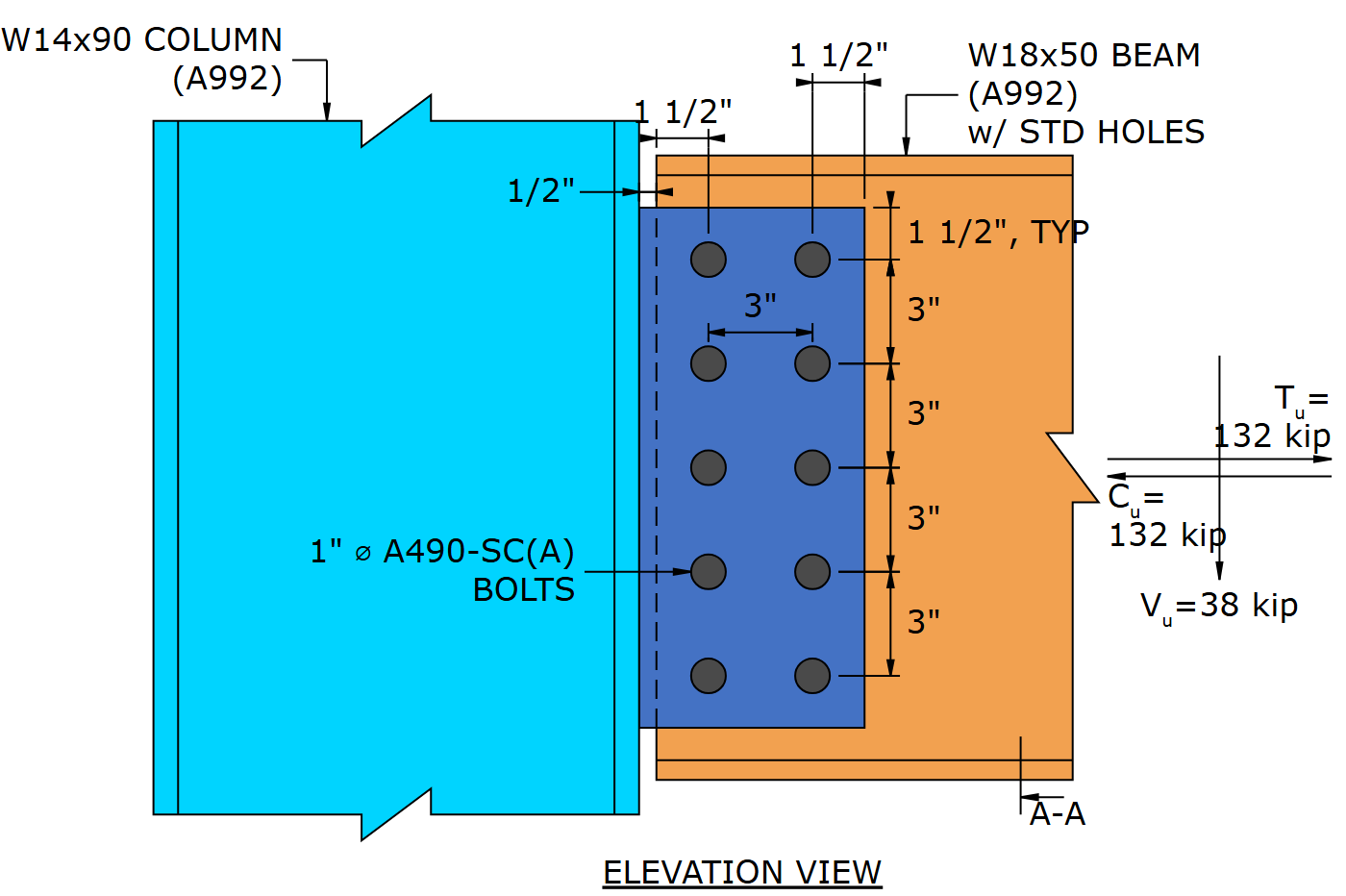
海拔. Two bolt columns of five rows at 3 in connect the W18x50 web to the plate, which is welded to the W14x90 column flange.
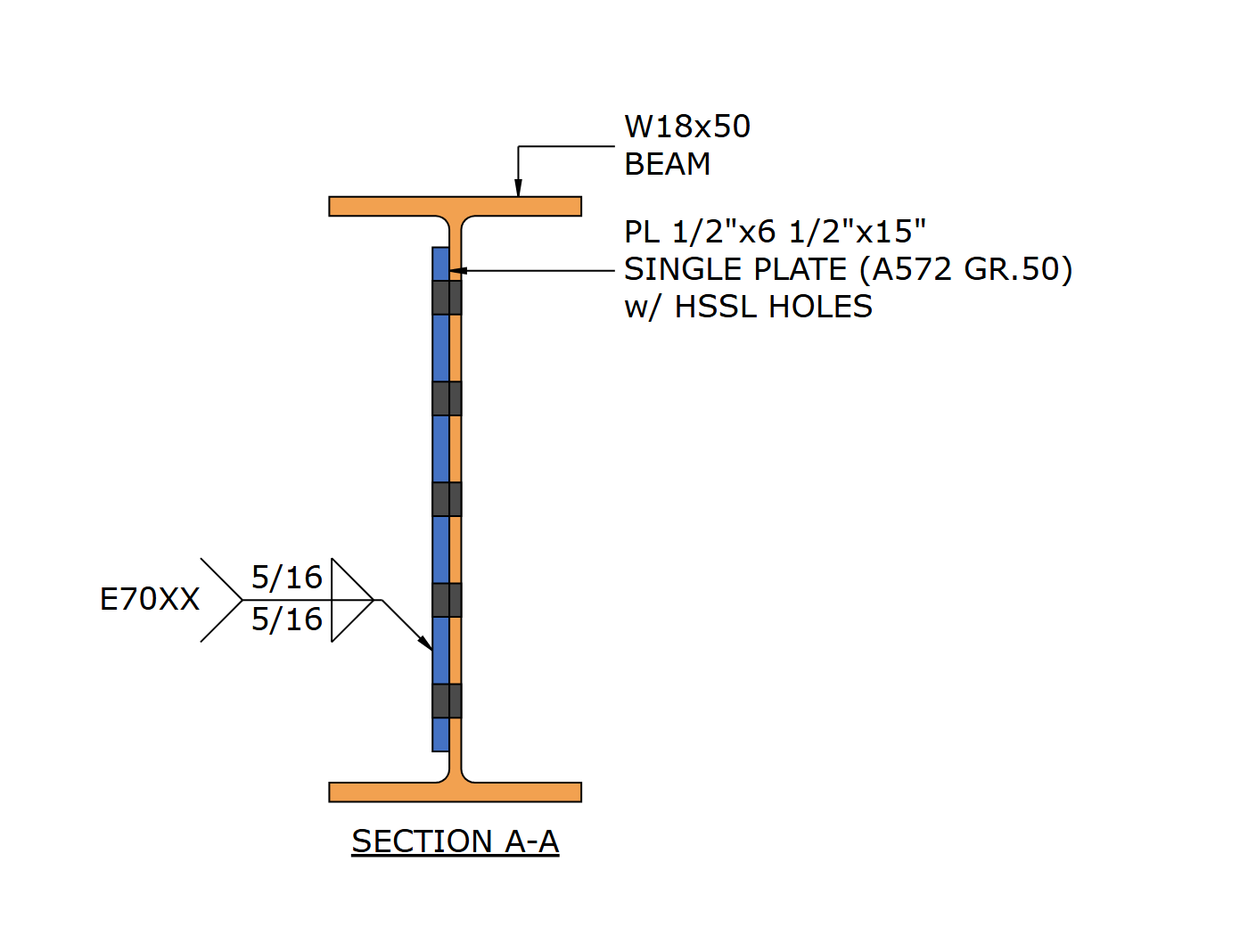
A-A部分. 该 1/2 in plate is welded to the column flange with 5/16 in fillet welds on both sides.
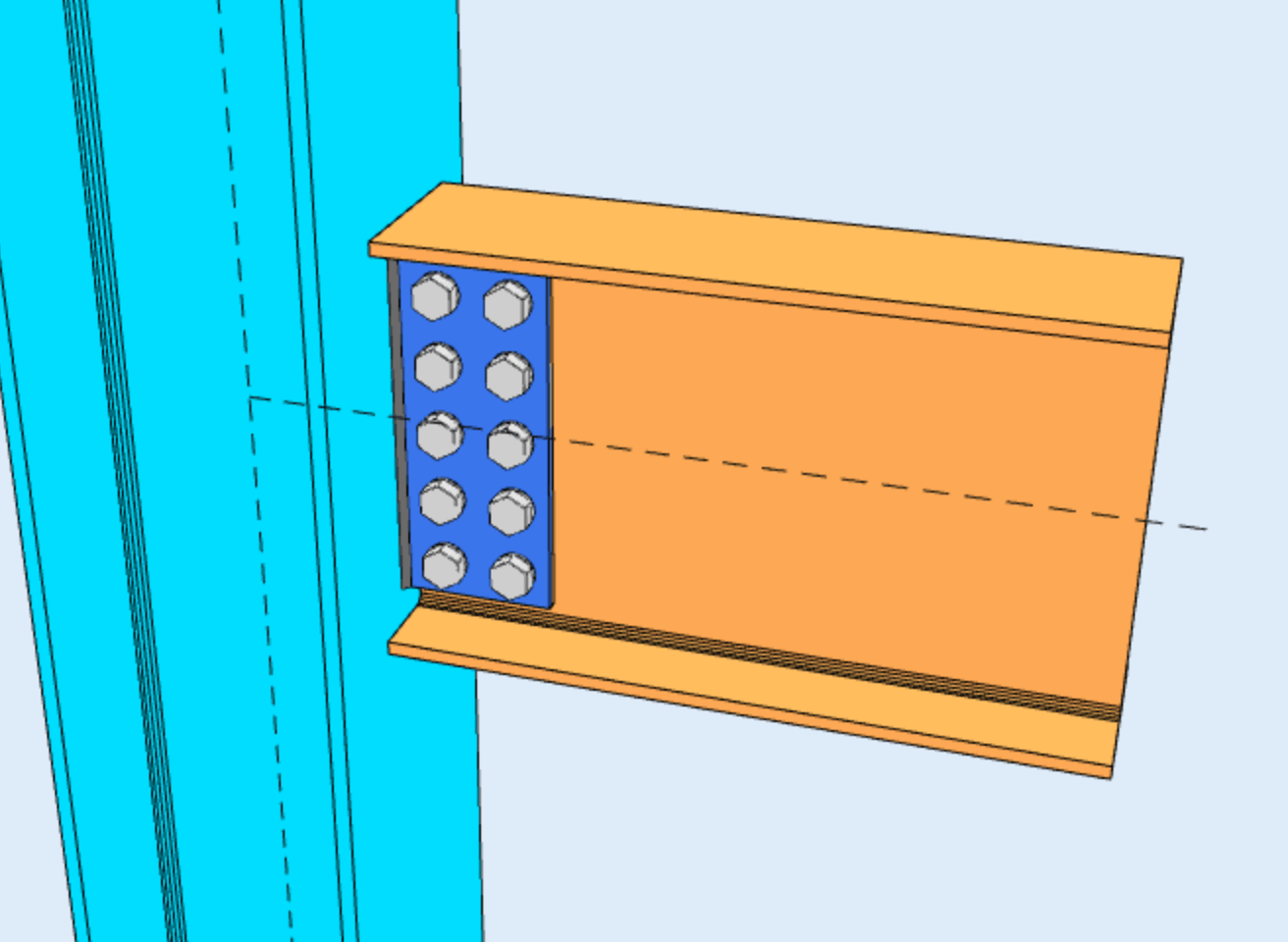
The same connection in the SkyCiv Connection Design 3D view.
Single plate shear and axial design: 步骤一目了然
- 检查梁侧的细节限制.
- Check the slip-critical bolt group for the resultant of the shear and axial force.
- Check the plate ductility (最大板厚).
- Check bolt bearing and tear-out on the plate for shear, 张力和压缩, and combine them.
- Repeat the bearing checks on the beam web.
- Check the plate in block shear for the shear and the axial force, and combine them.
- Check the plate in shear, 弯曲, 张力和压缩, with the interactions.
- Check the beam web in block shear and the beam in tension.
- Check the weld to the column flange.
- Check the column web under the axial tension and the axial compression.
本示例的设计输入
设计代码为AISC 360-16 LRFD. 截面属性来自 AISC 手册. The column’s kdes, used in web local yielding, 是 1.31 在.
| 物品 | 象征 | 值 |
|---|---|---|
| 剪力 | [mathin] V_{u} [mathin] | 38 kip |
| 轴向张力 / 压缩 | [mathin] T_{u},\ C_{u} [mathin] | 132 kip / 132 kip |
| Beam | W18x50, A992 | |
| 波束深度 / 腹板厚度 | [mathin] d_{bm},\ t_{wb} [mathin] | 18 在 / 0.355 在 |
| 梁翼缘宽度 / 厚度 | [mathin] b_{fb},\ t_{fb} [mathin] | 7.5 在 / 0.57 在 |
| 光束面积 | [mathin] A_{bm} [mathin] | 14.7 在2 |
| 光束产率 / 抗拉强度 | [mathin] F_{yb},\ F_{ub} [mathin] | 50 KSI / 65 KSI |
| 柱 | AISC 连接设计示例 | |
| 柱深 / 腹板厚度 | [mathin] d_{sup},\ t_{ws} [mathin] | 14 在 / 0.44 在 |
| 柱翼缘宽度 / 厚度 | [mathin] b_{fs},\ t_{fs} [mathin] | 14.5 在 / 0.71 在 |
| 柱产量 / 抗拉强度 | [mathin] F_{ys},\ F_{us} [mathin] | 50 KSI / 65 KSI |
| 弹性模量 | [mathin] E [mathin] | 29000 KSI |
| 物品 | 象征 | 值 |
|---|---|---|
| 单板 | PL 1/2 X 6 1/2 X 15, A572 Gr.50 | |
| 板宽 / 深度 / 厚度 | [mathin] b_{p},\ d_{p},\ t_{p} [mathin] | 6.5 在 / 15 在 / 0.5 在 |
| 板材产量 / 抗拉强度 | [mathin] F_{yp},\ F_{up} [mathin] | 50 KSI / 65 KSI |
| 螺栓 | 1 在 A490-SC 中, Class A faying surface, 一滑面 | |
| 螺栓直径 / 优势 | [mathin] d_{b},\ F_{nt},\ F_{nv} [mathin] | 1 在 / 113 KSI / 68 KSI |
| 洞 | 短槽卧式 (高速SSL) 在盘子里, standard in the beam web | |
| Weld to column flange | 5/16 in E70XX fillet, 双方 | |
| 焊缝尺寸 / 强度 | [mathin] W,\ F_{EXX} [mathin] | 0.3125 在 / 70 KSI |
| 几何 | 象征 | 值 |
|---|---|---|
| 螺栓排 / 行距 | [mathin] n_{r},\ s_{r} [mathin] | 5 / 3 在 |
| 螺栓柱 / 列间距 | [mathin] n_{c},\ s_{c} [mathin] | 2 / 3 在 |
| 梁腹间隙 | [mathin] clr [mathin] | 0.5 在 |
| Plate edge distances, 垂直 / 水平的 | [mathin] L_{ev\_pl},\ L_{eh\_pl} [mathin] | 1.5 在 / 1.5 在 |
| Beam web horizontal edge distance | [mathin] L_{eh\_bm} [mathin] | 1.5 在 |
| 螺栓组偏心率 | [mathin] e [mathin] | 3.5 在 |
步骤 1: 梁侧的详细限制 (AISC 360-16 J3.3, J3.4)
| 限制 | Limit value | 实际的 | 直流电 |
|---|---|---|---|
| 最小螺栓排间距 | 2.667 在 | 3.000 在 | 0.889 |
| 最大螺栓排间距 | 6.000 在 | 3.000 在 | 0.500 |
| 最小螺栓柱间距 | 2.667 在 | 3.000 在 | 0.889 |
| 最大螺栓柱间距 | 6.000 在 | 3.000 在 | 0.500 |
| 板材最小垂直边距 | 1.250 在 | 1.500 在 | 0.833 |
| 板材最小水平边距 | 1.375 在 | 1.500 在 | 0.917 |
| 梁最小水平边距 | 1.250 在 | 1.500 在 | 0.833 |
| 最小连接深度 | 7.750 在 | 15.000 在 | 0.517 |
| 最大连接深度 | 16.000 在 | 15.000 在 | 0.938 |
The maximum connection depth governs at 0.9375.
步骤 2: Slip-critical bolt group for the resultant force (AISC 360-16 J3.8, AISC手册部分 7)
The bolt group carries the resultant of the shear and the axial force, [mathin] R_{u} = 137.36\ \text{kip} [mathin] (the square root of 38 squared plus 132 squared), 在 [mathin] e = 3.5\ \text{in} [mathin] 偏心率. The instantaneous center of rotation method (AISC Manual pages 7-6 至 7-8) puts the instantaneous center at [mathin] x_{ic} = -0.62625\ \text{in} [mathin], [mathin] y_{ic} = 14.688\ \text{in} [mathin] from the bottom-left bolt, which gives the bolt group coefficient [mathin] C = 8.59 [mathin].
The bolts are slip-critical, 与 [mathin] \mu = 0.3 [mathin] 对于 A 级表面, [mathin] D_{u} = 1.13 [mathin], [mathin] h_{f} = 1 [mathin], the minimum pretension [mathin] T_{b} = 64\ \text{kip} [mathin] and one slip plane:
[math] \phi R_{n} = \phi \mu D_{u} h_{f} T_{b} N_{s} C = 0.85 \times 0.3 \times 1.13 \times 1 \times 64 \times 1 \times 8.59 = 158.41\ \text{kip} [math]
[math] DCR = \frac{R_{u}}{\phi R_{n}} = \frac{137.36}{158.41} = 0.8671 [math]
这是治理强度检查. Slip resistance is the limit here: the bolts would carry much more in bearing, as the next steps show.
步骤 3: 板材延展性, 最大板厚 (AISC 手动方程式. 10-3, 10-4)
The plate must yield in flexure before the bolts fail in shear. With the moment-only bolt group coefficient [mathin] C’ = 38.669\ \text{in} [mathin]:
[math] M_{max} = \frac{F_{nv}}{0.9} \frac{\pi}{4} d_{b}^{2} C’ = \frac{68}{0.9} \times \frac{\pi}{4} \times 1^{2} \times 38.669 = 191.22\ \text{kip-ft} [math]
[math] t_{max} = \frac{6 M_{max}}{F_{yp} d_{p}^{2}} = \frac{6 \times 191.22 \times 12}{50 \times 15^{2}} = 1.2238\ \text{in} [math]
[math] DCR = \frac{t_{p}}{t_{max}} = \frac{0.5}{1.2238} = 0.40855 [math]
步骤 4: Bolt bearing and tear-out on the plate in shear (AISC 360-16 J3.10)
For the vertical shear the hole size across the plate is [mathin] d_{h} = 1.125\ \text{in} [mathin], 所以 [mathin] l_{c1} = 1.5 – 1.125/2 = 0.9375\ \text{in} [mathin] at the bottom bolt and [mathin] l_{c2} = 3 – 1.125 = 1.875\ \text{in} [mathin] between bolts. The bolt group coefficient C takes the place of the number of bolts:
[math] \phi R_{n} = \phi \left[\min(1.2 l_{c1}, 2.4 d_{b}) t_{p} F_{up} + \min(1.2 l_{c2}, 2.4 d_{b}) t_{p} F_{up} (n_{r} – 1)\right] \frac{C}{n_{r}} = 424\ \text{kip} [math]
[math] DCR = \frac{V_{u}}{\phi R_{n}} = \frac{38}{424} = 0.089623 [math]
步骤 5: Bolt bearing and tear-out on the plate under axial tension (AISC 360-16 J3.10)
In tension the bolts bear on the plate toward its free end. Along the member the slotted hole is [mathin] d_{h} = 1.3125\ \text{in} [mathin], 所以 [mathin] l_{c1} = 1.5 – 1.3125/2 = 0.84375\ \text{in} [mathin] at the end bolt and [mathin] l_{c2} = 3 – 1.3125 = 1.6875\ \text{in} [mathin] between the two bolt columns:
[math] \phi R_{n} = \phi \left[\min(1.2 l_{c1}, 2.4 d_{b}) t_{p} F_{up} + \min(1.2 l_{c2}, 2.4 d_{b}) t_{p} F_{up} (n_{c} – 1)\right] \frac{C}{n_{c}} = 318\ \text{kip} [math]
[math] DCR = \frac{T_{u}}{\phi R_{n}} = \frac{132}{318} = 0.4151 [math]
步骤 6: Bolt bearing and tear-out on the plate under axial compression (AISC 360-16 J3.10)
In compression the bolts bear toward the support. The distance from the support to the nearest bolt line is [mathin] a = 2\ \text{in} [mathin], 所以 [mathin] l_{c1} = 2 – 1.3125/2 = 1.3438\ \text{in} [mathin], 与 [mathin] l_{c2} = 1.6875\ \text{in} [mathin] as before:
[math] \phi R_{n} = 0.75 \times \left[\min(1.2 \times 1.3438,\ 2.4) \times 0.5 \times 65 + \min(1.2 \times 1.6875,\ 2.4) \times 0.5 \times 65 \times 1\right] \times \frac{8.59}{2} = 380.81\ \text{kip} [math]
[math] DCR = \frac{C_{u}}{\phi R_{n}} = \frac{132}{380.81} = 0.34663 [math]
步骤 7: Shear and axial interaction of bearing on the plate
The tension case governs, because its axial ratio is the larger one. The software combines it with the shear ratio from Step 4:
[math] Interaction = \left(\frac{V_{u}}{\phi R_{n}}\right)^{2} + \left(\frac{T_{u}}{\phi R_{n}}\right)^{2} = \left(\frac{38}{424}\right)^{2} + \left(\frac{132}{318}\right)^{2} = 0.18034 [math]
步骤 8: Bolt bearing and tear-out on the beam web in shear (AISC 360-16 J3.10)
梁腹板在螺栓上方和下方是连续的, 所以每个螺栓都使用孔之间的净距离:
[math] \phi R_{n} = \phi \min(1.2 l_{c2}, 2.4 d_{b}) t_{wb} F_{ub} C = 0.75 \times \min(1.2 \times 1.875,\ 2.4 \times 1) \times 0.355 \times 65 \times 8.59 = 334.49\ \text{kip} [math]
[math] DCR = \frac{V_{u}}{\phi R_{n}} = \frac{38}{334.49} = 0.11361 [math]
步骤 9: Bolt bearing and tear-out on the beam web under axial tension (AISC 360-16 J3.10)
In tension the bolts bear toward the end of the beam. The standard hole gives [mathin] l_{c1} = 1.5 – 1.125/2 = 0.9375\ \text{in} [mathin] 和 [mathin] l_{c2} = 3 – 1.125 = 1.875\ \text{in} [mathin]:
[math] \phi R_{n} = \phi \left[\min(1.2 l_{c1}, 2.4 d_{b}) t_{wb} F_{ub} + \min(1.2 l_{c2}, 2.4 d_{b}) t_{wb} F_{ub} (n_{c} – 1)\right] \frac{C}{n_{c}} = 250.86\ \text{kip} [math]
[math] DCR = \frac{T_{u}}{\phi R_{n}} = \frac{132}{250.86} = 0.52618 [math]
步骤 10: Bolt bearing and tear-out on the beam web under axial compression (AISC 360-16 J3.10)
In compression the bolts bear toward the span, where the web is continuous. The farthest bolt has no edge beyond it, so it takes the bearing limit of 2.4 螺栓的剪切强度:
[math] \phi R_{n} = \phi \left[2.4 d_{b} t_{wb} F_{ub} + \min(1.2 l_{c2}, 2.4 d_{b}) t_{wb} F_{ub} (n_{c} – 1)\right] \frac{C}{n_{c}} = 345.64\ \text{kip} [math]
[math] DCR = \frac{C_{u}}{\phi R_{n}} = \frac{132}{345.64} = 0.3819 [math]
步骤 11: Shear and axial interaction of bearing on the beam web
[math] Interaction = \left(\frac{38}{334.49}\right)^{2} + \left(\frac{132}{250.86}\right)^{2} = 0.28977 [math]
步骤 12: Block shear of the plate in shear (AISC 360-16 J4.3)
The L-shaped block runs down the outer bolt line to the bottom of the plate. The tension plane crosses both bolt columns, with the slotted hole size along the member:
[math] A_{nt} = t_{p}\left[(n_{c} – 1) s_{c} + L_{eh\_pl} – (n_{c} – 0.5)(d_{h} + 0.0625)\right] = 0.5 \times (3 + 1.5 – 1.5 \times 1.375) = 1.2188\ \text{in}^{2} [math]
[math] A_{gv} = t_{p}\left[L_{ev\_pl} + (n_{r} – 1) s_{r}\right] = 0.5 \times (1.5 + 4 \times 3) = 6.75\ \text{in}^{2} [math]
[math] A_{nv} = t_{p}\left[d_{p} – L_{ev\_pl} – (n_{r} – 0.5)(d_{h} + 0.0625)\right] = 0.5 \times (15 – 1.5 – 4.5 \times 1.1875) = 4.0781\ \text{in}^{2} [math]
对于两个螺栓柱,拉应力不均匀, 所以 [mathin] U_{bs} = 0.5 [mathin]:
[math] \phi R_{n} = 0.75 \times \min(0.6 \times 65 \times 4.0781,\ 0.6 \times 50 \times 6.75) + 0.75 \times 0.5 \times 65 \times 1.2188 = 148.99\ \text{kip} [math]
[math] DCR = \frac{V_{u}}{\phi R_{n}} = \frac{38}{148.99} = 0.25505 [math]
步骤 13: Block shear of the plate under the axial force (AISC 360-16 J4.3)
For the axial force the block turns 90 度数: tension down the bolt column, shear along the bolt rows. The plate’s unbraced length [mathin] L_{b} = 2\ \text{in} [mathin] is the distance from the support to the first bolt line:
[math] A_{nt} = t_{p}\left[(n_{r} – 1) s_{r} + L_{ev\_pl} – (n_{r} – 0.5)(d_{h} + 0.0625)\right] = 0.5 \times (12 + 1.5 – 4.5 \times 1.1875) = 4.0781\ \text{in}^{2} [math]
[math] A_{gv} = t_{p}\left[L_{eh\_pl} + (n_{c} – 1) s_{c}\right] = 0.5 \times (1.5 + 3) = 2.25\ \text{in}^{2} [math]
[math] A_{nv} = t_{p}\left[b_{p} – L_{b} – (n_{c} – 0.5)(d_{h} + 0.0625)\right] = 0.5 \times (6.5 – 2 – 1.5 \times 1.375) = 1.2188\ \text{in}^{2} [math]
[math] \phi R_{n} = 0.75 \times \min(0.6 \times 65 \times 1.2188,\ 0.6 \times 50 \times 2.25) + 0.75 \times 1 \times 65 \times 4.0781 = 234.46\ \text{kip} [math]
[math] DCR = \frac{T_{u}}{\phi R_{n}} = \frac{132}{234.46} = 0.563 [math]
步骤 14: Shear and axial interaction of block shear in the plate
[math] Interaction = \left(\frac{V_{u}}{\phi R_{n}}\right)^{2} + \left(\frac{T_{u}}{\phi R_{n}}\right)^{2} = \left(\frac{38}{148.99}\right)^{2} + \left(\frac{132}{234.46}\right)^{2} = 0.38202 [math]
步骤 15: Shear yielding and shear rupture of the plate (AISC 360-16 J4.2)
[math] \phi R_{n,sy} = \phi\ 0.6 F_{yp} d_{p} t_{p} = 1.0 \times 0.6 \times 50 \times 7.5 = 225\ \text{kip} [math]
[math] A_{nv} = t_{p}\left[d_{p} – n_{r}(d_{h} + 0.0625)\right] = 0.5 \times (15 – 5 \times 1.1875) = 4.5313\ \text{in}^{2} [math]
[math] \phi R_{n,sr} = \phi\ 0.6 F_{up} A_{nv} = 0.75 \times 0.6 \times 65 \times 4.5313 = 132.54\ \text{kip} [math]
[math] DCR = \frac{V_{u}}{\min(225,\ 132.54)} = \frac{38}{132.54} = 0.28671 [math]
步骤 16: Flexure of the plate, 双应对手术 (AISC 360-16 F11.2, AISC 手动方程式. 9-4, 9-15)
过度 [mathin] L_{b} = 2\ \text{in} [mathin] the ratio [mathin] L_{b} d/t^{2} = 2 \times 15/0.5^{2} = 120 [mathin] is between 46.4 和 1102, 与 [mathin] Z = 28.125\ \text{in}^{3} [mathin], [mathin] S = 18.75\ \text{in}^{3} [mathin] 和, 毫无应对, [mathin] C_{b} = 1.84 [mathin]:
[math] \phi M_{n} = \phi \min\left(C_{b}\left[1.52 – 0.274 \left(\frac{L_{b} d}{t^{2}}\right) \frac{F_{yp}}{E}\right] F_{yp} S,\ F_{yp} Z\right) = 105.47\ \text{kip-ft} [math]
[math] \phi V_{n,y} = \frac{\phi M_{n}}{L_{b}} = \frac{105.47 \times 12}{2} = 632.81\ \text{kip} [math]
For flexural rupture the net plastic section modulus from AISC Manual Table 15-3 是 [mathin] Z_{net} = 17.261\ \text{in}^{3} [mathin]:
[math] \phi M_{n} = \phi F_{up} Z_{net} = 0.75 \times 65 \times 17.261 = 70.124\ \text{kip-ft} [math]
[math] \phi V_{n,r} = \frac{70.124 \times 12}{2} = 420.74\ \text{kip} [math]
[math] DCR = \frac{V_{u}}{\min(632.81,\ 420.74)} = \frac{38}{420.74} = 0.090317 [math]
步骤 17: Tension yielding and tension rupture of the plate (AISC 360-16 J4.1)
[math] \phi R_{n,ty} = \phi F_{yp} t_{p} d_{p} = 0.9 \times 50 \times 0.5 \times 15 = 337.5\ \text{kip} [math]
[math] \phi R_{n,tr} = \phi F_{up} t_{p}\left[d_{p} – n_{r}(d_{h} + 0.0625)\right] = 0.75 \times 65 \times 0.5 \times (15 – 5 \times 1.1875) = 220.9\ \text{kip} [math]
[math] DCR = \frac{T_{u}}{\min(337.5,\ 220.9)} = \frac{132}{220.9} = 0.59756 [math]
步骤 18: 剪力, tension and flexure interaction of the plate, 屈服
The software combines the axial ratio and the flexure ratio linearly, then adds the shear ratio squared, using the yielding strengths:
[math] Interaction = \left(\frac{T_{u}}{\phi R_{n,ty}} + \frac{8 V_{u}}{9 \phi V_{n,y}}\right)^{2} + \left(\frac{V_{u}}{\phi R_{n,sy}}\right)^{2} = \left(\frac{132}{337.5} + \frac{8 \times 38}{9 \times 632.81}\right)^{2} + \left(\frac{38}{225}\right)^{2} = 0.22609 [math]
步骤 19: 剪力, tension and flexure interaction of the plate, 破裂
[math] Interaction = \left(\frac{T_{u}}{\phi R_{n,tr}} + \frac{8 V_{u}}{9 \phi V_{n,r}}\right)^{2} + \left(\frac{V_{u}}{\phi R_{n,sr}}\right)^{2} = \left(\frac{132}{220.9} + \frac{8 \times 38}{9 \times 420.74}\right)^{2} + \left(\frac{38}{132.54}\right)^{2} = 0.54167 [math]
步骤 20: Compression strength of the plate (AISC 360-16 J4.4)
和 [mathin] K = 1.2 [mathin], the slenderness is [mathin] KL/r = 16.628 [mathin]. That is not more than 25, so the plate takes its yield strength:
[math] \phi R_{n} = \phi F_{yp} t_{p} d_{p} = 0.9 \times 50 \times 0.5 \times 15 = 337.5\ \text{kip} [math]
[math] DCR = \frac{C_{u}}{\phi R_{n}} = \frac{132}{337.5} = 0.39111 [math]
步骤 21: 剪力, compression and flexure interaction of the plate
[math] Interaction = \left(\frac{132}{337.5} + \frac{8 \times 38}{9 \times 632.81}\right)^{2} + \left(\frac{38}{225}\right)^{2} = 0.22609 [math]
步骤 22: Block shear of the beam web under the axial tension (AISC 360-16 J4.3)
The axial tension can tear a block out of the beam end: tension across the bolt rows, shear along the top and bottom bolt rows to the end of the beam.
[math] A_{nt} = t_{wb}\left[(n_{r} – 1) s_{r} – (n_{r} – 1)(d_{h} + 0.0625)\right] = 0.355 \times (12 – 4 \times 1.1875) = 2.5737\ \text{in}^{2} [math]
[math] A_{gv} = 2 t_{wb}\left[L_{eh\_bm} + (n_{c} – 1) s_{c}\right] = 2 \times 0.355 \times (1.5 + 3) = 3.195\ \text{in}^{2} [math]
[math] A_{nv} = 2 t_{wb}\left[(n_{c} – 1) s_{c} + L_{eh\_bm} – (n_{c} – 0.5)(d_{h} + 0.0625)\right] = 2 \times 0.355 \times (3 + 1.5 – 1.5 \times 1.1875) = 1.9303\ \text{in}^{2} [math]
[math] \phi R_{n} = 0.75 \times \min(0.6 \times 65 \times 1.9303,\ 0.6 \times 50 \times 3.195) + 0.75 \times 1 \times 65 \times 2.5737 = 181.93\ \text{kip} [math]
[math] DCR = \frac{T_{u}}{\phi R_{n}} = \frac{132}{181.93} = 0.72555 [math]
步骤 23: Tension rupture of the beam (AISC 360-16 D3, J4.1)
Only the web is connected, so shear lag applies. 和 [mathin] \bar{x} = 1.1395\ \text{in} [mathin], Table D3.1 case 2 给出 [mathin] U = 0.62033 [mathin]. The net area deducts the five bolt holes in the web:
[math] \phi R_{n,tr} = \phi F_{ub} U \left[A_{bm} – n_{r}(d_{h} + 0.0625) t_{wb}\right] = 0.75 \times 65 \times 0.62033 \times (14.7 – 5 \times 1.1875 \times 0.355) = 380.8\ \text{kip} [math]
[math] DCR = \frac{T_{u}}{\phi R_{n,tr}} = \frac{132}{380.8} = 0.34664 [math]
步骤 24: 支撑侧的详细限制
The fillet weld size is limited by the beam web clearance: 0.313 in against a 0.500 在限制内, a DCR of 0.626.
步骤 25: Weld required to develop the plate (AISC手册部分 10)
[math] W_{duc} = \frac{5}{8} t_{p} = \frac{5}{8} \times 0.5 = 0.3125\ \text{in} [math]
[math] DCR = \frac{W_{duc}}{W} = \frac{0.3125}{0.3125} = 1 [math]
该 5/16 in weld is exactly the size AISC Manual Part 10 asks for to develop a 1/2 在盘子里, so this ductility check sits at 1.000. It passes; a smaller weld would not.
步骤 26: Fillet weld to the column flange (AISC 360-16 J2.4, AISC 手动方程式. 9-2)
The base metal limit uses half the plate thickness, because the plate is welded on both sides:
[math] D_{max} = \frac{\min(0.5 t_{p} F_{up},\ t_{fs} F_{us})}{3.09 \times F_{EXX}/F_{E70XX}} = \frac{\min(0.25 \times 65,\ 0.71 \times 65)}{3.09 \times 1} = 5.2589 [math]
[math] L_{w} = 2\left[d_{p} – 2W\right] = 2 \times (15 – 2 \times 0.3125) = 28.75\ \text{in} [math]
The weld carries the same 137.36 kip resultant as the bolts. Its angle to the weld axis is [mathin] \theta_{u} = 73.94^{\circ} [mathin], so the directional strength increase applies. 该 5/16 in weld is smaller than [mathin] D_{max}/16 = 0.3287\ \text{in} [mathin]:
[math] \phi R_{n} = \phi\ 0.6 F_{EXX} \frac{\sqrt{2}}{2} W \left[1 + 0.5 \sin^{1.5}\theta_{u}\right] L_{w} = 0.75 \times 0.6 \times 70 \times \frac{\sqrt{2}}{2} \times 0.3125 \times \left[1 + 0.5 \sin^{1.5}(73.94^{\circ})\right] \times 28.75 = 294.38\ \text{kip} [math]
[math] DCR = \frac{R_{u}}{\phi R_{n}} = \frac{137.36}{294.38} = 0.46662 [math]
步骤 27: Column under the axial tension (AISC 360-16 J10.1, J10.2)
Flange local bending need not be checked when the length of loading across the flange is less than [mathin] 0.15 b_{fs} = 0.15 \times 14.5 = 2.175\ \text{in} [mathin]. The report finds the length of loading across the flange is less than this, so flange local bending is not checked. Web local crippling is for compression only, which leaves web local yielding, 与 15 in plate depth as the bearing length:
[math] \phi R_{n,wly} = \phi F_{ys} t_{ws} (5 k_{des} + d_{p}) = 1.0 \times 50 \times 0.44 \times (5 \times 1.31 + 15) = 474.1\ \text{kip} [math]
[math] DCR = \frac{T_{u}}{\phi R_{n,wly}} = \frac{132}{474.1} = 0.27842 [math]
步骤 28: Column under the axial compression (AISC 360-16 J10.2, J10.3)
[math] \phi R_{n,wlc} = \phi\ 0.8 t_{ws}^{2} \left[1 + 3\left(\frac{d_{p}}{d_{sup}}\right)\left(\frac{t_{ws}}{t_{fs}}\right)^{1.5}\right] \sqrt{\frac{E F_{ys} t_{fs}}{t_{ws}}} Q_{f} = 456.31\ \text{kip} [math]
与 [mathin] \phi = 0.75 [mathin], [mathin] d_{p}/d_{sup} = 15/14 [mathin] 和 [mathin] Q_{f} = 1 [mathin]. Web local yielding is 474.1 kip as in Step 27, 所以:
[math] DCR = \frac{C_{u}}{\min(456.31,\ 474.1)} = \frac{132}{456.31} = 0.28928 [math]
设计检查总结
| 设计检查 | 需求 | 容量 | 直流电 |
|---|---|---|---|
| 梁侧的详细限制 | 15 在 | 16 在 | 0.938 |
| **Slip-critical bolt group (治理)** | **137.36 kip** | **158.41 kip** | **0.867** |
| 板材延展性 (maximum thickness) | 0.5 在 | 1.2238 在 | 0.409 |
| Bearing on the plate, 剪力 | 38 kip | 424 kip | 0.090 |
| Bearing on the plate, 轴向拉力 | 132 kip | 318 kip | 0.415 |
| Bearing on the plate, 轴向压缩 | 132 kip | 380.81 kip | 0.347 |
| Bearing interaction on the plate | 0.180 | 1.0 | 0.180 |
| 梁腹板上的轴承, 剪力 | 38 kip | 334.49 kip | 0.114 |
| 梁腹板上的轴承, 轴向拉力 | 132 kip | 250.86 kip | 0.526 |
| 梁腹板上的轴承, 轴向压缩 | 132 kip | 345.64 kip | 0.382 |
| Bearing interaction on the beam web | 0.290 | 1.0 | 0.290 |
| 板块剪切, 剪力 | 38 kip | 148.99 kip | 0.255 |
| 板块剪切, 轴向的 | 132 kip | 234.46 kip | 0.563 |
| Plate block shear interaction | 0.382 | 1.0 | 0.382 |
| Plate in shear | 38 kip | 132.54 kip | 0.287 |
| Plate in flexure | 38 kip | 420.74 kip | 0.090 |
| Plate in tension | 132 kip | 220.9 kip | 0.598 |
| Plate interaction, 屈服 | 0.226 | 1.0 | 0.226 |
| Plate interaction, 破裂 | 0.542 | 1.0 | 0.542 |
| Plate in compression | 132 kip | 337.5 kip | 0.391 |
| Plate interaction, 压缩 | 0.226 | 1.0 | 0.226 |
| 梁腹块剪, 轴向的 | 132 kip | 181.93 kip | 0.726 |
| 梁受拉 | 132 kip | 380.8 kip | 0.347 |
| 支撑侧的详细限制 | 0.313 在 | 0.5 在 | 0.626 |
| 焊接显影板 | 0.3125 在 | 0.3125 在 | 1.000 |
| Weld to the column flange | 137.36 kip | 294.38 kip | 0.467 |
| Column under axial tension | 132 kip | 474.1 kip | 0.278 |
| Column under axial compression | 132 kip | 456.31 kip | 0.289 |
每项检查均通过. The slip-critical bolt group governs the strength checks at 0.867, followed by block shear of the beam web under the axial tension at 0.726. The weld to develop the plate sits exactly at 1.000, which is a ductility requirement met on the limit, and the maximum connection depth is the highest detailing ratio at 0.938. Almost every check that only sees the 38 kip shear stays below 0.3, so the axial force is what sizes this connection.
如果检查失败要更改什么
- Slip-critical bolt group: add bolt rows or bolt columns, use a larger bolt for a higher pretension, or a Class B faying surface for a higher slip coefficient. If slip is not a design requirement, bearing-type bolts carry far more.
- Beam web block shear or bearing on the web: increase the bolt spacing or the edge distance at the beam end, or add bolt columns. 具有较厚腹板的梁也有帮助.
- Plate in tension, 块剪或轴承: 使用更厚或更深的板, or increase the edge distances.
- 板材延展性: the plate must stay thinner than the maximum thickness. Use a thinner plate in a higher grade if you need more plate strength.
- 焊接显影板: keep the weld at least 5/8 板厚的. A thicker plate needs a larger weld.
- Column web under the axial load: a heavier column, or stiffeners at the connection.
Auto Design is available for the single plate shear and axial connection to a column flange. 它会更改连接的设计变量,直到每项检查都通过, 并保留您输入的成员和负载. 见 汽车设计 其适用的首选项页面.
常见问题
What changes when a single plate connection carries axial force?
The bolts and the weld are checked for the resultant of the shear and the axial force. 轴承, tear-out and block shear are checked again in the direction of the axial force and combined with the shear checks. The plate gets tension and compression checks with their interactions, the beam is checked for block shear and tension rupture, and the column web is checked for the axial force as a concentrated load.
Why are tension and compression bearing checks different?
The bolts bear in the direction of the force. In tension they bear toward the free end of the plate and the end of the beam, where the edge distances are 1.5 在. In compression they bear toward the support, where the plate has 2 in to the support, and into the beam span, where the web has no edge at all. That is why the compression bearing strengths in Steps 6 和 10 are higher.
Why are slip-critical bolts used here?
The plate has short-slotted holes running horizontally, along the axial force. AISC 360-16 J3.2 allows short-slotted holes in bearing-type connections only when the slot is perpendicular to the load, so with load along the slot the bolts must be slip-critical. The price is a lower design strength: 滑移, 在 158.41 kip, governs well before bolt bearing on the plate or the beam web.
Why is the weld to develop the plate exactly 1.0?
AISC手册部分 10 sizes the single plate weld at 5/8 of the plate thickness so that the plate yields before the weld fails. 为一个 1/2 in plate that is exactly 5/16 在, which is the weld used. A DCR of 1.0 通过; it means the weld meets the requirement with nothing to spare.
此示例是否遵循 AISC 第 15 版或 AISC 第 16 版手册?
它遵循 AISC 360-16 和 AISC 手册第 15 版, 这是围绕该规范编写的. AISC 第 16 版手册与后续版本配对 360-22 规范. 新版本中的条款和方程编号发生了变化, 因此,请根据您的项目使用的版本检查参考文献.
对于 AISC ASD 而不是 LRFD 来说,这会如何变化?
极限状态和标称强度相同. 使用 AISC ASD,您可以将服务水平力与标称强度除以安全系数进行比较,而不是乘以阻力系数. 阻力系数为 0.75 成为安全系数 2.00, 0.90 变成 1.67, 和 1.00 变成 1.50. The slip-critical bolts use a safety factor of 1.76 in place of the 0.85 阻力系数. 荷载组合也发生变化, so the shear and axial force are lower.
Design a single plate shear and axial connection for free
此页上的每个数字都来自一个解决方案. Pick the single plate configuration for shear plus axial load, 输入你的光束, 柱子, 盘子, 螺栓, 焊缝, shear and axial force, 并在浏览器中查看每项检查. 没有什么可安装的. 该 载荷和载荷组合 page explains how the shear and axial force are entered.
SkyCiv Connection Design 模块是本示例背后的连接设计软件. 它为您提供完整的计算报告,其中包含每个方程和您的数字, 就像上面的步骤一样, 加上每个容量和 DCR, 对于AISC 360-22 和AISC 360-16 (LRFD 和 ASD) 并作为 4100:2020. 该 螺栓计算器 和 焊接计算器 单独覆盖螺栓组和焊接组.
参考资料
- AISC 360-16, 钢结构建筑规范: D3 (表D3.1), F11.2 (情商. F11-2), J2.4, J3.2, J3.3, J3.4, J3.8 (情商. J3-4), J3.10 (情商. J3-6a, J3-6c), J4.1 (情商. J4-1, J4-2), J4.2 (情商. J4-3, J4-4), J4.3, J4.4, J10.1, J10.2 (情商. J10-2), J10.3 (情商. J10-4).
- AISC 钢结构手册, 15第版: 部分 1 截面属性; 部分 7 instantaneous center of rotation and Eq. 7-1; 部分 9 情商. 9-2, 9-4, 9-15; 部分 10 情商. 10-3, 10-4 and the single plate weld size; 部分 15 桌子 15-3.
- Single plate shear connection design (shear only)
- 使用 AISC 进行钢连接设计 360-16
- 螺栓 和 焊缝 SkyCiv 连接设计

哈罗德穆纳勒姆
产品经理, 连接设计
10+ 从事钢结构连接设计多年
领英
