
Block shear rupture is the failure where a whole block of material tears out of a bolted plate or member: one face fails in shear along the line of bolts and the other face fails in tension across the end of the block. AISC 360-16 Section J4.3 checks it with one equation that adds a shear plane strength to a tension plane strength. This article explains the check, shows the equation, and works it with the numbers from a real end plate connection solved in SkyCiv Connection Design.
What is block shear rupture?
In a bolted connection the load passes from the bolts into the plate through the holes. If the holes sit close to an edge, the plate can tear along the bolt line and then across to the edge, so a block of plate shaped like an L (or a U, for a group in the middle of a plate) pulls out. The bolts and the rest of the plate are undamaged; only that block has failed. Every bolted element that carries load past a free edge can fail this way: shear tabs, 端板, 角度, gussets and the webs of coped beams.
Block shear tends to govern when the plate is thin, the edge distances are short, and there are many bolts in a line, because a long bolt line makes a long shear plane full of holes. It is less likely to govern in thick plates or where the bolt group is far from the edges. In shear connections it often sits close to plate shear rupture, and in coped beams it is frequently the controlling check on the beam side.
美国钢铁协会 360-16 block shear equation (J4.3)
The available strength for block shear rupture along a shear plane and a perpendicular tension plane is:
[math] \phi R_{n} = \phi \left( 0.6 F_{u} A_{nv} + U_{bs} F_{u} A_{nt} \right) \leq \phi \left( 0.6 F_{y} A_{gv} + U_{bs} F_{u} A_{nt} \right) [math]
哪里:
- [mathin] \phi = 0.75 [mathin] is the resistance factor (LRFD)
- [mathin] F_{u} [mathin] 和 [mathin] F_{y} [mathin] are the tensile and yield stress of the plate
- [mathin] A_{gv} [mathin] is the gross area in shear, along the bolt line to the edge
- [mathin] A_{nv} [mathin] is the net area in shear, the gross area less the holes along that line
- [mathin] A_{nt} [mathin] is the net area in tension, across the end of the block less the holes
- [mathin] U_{bs} [mathin] 是 1 when the tension stress is uniform and 0.5 when it is not, for example with more than one bolt line in a coped beam
The left side is shear rupture plus tension rupture. The right side caps the shear part at shear yielding on the gross area, so the smaller of the two governs. The hole sizes used for the net areas include an extra 1/16 在, as AISC 360-16 B4.3b asks for.
Worked example: block shear on an end plate
This example is Check 8 的 end plate shear and axial connection design example: a W18x35 beam with a PL 3/4 X 8 1/2 X 9 A572组. 50 端板, bolted to the flange of a W14x90 column with six 3/4 in A325-N bolts in horizontal short-slotted holes. The shear is [mathin] V_{u} = 32\ \text{kip} [mathin]. It was solved again on the current release and the numbers are the same as on the published example.
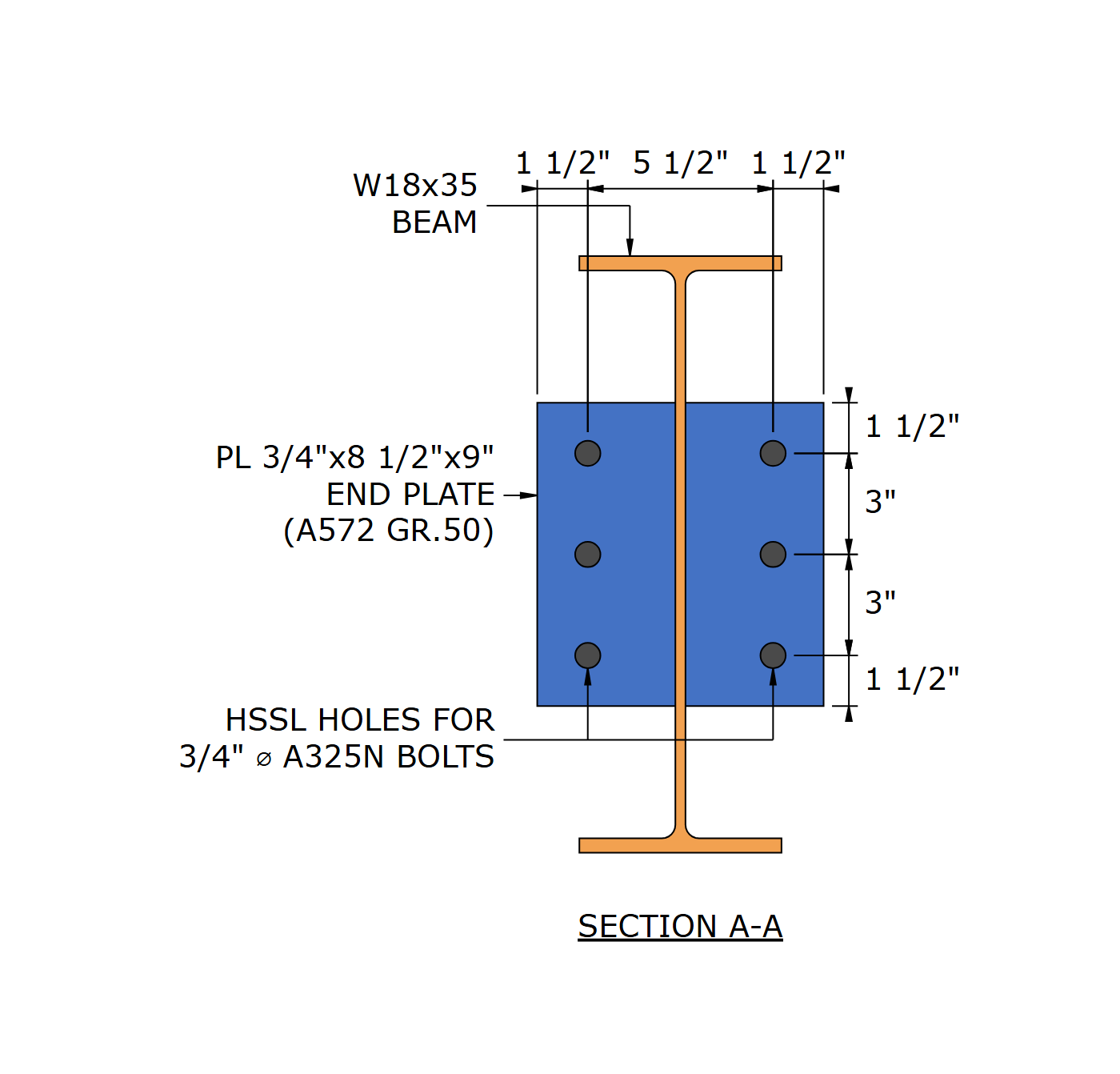
A-A部分. One bolt line each side of the beam web, 1 1/2 in from the plate edges, so two L-shaped blocks can tear out of the plate.
The plate has one bolt column each side of the web ([mathin] n_{c} = 2 [mathin], [mathin] s_{c} = 0\ \text{in} [mathin]), 与 [mathin] L_{eh} = 1.5\ \text{in} [mathin], [mathin] L_{ev} = 1.5\ \text{in} [mathin], three rows at [mathin] s_{r} = 3\ \text{in} [mathin] and a plate depth [mathin] d_{p} = 9\ \text{in} [mathin]. The slots are 1 in long horizontally and 0.8125 in wide vertically. Two blocks fail together, one each side, so the areas are taken over [mathin] 2t_{p} = 1.5\ \text{in} [mathin].
受拉净面积, across the end of each block (的 1 in slot length lies across this plane):
[math] A_{nt} = 2t_{p} \left[ \left( \frac{n_{c}}{2} – 1 \right) s_{c} + L_{eh} – \left( \frac{n_{c}}{2} – 0.5 \right) \left( d_{h} + 0.0625 \right) \right] = 1.5 \times \left[ 0 + 1.5 – 0.5 \times 1.0625 \right] = 1.4531\ \text{in}^{2} [math]
剪切总面积, along the bolt line:
[math] A_{gv} = 2t_{p} \left[ L_{ev} + \left( n_{r} – 1 \right) s_{r} \right] = 1.5 \times \left[ 1.5 + 2 \times 3 \right] = 11.25\ \text{in}^{2} [math]
剪切净面积, less two and a half holes (的 0.8125 in slot width lies across this plane):
[math] A_{nv} = 2t_{p} \left[ d_{p} – L_{ev} – \left( n_{r} – 0.5 \right) \left( d_{h} + 0.0625 \right) \right] = 1.5 \times \left[ 9 – 1.5 – 2.5 \times 0.875 \right] = 7.9688\ \text{in}^{2} [math]
Each block has a single bolt line, so the tension stress is uniform and [mathin] U_{bs} = 1 [mathin]. 和 [mathin] F_{up} = 65\ \text{ksi} [mathin] 和 [mathin] F_{yp} = 50\ \text{ksi} [mathin]:
[math] \phi R_{n} = 0.75 \times \left( 0.6 \times 65 \times 7.9688 + 1 \times 65 \times 1.4531 \leq 0.6 \times 50 \times 11.25 + 1 \times 65 \times 1.4531 \right) [math]
The rupture side is 405.23 kip and the yield side is 431.95 kip, so shear rupture on the net area governs:
[math] \phi R_{n} = 0.75 \times 405.23 = 303.93\ \text{kip} [math]
[math] DCR = \frac{V_{u}}{\phi R_{n}} = \frac{32}{303.93} = 0.10529 [math]
The block shear check uses the 32 基普剪. 该 93 kip axial load in this connection is carried by the bolts in tension and the prying checks.
How SkyCiv Connection Design reports it
Block shear appears in the summary of checks as its own row, for example "Design Capacity of End Plate in Block Shear at Support Side" with a demand of 32 kip, a capacity of 303.926 kip and a DCR of 0.105289. The row name links to the calculation, which lists every input with its symbol and value, then works out [mathin] A_{nt} [mathin], [mathin] A_{gv} [mathin] 和 [mathin] A_{nv} [mathin] with the numbers substituted, then writes Eq. J4-5 with the numbers in it, and ends with PASS or FAIL and the DCR. The same check appears for the plates and angles of the other shear connections, and for the beam web of a coped beam as "Design Capacity of Coped Beam in Block Shear".
What to change if it fails
- Increase the edge distances: a longer [mathin] L_{eh} [mathin] adds tension area, and a longer [mathin] L_{ev} [mathin] adds shear area.
- Use a thicker plate or angle: every area in the equation scales with thickness.
- Use a stronger material: a higher [mathin] F_{u} [mathin] 和 [mathin] F_{y} [mathin] raise both sides of the equation.
- Spread the bolts: a larger row pitch lengthens the shear plane, and a larger gage between bolt lines lengthens the tension plane.
- Use standard holes instead of slots where the detail allows, so less area is deducted.
- For a coped beam, reduce the cope or move the bolts further from the end of the beam.
常见问题
What is the difference between block shear and shear rupture of the plate?
Shear rupture of the plate (J4.2) checks one full vertical section through the bolt line. Block shear checks a block that tears along the bolt line in shear and then across to the edge in tension. The two are separate rows in the SkyCiv report. In this example plate shear (直流电 0.114407) is slightly more critical than block shear (直流电 0.105289).
When is Ubs equal to 0.5?
AISC 360-16 J4.3 takes [mathin] U_{bs} = 0.5 [mathin] where the tension stress across the block is not uniform. The Commentary’s example is a coped beam with two or more bolt lines, where the line nearer the beam end carries more of the load. 用一根螺栓线, as in each half of this end plate, [mathin] U_{bs} = 1 [mathin].
为什么是 1/16 in added to the hole size?
AISC 360-16 B4.3b says that, for net area, the width of a bolt hole is taken 1/16 in larger than its nominal dimension, to allow for damage around the hole when it is punched or drilled. 那就是 0.0625 in added to [mathin] d_{h} [mathin] in both net areas.
Is block shear checked for axial load too?
是的, where the axial load can tear a block out. 在 double angle shear and axial connection design example, the report has a separate row, "Design Capacity of Beam in Block Shear due to Axial Load", 为了 132 kip axial force, with a DCR of 0.533091. In the end plate example above, the block shear row uses the shear only.
Check block shear in your own connection
Choose a shear connection in the 免费连接设计计算器, 输入您的会员, 螺栓和负载, and the block shear checks are run for you alongside every other check.
SkyCiv 连接设计模块为您提供完整的计算报告,其中包含每个方程和您的数字, 对于AISC 360-22 和AISC 360-16 (LRFD 和 ASD) 并作为 4100:2020. 该 端板连接计算器 和 剪力连接 page cover the connection types where block shear is checked. For how the bolt group itself is sized, 看到 使用 ICOR 计算螺栓组 和 Bolts used in bolted connections.
参考资料
- AISC 360-16, 钢结构建筑规范: B4.3b, J4.2, J4.3 (情商. J4-5).
- End plate shear and axial connection design example
- 使用 AISC 进行钢连接设计 360-16

哈罗德穆纳勒姆
产品经理, 连接设计
10+ 从事钢结构连接设计多年
领英
