
This example designs a double angle connection to AISC 360-16 自卫队. The two clip angles are shop-welded to the beam web and field-bolted to the column flange, so the beam side is a weld group and the support side is a bolt group. On the beam side you check the weld, and shear and flexure of the angles. On the support side you check bolt shear, 轴承和撕裂, 块剪, shear and flexure of the angles, plus the detailing limits on both sides. Every strength is an allowable strength, the nominal strength divided by a safety factor.
The connection is a W12x14 beam framing into the flange of a W14x90 column with a 9 kip ASD reaction. It uses 2L4x3-1/2×1/4 A36 angles 6 长, 焊接到梁腹板上 3/16 in E70XX fillets and bolted to the column with four 3/4 在 A325-N 螺栓中. 设计符合AISC 360-16 和 AISC 手册第 15 版. 每个方程都用它的数字写出来, 按照与 AISC 计算表相同的顺序 SkyCiv Connection Design 模块为其生成. The LRFD version works a double angle connection that is bolted on both sides.
什么是双角连接?
双角钢连接是一对角钢, 梁腹板的每一侧, with one leg attached to the web and the other leg bolted to the supporting member. 它传递梁端剪力,并在 AISC 下被归类为简单连接 360-16 B3.4, 所以角度的细节是为了弯曲而不是抵抗力矩. Here the legs on the beam are welded in the shop, which removes the beam-side bolts and their holes from the web.
这是一个常见的 剪力连接 用于将梁框架装入柱翼缘中, 柱腹板和梁. The beam web sits between the two angles, so the connection is symmetric and does not twist the beam. 同一工作的其他选项是 单板 (剪切板) 联系, 的 单角连接 和剪切力 端板连接. 您可以直接在以下位置查看此示例 双角连接计算器.
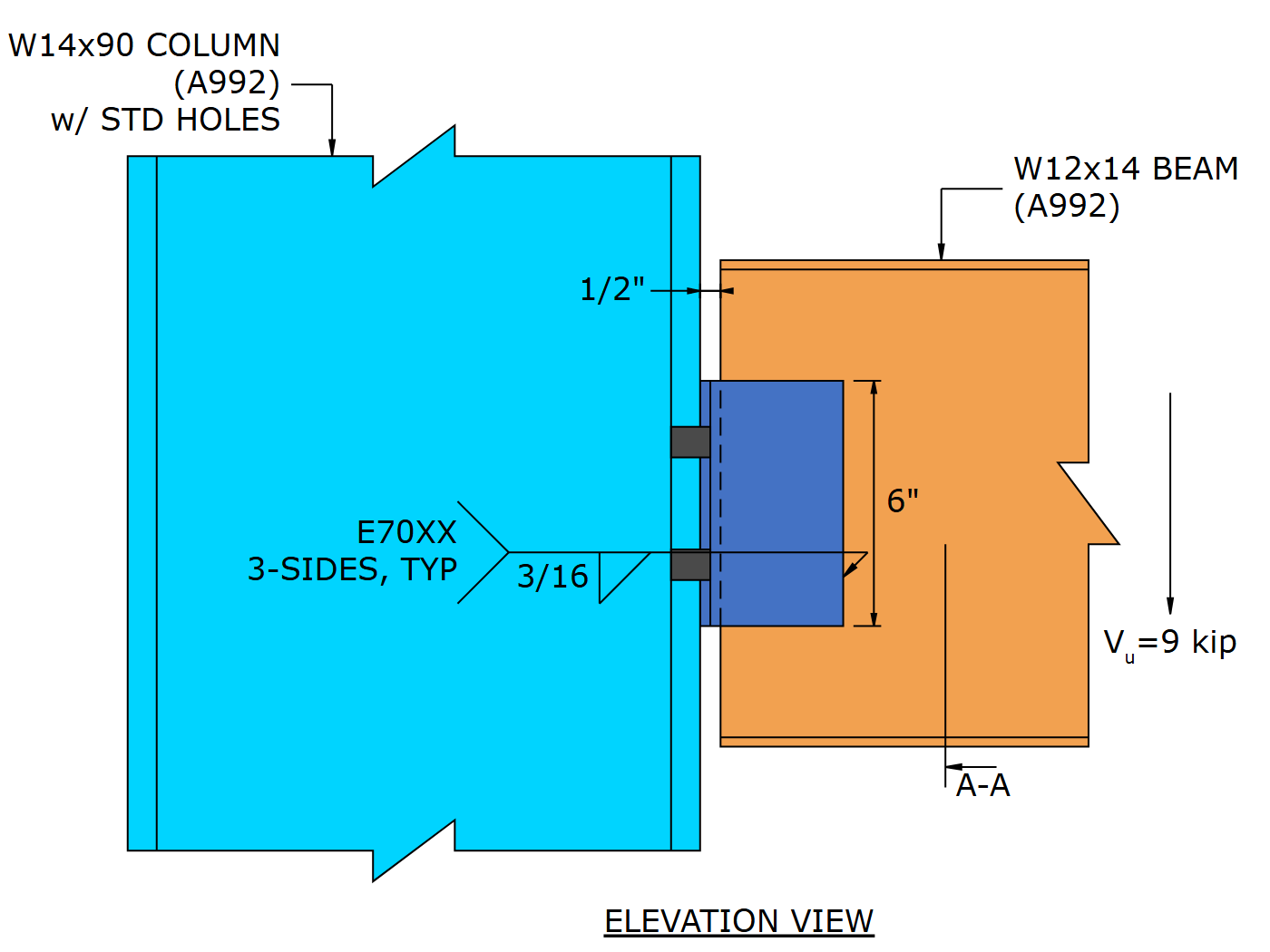
示例连接的标高. The angles are welded to the beam web in the shop and bolted to the column flange, 与一个 1/2 梁端与柱之间的间隙.
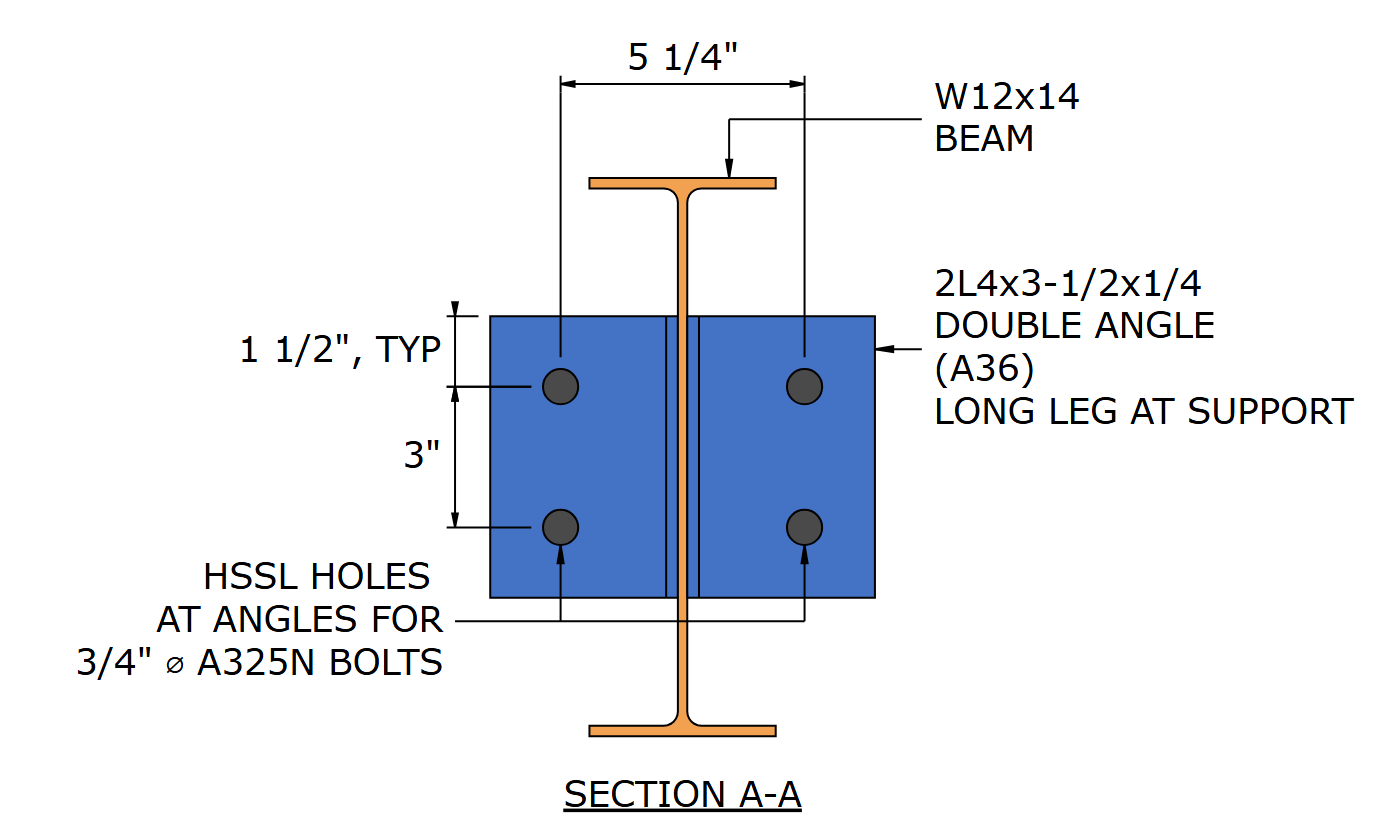
A-A部分. The outstanding legs are bolted to the column flange through horizontal short-slotted holes. The drawing rounds the 5.2 in gage to 5 1/4 在.
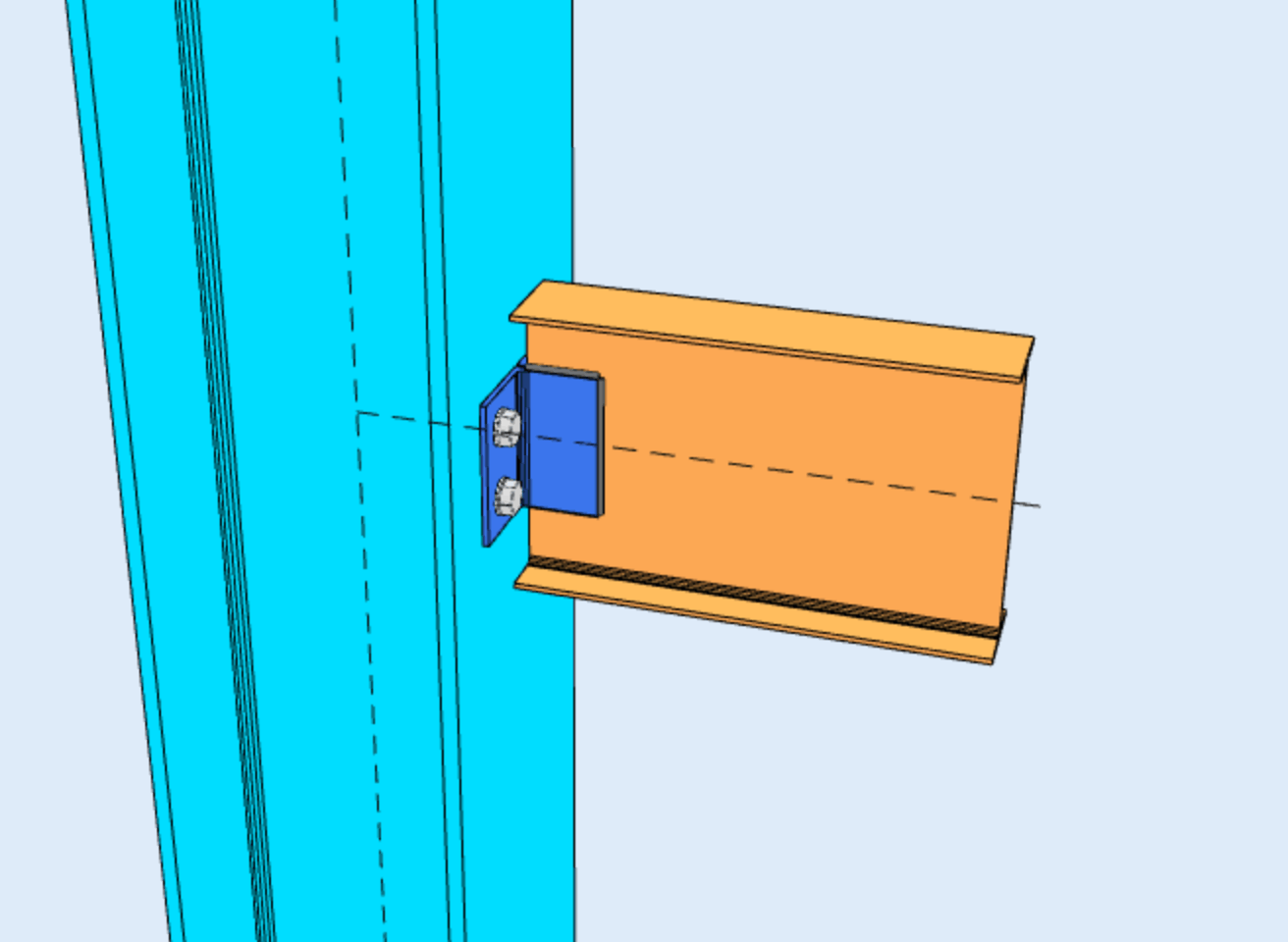
The same connection in the SkyCiv Connection Design 3D view.
如何设计双角连接? 步骤一览
- 检查梁侧的细节限制: connection depth and weld size.
- Check the weld group strength at the beam with the instantaneous center of rotation.
- 检查梁侧角的剪切屈服和剪切断裂.
- Check flexure of the angles at the beam side using the double coped procedure.
- 检查梁侧角度的剪力和力矩相互作用.
- 检查支撑侧的详细限制: 间距, 边距和规格.
- 检查螺栓组的剪切情况.
- Check bolt bearing and tear-out on the angles.
- 检查柱法兰上的螺栓轴承和撕裂情况.
- 联合剪, 每个螺栓的承载和撕裂以获得有效的组强度.
- Check block shear of the angles.
- 检查支撑侧角部的剪切屈服和剪切断裂.
- Check flexure of the angles at the support side.
- 检查支撑侧角度的剪力和力矩相互作用.
本示例的设计输入
设计代码为AISC 360-16 自卫队, so the load is the ASD load combination reaction and each strength is divided by its safety factor, Ω. 截面属性来自 AISC 手册.
| 物品 | 象征 | 值 |
|---|---|---|
| Vertical shear (ASD load combination) | [mathin] V_{a} [mathin] | 9 kip |
| Beam | 宽 12x14, A992 | |
| 波束深度 / 腹板厚度 | [mathin] d_{bm},\ t_{wb} [mathin] | 11.9 在 / 0.2 在 |
| 光束产率 / 拉应力 | [mathin] F_{yb},\ F_{ub} [mathin] | 50 KSI / 65 KSI |
| 柱 | AISC 连接设计示例, A992 | |
| 柱翼缘宽度 / 厚度 | [mathin] b_{fs},\ t_{fs} [mathin] | 14.5 在 / 0.71 在 |
| 柱产量 / 拉应力 | [mathin] F_{ys},\ F_{us} [mathin] | 50 KSI / 65 KSI |
| 弹性模量 | [mathin] E [mathin] | 29000 KSI |
| 物品 | 象征 | 值 |
|---|---|---|
| 角度 | 2L4x3-1/2×1/4, A36, 6 长 | |
| 角度深度 / 厚度 | [mathin] d_{a},\ t_{a} [mathin] | 6 在 / 0.25 在 |
| Leg on the beam / leg on the support | [mathin] b_{a,NSL},\ b_{a,OSL} [mathin] | 3.5 在 / 4 在 |
| 角度屈服 / 拉应力 | [mathin] F_{ya},\ F_{ua} [mathin] | 36 KSI / 58 KSI |
| 立柱上的螺栓 | 3/4 在A325-N中 | |
| 螺栓直径 / 标称剪应力 | [mathin] d_{b},\ F_{nv} [mathin] | 0.75 在 / 54 KSI |
| Holes in angles / 柱子 | 短槽卧式 (高速SSL) / 标准 (性病) | |
| 梁处焊缝 | 3/16 in C-shaped fillet, E70XX | |
| 焊缝尺寸 / 填料强度 | [mathin] W,\ F_{EXX} [mathin] | 0.1875 在 / 70 KSI |
| 几何 | 象征 | 值 |
|---|---|---|
| 梁腹板与柱的间隙 | [mathin] clr [mathin] | 0.5 在 |
| Weld return / vertical weld length | [mathin] kL,\ L [mathin] | 3 在 / 6 在 |
| Weld group eccentricity | [mathin] e [mathin] | 2.75 在 |
| 螺栓排 / 行距 | [mathin] n_{r},\ s_{r} [mathin] | 2 / 3 在 |
| Bolt columns per angle | [mathin] n_{c} [mathin] | 1 |
| Gage at the support | [mathin] g [mathin] | 5.2 在 |
| 垂直的 / horizontal edge distance on angle | [mathin] L_{ev,a},\ L_{eh,a} [mathin] | 1.5 在 / 1.5 在 |
步骤 1: 梁侧的详细限制 (AISC 360-16 J2.2b)
The angles have to be deep enough to give the beam web some rotational restraint and shallow enough to fit within the flat part of the web. The fillet weld along the toe of each angle is limited by the angle thickness, because a weld run along the edge of a plate 1/4 in or thicker can be no larger than the thickness less 1/16 在 (J2.2b).
| 详细限制 | 限制 (在) | 实际的 (在) | 直流电 | 结果 |
|---|---|---|---|---|
| 最小连接深度 | 5.188 | 6.000 | 0.865 | 通过 |
| 最大连接深度 | 9.469 | 6.000 | 0.634 | 通过 |
| Maximum fillet weld size per angle thickness | 0.188 | 0.188 | 1.000 | 通过 |
[math] W_{max} = t_{a} – \tfrac{1}{16}\ \text{in} = 0.25\ \text{in} – 0.0625\ \text{in} = 0.1875\ \text{in} [math]
[math] DCR = \frac{W}{W_{max}} = \frac{0.1875\ \text{in}}{0.1875\ \text{in}} = 1.000 [math]
DCR = 1.000 ≤ 1.0, 行
该 3/16 in weld is exactly the largest weld allowed along the toe of a 1/4 成角度, so this limit is met with no margin. A larger weld would need a thicker angle.
步骤 2: Weld group strength at the beam side (AISC手册部分 8)
Each angle is welded to the beam web with a C-shaped fillet: a vertical weld along the angle toe and a horizontal return at the top and bottom. The reaction acts away from the weld group, so the weld carries a moment as well as shear. The instantaneous center of rotation method gives a coefficient C for the whole group.
母材对焊缝尺寸的限制 (AISC 手动方程式. 9-2)
最大焊缝尺寸, 十六分之一英寸, 连接的部件可以支持. Each angle has a weld on one face only, so the full angle thickness counts. The beam web has a weld on each face, 所以每个焊缝的腹板厚度都是一半, which the calc sheet lists as [mathin] d_{ct} [mathin].
[math] D_{max} = \frac{\min\left( t_{a} F_{ua},\; \frac{t_{wb}}{2} F_{ub} \right)}{3.09\ \text{kip/in} \times \left( F_{EXX}/70\ \text{ksi} \right)} = \frac{\min\left( (0.25\ \text{in})(58\ \text{ksi}),\; (0.1\ \text{in})(65\ \text{ksi}) \right)}{(3.09\ \text{kip/in})(1)} = 2.1036 [math]
该 3/16 in weld is D = 3 十六分之几, so the thin 0.2 in beam web limits the weld to 2.1036 十六分之几.
Weld group coefficient
The weld is split into short segments and the IC is found by iteration, with the load-deformation relationship of AISC Manual Eq. (8-3) and the procedure on pages 8-9 至 8-12. 对于 3 in returns, 的 6 in vertical weld and the 2.75 偏心, the iteration converges with:
[math] x_{ic} = -1.4171\ \text{in}, \qquad y_{ic} = 3\ \text{in}, \qquad C = 3\ \text{kip/in} [math]
Weld group strength (AISC 手动方程式. 8-21)
There are two identical weld groups, one per angle, so the length term is twice the vertical weld length. The electrode coefficient is [mathin] C_{1} = 1 [mathin] for E70XX (手动表 8-3).
[math] \frac{R_{n}}{\Omega} = \frac{C\, C_{1} \min\left( D,\, D_{max} \right) 2L}{\Omega} [math]
[math] \frac{R_{n}}{\Omega} = \frac{(3\ \text{kip/in}) \times (1) \times \min\left( 3,\, 2.1036 \right) \times (12\ \text{in})}{2} [math]
[math] \frac{R_{n}}{\Omega} = 37.864\ \text{kip} [math]
DCR = 9 kip / 37.864 基普= 0.238 < 1.0, 行
步骤 3: Shear yielding and shear rupture of the angles at the beam side (AISC 360-16 J4.2)
The welded legs have no holes, so the net area equals the gross area and both limit states use the same area.
[math] A_{gv} = d_{a}\, 2t_{a} = (6\ \text{in}) \times (0.5\ \text{in}) = 3\ \text{in}^{2} [math]
[math] \frac{R_{n,sy}}{\Omega} = \frac{0.6\, F_{ya} A_{gv}}{\Omega} = \frac{0.6 \times (36\ \text{ksi}) \times (3\ \text{in}^{2})}{1.50} = 43.2\ \text{kip} [math]
[math] \frac{R_{n,sr}}{\Omega} = \frac{0.6\, F_{ua} A_{gv}}{\Omega} = \frac{0.6 \times (58\ \text{ksi}) \times (3\ \text{in}^{2})}{2.00} = 52.2\ \text{kip} [math]
[math] \frac{R_{n}}{\Omega} = \min\left( 43.2\ \text{kip},\, 52.2\ \text{kip} \right) = 43.2\ \text{kip} [math]
DCR = 9 kip / 43.2 基普= 0.208 < 1.0, 行
步骤 4: Flexure of the angles at the beam side, 双应对手术 (AISC 360-16 F11.1)
The calc sheet takes the beam web clearance as the unbraced length on the beam side, [mathin] L_{b} = 0.5\ \text{in} [mathin]. Each angle leg is treated like a beam web with both flanges coped, and the two angles are added together.
范围检查
[math] \frac{L_{b} d}{t^{2}} = \frac{(0.5\ \text{in})(6\ \text{in})}{(0.25\ \text{in})^{2}} = 48 [math]
[math] 48 \le \frac{0.08 E}{F_{y}} = \frac{0.08 \times 29000\ \text{ksi}}{36\ \text{ksi}} = 64.444 [math]
The ratio is below the lower limit, so the angle reaches its full yield moment without lateral-torsional buckling and Eq. F11-1 applies.
一角腿截面模数
[math] Z = \frac{t_{a} d_{a}^{2}}{4} = \frac{(0.25\ \text{in})(6\ \text{in})^{2}}{4} = 2.25\ \text{in}^{3} \qquad S = \frac{t_{a} d_{a}^{2}}{6} = \frac{(0.25\ \text{in})(6\ \text{in})^{2}}{6} = 1.5\ \text{in}^{3} [math]
抗弯强度 (情商. F11-1)
[math] \frac{M_{n}}{\Omega} = 2\, \frac{\min\left( F_{ya} Z,\; 1.6\, F_{ya} S \right)}{\Omega} = 2 \times \frac{\min\left( (36)(2.25),\; 1.6 \times (36)(1.5) \right)}{1.67} = 8.0838\ \text{kip-ft} [math]
等效剪切能力
[math] \frac{V_{n}}{\Omega} = \frac{\frac{M_{n}}{\Omega}}{L_{b}} = \frac{8.0838\ \text{kip-ft} \;(97.006\ \text{kip-in})}{0.5\ \text{in}} = 194.01\ \text{kip} [math]
DCR = 9 kip / 194.01 基普= 0.046 < 1.0, 行
步骤 5: Shear and moment interaction of the angles at the beam side (AISC 手动方程式. 10-5)
The angles carry shear and bending together at the same section. AISC 手动方程式. 10-5 combines them with the shear yielding strength and the flexural strength:
[math] M_{r} = V_{a} L_{b} = (9\ \text{kip}) \times (0.5\ \text{in}) = 0.375\ \text{kip-ft} [math]
[math] I_{nt} = \left( \frac{V_{a}}{\frac{R_{n,sy}}{\Omega}} \right)^{2} + \left( \frac{M_{r}}{\frac{M_{n}}{\Omega}} \right)^{2} = \left( \frac{9\ \text{kip}}{43.2\ \text{kip}} \right)^{2} + \left( \frac{0.375\ \text{kip-ft}}{8.0838\ \text{kip-ft}} \right)^{2} = 0.0456 [math]
DCR = 0.0456 < 1.0, 行
步骤 6: 详细说明支持方的限制 (AISC 360-16 J3.3, J3.4, J3.5)
The bolts in the outstanding legs need the same spacing and edge distances as any bolt group. The gage across the two angles also has two minimums: one so the bolts clear the column, and one so the bolts can be installed with the beam web between the angles.
| 详细限制 | 限制 (在) | 实际的 (在) | 直流电 | 结果 |
|---|---|---|---|---|
| 最小螺栓排间距 | 2.000 | 3.000 | 0.667 | 通过 |
| 最大螺栓排间距 | 6.000 | 3.000 | 0.500 | 通过 |
| 角度最小垂直边缘距离 | 1.000 | 1.500 | 0.667 | 通过 |
| 角度最小水平边距 | 1.125 | 1.500 | 0.750 | 通过 |
| 支持最小水平边距 | 1.000 | 4.650 | 0.215 | 通过 |
| 支撑处的最小螺栓规格 | 4.375 | 5.200 | 0.841 | 通过 |
| 双角最小螺栓规格 | 2.938 | 5.200 | 0.565 | 通过 |
The horizontal edge distance on the angle is measured across the short slot, 因此表 J3.5 添加了 1/8 in to the 1 来自表 J3.4. The governing row is the minimum gage at the support:
[math] DCR = \frac{4.375\ \text{in}}{5.2\ \text{in}} = 0.841 [math]
DCR = 0.841 < 1.0, 行
步骤 7: 支撑侧螺栓组剪力 (AISC 360-16 J3.6)
Each bolt passes through one angle leg and the column flange, so it is in single shear, [mathin] N_{s} = 1 [mathin]. There are two rows of bolts in each angle, four bolts in total. The reaction acts at the column face, so there is no eccentricity and every bolt takes an equal share. With no fillers, [mathin] h_{f} = 1 [mathin] (J5.2(一个)).
[math] \frac{R_{n}}{\Omega} = \frac{F_{nv}\, \frac{\pi}{4} d_{b}^{2}\, N_{s}\, N_{V}\, h_{f}}{\Omega} [math]
[math] \frac{R_{n}}{\Omega} = \frac{(54\ \text{ksi}) \times \frac{\pi}{4} (0.75\ \text{in})^{2} \times (1) \times (4) \times (1)}{2} [math]
[math] \frac{R_{n}}{\Omega} = 47.713\ \text{kip} [math]
DCR = 9 kip / 47.713 基普= 0.189 < 1.0, 行
步骤 8: Bolt bearing and tear-out on the angles (AISC 360-16 J3.10)
The bolts bear on the angle legs. The edge bolt tears out to the end of the angle, and the others tear out to the next hole. 插槽水平延伸, so the hole dimension across the member length is [mathin] d_{h} = 0.8125\ \text{in} [mathin].
[math] l_{c1} = L_{ev,a} – \frac{d_{h}}{2} = 1.5\ \text{in} – \frac{0.8125\ \text{in}}{2} = 1.0938\ \text{in} [math]
[math] l_{c2} = s_{r} – d_{h} = 3\ \text{in} – 0.8125\ \text{in} = 2.1875\ \text{in} [math]
The strength of one line of bolts, times the number of lines (one per angle):
[math] \frac{R_{n}}{\Omega} = \frac{\left[ \min\left(1.2\, l_{c1},\, 2.4\, d_{b}\right) t_{a} F_{ua} + \min\left(1.2\, l_{c2},\, 2.4\, d_{b}\right) t_{a} F_{ua} \left( n_{r} – 1 \right) \right] \frac{N_{V}}{n_{r}}}{\Omega} [math]
[math] \frac{R_{n}}{\Omega} = \frac{\left[ \min\left(1.3125,\, 1.8\right)(0.25)(58) + \min\left(2.625,\, 1.8\right)(0.25)(58)(2 – 1) \right] \times \frac{4}{2}}{2} [math]
[math] \frac{R_{n}}{\Omega} = 45.131\ \text{kip} [math]
DCR = 9 kip / 45.131 基普= 0.199 < 1.0, 行
步骤 9: 柱法兰上的螺栓轴承和撕裂 (AISC 360-16 J3.10)
The column flange has no edge in the direction of the load, so every bolt bears as an inner bolt with the clear distance between holes.
[math] l_{c2} = s_{r} – d_{h} = 3\ \text{in} – 0.8125\ \text{in} = 2.1875\ \text{in} [math]
[math] \frac{R_{n}}{\Omega} = \frac{\min\left(1.2\, l_{c2},\, 2.4\, d_{b}\right) t_{fs} F_{us} N_{V}}{\Omega} [math]
[math] \frac{R_{n}}{\Omega} = \frac{\min\left(1.2 \times 2.1875\ \text{in},\, 2.4 \times 0.75\ \text{in}\right) \times (0.71\ \text{in}) \times (65\ \text{ksi}) \times (4)}{2} [math]
[math] \frac{R_{n}}{\Omega} = 166.14\ \text{kip} [math]
DCR = 9 kip / 166.14 基普= 0.054 < 1.0, 行
步骤 10: 螺栓组有效强度 (AISC 360-16 J3.6 评论)
Each bolt delivers the least of its shear strength, its bearing or tear-out strength on the angle, and its bearing strength on the column flange. The group strength is the sum of those per-bolt values.
[math] \frac{r_{v}}{\Omega} = \frac{\frac{R_{n}}{\Omega}}{N_{V}} = \frac{47.713\ \text{kip}}{4} = 11.928\ \text{kip} [math]
[math] \frac{r_{n1e}}{\Omega} = \frac{\min\left(1.3125,\, 1.8\right)(0.25)(58)}{2} = 9.5156\ \text{kip} \qquad \frac{r_{n1i}}{\Omega} = \frac{\min\left(2.625,\, 1.8\right)(0.25)(58)}{2} = 13.05\ \text{kip} [math]
[math] \frac{r_{n2}}{\Omega} = \frac{\min\left(2.625,\, 1.8\right)(0.71)(65)}{2} = 41.535\ \text{kip} [math]
螺栓从行顶部开始编号, 所以螺栓 1 是角上的边缘螺栓:
| 螺栓 | 螺栓剪 (kip) | 轴承 / tear-out on the angle (kip) | Bearing on the column flange (kip) | 有效强度 (kip) |
|---|---|---|---|---|
| 1 | 11.93 | 9.52 | 41.53 | 9.52 |
| 2 | 11.93 | 13.05 | 41.53 | 11.93 |
[math] \sum \frac{r_{eff}}{\Omega} = (1) \times (9.5156\ \text{kip}) + (1) \times (11.928\ \text{kip}) = 21.444\ \text{kip} [math]
[math] \frac{R_{n,eff}}{\Omega} = \frac{N_{V}}{n_{r}} \sum \frac{r_{eff}}{\Omega} = \frac{4}{2} \times (21.444\ \text{kip}) = 42.888\ \text{kip} [math]
DCR = 9 kip / 42.888 基普= 0.210 < 1.0, 行
Tear-out at the edge bolt, 9.52 kip, is lower than the bolt’s 11.93 kip shear strength, which is why this check is a little lower than the bolt shear check in Step 7.
步骤 11: Block shear of the angles at the support side (AISC 360-16 J4.3)
A block of each outstanding leg can tear out: shear down the bolt line and tension across to the toe of the leg. The tension area uses the slot length along the member, [mathin] d_{h} = 1\ \text{in} [mathin], 每个孔都会增加 0.0625 损坏 (B4.3). The areas include both angles, [mathin] 2t_{a} = 0.5\ \text{in} [mathin].
[math] A_{nt} = 2t_{a} \left[ L_{eh,a} – 0.5\left( d_{h} + 0.0625\ \text{in} \right) \right] = (0.5) \times \left[ 1.5 – 0.5 (1.0625) \right] = 0.48438\ \text{in}^{2} [math]
[math] A_{gv} = 2t_{a} \left[ L_{ev,a} + (n_{r}-1) s_{r} \right] = (0.5) \times \left[ 1.5 + (1)(3) \right] = 2.25\ \text{in}^{2} [math]
[math] A_{nv} = 2t_{a} \left[ d_{a} – L_{ev,a} – (n_{r}-0.5)\left( d_{h} + 0.0625\ \text{in} \right) \right] = (0.5) \times \left[ 6 – 1.5 – (1.5)(0.875) \right] = 1.5938\ \text{in}^{2} [math]
[math] \frac{R_{n}}{\Omega} = \frac{\min\left( 0.6 F_{ua} A_{nv},\; 0.6 F_{ya} A_{gv} \right) + U_{bs} F_{ua} A_{nt}}{\Omega} [math]
[math] \frac{R_{n}}{\Omega} = \frac{\min\left( 0.6 \times 58 \times 1.5938,\; 0.6 \times 36 \times 2.25 \right) + 1 \times 58 \times 0.48438}{2} [math]
[math] \frac{R_{n}}{\Omega} = 38.347\ \text{kip} [math]
DCR = 9 kip / 38.347 基普= 0.235 < 1.0, 行
与 [mathin] U_{bs} = 1 [mathin]. Shear yielding on the gross area is the lower branch, so it sets the strength.
步骤 12: Shear yielding and shear rupture of the angles at the support side (AISC 360-16 J4.2)
Shear yielding is the same as on the beam side. Shear rupture now uses the net area through the bolt holes.
[math] \frac{R_{n,sy}}{\Omega} = \frac{0.6 \times (36\ \text{ksi}) \times (3\ \text{in}^{2})}{1.50} = 43.2\ \text{kip} [math]
[math] A_{nv} = 2t_{a} \left[ d_{a} – n_{r}\left( d_{h} + 0.0625\ \text{in} \right) \right] = (0.5\ \text{in}) \times \left[ 6\ \text{in} – 2 \times (0.875\ \text{in}) \right] = 2.125\ \text{in}^{2} [math]
[math] \frac{R_{n,sr}}{\Omega} = \frac{0.6 \times (58\ \text{ksi}) \times (2.125\ \text{in}^{2})}{2.00} = 36.975\ \text{kip} [math]
[math] \frac{R_{n}}{\Omega} = \min\left( 43.2\ \text{kip},\, 36.975\ \text{kip} \right) = 36.975\ \text{kip} [math]
DCR = 9 kip / 36.975 基普= 0.243 < 1.0, 行
步骤 13: Flexure of the angles at the support side, 双应对手术 (AISC 360-16 F11.2)
On the support side the unbraced length is the distance from the bolt line to the face of the beam web, half of the gage less the web thickness: [mathin] L_{b} = (5.2 – 0.2)/2 = 2.5\ \text{in} [mathin].
范围检查
[math] \frac{L_{b} d}{t^{2}} = \frac{(2.5\ \text{in})(6\ \text{in})}{(0.25\ \text{in})^{2}} = 240 [math]
[math] \frac{0.08 E}{F_{y}} = \frac{0.08 \times 29000\ \text{ksi}}{36\ \text{ksi}} = 64.444 \lt 240 \le \frac{1.9 E}{F_{y}} = \frac{1.9 \times 29000\ \text{ksi}}{36\ \text{ksi}} = 1530.6 [math]
The ratio is between the two limits, 所以方程. F11-2 applies with the buckling modification factor.
一角腿截面模数
[math] Z = \frac{t_{a} d_{a}^{2}}{4} = \frac{(0.25\ \text{in})(6\ \text{in})^{2}}{4} = 2.25\ \text{in}^{3} \qquad S = \frac{t_{a} d_{a}^{2}}{6} = \frac{(0.25\ \text{in})(6\ \text{in})^{2}}{6} = 1.5\ \text{in}^{3} [math]
横向扭转屈曲修正系数 (AISC 手动方程式. 9-15)
The angles are not coped, 所以 [mathin] d_{ct} = 0 [mathin]:
[math] C_{b} = \left[ 3 + \ln\left( \frac{2.5\ \text{in}}{6\ \text{in}} \right) \right] \times \left( 1 – \frac{0}{6} \right) = 2.1245 \ge 1.84 [math]
抗弯强度 (情商. F11-2)
[math] \frac{M_{n}}{\Omega} = 2\, \frac{\min\left\{ C_{b} \left[ 1.52 – 0.274 \left( \frac{L_{b} d}{t^{2}} \right) \frac{F_{ya}}{E} \right] F_{ya} S,\; F_{ya} Z \right\}}{\Omega} [math]
[math] \frac{M_{n}}{\Omega} = 2 \times \frac{\min\left\{ (2.1245) \left[ 1.52 – 0.274 \times (240) \times \frac{36}{29000} \right] (36)(1.5),\; (36)(2.25) \right\}}{1.67} = 8.0838\ \text{kip-ft} [math]
The plastic moment governs, so the angles do not buckle sideways at this length.
等效剪切能力
[math] \frac{V_{n}}{\Omega} = \frac{\frac{M_{n}}{\Omega}}{L_{b}} = \frac{8.0838\ \text{kip-ft} \;(97.006\ \text{kip-in})}{2.5\ \text{in}} = 38.802\ \text{kip} [math]
DCR = 9 kip / 38.802 基普= 0.232 < 1.0, 行
步骤 14: Shear and moment interaction of the angles at the support side (AISC 手动方程式. 10-5)
The angles carry shear and bending together at the same section. AISC 手动方程式. 10-5 combines them with the shear yielding strength and the flexural strength:
[math] M_{r} = V_{a} L_{b} = (9\ \text{kip}) \times (2.5\ \text{in}) = 1.875\ \text{kip-ft} [math]
[math] I_{nt} = \left( \frac{V_{a}}{\frac{R_{n,sy}}{\Omega}} \right)^{2} + \left( \frac{M_{r}}{\frac{M_{n}}{\Omega}} \right)^{2} = \left( \frac{9\ \text{kip}}{43.2\ \text{kip}} \right)^{2} + \left( \frac{1.875\ \text{kip-ft}}{8.0838\ \text{kip-ft}} \right)^{2} = 0.0972 [math]
DCR = 0.0972 < 1.0, 行
设计检查总结
| 设计检查 | 需求 | Allowable strength | 直流电 | 结果 |
|---|---|---|---|---|
| 1. 梁侧的详细限制 | 0.1875 在 | 0.1875 在 | 1.000 | 通过 |
| 2. Weld group at the beam | 9 kip | 37.864 kip | 0.238 | 通过 |
| 3. Angle shear at the beam side | 9 kip | 43.200 kip | 0.208 | 通过 |
| 4. Angle flexure at the beam side | 9 kip | 194.01 kip | 0.046 | 通过 |
| 5. Shear and moment interaction, 梁侧 | 0.0456 | 1.000 | 0.046 | 通过 |
| 6. 详细说明支持方的限制 | 4.375 在 | 5.2 在 | 0.841 | 通过 |
| 7. 螺栓群剪力 | 9 kip | 47.713 kip | 0.189 | 通过 |
| 8. Bearing and tear-out on the angles | 9 kip | 45.131 kip | 0.199 | 通过 |
| 9. Bearing and tear-out on the column flange | 9 kip | 166.14 kip | 0.054 | 通过 |
| 10. 螺栓组有效强度 | 9 kip | 42.888 kip | 0.210 | 通过 |
| 11. Block shear of the angles | 9 kip | 38.347 kip | 0.235 | 通过 |
| **12. Angle shear at the support side** | **9 基普** | **36.975 基普** | **0.243** | **PASS** |
| 13. Angle flexure at the support side | 9 kip | 38.802 kip | 0.232 | 通过 |
| 14. Shear and moment interaction, 支持方 | 0.0972 | 1.000 | 0.097 | 通过 |
连接通过了每项检查. Shear rupture of the angles through the bolt holes governs the strength checks at 0.243, with block shear (0.235), the weld (0.238) and flexure at the support (0.232) close behind. The highest ratio on the page is the beam-side detailing limit at 1.000: 的 3/16 in weld is the largest allowed along the toe of a 1/4 成角度. 该 9 kip reaction is light for these angles, so most of the reserve is in strength, not in detailing.
如果检查失败要更改什么
- 梁处焊缝: a longer angle or longer returns raise C and the weld length. A larger weld only helps up to the base metal limit set by the beam web, and it must stay within the angle-thickness limit in Step 1.
- Weld size per angle thickness: use a thicker angle, or a smaller weld.
- 螺栓剪切或有效强度: 添加螺栓排或使用更大的螺栓.
- Tear-out at the edge bolt: increase the vertical edge distance on the angles.
- Block shear or shear rupture of the angles: make the angles longer with another bolt row, 或者使用更粗的角度.
- Angle flexure at the support: a smaller gage shortens the lever arm, but it must stay above both minimum gages in Step 6.
- Minimum gage at the support: widen the gage, which may need longer outstanding legs to keep the edge distance.
Auto Design is available for the double angle connection to a column flange. 它会更改连接的设计变量,直到每项检查都通过, 并保留您输入的成员和负载. 见 汽车设计 其适用的首选项页面.
常见问题
How does this ASD example differ from the LRFD version?
The limit states and the nominal strengths are the same. In ASD the load is the ASD load combination reaction, and each nominal strength is divided by a safety factor instead of multiplied by a resistance factor: Ω = 2.00 where LRFD uses φ = 0.75, Ω = 1.50 for shear yielding where LRFD uses φ = 1.00, and Ω = 1.67 for flexure where LRFD uses φ = 0.90. The LRFD version also bolts the angles to the beam web, so it has bolt checks on the beam side where this example has a weld check.
Why weld the angles to the beam instead of bolting them?
Shop welding the angles to the beam leaves no holes in the beam web, and only the column-side bolts are installed on site. The trade-off is that the weld has to carry the reaction with an eccentricity, and the beam web thickness limits how much of the weld counts.
Why are the column bolts in single shear?
Each bolt at the column passes through one angle leg and the column flange, which is one shear plane. On a bolted beam side, the bolts pass through both angles and the beam web, which gives two shear planes.
Why does the thin beam web limit the weld?
The weld transfers shear into the beam web, and the web has a weld on each face. AISC 手动方程式. 9-2 limits each weld to what half the web thickness can carry in shear rupture, so a thin web caps the useful weld size.
为什么使用双内束程序来检查角度?
A leg of an angle loaded in its own plane behaves like a deep, thin rectangle in bending, which is what a beam web with both flanges coped looks like. The AISC Manual uses the same F11 equations, with the buckling factor of Manual Eq. 9-15, 对彼此而言.
此示例是否遵循 AISC 第 15 版或 AISC 第 16 版手册?
它遵循 AISC 360-16 和 AISC 手册第 15 版, 这是围绕该规范编写的. AISC 第 16 版手册与后续版本配对 360-22 规范. 双角度连接的极限状态在两种情况下都是相同的, 但子句和页面引用会移动, 因此请根据您的项目使用的版本检查它们.
免费设计双角连接
此页上的每个数字都来自一个解决方案. 选择双角度配置, 选择AISC 360-16 自卫队, 输入你的光束, 支持, 角度, 焊接, 螺栓和反作用力, 并在浏览器中查看每项检查. 没有什么可安装的.
SkyCiv Connection Design 模块是本示例背后的连接设计软件. 它为您提供完整的计算报告,其中包含每个方程和您的数字, 就像上面的步骤一样, 加上每个容量和 DCR, 对于AISC 360-22 和AISC 360-16 (LRFD 和 ASD) 并作为 4100:2020. 该 螺栓计算器 和 焊接计算器 自行覆盖螺栓组和焊接检查.
参考资料
- AISC 360-16, 钢结构建筑规范: B3.4, B4.3, F11.1 (情商. F11-1), F11.2 (情商. F11-2), J2.2b, J3.3, J3.4 (表J3.4), J3.5 (表 J3.5), J3.6 (情商. J3-1) 及评论, J3.10 (情商. J3-6a, J3-6c), J4.2 (情商. J4-3, J4-4), J4.3, J5.2(一个).
- AISC 钢结构手册, 15第版: 部分 8, 首先介绍你自己和你申请的职位 8-9 至 8-12, 情商. 8-3 和 8-21, 桌子 8-3; 部分 9, 情商. 9-2 和 9-15; 部分 10, 情商. 10-5.
- Double angle connection design, LRFD version
- 使用 AISC 进行钢连接设计 360-16
- 螺栓 和 焊缝 SkyCiv 连接设计

哈罗德穆纳勒姆
产品经理, 连接设计
10+ 从事钢结构连接设计多年
领英
