
A bolt in a shear connection designed to AS 4100:2020 is checked twice: once for the bolt itself shearing through (Clausola 9.2.2.1) and once for the plies it passes through, which can bear or tear out at the holes (Clausola 9.2.2.4). If the bolts are fully tensioned friction-type bolts (8.8/TF or 10.9/TF), a third check under Clause 9.2.3.1 makes sure the joint does not slip in service.
This page explains each of these checks and works them through with the same connection as our web side plate design example: eight M20 8.8/S bolts carrying 150 kN from a 460 Puoi trovare una gamma di tipi di connessione che soddisfano le tue esigenze senza dover occuparti di sistemi di interfaccia utente disordinati che richiedono una curva di apprendimento ripida per iniziare 82.1 beam into a 10 piastra da mm. Every number comes from the calculation report that SkyCiv Connection Design produces for that connection.
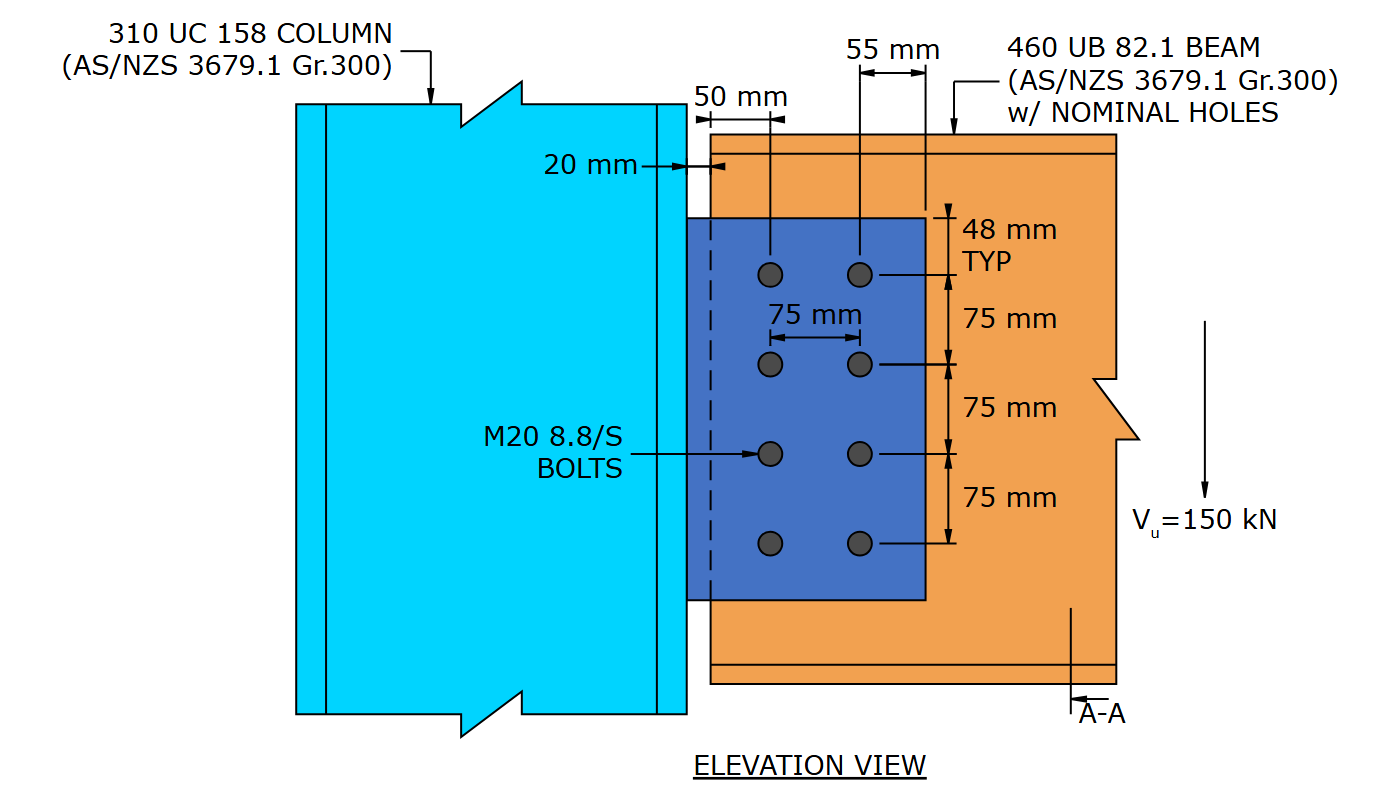
Which bolt checks does AS 4100 require in shear?
| Verifica | Clausola | Applies to |
|---|---|---|
| Bullone a taglio, [mathin]\phi V_{f}[mathin] | 9.2.2.1 | Every bolt category (4.6/S, 8.8/S, 8.8/TBC, 8.8/TF and the 10.9 ones) |
| Strato nel cuscinetto, [mathin]\phi V_{b}[mathin] | 9.2.2.4 | Every ply the bolt passes through: the plate, the beam web, the support |
| Friction-type joint in service, [mathin]\phi V_{sf}[mathin] | 9.2.3.1 | 8.8/TF and 10.9/TF bolts |
In a connection where the load is eccentric to the bolt group, the program finds the share of each bolt with the instantaneous centre of rotation method (Clausola 9.3.1) and turns it into a bolt group coefficient C. The single-bolt capacities on this page are then multiplied by C. How C is found is covered step by step in calcolo del gruppo di bulloni utilizzando ICOR.
Design inputs for the example
| Articolo | Simbolo | Valore |
|---|---|---|
| Taglio di progettazione | [mathin]V^{*}[mathin] | 150 kN |
| bulloni | 8 x M20 8.8/S, 4 righe x 2 colonne | |
| Diametro del bullone / hole diameter | [mathin]d_{f},\ d_{h}[mathin] | 20 mm / 22 mm |
| Bolt minimum tensile strength | [mathin]f_{uf}[mathin] | 830 MPa |
| Core area / area del gambo | [mathin]A_{c},\ A_{o}[mathin] | 225 mm2 / 314.16 mm2 |
| Passo / misura | [mathin]s_{p},\ s_{g}[mathin] | 75 mm / 75 mm |
| Eccentricità del gruppo bulloni | [mathin]e_{b}[mathin] | 107.5 mm |
| Piatto | [mathin]t_{i},\ f_{up}[mathin] | 10 mmGr.250, 410 MPa |
| Distanze dai bordi della piastra, verticale / orizzontale | [mathin]l_{ev\_wp},\ l_{eh\_wp}[mathin] | 47.5 mm / 55 mm |
| Rete del fascio | [mathin]t_{wb},\ f_{ub}[mathin] | 9.9 mm Gr.300, 440 MPa |
| Distanza dal bordo orizzontale dell'anima della trave | [mathin]l_{eh\_w}[mathin] | 50 mm |
Bolt shear capacity (Clausola 9.2.2.1)
The design shear capacity of one bolt is:
[math]\phi V_{f} = \phi \times 0.62 \times f_{uf} \times k_{rd} \times k_{r} \times \left( n_{n} A_{c} + n_{x} A_{o} \right)[math]
con [mathin]\phi = 0.8[mathin] for a bolt in shear. The terms that change from one connection to another are:
- Threads in the shear plane, [mathin]n_{n}[mathin] e [mathin]n_{x}[mathin]. A shear plane through the threads uses the core area [mathin]A_{c}[mathin]; a plane through the plain shank uses the shank area [mathin]A_{o}[mathin]. For an M20 bolt that is 225 mm2 contro 314.16 mm2, so excluding the threads is worth 40% more capacity. The program accepts "threads excluded" only when a standard bolt length leaves the threads clear of the shear plane for the plies entered, and never for 4.6 bulloni. Otherwise it designs with threads included.
- Ductility factor [mathin]k_{rd}[mathin]. The program takes 0.83 per 10.9 bolts with threads included in the shear plane, e 1.0 for every other case.
- Lap length factor [mathin]k_{r}[mathin]. Long bolted lap joints lose capacity because the end bolts take more than their share. The program works out the joint length as [mathin]l_{j} = (n_{rows} – 1) s_{p}[mathin] along the force and applies:
| Joint length | [mathin]k_{r}[mathin] |
|---|---|
| [mathin]l_{j} \lt 300[mathin] mm | 1.0 |
| 300 mm a 1300 mm | [mathin]1.075 – l_{j}/4000[mathin] |
| [mathin]l_{j} \gt 1300[mathin] mm | 0.75 |
The lap reduction is applied in flange plate connections and splices, where the force runs along a line of bolts. In beam shear connections such as the web side plate, the report shows [mathin]k_{r,bolt} = 1[mathin].
Step 1: Capacità di taglio di progetto di un bullone
The 8.8/S bolts in the example have the threads in the single shear plane, COSÌ [mathin]n_{n} = 1[mathin] e [mathin]n_{x} = 0[mathin]:
[math]\phi V_{f} = 0.8 \times 0.62 \times 830 \times 1 \times 1 \times \left( 1 \times 225 + 0 \times 314.16 \right) = 92.628\ \text{kN}[math]
Step 2: Gruppo bulloni a taglio (Clausola 9.3.1)
Il 150 kN shear acts 107.5 mm from the centroid of the bolt group. The ICOR iteration places the instantaneous centre at [mathin]x_{ic} = -30.727\ \text{mm}[mathin] e [mathin]y_{ic} = 112.5\ \text{mm}[mathin] from Bolt No. 1 (bottom left). The vertical reactions of the eight bolts, each at its [mathin]\phi V_{f}[mathin] limite, add up to:
[math]\phi V_{df} = \sum R_{y} = 430.69\ \text{kN}, \qquad C = \frac{\phi V_{df}}{\phi V_{f}} = \frac{430.69}{92.628} = 4.6497[math]
DCR = 150 kN / 430.69 kN = 0.348 ≤ 1.0, ok
Step 3: The same bolts with threads excluded
Switching the same input to threads excluded from the shear plane gives [mathin]n_{n} = 0[mathin] e [mathin]n_{x} = 1[mathin]:
[math]\phi V_{f} = 0.8 \times 0.62 \times 830 \times 1 \times 1 \times \left( 0 \times 225 + 1 \times 314.16 \right) = 129.33\ \text{kN}[math]
The bolt group capacity rises to [mathin]\phi V_{df} = 601.36\ \text{kN}[mathin], and the DCR drops from 0.348 per 0.249. The bearing checks below do not change, because they do not depend on the threads.
Ply bearing capacity (Clausola 9.2.2.4)
A ply can fail at a bolt hole in two ways: the bolt crushes the material in front of it (capacità portante), or the bolt tears out through the edge of the ply or into the next hole (strappo). The program takes the smaller of the two:
[math]\phi V_{b} = \phi \times \min\left( 3.2\, d_{f}\, t_{p}\, f_{up},\ a_{e}\, t_{p}\, f_{up} \right)[math]
con [mathin]\phi = 0.9[mathin] for a ply in bearing. [mathin]a_{e}[mathin] è la distanza dal bordo del foro al bordo dello strato, più metà del diametro del bullone, measured in the direction of the force:
- to a free edge: [mathin]a_{e} = l_{e} – 0.5\, d_{h} + 0.5\, d_{f}[mathin]
- to the next hole: [mathin]a_{e} = s – d_{h} + 0.5\, d_{f}[mathin]
When the bolt forces come from an ICOR analysis they act in different directions, so the program takes the least [mathin]a_{e}[mathin] in either direction for each ply.
Step 4: Cuscinetto sulla piastra laterale del nastro
[math]a_{e1} = 47.5 – 0.5 \times 22 + 0.5 \times 20 = 46.5\ \text{mm} \qquad a_{e2} = 75 – 22 + 0.5 \times 20 = 63\ \text{mm}[math]
[math]a_{e3} = 55 – 0.5 \times 22 + 0.5 \times 20 = 54\ \text{mm} \qquad a_{e4} = 75 – 22 + 0.5 \times 20 = 63\ \text{mm}[math]
The vertical edge distance governs, [mathin]a_{e} = 46.5\ \text{mm}[mathin]:
[math]\phi V_{b,pl} = 0.9 \times \min\left( 3.2 \times 20 \times 10 \times 410,\ 46.5 \times 10 \times 410 \right) = 171.59\ \text{kN}[math]
Tear-out governs here: [mathin]3.2 d_{f} = 64\ \text{mm}[mathin] is more than the 46.5 mm available.
Step 5: Appoggio sull'anima della trave
The beam web has no vertical free edge near the bolts, so only the pitch, the horizontal edge and the gauge count:
[math]a_{e5} = 75 – 22 + 0.5 \times 20 = 63\ \text{mm} \qquad a_{e6} = 50 – 0.5 \times 22 + 0.5 \times 20 = 49\ \text{mm} \qquad a_{e7} = 63\ \text{mm}[math]
[math]\phi V_{b,beam} = 0.9 \times \min\left( 3.2 \times 20 \times 9.9 \times 440,\ 49 \times 9.9 \times 440 \right) = 192.1\ \text{kN}[math]
Step 6: Bolt group in bearing
The weaker ply governs, and the same coefficient C spreads it over the group:
[math]\phi V_{b} = \min\left( 171.59,\ 192.1 \right) \times 4.6497 = 797.82\ \text{kN}[math]
DCR = 150 kN / 797.82 kN = 0.188 ≤ 1.0, ok
Bolt shear governs this connection by a wide margin (0.348 contro 0.188). That is typical for 8.8 bolts in 10 mm plates; bearing tends to govern with thin plies, short edge distances or 10.9 bulloni.
Friction-type bolts: manutenibilità (Clausola 9.2.3.1)
With 8.8/TF bolts the joint is meant not to slip at the serviceability limit state. The report adds a check of the slip capacity of the bolt group:
[math]\phi V_{sf} = \phi\, \mu\, n_{ei}\, N_{ti}\, k_{h}\, C[math]
con [mathin]\phi = 0.7[mathin], the slip factor [mathin]\mu = 0.35[mathin], [mathin]n_{ei}[mathin] the number of effective interfaces, [mathin]N_{ti}[mathin] the minimum bolt tension at installation (Tabella 15.2.2.2) e [mathin]k_{h}[mathin] the hole type factor, 1.0 for standard holes and 0.85 for oversize or short slotted holes. Changing the example’s bolts to M20 8.8/TF:
[math]\phi V_{sf} = 0.7 \times 0.35 \times 1 \times 145 \times 1 \times 4.6497 = 165.18\ \text{kN}[math]
DCR = 150 kN / 165.18 kN = 0.908 ≤ 1.0, ok
The strength checks of Steps 1 per 6 still apply to TF bolts unchanged. The serviceability check uses the design shear entered for the connection, so if your serviceability shear is lower than the strength one, the DCR shown is on the safe side.
Summary of the bolt checks
| Astuccio | Verifica | Capacità | DCR |
|---|---|---|---|
| 8.8/S, fili inclusi | Gruppo bulloni a taglio | 430.69 kN | 0.348 |
| 8.8/S, discussioni escluse | Gruppo bulloni a taglio | 601.36 kN | 0.249 |
| Qualunque | Bolt group in bearing (plate governs) | 797.82 kN | 0.188 |
| 8.8/La resistenza alla compressione sarà considerata come da AS4600 | Slip in service | 165.18 kN | 0.908 |
What to change if a bolt check fails
- Taglio dei bulloni: aggiungi una riga di bulloni (it raises C), use M24 bolts or a 10.9 grado, keep the threads out of the shear plane if the bolt length allows, or move the bolts closer to the support to cut the eccentricity.
- Bearing on a ply: increase the edge distance in the direction of the force, increase the pitch, or use a thicker ply. Se la trave governa, aggiungere bulloni o utilizzare un bullone più grande.
- Slip of TF bolts: aggiungere bulloni, use a larger bolt for a higher [mathin]N_{ti}[mathin], or use standard holes rather than oversize or slotted ones.
For web side plates, flexible end plates, single and double angle cleats, flange plates and beam and column splices with flange and web plates, Progettazione automobilistica will try these changes for you and return a layout that passes.
Domande frequenti
Why is the shear on one bolt not just V* divided by the number of bolts?
Because the load is eccentric to the group. Il 107.5 mm lever arm adds a moment that the bolts farthest from the instantaneous centre resist most, so the group is worth C = 4.6497 single bolts, not eight.
Does the bearing check depend on the bolt grade?
No. Clausola 9.2.2.4 uses the ply’s tensile strength [mathin]f_{up}[mathin], its thickness and the bolt diameter. The bolt grade only enters the bolt shear check.
Why does the plate govern bearing when the beam web is thinner?
The plate’s tensile strength is lower (410 MPa contro 440 MPa) and its vertical edge distance gives [mathin]a_{e} = 46.5\ \text{mm}[mathin], meno del 49 mm that governs the beam web.
Are TF bolts checked for slip at the strength limit state?
No. Clausola 9.2.3.1 is a serviceability check. At the strength limit state a TF bolt is designed as a bearing bolt, with the same shear and ply bearing checks as an S bolt.
Check your own bolts for free
Scegli AS 4100:2020 and a bolted connection, set the bolt category, size and hole type, and every bolt check above comes back with its DCR and clause. Non c'è niente da installare.
Il modulo SkyCiv Connection Design ti fornisce il rapporto di calcolo completo con ogni equazione e i tuoi numeri in esso, per AS 4100:2020 connessioni a taglio, connessioni momento e giunzioni. Il calcolatore di bulloni is a quick way to check a single bolt group.
Riferimenti
- AS 4100:2020, Strutture in acciaio: Clausole 9.2.2.1, 9.2.2.4, 9.2.3.1, 9.3.1; Tabella 15.2.2.2.
- Web side plate connection design example to AS 4100
- Calcolo del gruppo di bulloni mediante ICOR
- Progettazione di connessioni in acciaio utilizzando AS 4100:2020

Harold Munalem
Responsabile del prodotto, Connection Design
10+ anni nella progettazione di connessioni in acciaio
LinkedIn
