
To design a single angle cleat connection to AS 4100, you check both legs of the angle separately: the outstanding leg bolted to the support, and the leg bolted to the beam web. Each leg has its own bolt group in shear and bearing, both loaded eccentrically, and the angle is checked in shear, bending and block shear at each leg. Then the beam is checked in shear at the connection.
本页从头到尾介绍一个示例: an uncoped 460 UB 82.1 beam framing into the flange of a 310 加州大学 158 column through one 100×6 equal angle, 300 mm long, with a design shear of 150 kN and M20 8.8/S bolts, designed to AS 4100:2020. 每个方程都用它的数字写出来, in the same order as the calculation report that the SkyCiv Connection Design 模块为其生成. It uses the same beam, column and design shear as the web side plate example, and the same angle size as the double angle cleat example. The scope and conventions of the AS 4100 module are on the design of steel connections using AS 4100:2020 页.
What is a single angle cleat connection?
A single angle cleat connection is one angle, bolted to the beam web through one leg and to the supporting member through the other. 这是一个简单的连接: the angle is thin and bolted on both legs, so the beam end can rotate and the joint carries the end shear with almost no moment. With an angle on one side only, it is quick to fit, and it is useful where there is no room for a second cleat on the other side of the web.
The report names the legs by their position. The NSL (near side leg) is the leg against the beam web, and the OSL (outstanding leg) is the leg against the support. In this example both legs are 100 毫米宽, and each has one line of four bolts at 75 毫米间距. In the AS 4100 module this connection sits beside the web side plate, the flexible end plate and the double angle cleat.
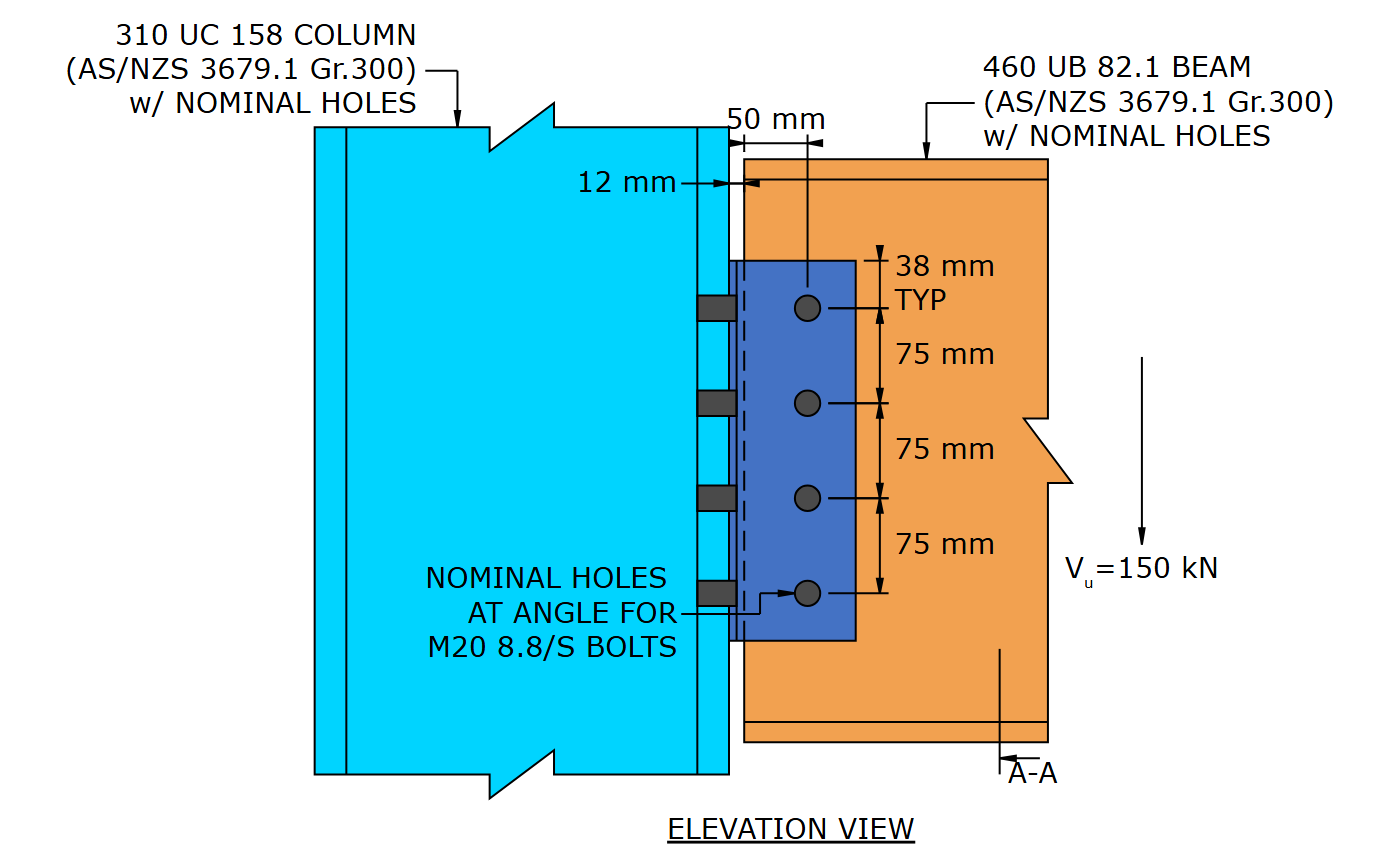
示例连接的标高. The beam stops 12 mm short of the column flange; four bolts in each leg at 75 毫米间距.
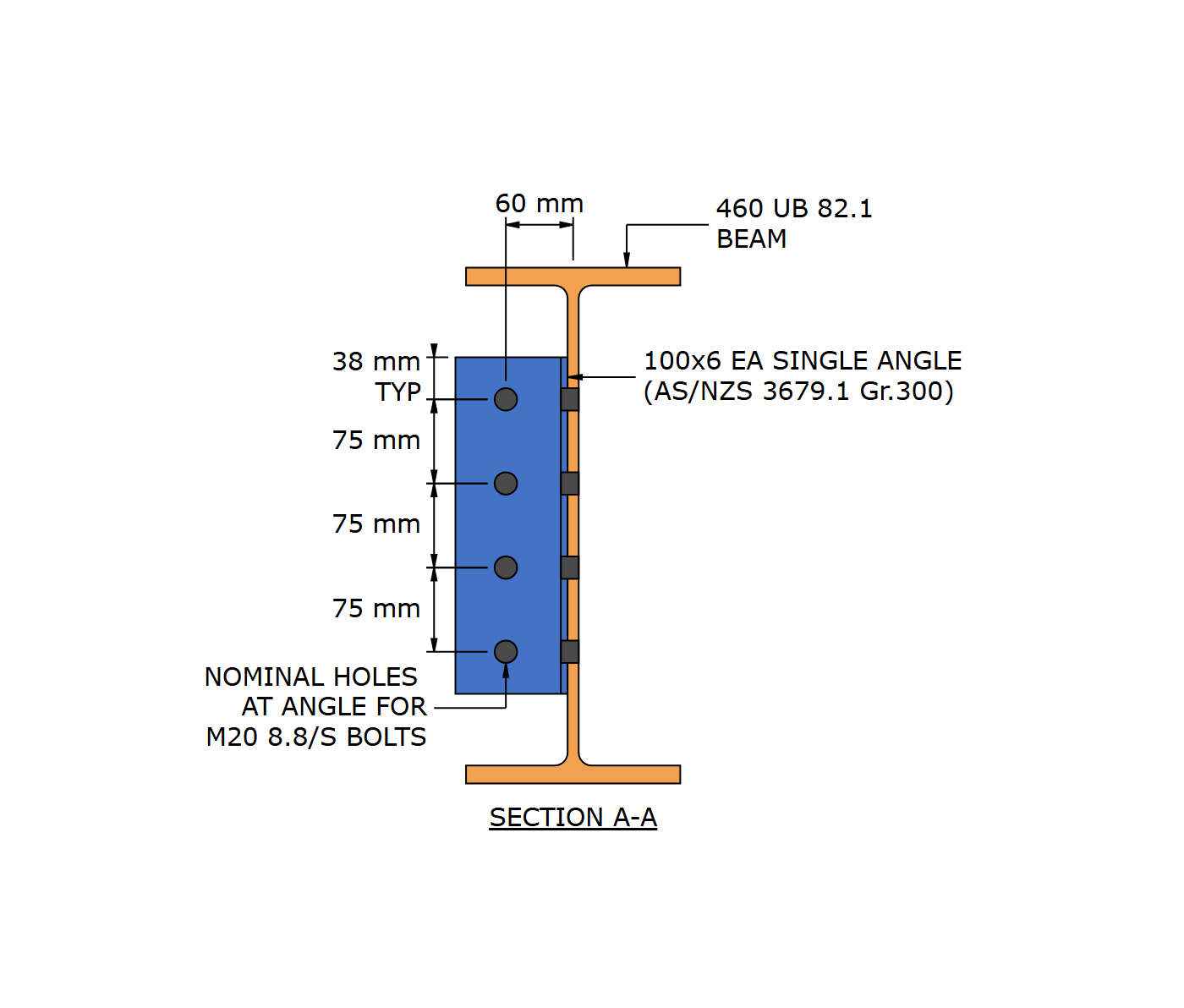
A-A部分, looking at the outstanding leg. 四个螺栓位于 75 毫米间距, 60 mm from the centreline of the beam web.
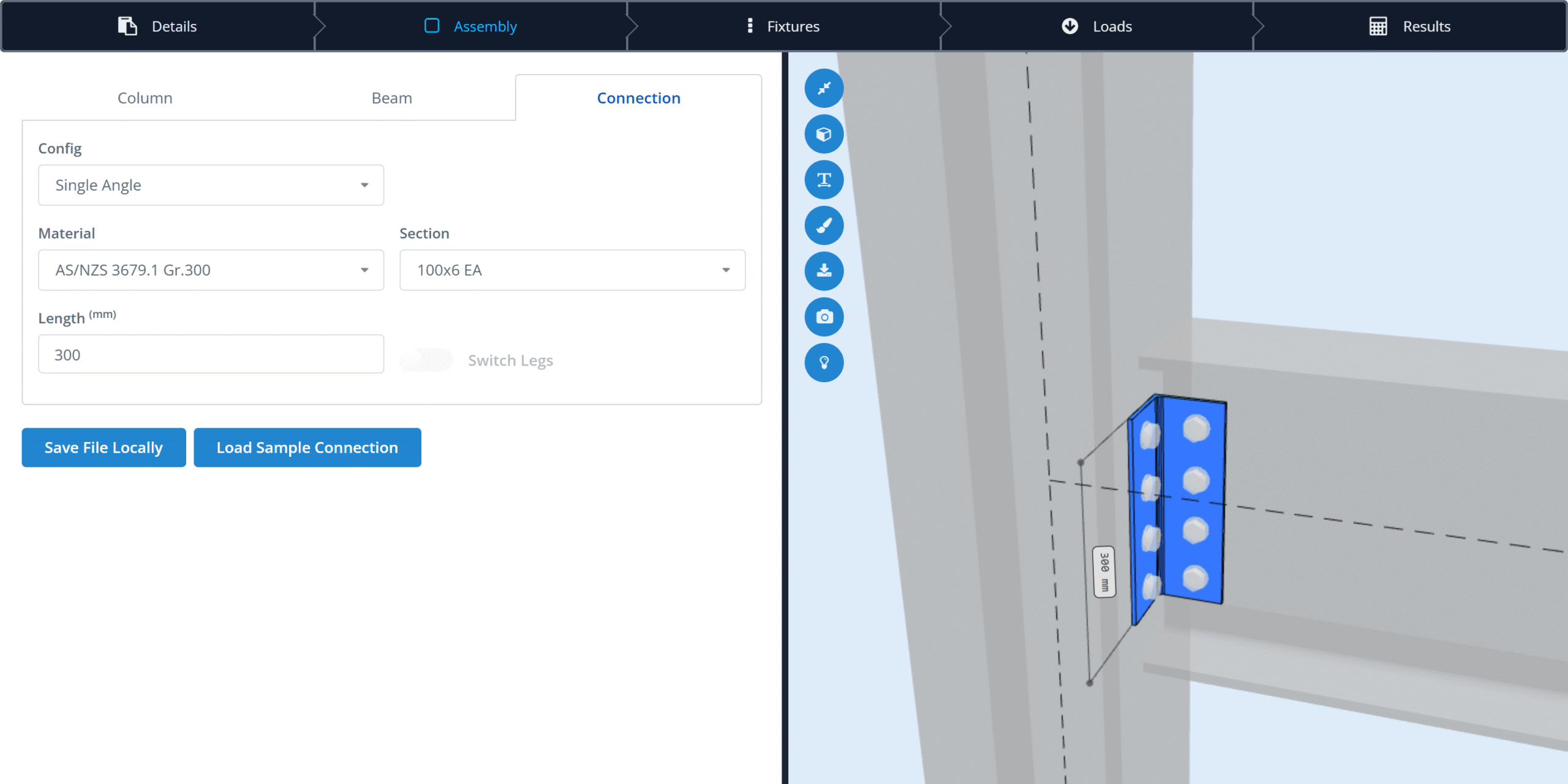
SkyCiv 连接设计中的相同连接, with the angle selected on the Assembly tab.
Single angle connection design: 步骤一目了然
- Check the connection detailing limits at the outstanding leg (OSL).
- Check the bolt group in shear at the OSL, by the instantaneous centre of rotation.
- Check the bolt group in bearing on the angle and the column flange at the OSL.
- Check the angle in shear, bending and block shear at the OSL.
- Check the connection detailing limits at the near side leg (NSL).
- Check the bolt group in shear at the NSL.
- Check the bolt group in bearing on the angle and the beam web at the NSL.
- Check the angle in shear, bending and block shear at the NSL.
- Check the beam in shear.
本示例的设计输入
The design code is AS 4100:2020, with section properties from the Australian section database. The yield strength of each part follows its grade and thickness: 300 MPa for the beam, 280 MPa for the column with its 25 mm flange, 和 320 MPa for the 6 mm angle.
| 物品 | 象征 | 值 |
|---|---|---|
| Design shear (design action effect) | [mathin] V^{*} [mathin] | 150 千牛 |
| Beam | 460 UB 82.1, AS / NZS 3679.1 Gr.300, uncoped | |
| 波束深度 / 腹板厚度 | [mathin] d_{bm},\ t_{wb} [mathin] | 460 毫米 / 9.9 毫米 |
| 光束产率 / 抗拉强度 | [mathin] f_{yb},\ f_{ub} [mathin] | 300 兆帕 / 440 兆帕 |
| 柱 | 310 加州大学 158, AS / NZS 3679.1 Gr.300 | |
| 柱翼缘宽度 / 厚度 | [mathin] b_{fs},\ t_{fs} [mathin] | 311 毫米 / 25 毫米 |
| 柱产量 / 抗拉强度 | [mathin] f_{ys},\ f_{us} [mathin] | 280 兆帕 / 440 兆帕 |
| 物品 | 象征 | 值 |
|---|---|---|
| Angle cleat | 100×6 她, AS / NZS 3679.1 Gr.300 | |
| Angle length (深度) / 厚度 | [mathin] d_{i},\ t_{i} [mathin] | 300 毫米 / 6 毫米 |
| Leg widths at beam (NSL) / 柱子 (OSL) | [mathin] b_{iNSL},\ b_{iOSL} [mathin] | 100 毫米 / 100 毫米 |
| 角度屈服 / 抗拉强度 | [mathin] f_{ya},\ f_{ua} [mathin] | 320 兆帕 / 440 兆帕 |
| 螺栓 | M20 8.8/S, threads included in the shear plane | |
| 螺栓直径 / minimum tensile strength | [mathin] d_{fw},\ f_{uf} [mathin] | 20 毫米 / 830 兆帕 |
| Holes in angle, beam web and column flange | [mathin] d_{h} [mathin] | 标称, 22 毫米 |
| Beam end clearance to column flange | [mathin] clr [mathin] | 12 毫米 |
| 几何 | At beam web (NSL) | At column flange (OSL) |
|---|---|---|
| 螺栓排 / row pitch | 4 / 75 毫米 | 4 / 75 毫米 |
| 螺栓柱 | 1 | 1 |
| Gauge | [mathin] g_{1} = 62\ \text{mm} [mathin] 从柱面看 | [mathin] g_{2} = 55.05\ \text{mm} [mathin] from the heel |
| 角度上的垂直边缘距离 | [mathin] l_{ev\_NSL} = 37.5\ \text{mm} [mathin] | [mathin] l_{ev\_OSL} = 37.5\ \text{mm} [mathin] |
| 螺栓偏心距 | [mathin] e_{b} = 62\ \text{mm} [mathin] | [mathin] e_{b} = 60\ \text{mm} [mathin] |
The gauge at the OSL is measured from the heel of the angle. Adding half the beam web thickness gives the distance from the centreline of the web to the bolts, 55.05 + 4.95 = 60 毫米, which is the bolt gauge on the column flange in Step 1 和 60 mm bolt eccentricity at the OSL. The horizontal edge on the outstanding leg is 100 – 55.05 = 44.95 毫米. At the beam web, 的 62 mm gauge from the column face leaves 100 – 62 = 38 mm to the toe of the angle, 和 62 – 12 = 50 mm to the end of the beam.
Design shear (作为 4100 条款 9.1.4)
作为 4100 条款 9.1.4 sets a minimum design action for a simple connection. 设计剪力不小于以下较小者 0.15 times the design shear capacity of the uncoped beam (条款 5.11.2) 和 40 千牛:
[math] \phi V_{vo} = \phi\, 0.6\, f_{yb}\, d_{bm}\, t_{wb} = (0.9) \times 0.6 \times (300\ \text{MPa}) \times (460\ \text{mm}) \times (9.9\ \text{mm}) = 737.75\ \text{kN} [math]
[math] V^{*}_{min} = \min\left( 0.15\, \phi V_{vo},\ 40\ \text{kN} \right) = \min\left( 0.15 \times (737.75\ \text{kN}),\ 40\ \text{kN} \right) = 40\ \text{kN} [math]
[math] V^{*} = \max\left( V^{*},\ V^{*}_{min} \right) = \max\left( 150\ \text{kN},\ 40\ \text{kN} \right) = 150\ \text{kN} [math]
该 150 kN entered is above the minimum, so it is the design action effect for every check below.
步骤 1: Connection detailing limitations at the OSL (作为 4100 条款 9.5)
The minimum pitch is [mathin] 2.5\, d_{f} = 2.5 \times 20\ \text{mm} = 50\ \text{mm} [mathin] (条款 9.5.1). The minimum edge distance for an M20 bolt is 35 毫米, [mathin] 1.75\, d_{f} [mathin] 从表 9.5.2. The maximum edge distance is 12 times the angle thickness, [mathin] 12 \times 6\ \text{mm} = 72\ \text{mm} [mathin]. 该 124 mm maximum pitch and the 44.35 mm minimum bolt gauge on the column flange are the limits the module applies for this angle and support. The edge on the column flange is [mathin] 311 / 2 – 60 = 95.5\ \text{mm} [mathin].
| 详细限制 (OSL) | 限制 (毫米) | 实际的 (毫米) | 直流电 | 结果 |
|---|---|---|---|---|
| Minimum bolt row pitch | 50.000 | 75.000 | 0.667 | 通过 |
| Maximum bolt row pitch | 124.000 | 75.000 | 0.605 | 通过 |
| Minimum vertical edge distance on angle | 35.000 | 37.500 | 0.933 | 通过 |
| Minimum horizontal edge distance on angle | 35.000 | 44.950 | 0.779 | 通过 |
| Minimum horizontal edge distance on column flange | 35.000 | 95.500 | 0.366 | 通过 |
| Minimum bolt gauge on column flange | 44.350 | 60.000 | 0.739 | 通过 |
| Maximum edge distance | 72.000 | 44.950 | 0.624 | 通过 |
对于最小限制,该比率是实际值的限制, 对于最大值来说,它实际上超出了限制. The governing row is the vertical edge distance at the top and bottom of the 300 mm angle:
[math] DCR = \frac{35\ \text{mm}}{37.5\ \text{mm}} = 0.93333 [math]
DCR = 0.933 ≤ 1.0, 行
This is the highest ratio in the report, but it is a detailing limit, not a strength check: 的 37.5 mm end distances are only 2.5 mm above the minimum.
步骤 2: Bolt group in shear at the OSL (作为 4100 Clauses 9.2.2.1, 9.3.1)
The four bolts in the outstanding leg take the design shear 60 mm away from their line, so the group carries a moment as well as the shear. 条款 9.3.1 allows the bolt forces to be found by an analysis of the group, and the module uses the instantaneous centre of rotation (ICOR) 方法, which turns the eccentric group into a bolt group coefficient C.
Design shear capacity of one bolt
The threads are in the single shear plane, so the core area is used: [mathin] n_{n} = 1,\ A_{c} = 225\ \text{mm}^{2} [mathin] 和 [mathin] n_{x} = 0 [mathin]. The capacity factor for a bolt in shear is 0.8, and the reduction factors [mathin] k_{rd} [mathin] 和 [mathin] k_{r,bolt} [mathin] are both 1:
[math] \phi V_{f} = \phi\, 0.62\, f_{uf}\, k_{rd}\, k_{r,bolt}\, \left( n_{n} A_{c} + n_{x} A_{o} \right) [math]
[math] \phi V_{f} = (0.8) \times 0.62 \times (830\ \text{MPa}) \times (1) \times (1) \times \left( (1)(225\ \text{mm}^{2}) + (0)(314.16\ \text{mm}^{2}) \right) = 92.628\ \text{kN} [math]
Locating the instantaneous centre
螺栓 1 位于该行的底部. The instantaneous centre is found by iteration, as described on the 作为 4100 module page.
| 螺栓 | X (毫米) | 和 (毫米) |
|---|---|---|
| 1 | 0.00 | 0.00 |
| 2 | 0.00 | 75.00 |
| 3 | 0.00 | 150.00 |
| 4 | 0.00 | 225.00 |
The iteration converges with the instantaneous centre, measured from bolt 1, 在:
[math] x_{ic} = -103.32\ \text{mm}, \qquad y_{ic} = 112.5\ \text{mm} [math]
The bolt reactions at that point are:
| 螺栓 | [R (千牛) | 接收 (千牛) | 瑞 (千牛) | 锰 (kn-mm) |
|---|---|---|---|---|
| 1 | 90.91 | 66.96 | 61.50 | 13886.64 |
| 2 | 88.13 | 30.07 | 82.84 | 9686.28 |
| 3 | 88.13 | -30.07 | 82.84 | 9686.28 |
| 4 | 90.91 | -66.96 | 61.50 | 13886.64 |
Bolt group capacity
The reactions give a bolt group coefficient of C = 3.12, so the eccentric group of four bolts works like 3.12 bolts loaded directly:
[math] \phi V_{df} = \phi V_{f}\, C = (92.628\ \text{kN}) \times (3.12) = 289\ \text{kN} [math]
[math] V^{*} = 150\ \text{kN} \le \phi V_{df} = 289\ \text{kN} [math]
DCR = 150 千牛 / 289 kN = 0.519 ≤ 1.0, 行
步骤 3: Bolt group in bearing at the OSL (作为 4100 条款 9.2.2.4)
Each bolt bears on its hole in the angle and in the column flange. A ply can fail by crushing at the hole, 上限为 [mathin] 3.2\, d_{fw}\, t_{p}\, f_{up} [mathin], or by tearing out to an edge or to the next hole, which depends on [mathin] a_{e} [mathin]. Under ICOR the bolt forces act in different directions, so the least distance in any direction governs each ply.
轴承角度
[math] a_{e1} = l_{ev\_OSL} – 0.5\, d_{h} + 0.5\, d_{fw} = (37.5\ \text{mm}) – 0.5 \times (22\ \text{mm}) + 0.5 \times (20\ \text{mm}) = 36.5\ \text{mm} [math]
[math] a_{e2} = s_{p} – d_{h} + 0.5\, d_{fw} = (75\ \text{mm}) – (22\ \text{mm}) + 0.5 \times (20\ \text{mm}) = 63\ \text{mm} [math]
[math] a_{e3} = l_{eh\_OSL} – 0.5\, d_{h} + 0.5\, d_{fw} = (44.95\ \text{mm}) – 0.5 \times (22\ \text{mm}) + 0.5 \times (20\ \text{mm}) = 43.95\ \text{mm} [math]
[math] a_{e} = \min\left( 36.5,\ 63,\ 43.95 \right)\ \text{mm} = 36.5\ \text{mm} [math]
The capacity factor for a ply in bearing is 0.9:
[math] \phi V_{b} = \phi \min\left( 3.2\, d_{fw}\, t_{i}\, f_{ua},\ a_{e}\, t_{i}\, f_{ua} \right) [math]
[math] \phi V_{b,pl} = (0.9) \times \min\left( 3.2 \times (20\ \text{mm}) \times (6\ \text{mm}) \times (440\ \text{MPa}),\ (36.5\ \text{mm}) \times (6\ \text{mm}) \times (440\ \text{MPa}) \right) = 86.724\ \text{kN} [math]
Bearing on the column flange
[math] a_{e4} = s_{p} – d_{h} + 0.5\, d_{fw} = (75\ \text{mm}) – (22\ \text{mm}) + 0.5 \times (20\ \text{mm}) = 63\ \text{mm} [math]
[math] a_{e5} = l_{eh\_fs} – 0.5\, d_{h} + 0.5\, d_{fw} = (95.5\ \text{mm}) – 0.5 \times (22\ \text{mm}) + 0.5 \times (20\ \text{mm}) = 94.5\ \text{mm} [math]
[math] \phi V_{b,sup} = (0.9) \times \min\left( 3.2 \times (20\ \text{mm}) \times (25\ \text{mm}) \times (440\ \text{MPa}),\ (63\ \text{mm}) \times (25\ \text{mm}) \times (440\ \text{MPa}) \right) = 623.7\ \text{kN} [math]
Bolt group bearing capacity
The weaker ply per bolt, scaled by the bolt group coefficient from Step 2:
[math] \phi V_{b} = \min\left( \phi V_{b,pl},\ \phi V_{b,sup} \right) C = \min\left( 86.724\ \text{kN},\ 623.7\ \text{kN} \right) \times (3.12) = 270.58\ \text{kN} [math]
[math] V^{*} = 150\ \text{kN} \le \phi V_{b} = 270.58\ \text{kN} [math]
DCR = 150 千牛 / 270.58 kN = 0.554 ≤ 1.0, 行
该 6 mm angle is the weak ply, by a wide margin over the 25 mm column flange, 和它的 37.5 mm end distance sets the tear-out capacity.
步骤 4: Angle in shear at the OSL (作为 4100 条款 5.11.3)
The full design shear passes down the leg of the angle as vertical shear. The leg is a rectangle, so Clause 5.11.3 给出 0.5 fy on the gross area:
[math] \phi V_{v} = \phi\, 0.5\, f_{ya}\, d_{i}\, t_{i} [math]
[math] \phi V_{v} = (0.9) \times 0.5 \times (320\ \text{MPa}) \times (300\ \text{mm}) \times (6\ \text{mm}) = 259.2\ \text{kN} [math]
[math] V^{*} = 150\ \text{kN} \le \phi V_{v} = 259.2\ \text{kN} [math]
DCR = 150 千牛 / 259.2 kN = 0.579 ≤ 1.0, 行
This is the governing strength check of the connection, tied with the same check at the NSL in Step 10. 一 6 mm angle carries all the shear, so gross shear in the leg comes before any bolt check.
步骤 5: Angle in bending at the OSL (作为 4100 条款 5.2.1)
The design shear acts 60 mm from the bolt line, so the leg bends about its strong axis. The design section moment capacity of the leg, using its plastic section modulus:
[math] \phi M_{s} = \phi\, \frac{f_{ya}\, t_{i}\, d_{i}^{2}}{4} [math]
[math] \phi M_{s} = (0.9) \times \frac{(320\ \text{MPa}) \times (6\ \text{mm}) \times (300\ \text{mm})^{2}}{4} = 38.88\ \text{kNm} [math]
Expressed as the shear it can carry at the bolt eccentricity:
[math] \phi V_{n} = \frac{\phi M_{s}}{e_{b}} = \frac{38.88\ \text{kNm}}{60\ \text{mm}} = 648\ \text{kN} [math]
[math] V^{*} = 150\ \text{kN} \le \phi V_{n} = 648\ \text{kN} [math]
DCR = 150 千牛 / 648 kN = 0.231 ≤ 1.0, 行
步骤 6: Angle in block shear at the OSL (作为 4100 条款 9.1.9)
A block of the outstanding leg can tear out: shear down the bolt line to the bottom of the angle, plus tension across to the free edge of the leg.
[math] A_{nt} = \left[ l_{eh\_OSL} – 0.5\, d_{h} \right] t_{i} = \left[ (44.95\ \text{mm}) – 0.5 \times (22\ \text{mm}) \right] \times (6\ \text{mm}) = 203.7\ \text{mm}^{2} [math]
[math] A_{gv} = \left[ l_{ev\_OSL} + (n_{p} – 1)\, s_{p} \right] t_{i} = \left[ (37.5\ \text{mm}) + (4 – 1)(75\ \text{mm}) \right] \times (6\ \text{mm}) = 1575\ \text{mm}^{2} [math]
[math] A_{nv} = \left[ l_{ev\_OSL} + (n_{p} – 1)\, s_{p} – (n_{p} – 0.5)\, d_{h} \right] t_{i} = \left[ (262.5\ \text{mm}) – (3.5)(22\ \text{mm}) \right] \times (6\ \text{mm}) = 1113\ \text{mm}^{2} [math]
The tension stress is uniform, 所以 [mathin] k_{bs} = 1 [mathin], and the capacity factor for block shear is 0.75:
[math] \phi R_{bs} = \phi \min\left( 0.6\, f_{ua}\, A_{nv} + k_{bs}\, f_{ua}\, A_{nt},\ 0.6\, f_{ya}\, A_{gv} + k_{bs}\, f_{ua}\, A_{nt} \right) [math]
[math] \phi R_{bs} = (0.75) \times \min\left( 0.6 \times (440)(1113) + (1)(440)(203.7),\ 0.6 \times (320)(1575) + (1)(440)(203.7) \right) \times 10^{-3} = 287.6\ \text{kN} [math]
[math] V^{*} = 150\ \text{kN} \le \phi R_{bs} = 287.6\ \text{kN} [math]
DCR = 150 千牛 / 287.6 kN = 0.522 ≤ 1.0, 行
步骤 7: Connection detailing limitations at the NSL (作为 4100 条款 9.5)
The same pitch and edge limits apply to the leg on the beam web. The angle depth is also checked against the 230 mm minimum and the 405.2 mm maximum the module applies for this beam.
| 详细限制 (NSL) | 限制 (毫米) | 实际的 (毫米) | 直流电 | 结果 |
|---|---|---|---|---|
| Minimum bolt row pitch | 50.000 | 75.000 | 0.667 | 通过 |
| Maximum bolt row pitch | 124.000 | 75.000 | 0.605 | 通过 |
| Minimum vertical edge distance on angle | 35.000 | 37.500 | 0.933 | 通过 |
| Minimum horizontal edge distance on angle | 35.000 | 38.000 | 0.921 | 通过 |
| Minimum horizontal edge distance on beam web | 35.000 | 50.000 | 0.700 | 通过 |
| Minimum angle depth | 230.000 | 300.000 | 0.767 | 通过 |
| Maximum angle depth | 405.200 | 300.000 | 0.740 | 通过 |
| Maximum edge distance | 72.000 | 50.000 | 0.694 | 通过 |
The governing row is again the 37.5 mm vertical edge distance on the angle:
[math] DCR = \frac{35\ \text{mm}}{37.5\ \text{mm}} = 0.93333 [math]
DCR = 0.933 ≤ 1.0, 行
步骤 8: Bolt group in shear at the NSL (作为 4100 Clauses 9.2.2.1, 9.3.1)
The four bolts in the beam web are in single shear through the angle and the web, with the same 92.628 kN capacity as Step 2. They are 62 mm from the column face, so the group is loaded eccentrically and ICOR is used again, with the same bolt coordinates as Step 2.
[math] x_{ic} = -99.375\ \text{mm}, \qquad y_{ic} = 112.5\ \text{mm} [math]
| 螺栓 | [R (千牛) | 接收 (千牛) | 瑞 (千牛) | 锰 (kn-mm) |
|---|---|---|---|---|
| 1 | 90.91 | 68.14 | 60.19 | 13646.66 |
| 2 | 87.94 | 31.05 | 82.28 | 9340.66 |
| 3 | 87.94 | -31.05 | 82.28 | 9340.66 |
| 4 | 90.91 | -68.14 | 60.19 | 13646.66 |
The reactions give C = 3.08 for the four bolts:
[math] \phi V_{df} = \phi V_{f}\, C = (92.628\ \text{kN}) \times (3.08) = 285.29\ \text{kN} [math]
[math] V^{*} = 150\ \text{kN} \le \phi V_{df} = 285.29\ \text{kN} [math]
DCR = 150 千牛 / 285.29 kN = 0.526 ≤ 1.0, 行
该 2 mm larger eccentricity at the beam web gives a slightly lower coefficient than the 3.12 at the column.
步骤 9: Bolt group in bearing at the NSL (作为 4100 条款 9.2.2.4)
轴承角度
[math] a_{e1} = l_{ev\_NSL} – 0.5\, d_{h} + 0.5\, d_{fw} = (37.5\ \text{mm}) – 0.5 \times (22\ \text{mm}) + 0.5 \times (20\ \text{mm}) = 36.5\ \text{mm} [math]
[math] a_{e2} = s_{p} – d_{h} + 0.5\, d_{fw} = (75\ \text{mm}) – (22\ \text{mm}) + 0.5 \times (20\ \text{mm}) = 63\ \text{mm} [math]
[math] a_{e3} = l_{eh\_NSL} – 0.5\, d_{h} + 0.5\, d_{fw} = (38\ \text{mm}) – 0.5 \times (22\ \text{mm}) + 0.5 \times (20\ \text{mm}) = 37\ \text{mm} [math]
[math] \phi V_{b,pl} = (0.9) \times \min\left( 3.2 \times (20\ \text{mm}) \times (6\ \text{mm}) \times (440\ \text{MPa}),\ (36.5\ \text{mm}) \times (6\ \text{mm}) \times (440\ \text{MPa}) \right) = 86.724\ \text{kN} [math]
梁腹板上的轴承
[math] a_{e4} = s_{p} – d_{h} + 0.5\, d_{fw} = 63\ \text{mm}, \qquad a_{e5} = l_{eh\_w} – 0.5\, d_{h} + 0.5\, d_{fw} = (50\ \text{mm}) – 11\ \text{mm} + 10\ \text{mm} = 49\ \text{mm} [math]
[math] \phi V_{b,beam} = (0.9) \times \min\left( 3.2 \times (20\ \text{mm}) \times (9.9\ \text{mm}) \times (440\ \text{MPa}),\ (49\ \text{mm}) \times (9.9\ \text{mm}) \times (440\ \text{MPa}) \right) = 192.1\ \text{kN} [math]
Bolt group bearing capacity
[math] \phi V_{b} = \min\left( \phi V_{b,pl},\ \phi V_{b,beam} \right) C = \min\left( 86.724\ \text{kN},\ 192.1\ \text{kN} \right) \times (3.08) = 267.11\ \text{kN} [math]
[math] V^{*} = 150\ \text{kN} \le \phi V_{b} = 267.11\ \text{kN} [math]
DCR = 150 千牛 / 267.11 kN = 0.562 ≤ 1.0, 行
步骤 10: Angle in shear at the NSL (作为 4100 条款 5.11.3)
The leg on the beam web has the same depth and thickness as the outstanding leg, so the shear capacity is the same:
[math] \phi V_{v} = \phi\, 0.5\, f_{ya}\, d_{i}\, t_{i} = (0.9) \times 0.5 \times (320\ \text{MPa}) \times (300\ \text{mm}) \times (6\ \text{mm}) = 259.2\ \text{kN} [math]
DCR = 150 千牛 / 259.2 kN = 0.579 ≤ 1.0, 行
步骤 11: Angle in bending at the NSL (作为 4100 条款 5.2.1)
At the beam web the lever arm is the 62 mm bolt eccentricity:
[math] \phi V_{n} = \frac{\phi M_{s}}{e_{b}} = \frac{38.88\ \text{kNm}}{62\ \text{mm}} = 627.1\ \text{kN} [math]
DCR = 150 千牛 / 627.1 kN = 0.239 ≤ 1.0, 行
步骤 12: Angle in block shear at the NSL (作为 4100 条款 9.1.9)
[math] A_{nt} = \left[ l_{eh\_NSL} – 0.5\, d_{h} \right] t_{i} = \left[ (38\ \text{mm}) – 0.5 \times (22\ \text{mm}) \right] \times (6\ \text{mm}) = 162\ \text{mm}^{2} [math]
[math] A_{gv} = \left[ (37.5\ \text{mm}) + (4 – 1)(75\ \text{mm}) \right] \times (6\ \text{mm}) = 1575\ \text{mm}^{2}, \qquad A_{nv} = \left[ (262.5\ \text{mm}) – (3.5)(22\ \text{mm}) \right] \times (6\ \text{mm}) = 1113\ \text{mm}^{2} [math]
[math] \phi R_{bs} = (0.75) \times \min\left( 0.6 \times (440)(1113) + (1)(440)(162),\ 0.6 \times (320)(1575) + (1)(440)(162) \right) \times 10^{-3} = 273.83\ \text{kN} [math]
DCR = 150 千牛 / 273.83 kN = 0.548 ≤ 1.0, 行
步骤 13: Supported member in shear (作为 4100 条款 5.11.2)
The beam is uncoped, so its full web carries the shear. 条款 5.11.2 allows the uniform shear capacity when the web is stocky enough not to buckle in shear:
[math] \frac{d_{p}}{t_{w}} = 43.232 \le \frac{82}{\sqrt{f_{y} / 250}} = 74.855 [math]
[math] \phi V_{vo} = \phi\, 0.6\, f_{yb}\, d_{bm}\, t_{wb} = (0.9) \times 0.6 \times (300\ \text{MPa}) \times (460\ \text{mm}) \times (9.9\ \text{mm}) = 737.75\ \text{kN} [math]
[math] V^{*} = 150\ \text{kN} \le \phi V_{vo} = 737.75\ \text{kN} [math]
DCR = 150 千牛 / 737.75 kN = 0.203 ≤ 1.0, 行
检查摘要
| 设计检查 | Design action effect | Design capacity | 直流电 | 结果 |
|---|---|---|---|---|
| 连接详细限制 (OSL) | 35 毫米 | 37.5 毫米 | 0.933 | 通过 |
| 剪切螺栓组 (OSL) | 150 千牛 | 288.999 千牛 | 0.519 | 通过 |
| Bolt group in bearing on angle and support (OSL) | 150 千牛 | 270.579 千牛 | 0.554 | 通过 |
| Angle in shear (OSL) | 150 千牛 | 259.2 千牛 | 0.579 | 通过 |
| Angle in bending (OSL) | 150 千牛 | 648 千牛 | 0.231 | 通过 |
| Angle in block shear (OSL) | 150 千牛 | 287.595 千牛 | 0.522 | 通过 |
| 连接详细限制 (NSL) | 35 毫米 | 37.5 毫米 | 0.933 | 通过 |
| 剪切螺栓组 (NSL) | 150 千牛 | 285.294 千牛 | 0.526 | 通过 |
| Bolt group in bearing on angle and beam web (NSL) | 150 千牛 | 267.11 千牛 | 0.562 | 通过 |
| Angle in shear (NSL) | 150 千牛 | 259.2 千牛 | 0.579 | 通过 |
| Angle in bending (NSL) | 150 千牛 | 627.097 千牛 | 0.239 | 通过 |
| Angle in block shear (NSL) | 150 千牛 | 273.834 千牛 | 0.548 | 通过 |
| Supported member in shear | 150 千牛 | 737.748 千牛 | 0.203 | 通过 |
连接通过了每项检查. The angle in shear governs the strength at 0.579, the same at both legs: one 6 mm angle has 259.2 kN of gross shear capacity, against about 285 kN for either bolt group. The angle checks all sit between 0.52 和 0.58, so the 100×6 EA is well used at 150 千牛. 详细比例为 0.933 is higher, but it only says that the 37.5 mm end distances are close to the 35 mm minimum.
Auto Design is available for the single angle cleat in the AS 4100 模块. It changes the bolts and the angle until every check passes, and keeps your members and design actions as entered. 见 汽车设计 page for the AS 4100 preferences it works to.
如果检查失败要更改什么
- 构造限制: adjust the pitch, gauge or edge distances to the limits in Steps 1 和 7. A longer angle gives more end distance for the same bolt rows.
- Angle in shear, bending or block shear: use a thicker or longer angle. Going from 6 毫米至 8 mm raises the shear capacity by a third. A second angle on the other side of the web (a double angle cleat) doubles it.
- 剪切螺栓组: 添加螺栓行, 这提高了C, or use a larger bolt or a higher bolt grade.
- Bolt bearing: the thin angle governs here, so a thicker angle or a larger end distance helps most. If the beam web governs, increase the 62 mm gauge so the end of the beam has more edge distance.
- Supported member in shear: use a heavier beam, or add a web doubler at the connection.
常见问题
What are the OSL and NSL?
The outstanding leg (OSL) is the leg bolted to the support, here the leg on the column flange. The near side leg (NSL) is the leg bolted to the beam web. The report checks the bolts and the angle at each leg separately, OSL first.
Why are both bolt groups designed for an eccentricity?
The angle is on one side of the beam web, so each line of bolts is offset from the line where the other leg transfers its load. In this example the eccentricity is 60 mm at the column flange (the bolt gauge from the web centreline) 和 62 mm at the beam web (the gauge from the column face), and the module uses the instantaneous centre of rotation method for each bolt group.
Why does the angle shear govern rather than the bolts?
A single 6 mm angle has 259.2 kN of gross shear capacity, while each bolt group carries about 285 至 289 kN even after the eccentricity reduction. A thicker angle moves the governing check to the bolts or to bearing.
Why was the 150 kN design shear not increased to the Clause 9.1.4 最低?
条款 9.1.4 asks for a simple connection to be designed for at least the lesser of 0.15 times the beam’s design shear capacity and 40 千牛. 为了这 460 UB 82.1 那是 40 千牛, 和 150 kN entered is larger, so it is used as is.
什么是 12 mm clearance?
It is the gap between the end of the beam and the face of the column flange, so the beam can be fitted without touching the support. It sets the 50 mm horizontal edge distance on the beam web, 哪一个是 62 mm gauge less the clearance.
Single or double angle cleat?
A single angle is quicker to fit and leaves one side of the web clear, but its beam web bolts are in single shear and the connection is loaded on one side only. A double angle cleat puts the beam web bolts in double shear and doubles the angle capacity: the same beam, column and 100×6 EA angles give a governing ratio of 0.289 在里面 double angle cleat example, 反对 0.579 这里. Both are in the AS 4100 模块.
Design a single angle cleat connection for free
此页上的每个数字都来自一个解决方案. Pick AS 4100:2020 and the single angle, 输入你的光束, 支持, bolts and design shear, 并在浏览器中查看每项检查. 没有什么可安装的.
SkyCiv Connection Design 模块是本示例背后的连接设计软件. 它为您提供完整的计算报告,其中包含每个方程和您的数字, 就像上面的步骤一样, plus every design capacity and DCR, 对于作为 4100:2020 剪力连接, moment connections and splices. 该 螺栓计算器 自行涵盖螺栓组检查.
参考资料
- 作为 4100:2020, 钢结构: Clauses 5.2.1, 5.11.2, 5.11.3, 9.1.4, 9.1.9, 9.2.2.1, 9.2.2.4, 9.3.1, 9.5 (桌子 9.5.2).
- Design of steel connections using AS 4100:2020
- Web side plate connection design to AS 4100, the same beam and column with a web side plate
- Double angle cleat connection design to AS 4100, the same angle size used as a pair
- 汽车设计 SkyCiv 连接设计

哈罗德穆纳勒姆
产品经理, 连接设计
10+ 从事钢结构连接设计多年
领英
