
To design a double angle cleat connection to AS 4100, you check the two angles together at each leg. 在支持处, each angle has its own line of bolts in single shear. At the beam web, the same bolts pass through both angles and the web, so they are in double shear. The angles are checked as a pair in shear, bending and block shear, and the beam is checked in shear at the connection.
本页从头到尾介绍一个示例: an uncoped 460 UB 82.1 beam framing into the flange of a 310 加州大学 158 column through two 100×6 equal angles, with a design shear of 150 kN and M20 8.8/S bolts, designed to AS 4100:2020. 每个方程都用它的数字写出来, in the same order as the calculation report that the SkyCiv Connection Design 模块为其生成. The beam, column and design shear are the same as in the web side plate example. The scope and conventions of the AS 4100 module are on the design of steel connections using AS 4100:2020 页.
What is a double angle cleat connection?
A double angle cleat connection is a pair of angles, 梁腹板的每一侧. One leg of each angle is bolted to the beam web, with the bolts passing through both angles, and the other leg is bolted to the supporting member. The angles are thin and bolted on both legs, so the beam end can rotate and the joint is a simple connection that carries the end shear.
The report calls the leg on the beam web the NSL (near side leg) and the leg on the support the OSL (outstanding leg). Because the connection is symmetric about the beam web, it carries the shear without twisting the beam, and the beam web bolts work in double shear. In this example each angle has four bolts at 75 mm pitch in each leg, and the two bolt lines on the column flange are 120 mm apart.
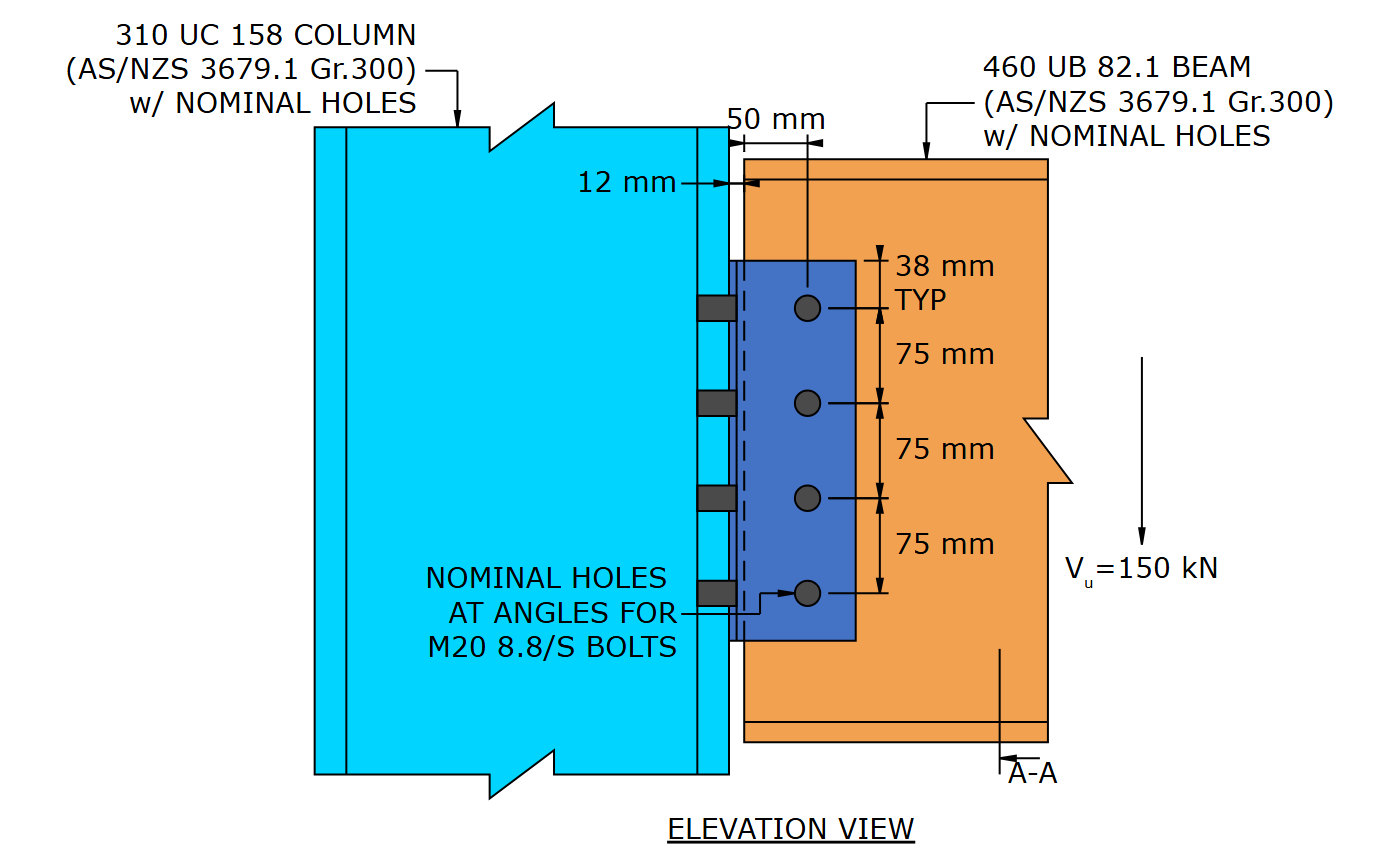
示例连接的标高. The beam stops 12 mm short of the column flange; four bolts in each leg at 75 毫米间距.
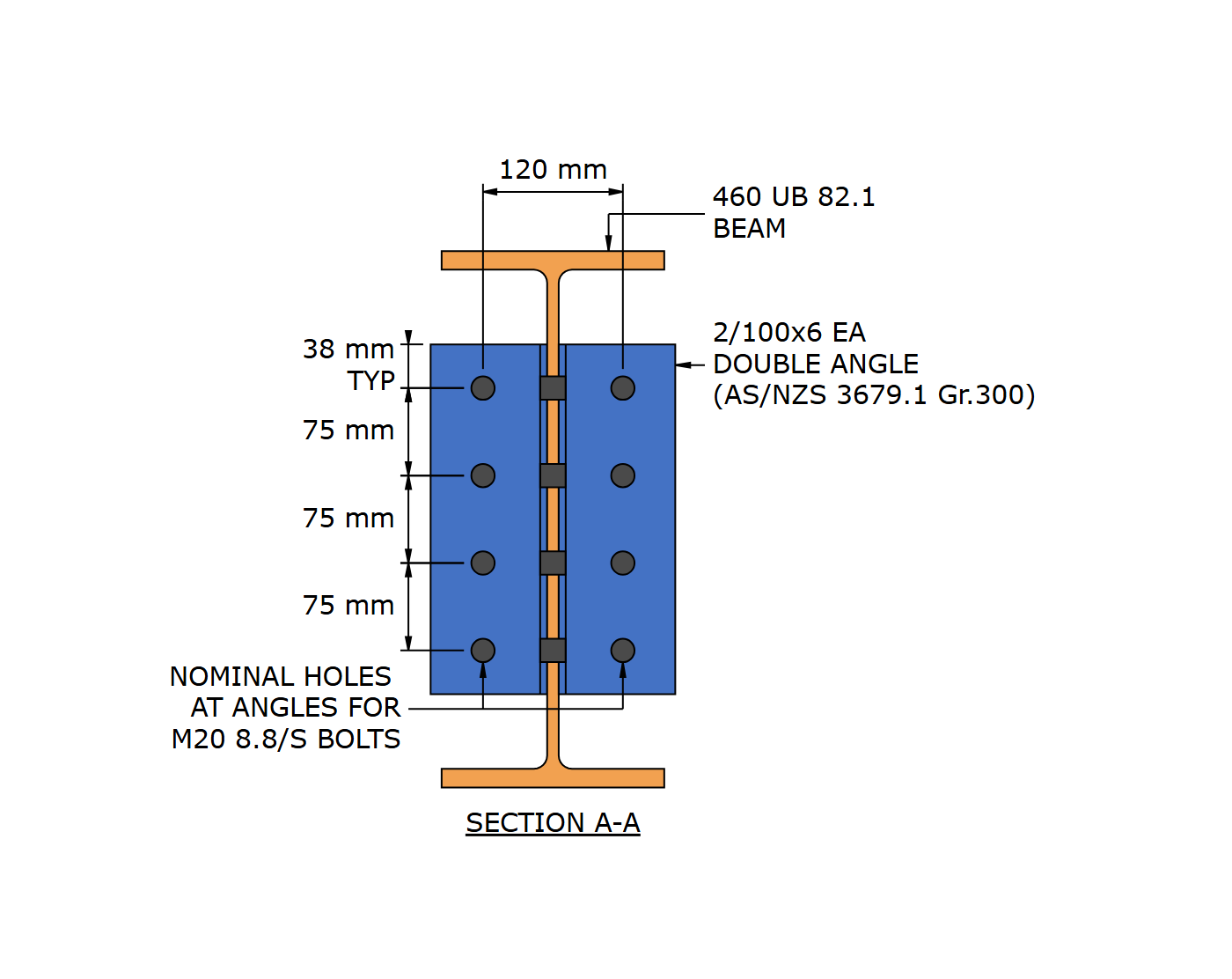
A-A部分, looking at the outstanding legs. The two bolt lines are 120 mm apart on the column flange.
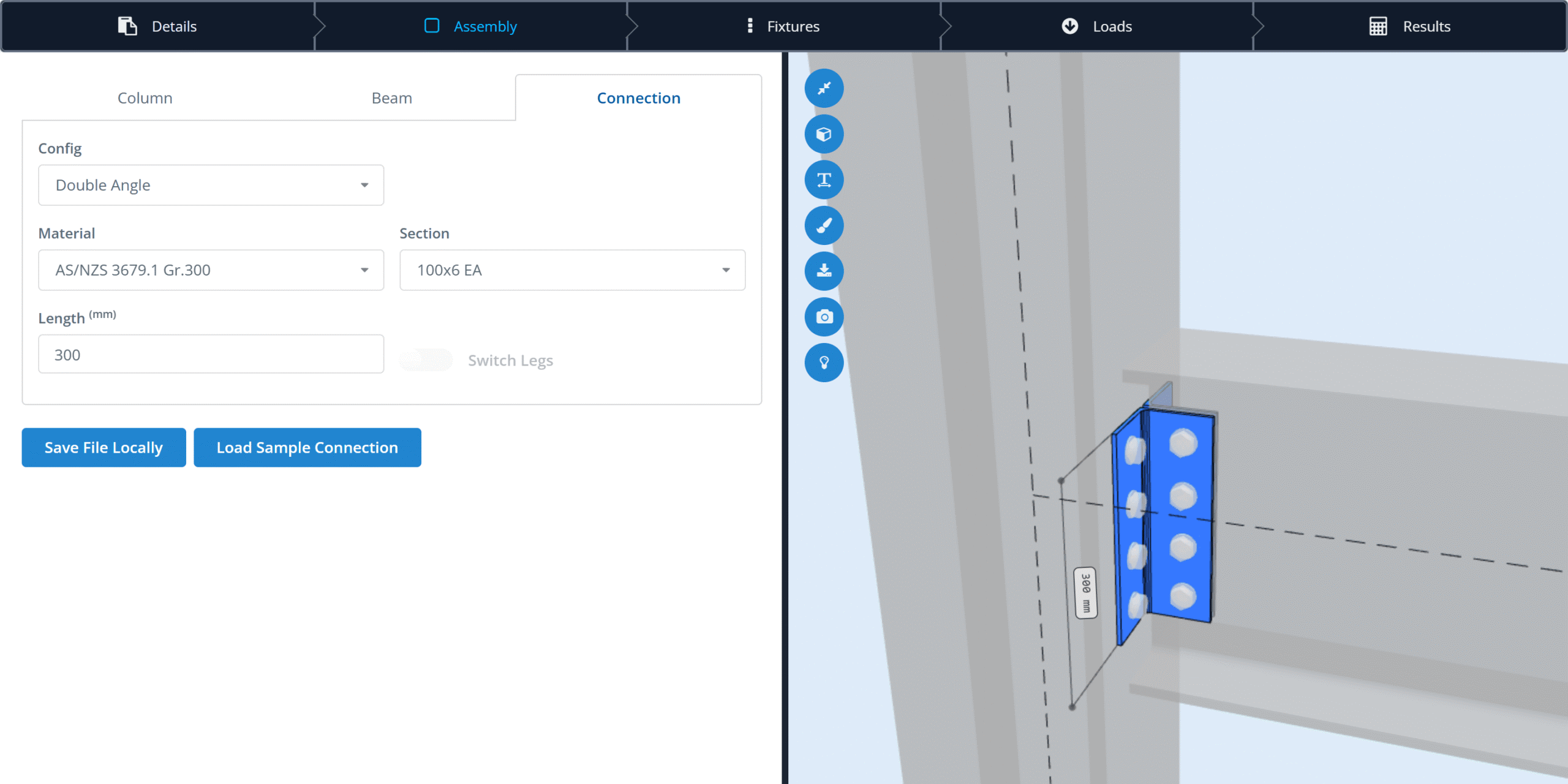
SkyCiv 连接设计中的相同连接, on the Assembly tab.
Double angle connection design: 步骤一目了然
- Check the connection detailing limits at the outstanding legs (OSL).
- Check the bolt group in shear at the OSL.
- Check the bolt group in bearing on the angles and the column flange at the OSL.
- Check the angles in shear, bending and block shear at the OSL.
- Check the connection detailing limits at the near side legs (NSL).
- Check the bolt group in double shear at the NSL, by the instantaneous centre of rotation.
- Check the bolt group in bearing on the angles and the beam web at the NSL.
- Check the angles in shear, bending and block shear at the NSL.
- Check the beam in shear.
本示例的设计输入
The design code is AS 4100:2020, with section properties from the Australian section database. The yield strength of each part follows its grade and thickness: 300 MPa for the beam, 280 MPa for the column with its 25 mm flange, 和 320 MPa for the 6 mm angles.
| 物品 | 象征 | 值 |
|---|---|---|
| Design shear (design action effect) | [mathin] V^{*} [mathin] | 150 千牛 |
| Beam | 460 UB 82.1, AS / NZS 3679.1 Gr.300, uncoped | |
| 波束深度 / 腹板厚度 | [mathin] d_{bm},\ t_{wb} [mathin] | 460 毫米 / 9.9 毫米 |
| 光束产率 / 抗拉强度 | [mathin] f_{yb},\ f_{ub} [mathin] | 300 兆帕 / 440 兆帕 |
| 柱 | 310 加州大学 158, AS / NZS 3679.1 Gr.300 | |
| 柱翼缘宽度 / 厚度 | [mathin] b_{fs},\ t_{fs} [mathin] | 311 毫米 / 25 毫米 |
| 柱产量 / 抗拉强度 | [mathin] f_{ys},\ f_{us} [mathin] | 280 兆帕 / 440 兆帕 |
| 物品 | 象征 | 值 |
|---|---|---|
| Angle cleats | 2 x 100×6 她, AS / NZS 3679.1 Gr.300 | |
| Angle length (深度) / 厚度 | [mathin] d_{i},\ t_{i} [mathin] | 300 毫米 / 6 毫米 |
| Leg widths at beam (NSL) / 柱子 (OSL) | [mathin] b_{iNSL},\ b_{iOSL} [mathin] | 100 毫米 / 100 毫米 |
| 角度屈服 / 抗拉强度 | [mathin] f_{ya},\ f_{ua} [mathin] | 320 兆帕 / 440 兆帕 |
| 螺栓 | M20 8.8/S, threads included in the shear planes | |
| 螺栓直径 / minimum tensile strength | [mathin] d_{fw},\ f_{uf} [mathin] | 20 毫米 / 830 兆帕 |
| Holes in angles, beam web and column flange | [mathin] d_{h} [mathin] | 标称, 22 毫米 |
| Beam end clearance to column flange | [mathin] clr [mathin] | 12 毫米 |
| 几何 | At beam web (NSL) | At column flange (OSL) |
|---|---|---|
| 螺栓排 / row pitch | 4 / 75 毫米 | 4 / 75 毫米, in each angle |
| 螺栓柱 | 1 | 1 in each angle |
| Gauge | [mathin] g_{1} = 62\ \text{mm} [mathin] 从柱面看 | [mathin] g_{2} = 120\ \text{mm} [mathin] between the bolt lines |
| 角度上的垂直边缘距离 | [mathin] l_{ev\_NSL} = 37.5\ \text{mm} [mathin] | [mathin] l_{ev\_OSL} = 37.5\ \text{mm} [mathin] |
| 螺栓偏心距 (输入) | [mathin] e_{b} = 62\ \text{mm} [mathin] | [mathin] e_{b} = 0\ \text{mm} [mathin] |
该 120 mm gauge on the column flange puts each bolt line 60 mm from the centreline of the beam web. Less half the web thickness, 那是 55.05 mm from the heel of each angle, which leaves a 100 – 55.05 = 44.95 mm horizontal edge on the outstanding leg. At the beam web, 的 62 mm gauge from the column face leaves 100 – 62 = 38 mm to the toe of the angle, 和 62 – 12 = 50 mm to the end of the beam.
Design shear (作为 4100 条款 9.1.4)
作为 4100 条款 9.1.4 sets a minimum design action for a simple connection. 设计剪力不小于以下较小者 0.15 times the design shear capacity of the uncoped beam (条款 5.11.2) 和 40 千牛:
[math] \phi V_{vo} = \phi\, 0.6\, f_{yb}\, d_{bm}\, t_{wb} = (0.9) \times 0.6 \times (300\ \text{MPa}) \times (460\ \text{mm}) \times (9.9\ \text{mm}) = 737.75\ \text{kN} [math]
[math] V^{*}_{min} = \min\left( 0.15\, \phi V_{vo},\ 40\ \text{kN} \right) = \min\left( 0.15 \times (737.75\ \text{kN}),\ 40\ \text{kN} \right) = 40\ \text{kN} [math]
[math] V^{*} = \max\left( V^{*},\ V^{*}_{min} \right) = \max\left( 150\ \text{kN},\ 40\ \text{kN} \right) = 150\ \text{kN} [math]
该 150 kN entered is above the minimum, so it is the design action effect for every check below.
步骤 1: Connection detailing limitations at the OSL (作为 4100 条款 9.5)
The minimum pitch is [mathin] 2.5\, d_{f} = 2.5 \times 20\ \text{mm} = 50\ \text{mm} [mathin] (条款 9.5.1). The minimum edge distance for an M20 bolt is 35 毫米, [mathin] 1.75\, d_{f} [mathin] 从表 9.5.2. The maximum edge distance is 12 times the angle thickness, [mathin] 12 \times 6\ \text{mm} = 72\ \text{mm} [mathin]. 该 124 mm maximum pitch and the 88.7 mm minimum bolt gauge on the column flange are the limits the module applies for these angles and this support. The edge on the column flange is [mathin] 311 / 2 – 60 = 95.5\ \text{mm} [mathin].
| 详细限制 (OSL) | 限制 (毫米) | 实际的 (毫米) | 直流电 | 结果 |
|---|---|---|---|---|
| Minimum bolt row pitch | 50.000 | 75.000 | 0.667 | 通过 |
| Maximum bolt row pitch | 124.000 | 75.000 | 0.605 | 通过 |
| Minimum vertical edge distance on angle | 35.000 | 37.500 | 0.933 | 通过 |
| Minimum horizontal edge distance on angle | 35.000 | 44.950 | 0.779 | 通过 |
| Minimum horizontal edge distance on column flange | 35.000 | 95.500 | 0.366 | 通过 |
| Minimum bolt gauge on column flange | 88.700 | 120.000 | 0.739 | 通过 |
| Maximum edge distance | 72.000 | 44.950 | 0.624 | 通过 |
对于最小限制,该比率是实际值的限制, 对于最大值来说,它实际上超出了限制. The governing row is the vertical edge distance on the angle, at the top and bottom of the 300 mm angle:
[math] DCR = \frac{35\ \text{mm}}{37.5\ \text{mm}} = 0.93333 [math]
DCR = 0.933 ≤ 1.0, 行
This is the highest ratio in the report, but it is a detailing limit, not a strength check: 的 37.5 mm end distances are only 2.5 mm above the minimum.
步骤 2: Bolt group in shear at the OSL (作为 4100 Clauses 9.2.2.1, 9.3.1)
Each outstanding leg has its own line of bolts, each bolt in single shear through the angle and the column flange. The threads are in the shear plane, so the core area is used: [mathin] n_{n} = 1,\ A_{c} = 225\ \text{mm}^{2} [mathin] 和 [mathin] n_{x} = 0 [mathin]. The capacity factor for a bolt in shear is 0.8, 和 [mathin] k_{rd} [mathin] 和 [mathin] k_{r,bolt} [mathin] are both 1:
[math] \phi V_{f} = \phi\, 0.62\, f_{uf}\, k_{rd}\, k_{r,bolt}\, \left( n_{n} A_{c} + n_{x} A_{o} \right) [math]
[math] \phi V_{f} = (0.8) \times 0.62 \times (830\ \text{MPa}) \times (1) \times (1) \times \left( (1)(225\ \text{mm}^{2}) + (0)(314.16\ \text{mm}^{2}) \right) = 92.628\ \text{kN} [math]
The two bolt lines sit symmetrically either side of the beam web, so the report takes the full capacity of the group: two angles, each with four bolts.
[math] \phi V_{df} = 2\, n_{b}\, \phi V_{f} = 2 \times (4) \times (92.628\ \text{kN}) = 741.02\ \text{kN} [math]
[math] V^{*} = 150\ \text{kN} \le \phi V_{df} = 741.02\ \text{kN} [math]
DCR = 150 千牛 / 741.02 kN = 0.202 ≤ 1.0, 行
步骤 3: Bolt group in bearing at the OSL (作为 4100 条款 9.2.2.4)
Each bolt bears on its hole in the angle and in the column flange. A ply can fail by crushing at the hole, 上限为 [mathin] 3.2\, d_{fw}\, t_{p}\, f_{up} [mathin], or by tearing out, which depends on the edge distance [mathin] a_{e} [mathin] in the direction of the force. With the load straight down the bolt line, the vertical distances govern.
Bearing on the angles
[math] a_{e1} = l_{ev\_OSL} – 0.5\, d_{h} + 0.5\, d_{fw} = (37.5\ \text{mm}) – 0.5 \times (22\ \text{mm}) + 0.5 \times (20\ \text{mm}) = 36.5\ \text{mm} [math]
[math] a_{e2} = s_{p} – d_{h} + 0.5\, d_{fw} = (75\ \text{mm}) – (22\ \text{mm}) + 0.5 \times (20\ \text{mm}) = 63\ \text{mm} [math]
[math] a_{e} = \min\left( 36.5,\ 63 \right)\ \text{mm} = 36.5\ \text{mm} [math]
The capacity factor for a ply in bearing is 0.9, and the report adds the two angles:
[math] \phi V_{b,pl} = 2\, \phi \min\left( 3.2\, d_{fw}\, t_{i}\, f_{ua},\ a_{e}\, t_{i}\, f_{ua} \right) [math]
[math] \phi V_{b,pl} = 2 \times (0.9) \times \min\left( 3.2 \times (20\ \text{mm}) \times (6\ \text{mm}) \times (440\ \text{MPa}),\ (36.5\ \text{mm}) \times (6\ \text{mm}) \times (440\ \text{MPa}) \right) = 173.45\ \text{kN} [math]
Bearing on the column flange
[math] a_{e3} = s_{p} – d_{h} + 0.5\, d_{fw} = (75\ \text{mm}) – (22\ \text{mm}) + 0.5 \times (20\ \text{mm}) = 63\ \text{mm} [math]
[math] \phi V_{b,sup} = 2 \times (0.9) \times \min\left( 3.2 \times (20\ \text{mm}) \times (25\ \text{mm}) \times (440\ \text{MPa}),\ (63\ \text{mm}) \times (25\ \text{mm}) \times (440\ \text{MPa}) \right) = 1247.4\ \text{kN} [math]
Bolt group bearing capacity
The weaker ply, over the four bolt rows:
[math] \phi V_{b} = \min\left( \phi V_{b,pl},\ \phi V_{b,sup} \right) n_{b} = \min\left( 173.45\ \text{kN},\ 1247.4\ \text{kN} \right) \times (4) = 693.79\ \text{kN} [math]
[math] V^{*} = 150\ \text{kN} \le \phi V_{b} = 693.79\ \text{kN} [math]
DCR = 150 千牛 / 693.79 kN = 0.216 ≤ 1.0, 行
步骤 4: Angles in shear at the OSL (作为 4100 条款 5.11.3)
The design shear passes down the two outstanding legs as vertical shear. Each leg is a rectangle, so Clause 5.11.3 给出 0.5 fy on the gross area, doubled for the pair:
[math] \phi V_{v} = 2\, \phi\, 0.5\, f_{ya}\, d_{i}\, t_{i} [math]
[math] \phi V_{v} = 2 \times (0.9) \times 0.5 \times (320\ \text{MPa}) \times (300\ \text{mm}) \times (6\ \text{mm}) = 518.4\ \text{kN} [math]
[math] V^{*} = 150\ \text{kN} \le \phi V_{v} = 518.4\ \text{kN} [math]
DCR = 150 千牛 / 518.4 kN = 0.289 ≤ 1.0, 行
This is the governing strength check of the connection, tied with the same check at the NSL in Step 10. 该 6 mm angles are thin, so gross shear in the legs comes before any bolt check.
步骤 5: Angles in bending at the OSL (作为 4100 条款 5.2.1)
The design section moment capacity of the two legs, using the plastic section modulus of each:
[math] \phi M_{s} = 2\, \phi\, \frac{f_{ya}\, t_{i}\, d_{i}^{2}}{4} [math]
[math] \phi M_{s} = 2 \times (0.9) \times \frac{(320\ \text{MPa}) \times (6\ \text{mm}) \times (300\ \text{mm})^{2}}{4} = 77.76\ \text{kNm} [math]
The report takes a load eccentricity of 60 mm on each angle and expresses the moment capacity as the shear it can carry:
[math] \phi V_{n} = \frac{\phi M_{s}}{e} = \frac{77.76\ \text{kNm}}{60\ \text{mm}} = 1296\ \text{kN} [math]
[math] V^{*} = 150\ \text{kN} \le \phi V_{n} = 1296\ \text{kN} [math]
DCR = 150 千牛 / 1296 kN = 0.116 ≤ 1.0, 行
步骤 6: Angles in block shear at the OSL (作为 4100 条款 9.1.9)
A block of each outstanding leg can tear out: shear down the bolt line to the bottom of the angle, plus tension across to the free edge of the leg.
[math] A_{nt} = \left[ l_{eh\_OSL} – 0.5\, d_{h} \right] t_{i} = \left[ (44.95\ \text{mm}) – 0.5 \times (22\ \text{mm}) \right] \times (6\ \text{mm}) = 203.7\ \text{mm}^{2} [math]
[math] A_{gv} = \left[ l_{ev\_OSL} + (n_{p} – 1)\, s_{p} \right] t_{i} = \left[ (37.5\ \text{mm}) + (4 – 1)(75\ \text{mm}) \right] \times (6\ \text{mm}) = 1575\ \text{mm}^{2} [math]
[math] A_{nv} = \left[ l_{ev\_OSL} + (n_{p} – 1)\, s_{p} – (n_{p} – 0.5)\, d_{h} \right] t_{i} = \left[ (262.5\ \text{mm}) – (3.5)(22\ \text{mm}) \right] \times (6\ \text{mm}) = 1113\ \text{mm}^{2} [math]
The tension stress is uniform, 所以 [mathin] k_{bs} = 1 [mathin]. The capacity factor for block shear is 0.75, and the report adds the two angles:
[math] \phi R_{bs} = 2\, \phi \min\left( 0.6\, f_{ua}\, A_{nv} + k_{bs}\, f_{ua}\, A_{nt},\ 0.6\, f_{ya}\, A_{gv} + k_{bs}\, f_{ua}\, A_{nt} \right) [math]
[math] \phi R_{bs} = 2 \times (0.75) \times \min\left( 0.6 \times (440)(1113) + (1)(440)(203.7),\ 0.6 \times (320)(1575) + (1)(440)(203.7) \right) \times 10^{-3} = 575.19\ \text{kN} [math]
[math] V^{*} = 150\ \text{kN} \le \phi R_{bs} = 575.19\ \text{kN} [math]
DCR = 150 千牛 / 575.19 kN = 0.261 ≤ 1.0, 行
步骤 7: Connection detailing limitations at the NSL (作为 4100 条款 9.5)
The same pitch and edge limits apply to the legs on the beam web. The angle depth is also checked against the 230 mm minimum and the 405.2 mm maximum the module applies for this beam.
| 详细限制 (NSL) | 限制 (毫米) | 实际的 (毫米) | 直流电 | 结果 |
|---|---|---|---|---|
| Minimum bolt row pitch | 50.000 | 75.000 | 0.667 | 通过 |
| Maximum bolt row pitch | 124.000 | 75.000 | 0.605 | 通过 |
| Minimum vertical edge distance on angle | 35.000 | 37.500 | 0.933 | 通过 |
| Minimum horizontal edge distance on angle | 35.000 | 38.000 | 0.921 | 通过 |
| Minimum horizontal edge distance on beam web | 35.000 | 50.000 | 0.700 | 通过 |
| Minimum angle depth | 230.000 | 300.000 | 0.767 | 通过 |
| Maximum angle depth | 405.200 | 300.000 | 0.740 | 通过 |
| Maximum edge distance | 72.000 | 50.000 | 0.694 | 通过 |
The governing row is again the 37.5 mm vertical edge distance on the angle:
[math] DCR = \frac{35\ \text{mm}}{37.5\ \text{mm}} = 0.93333 [math]
DCR = 0.933 ≤ 1.0, 行
步骤 8: Bolt group in shear at the NSL (作为 4100 Clauses 9.2.2.1, 9.3.1)
At the beam web each bolt passes through both angles and the web, so it has two shear planes, both with threads: [mathin] n_{n} = 2 [mathin].
[math] \phi V_{f} = (0.8) \times 0.62 \times (830\ \text{MPa}) \times (1) \times (1) \times \left( (2)(225\ \text{mm}^{2}) + (0)(314.16\ \text{mm}^{2}) \right) = 185.26\ \text{kN} [math]
螺栓是 62 mm from the column face, so the group is loaded eccentrically and the module uses the instantaneous centre of rotation (ICOR) method of Clause 9.3.1. 螺栓 1 位于该行的底部, and the centre is found by iteration as described on the 作为 4100 module page.
| 螺栓 | X (毫米) | 和 (毫米) |
|---|---|---|
| 1 | 0.00 | 0.00 |
| 2 | 0.00 | 75.00 |
| 3 | 0.00 | 150.00 |
| 4 | 0.00 | 225.00 |
[math] x_{ic} = -99.375\ \text{mm}, \qquad y_{ic} = 112.5\ \text{mm} [math]
| 螺栓 | [R (千牛) | 接收 (千牛) | 瑞 (千牛) | 锰 (kn-mm) |
|---|---|---|---|---|
| 1 | 90.91 | 68.14 | 60.19 | 13646.66 |
| 2 | 87.94 | 31.05 | 82.28 | 9340.66 |
| 3 | 87.94 | -31.05 | 82.28 | 9340.66 |
| 4 | 90.91 | -68.14 | 60.19 | 13646.66 |
The reactions give a bolt group coefficient of C = 3.08:
[math] \phi V_{df} = \phi V_{f}\, C = (185.26\ \text{kN}) \times (3.08) = 570.59\ \text{kN} [math]
[math] V^{*} = 150\ \text{kN} \le \phi V_{df} = 570.59\ \text{kN} [math]
DCR = 150 千牛 / 570.59 kN = 0.263 ≤ 1.0, 行
步骤 9: Bolt group in bearing at the NSL (作为 4100 条款 9.2.2.4)
Bearing on the angles
[math] a_{e1} = l_{ev\_NSL} – 0.5\, d_{h} + 0.5\, d_{fw} = (37.5\ \text{mm}) – 0.5 \times (22\ \text{mm}) + 0.5 \times (20\ \text{mm}) = 36.5\ \text{mm} [math]
[math] a_{e2} = s_{p} – d_{h} + 0.5\, d_{fw} = (75\ \text{mm}) – (22\ \text{mm}) + 0.5 \times (20\ \text{mm}) = 63\ \text{mm} [math]
[math] a_{e3} = l_{eh\_NSL} – 0.5\, d_{h} + 0.5\, d_{fw} = (38\ \text{mm}) – 0.5 \times (22\ \text{mm}) + 0.5 \times (20\ \text{mm}) = 37\ \text{mm} [math]
[math] \phi V_{b,pl} = 2 \times (0.9) \times \min\left( 3.2 \times (20\ \text{mm}) \times (6\ \text{mm}) \times (440\ \text{MPa}),\ (36.5\ \text{mm}) \times (6\ \text{mm}) \times (440\ \text{MPa}) \right) = 173.45\ \text{kN} [math]
梁腹板上的轴承
[math] a_{e4} = s_{p} – d_{h} + 0.5\, d_{fw} = 63\ \text{mm}, \qquad a_{e5} = l_{eh\_w} – 0.5\, d_{h} + 0.5\, d_{fw} = (50\ \text{mm}) – 11\ \text{mm} + 10\ \text{mm} = 49\ \text{mm} [math]
[math] \phi V_{b,beam} = (0.9) \times \min\left( 3.2 \times (20\ \text{mm}) \times (9.9\ \text{mm}) \times (440\ \text{MPa}),\ (49\ \text{mm}) \times (9.9\ \text{mm}) \times (440\ \text{MPa}) \right) = 192.1\ \text{kN} [math]
Bolt group bearing capacity
The weaker ply, scaled by the bolt group coefficient from Step 8:
[math] \phi V_{b} = \min\left( \phi V_{b,pl},\ \phi V_{b,beam} \right) C = \min\left( 173.45\ \text{kN},\ 192.1\ \text{kN} \right) \times (3.08) = 534.22\ \text{kN} [math]
[math] V^{*} = 150\ \text{kN} \le \phi V_{b} = 534.22\ \text{kN} [math]
DCR = 150 千牛 / 534.22 kN = 0.281 ≤ 1.0, 行
步骤 10: Angles in shear at the NSL (作为 4100 条款 5.11.3)
The legs on the beam web have the same depth and thickness as the outstanding legs:
[math] \phi V_{v} = 2\, \phi\, 0.5\, f_{ya}\, d_{i}\, t_{i} = 2 \times (0.9) \times 0.5 \times (320\ \text{MPa}) \times (300\ \text{mm}) \times (6\ \text{mm}) = 518.4\ \text{kN} [math]
DCR = 150 千牛 / 518.4 kN = 0.289 ≤ 1.0, 行
步骤 11: Angles in bending at the NSL (作为 4100 条款 5.2.1)
At the beam web the lever arm is the 62 mm bolt eccentricity:
[math] \phi V_{n} = \frac{\phi M_{s}}{e_{b}} = \frac{77.76\ \text{kNm}}{62\ \text{mm}} = 1254.2\ \text{kN} [math]
DCR = 150 千牛 / 1254.2 kN = 0.120 ≤ 1.0, 行
步骤 12: Angles in block shear at the NSL (作为 4100 条款 9.1.9)
[math] A_{nt} = \left[ l_{eh\_NSL} – 0.5\, d_{h} \right] t_{i} = \left[ (38\ \text{mm}) – 0.5 \times (22\ \text{mm}) \right] \times (6\ \text{mm}) = 162\ \text{mm}^{2} [math]
[math] A_{gv} = \left[ (37.5\ \text{mm}) + (4 – 1)(75\ \text{mm}) \right] \times (6\ \text{mm}) = 1575\ \text{mm}^{2}, \qquad A_{nv} = \left[ (262.5\ \text{mm}) – (3.5)(22\ \text{mm}) \right] \times (6\ \text{mm}) = 1113\ \text{mm}^{2} [math]
[math] \phi R_{bs} = 2 \times (0.75) \times \min\left( 0.6 \times (440)(1113) + (1)(440)(162),\ 0.6 \times (320)(1575) + (1)(440)(162) \right) \times 10^{-3} = 547.67\ \text{kN} [math]
DCR = 150 千牛 / 547.67 kN = 0.274 ≤ 1.0, 行
步骤 13: Supported member in shear (作为 4100 条款 5.11.2)
The beam is uncoped, so its full web carries the shear. 条款 5.11.2 allows the uniform shear capacity when the web is stocky enough not to buckle in shear:
[math] \frac{d_{p}}{t_{w}} = 43.232 \le \frac{82}{\sqrt{f_{y} / 250}} = 74.855 [math]
[math] \phi V_{vo} = \phi\, 0.6\, f_{yb}\, d_{bm}\, t_{wb} = (0.9) \times 0.6 \times (300\ \text{MPa}) \times (460\ \text{mm}) \times (9.9\ \text{mm}) = 737.75\ \text{kN} [math]
[math] V^{*} = 150\ \text{kN} \le \phi V_{vo} = 737.75\ \text{kN} [math]
DCR = 150 千牛 / 737.75 kN = 0.203 ≤ 1.0, 行
检查摘要
| 设计检查 | Design action effect | Design capacity | 直流电 | 结果 |
|---|---|---|---|---|
| 连接详细限制 (OSL) | 35 毫米 | 37.5 毫米 | 0.933 | 通过 |
| 剪切螺栓组 (OSL) | 150 千牛 | 741.024 千牛 | 0.202 | 通过 |
| Bolt group in bearing on angles and support (OSL) | 150 千牛 | 693.792 千牛 | 0.216 | 通过 |
| Angles in shear (OSL) | 150 千牛 | 518.4 千牛 | 0.289 | 通过 |
| Angles in bending (OSL) | 150 千牛 | 1296 千牛 | 0.116 | 通过 |
| Angles in block shear (OSL) | 150 千牛 | 575.19 千牛 | 0.261 | 通过 |
| 连接详细限制 (NSL) | 35 毫米 | 37.5 毫米 | 0.933 | 通过 |
| 剪切螺栓组 (NSL) | 150 千牛 | 570.588 千牛 | 0.263 | 通过 |
| Bolt group in bearing on angles and beam web (NSL) | 150 千牛 | 534.22 千牛 | 0.281 | 通过 |
| Angles in shear (NSL) | 150 千牛 | 518.4 千牛 | 0.289 | 通过 |
| Angles in bending (NSL) | 150 千牛 | 1254.19 千牛 | 0.120 | 通过 |
| Angles in block shear (NSL) | 150 千牛 | 547.668 千牛 | 0.274 | 通过 |
| Supported member in shear | 150 千牛 | 737.748 千牛 | 0.203 | 通过 |
连接通过了每项检查. The angles in shear govern the strength at 0.289, the same at both legs, because two 6 mm angles have less gross shear area than the bolts have capacity. 详细比例为 0.933 is higher, but it only says that the 37.5 mm end distances are close to the 35 mm minimum. With double shear at the beam web and eight single shear bolts at the column, the bolts have plenty in hand at this load.
Auto Design is available for the double angle cleat in the AS 4100 模块. It changes the bolts and the angles until every check passes, and keeps your members and design actions as entered. 见 汽车设计 page for the AS 4100 preferences it works to.
如果检查失败要更改什么
- 构造限制: adjust the pitch, gauge or edge distances to the limits in Steps 1 和 7. A longer angle gives more end distance for the same bolt rows.
- Angles in shear, bending or block shear: use thicker or longer angles. Going from 6 毫米至 8 mm angles raises the shear capacity by a third.
- 剪切螺栓组: 添加螺栓行, or use a larger bolt or a higher bolt grade.
- Bolt bearing: increase the edge distances or use thicker angles. If the beam web governs, increase the 62 mm gauge so the end of the beam has more edge distance.
- Supported member in shear: use a heavier beam, or add a web doubler at the connection.
常见问题
Why are the beam web bolts in double shear?
Each bolt at the beam web passes through one angle, the web and the other angle, so it is sheared across two planes. The report takes two threaded shear planes, which doubles the single bolt capacity to 185.26 千牛.
Why is the OSL bolt group not checked by ICOR?
The two bolt lines on the column flange are symmetric about the beam web, so the report takes the full capacity of the group, two angles each with four bolts, without an eccentricity reduction. At the beam web the bolts are 62 mm from the support, so ICOR is used there.
Why does the angle shear govern rather than the bolts?
The angles are 6 毫米厚. Their gross shear capacity is 518.4 kN for the pair, while the bolts at either leg carry more than 570 千牛. A thicker angle moves the governing check to the bolts or to bearing.
Why was the 150 kN design shear not increased to the Clause 9.1.4 最低?
条款 9.1.4 asks for a simple connection to be designed for at least the lesser of 0.15 times the beam’s design shear capacity and 40 千牛. 为了这 460 UB 82.1 那是 40 千牛, 和 150 kN entered is larger, so it is used as is.
什么是 12 mm clearance?
It is the gap between the end of the beam and the face of the column flange, so the beam can be fitted between the angles without touching the support. It sets the 50 mm horizontal edge distance on the beam web, 哪一个是 62 mm gauge less the clearance.
Double or single angle cleat?
A double angle cleat is symmetric and puts the beam web bolts in double shear, so it carries more shear for the same bolts. A single angle cleat is quicker to fit and leaves one side of the web clear, but its beam web bolts are in single shear. Both are in the AS 4100 模块.
Design a double angle cleat connection for free
此页上的每个数字都来自一个解决方案. Pick AS 4100:2020 and the double angle, 输入你的光束, 支持, bolts and design shear, 并在浏览器中查看每项检查. 没有什么可安装的.
SkyCiv Connection Design 模块是本示例背后的连接设计软件. 它为您提供完整的计算报告,其中包含每个方程和您的数字, 就像上面的步骤一样, plus every design capacity and DCR, 对于作为 4100:2020 剪力连接, moment connections and splices. 该 螺栓计算器 自行涵盖螺栓组检查.
参考资料
- 作为 4100:2020, 钢结构: Clauses 5.2.1, 5.11.2, 5.11.3, 9.1.4, 9.1.9, 9.2.2.1, 9.2.2.4, 9.3.1, 9.5 (桌子 9.5.2).
- Design of steel connections using AS 4100:2020
- Web side plate connection design to AS 4100, the same beam and column with a web side plate
- Single angle cleat connection design to AS 4100
- 汽车设计 SkyCiv 连接设计

哈罗德穆纳勒姆
产品经理, 连接设计
10+ 从事钢结构连接设计多年
领英
