
The design capacity of a fillet weld to AS 4100:2020 is a capacity per unit length, [mathin]\phi v_{w}[mathin], from Clause 9.6.3.10. It depends on the electrode strength, the throat of the weld, the weld category (SP o médico de cabecera) y, for long welds in lap joints, a length reduction. Before that, Tabla 9.6.3.2 sets the smallest fillet that can be laid on the parts being joined.
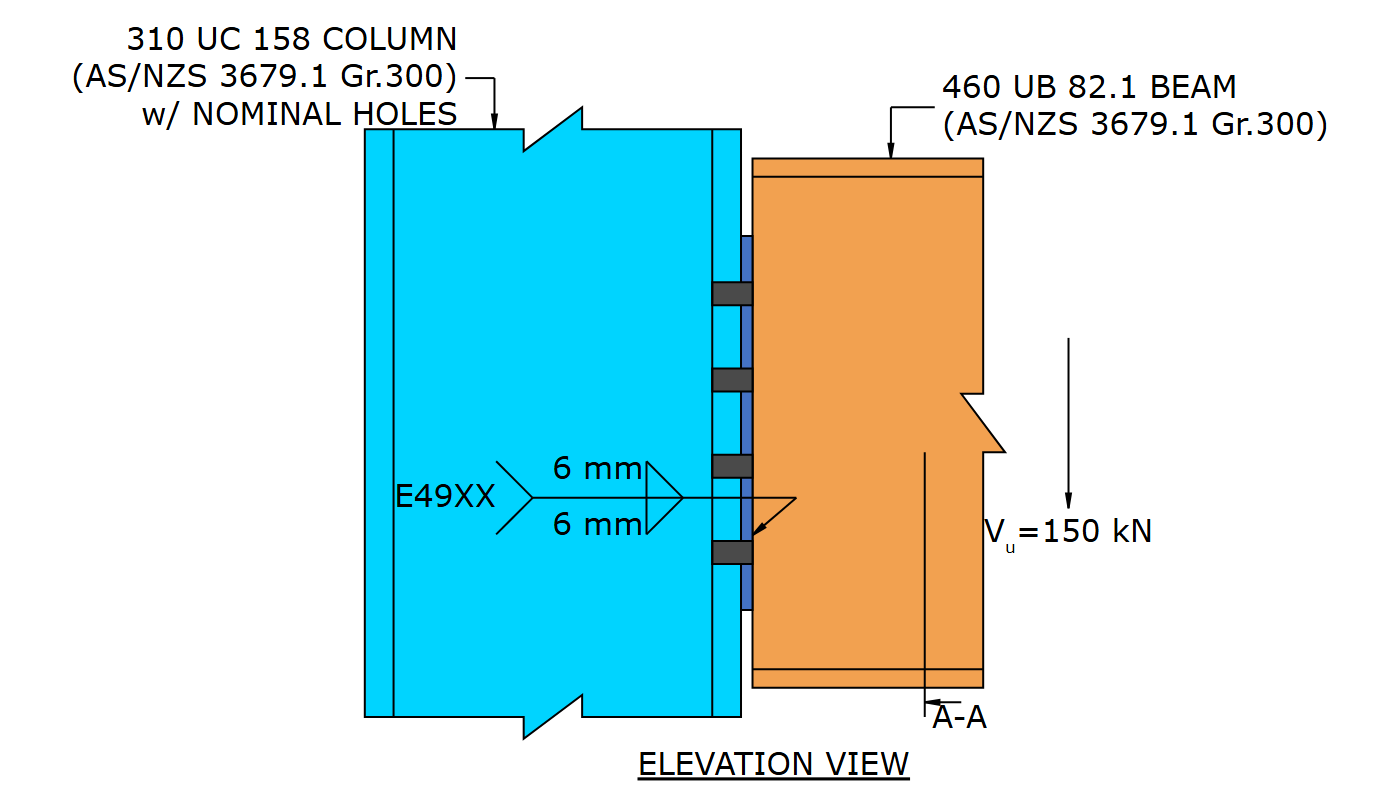
This page explains each term and works it through with the welds of our flexible end plate design example: a 10 mm end plate welded to the web of a 460 UB 82.1 con 6 mm E49XX fillets on both sides, carrying 150 kN. Every number comes from the calculation report that SkyCiv Connection Design produces for that connection.
The design capacity of a fillet weld (Cláusula 9.6.3.10)
[math]\phi v_{w} = \phi \times 0.6 \times f_{uw} \times t_{t} \times k_{r}[math]
- [mathin]f_{uw}[mathin] is the nominal tensile strength of the weld metal: 490 MPa for E49XX electrodes, as used in the examples here.
- [mathin]t_{t}[mathin] is the design throat thickness. For an equal-leg fillet of leg size [mathin]t_{w}[mathin] the report uses [mathin]t_{t} = \frac{\sqrt{2}}{2} t_{w}[mathin].
- [mathin]\phi[mathin] is the capacity factor of Table 3.4: 0.8 for SP (structural purpose) welds and 0.6 for GP (general purpose) soldaduras.
- [mathin]k_{r}[mathin] is the reduction factor for a welded lap connection.
The capacity of the weld group is then [mathin]\phi v_{w}[mathin] times the length of weld that carries the force.
Categoría de soldadura: SP o médico de cabecera
The weld category is a choice in the weld input. SP welds are made and inspected to the higher quality level and take [mathin]\phi = 0.8[mathin]; GP welds take [mathin]\phi = 0.6[mathin], so the same weld is worth 25% less as GP. Most structural connections are specified SP.
Long welds in lap joints: k_r (Tabla 9.6.3.10(B))
A long fillet weld in a lap joint does not load evenly along its length: the ends take more than the middle. For these welds the program reduces the capacity with the weld length [mathin]l_{w}[mathin] in metres:
[math]k_{r} = 1.10 – 0.06\, l_{w}, \qquad 0.62 \le k_{r} \le 1.0[math]
Entonces [mathin]k_{r}[mathin] stays at 1.0 up to about 1.7 m of weld and reaches the 0.62 floor at 8 m. The reduction is applied where a plate is lapped onto a member and welded along the direction of the force, such as the flange cover plates of a welded column splice. Beam shear connections, where the welds run across the end of the member, show [mathin]k_{r,weld} = 1[mathin] in the report.
Tamaño mínimo de soldadura de filete (Tabla 9.6.3.2)
The minimum size guards against a small weld cooling too fast on a thick part. The program takes the leg size from the thicker of the two parts joined, but never more than the thinner part:
| Thickness of the thicker part, t | Minimum leg size, [mathin]t_{w,min}[mathin] |
|---|---|
| hasta 7 mm | 3 mm |
| más de 7 mm up to 10 mm | 4 mm |
| más de 10 mm up to 15 mm | 5 mm |
| más de 15 mm | 6 mm |
Ejemplo resuelto: flexible end plate welds
Paso 1: cizalla de diseño (Cláusula 9.1.4)
A simple connection must be designed for at least the lesser of 0.15 veces la capacidad de corte de diseño de la viga y 40 kN. Para el 460 UB 82.1, [mathin]\phi V_{vo} = 737.75\ \text{kN}[mathin]:
[math]V^{*}_{min} = \min\left( 0.15 \times 737.75,\ 40 \right) = 40\ \text{kN} \qquad V^{*} = \max\left( 150,\ 40 \right) = 150\ \text{kN}[math]
Paso 2: Tamaño mínimo de soldadura
La placa final es 10 mm and the beam web 9.9 mm, so the thicker part is 10 mm and Table 9.6.3.2 asks for [mathin]t_{w,min} = 4\ \text{mm}[mathin]. El 6 mm weld provided is larger:
DCR = 4 mm / 6 milímetro = 0.667 ≤ 1.0, OK
Paso 3: Capacity per unit length
The welds run down both sides of the beam web, across the end of the beam, asi que [mathin]k_{r,weld} = 1[mathin]. With SP welds:
[math]\phi v_{w} = 0.8 \times 0.6 \times 490 \times \frac{\sqrt{2}}{2} \times 6 \times 1 = 0.99787\ \text{kN/mm}[math]
Paso 4: Weld group capacity
The welds are as long as the end plate is deep, [mathin]d_{i} = 325\ \text{mm}[mathin], uno a cada lado de la web:
[math]\phi V_{w} = 2\, d_{i}\, \phi v_{w} = 2 \times 325 \times 0.99787 = 648.61\ \text{kN}[math]
DCR = 150 kN / 648.61 kN = 0.231 ≤ 1.0, OK
Paso 5: The same welds as GP
Changing only the weld category to GP gives [mathin]\phi = 0.6[mathin]:
[math]\phi v_{w} = 0.6 \times 0.6 \times 490 \times \frac{\sqrt{2}}{2} \times 6 \times 1 = 0.7484\ \text{kN/mm} \qquad \phi V_{w} = 2 \times 325 \times 0.7484 = 486.46\ \text{kN}[math]
DCR = 150 kN / 486.46 kN = 0.308 ≤ 1.0, OK
A second case: the web side plate weld
En el ejemplo de placa lateral web a 10 mm plate is welded to a 25 ala de columna mm. Tabla 9.6.3.2 on its own asks for 6 mm. The program also asks for a leg of at least 0.75 veces el espesor de la placa, 7.5 mm, so that the weld is stronger than the plate and the plate yields first. El 8 mm weld provided meets both:
[math]\phi v_{w} = 0.8 \times 0.6 \times 490 \times \frac{\sqrt{2}}{2} \times 8 \times 1 = 1.3305\ \text{kN/mm} \qquad \phi V_{w} = 2 \times 320 \times 1.3305 = 851.51\ \text{kN}[math]
DCR = 150 kN / 851.51 kN = 0.176 ≤ 1.0, OK
Resumen
| Soldar | [mathin]\phi v_{w}[mathin] | [mathin]\phi V_{w}[mathin] | DCR |
|---|---|---|---|
| Placa final, 6 mm SP, 2 x 325 mm | 0.99787 kN/mm | 648.61 kN | 0.231 |
| Placa final, 6 mm GP, 2 x 325 mm | 0.7484 kN/mm | 486.46 kN | 0.308 |
| Placa lateral web, 8 mm SP, 2 x 320 mm | 1.3305 kN/mm | 851.51 kN | 0.176 |
What to change if a weld check fails
- Minimum size: increase the leg size to the Table 9.6.3.2 value for the thicker part, y para 0.75 times the plate thickness for a web side plate.
- Capacidad: increase the leg size, specify SP rather than GP, use un electrodo más fuerte, or lengthen the weld with a deeper plate.
For web side plates, flexible end plates and the other AS connections it covers, Diseño automático sizes the welds along with the plates and bolts.
Preguntas frecuentes
Why does the capacity use the throat and not the leg?
A fillet weld fails across its throat, the shortest path through the weld. For an equal-leg fillet the throat is the leg size times [mathin]\sqrt{2}/2[mathin], which is the factor in every [mathin]\phi v_{w}[mathin] line above.
Do I need a larger weld for a thicker part even if the load is small?
Sí. Tabla 9.6.3.2 is a minimum for weld quality, not strength. A small weld on a thick part cools too quickly and can crack, whatever the load.
Is a longer weld always stronger?
In a beam end connection, Sí: the capacity grows in proportion to length. In a lap joint where the weld runs along the force, the program applies the [mathin]k_{r}[mathin] reduction once the weld passes about 1.7 m, so the gain per metre drops.
Check your own welds for free
Elige como 4100:2020 and a welded connection, enter the electrode, weld size and category, and see each of these checks with its DCR. No hay nada que instalar.
El módulo SkyCiv Connection Design le brinda el informe de cálculo completo con cada ecuación y sus números., para AS 4100:2020 conexiones de corte, conexiones de momento y empalmes. El calculadora de soldadura is a quick way to check a single weld group.
Referencias
- AS 4100:2020, Estructuras de acero: Cláusulas 9.1.4, 9.6.3.10; Tablas 3.4, 9.6.3.2 y 9.6.3.10(B).
- Flexible end plate connection design example to AS 4100
- Web side plate connection design example to AS 4100
- Diseño de conexiones de acero utilizando AS. 4100:2020

Harold Munalem
Gerente de producto, Connection Design
10+ años en el diseño de conexiones de acero
LinkedIn
