
¿Qué es una conexión de momento??
Una conexión de momento es una unión que transfiere momento flector entre una columna y una viga, o entre dos miembros cualesquiera. Si una viga tiene momento interno en su extremo, la conexión tiene que transmitir ese momento a través de la unión en lugar de dejar que el extremo gire libremente.
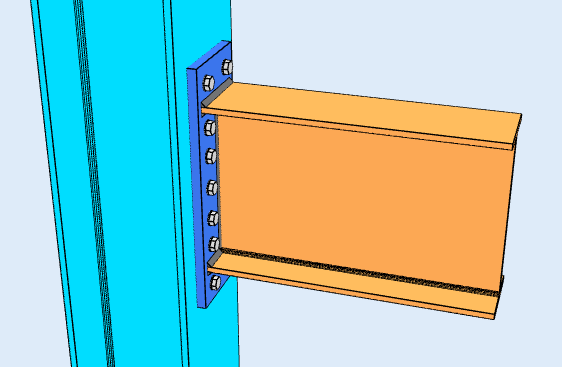
Conexión de placa final extendida, un ejemplo de una conexión de momento. Los pernos fuera de la brida de tensión le dan a la pareja un brazo de palanca más largo..
El objetivo de un momento de conexión es mantener la rotación final, que en términos de análisis es el código de fijación FFFFFF: restringido en las tres traslaciones y en las tres rotaciones. Por eso las conexiones de momento también se llaman conexiones rígidas..
AISC 360-16 La sección B3.4 es más precisa al respecto., Y la distinción importa cuando modelas el marco.. Una conexión momentánea es completamente restringido (FR), que mantiene el ángulo entre los miembros y justifica el supuesto FFFFFF, o parcialmente restringido (relaciones públicas), que transfiere momento pero gira lo suficiente como para que el análisis tenga en cuenta la rigidez real de la unión. Tratar una junta PR como completamente rígida exagera la rigidez del marco y subestima su deriva.
donde un conexión de corte Funciona principalmente a través de la red de la viga., una conexión de momento tiene que enganchar las bridas, porque ahí es donde está el esfuerzo de flexión. Placas de brida, bridas soldadas o una placa final hacen el mismo trabajo: convierten el momento de la viga en una fuerza de tensión en un ala y una fuerza de compresión en el otro, y llevar a esa pareja a la columna.
Tipos de conexión de momento
Las conexiones de momento conllevan mucho más momento que una conexión de corte., y cuestan más hacer: más material, más soldadura, Más ajuste y más inspección.. La mayoría de los marcos los usan solo cuando la estructura depende de la acción del marco para la estabilidad lateral., y use conexiones de corte en todos los demás lugares.
Las configuraciones disponibles dependen del código de diseño y de en qué se estructura la viga..
Viga a columna de sección I (AISC 360-16)
Cuatro configuraciones, estructura al ala de la columna o al alma de la columna.
Placa de brida
Las placas atraviesan las alas superior e inferior de la viga., atornillados o soldados a la viga y a la columna. Mientras la viga se dobla, Una placa entra en tensión y la otra en compresión., y esa pareja lleva el momento. El alma de la viga suele estar soportada por una placa de corte separada., entonces la conexión divide el trabajo: las bridas toman el momento, web toma la cizalla.
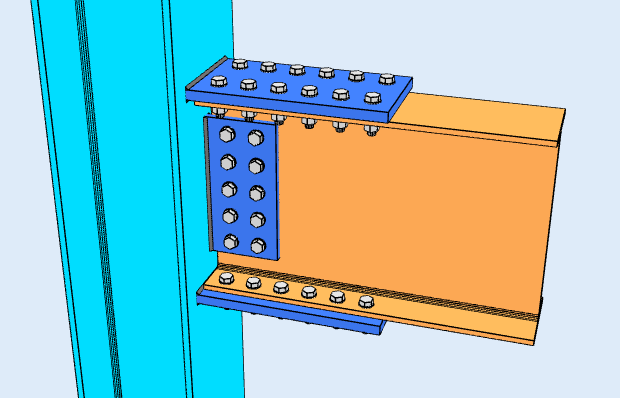
Bridas soldadas
Las alas de la viga están soldadas directamente al ala de la columna., sin placa intermedia, y la red está atornillada a una pestaña de corte. Esto proporciona la unión más rígida del grupo y la trayectoria de carga más limpia., pero es la soldadura en campo en un miembro que tiene que ajustarse dentro de la tolerancia., asi lleva precalentamiento, Costes de acceso e inspección que un detalle atornillado no.
Placa final al ras
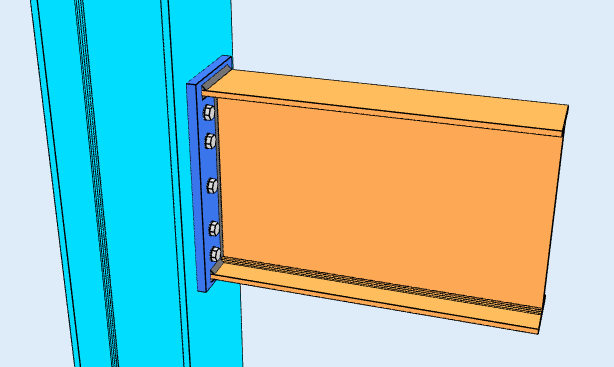
Una placa soldada al extremo de la viga y atornillada a la columna., con la placa terminando al ras con las alas de la viga y todos los pernos colocados entre ellas. Se adapta a momentos más bajos., porque el brazo de palanca del grupo de pernos está limitado por la profundidad de la viga.
Placa final extendida
la misma idea, con la placa extendida más allá de la brida de tensión para que los pernos puedan asentarse fuera de ella. Esos pernos exteriores tienen un brazo de palanca más largo alrededor de la brida de compresión., que es lo que compra la capacidad de momento extra. La acción de palanca en la parte extendida se convierte en un control de control.. Es la configuración que se muestra en la parte superior de esta página..
Ambas configuraciones de placa final están cubiertas por el calculadora de conexión de momento.
Viga a columna HSS (AISC 360-16)
Enmarcar una conexión de momento en una sección hueca es más difícil, porque no hay brida para atornillar ni acceso al otro lado. Una configuración está disponible: a placa de brida soldado a la cara del HSS, sin refuerzos.
AS 4100:2020
AS 4100 La cobertura en SkyCiv Connection Design es solo para conexiones de corte., estructura de viga a columna de sección en I o viga a viga. Conexiones de momento a AS 4100 no están disponibles. Para diseño de momento, utilizar AISC 360-16.
¿Qué comprueba el software??
Los detalles se ejecutan primero: distancias al borde del perno, espaciado de pernos (paso y calibre), espacios libres de herramientas, dimensiones mínimas y máximas de la placa, y detección de choques entre placas, refuerzos, pernos y soldaduras. Una conexión que no se puede construir no llega a la solución.
Las pruebas de fuerza siguen a la pareja a través de la articulación.. En el lado de la brida, eso significa la placa en tensión y en compresión., cizalla de perno, cojinete de perno y desgarro, ruptura por corte del bloque, acción de palanca sobre los pernos, y tensión en la garganta de soldadura. En el miembro de soporte significa flexión local de la brida., rendimiento local web y paralización web, ¿Cuáles son los estados límite que deciden si la columna necesita refuerzos o una placa doble?.
Cada fórmula, La verificación del diseño y la referencia del código se muestran en su totalidad., con números de cláusula de AISC 360-16, para que puedas seguir el cálculo en lugar de confiar en él.
Moment Connection vs Shear Connection: la diferencia
La diferencia es lo que sucede con el ángulo entre los dos miembros.. En una conexión momentánea ese ángulo se mantiene., entonces doblar un miembro lleva al otro. En una conexión de corte, la junta tiene libertad para girar., entonces el extremo de la viga gira y ningún momento significativo cruza la unión.
| Conexión de momento | Conexión de corte | |
|---|---|---|
| Fuerzas transferidas | Cizalla y momento | Solo cizalla |
| Nombres alternativos | Rígido, Fijo, Resistente al momento | Fijado, Bisagra, Sencillo |
| AISC 360-16 término | Conexión de momento FR o PR | Conexión sencilla |
| Rotación | Restringe la rotación | Libre para rotar |
| Código de fijación del software | FFFFFF | FFFFFR |
Software de diseño de conexión SkyCiv
Los modelos y controles anteriores son de SkyCiv Connection Design. cubre más 80+ tipos de conexión preconfigurados, diseños para AISC 360-16 en LRFD y ASD y a AS 4100:2020, y muestra cada fórmula, verificación de diseño y referencia de código completa.
Puedes modelar la conexión en 3D., intercambiar pernos, soldaduras o placas sin perder sus datos de carga, producir hojas de dibujo de detalles 2D en CloudCAD, y exportar la geometría 3D a IFC para su coordinación en Revit, Tekla o Navisworks.
Se ejecuta completamente en el navegador., sin descargas, actualizaciones o configuración de TI.
