
A fillet weld group is the set of welds that join one part to another, for example the C-shaped weld around the leg of an angle on a beam web. When the load does not pass through the centroid of the group, the welds also resist a moment, and the strength of the group depends on its shape, the load direction and the eccentricity. AISC 360-16 Section J2.4 gives the strength of fillet welds, and the AISC Manual Part 8 turns it into the instantaneous center of rotation method for weld groups. This article explains how SkyCiv Connection Design applies that method and works it with the numbers from a real double angle connection.
What is the capacity of a fillet weld group?
A single fillet weld is strongest when it is loaded across its length and weakest when it is loaded along it: AISC 360-16 J2.4 increases the strength of a weld element by [mathin] 1.0 + 0.5\sin^{1.5}\theta [mathin], nerede [mathin] \theta [mathin] is the angle between the load and the weld axis. A weld group under an eccentric load rotates about a point called the instantaneous center (IC). Each short piece of weld moves at right angles to the line joining it to the IC, by an amount proportional to its distance, and resists with a force that follows the weld’s load and deformation curve. The group’s strength is the load at which the most strained piece reaches its deformation limit.
The weld group check governs where welds carry an eccentric load: angles and plates welded to a beam web, brackets, and welded legs of shear connections. It matters most when the load is large compared with the weld length or acts far from the weld group, and when the load has an axial part, because the direction of the resultant then changes how much each weld piece can carry. The base metal next to the weld can also limit the weld size that is worth using, so the check comes with a base metal limit.
The equations SkyCiv uses
For an eccentric weld group, the AISC Manual Part 8 writes the design strength as:
[math] \phi R_{n} = \phi C C_{1} D l \quad \text{(Manual Eq. 8-21)} [math]
nerede:
- [mathin] \phi = 0.75 [mathin] direnç faktörüdür (LRFD)
- [mathin] C [mathin] is the weld group coefficient, in kip/in per sixteenth of an inch of weld size, from the instantaneous center method
- [mathin] C_{1} [mathin] is the electrode strength coefficient, 1 E70XX için (Manuel Tablo 8-3)
- [mathin] D [mathin] is the weld size in sixteenths of an inch, limited to [mathin] D_{max} [mathin] for the base metal
- [mathin] l [mathin] is the length of the vertical weld
SkyCiv finds the IC by iteration. It splits the welds into short segments, works out each segment’s reaction from the Manual’s load and deformation relationship, and moves the IC until the segment reactions balance the applied load. [mathin] C [mathin] is the resulting group strength divided by [mathin] D l [mathin]. The base metal limit on the weld size is:
[math] D_{max} = \frac{\min\left( t_{a} F_{ua},\ d_{ct} F_{ub} \right)}{3.09\ \text{kip/in} \times F_{EXX}/F_{E70XX}} \quad \text{(Manual Eq. 9-2)} [math]
ile [mathin] t_{a} [mathin] ve [mathin] F_{ua} [mathin] for the angle, ve [mathin] d_{ct} [mathin] ve [mathin] F_{ub} [mathin] kiriş ağı için.
SkyCiv uses the instantaneous center method for eccentrically loaded weld groups such as the C-shaped angle weld below. Other welds in the software use simpler methods: straight welds loaded directly, such as a directly welded beam web, AISC'yi kullan 360-16 Eşitlik. J2-4 with the [mathin] 1.0 + 0.5\sin^{1.5}\theta [mathin] increase, and the welds of a double angle to its support use the elastic method of Manual Part 10, Eşitlik. 10-1a.
Çalışılan örnek: double angle welded to a beam web
This example is Check 2 of double angle shear and axial connection design example: iki 5/8 in angles, 12 uzun süre, welded to the web of a W18x50 beam with 3/16 in E70XX fillet welds on three sides, and bolted to a W14x90 column flange. The connection carries [mathin] V_{u} = 38\ \text{kip} [mathin] shear and 132 kip axial tension or compression. Mevcut sürümde tekrar çözüldü ve sayılar yayınlanan örnekle aynı.
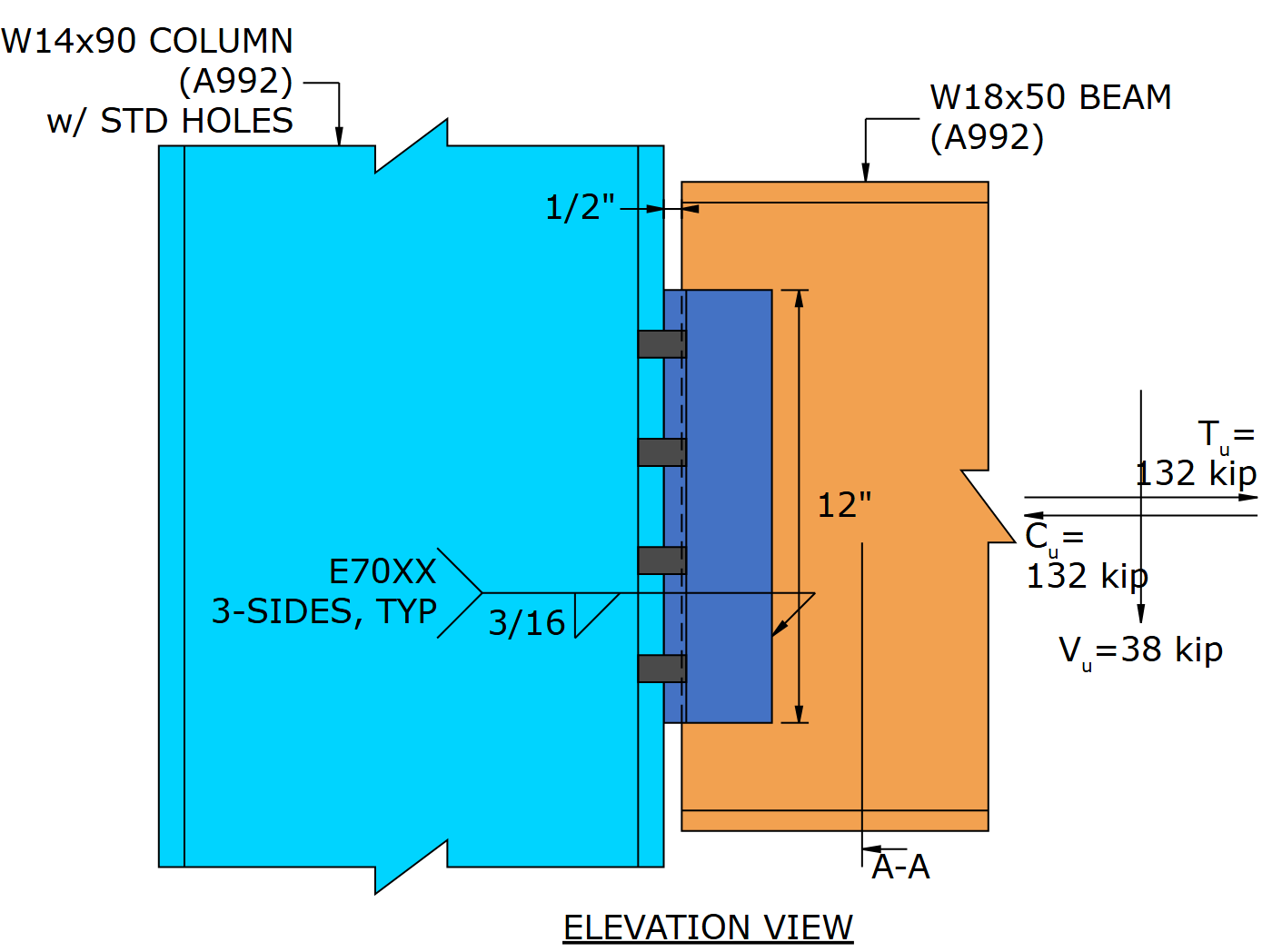
Yükseklik. Each angle is welded to the beam web along its 12 in length and across its top and bottom, a C-shaped weld group on each side of the web.
Load on the welds
The welds carry the resultant of the shear and the axial force:
[math] R_{u} = \sqrt{38^{2} + 132^{2}} = 137.36\ \text{kip} [math]
Base metal limit
The angles are 0.625 kalın. The beam web is welded on both faces, so each weld is checked against half the 0.355 internette, [mathin] d_{ct} = 0.1775\ \text{in} [mathin]. Her ikisi de [mathin] F_{u} = 65\ \text{ksi} [mathin]:
[math] D_{max} = \frac{\min\left( 0.625 \times 65,\ 0.1775 \times 65 \right)}{3.09 \times 1} = 3.7338 [math]
bu 3/16 kaynakta, [mathin] D = 3 [mathin], is below this limit, yani tam kaynak boyutu önemlidir.
Kaynak grubu katsayısı
Each weld group has a vertical length [mathin] L = 12\ \text{in} [mathin] and horizontal returns [mathin] kL = 2.5\ \text{in} [mathin], with an eccentricity [mathin] e = 2.6324\ \text{in} [mathin]. The report splits the group into 90 bölümler, 30 along the vertical weld and 30 along each return. The iteration puts the IC at:
[math] x_{ic} = -1.2142\ \text{in}, \quad y_{ic} = 13.581\ \text{in} [math]
The segment reactions add up to [mathin] \Sigma r_{ux} = 109.68\ \text{kip} [mathin] ve [mathin] \Sigma r_{uy} = 31.57\ \text{kip} [mathin], with a moment about the IC of [mathin] \Sigma M_{ru,ic} = 80.38\ \text{kip-ft} [mathin]. The ratio of the two sums is the same as 38 -e 132, so the resultant is mostly along the beam axis, which is the direction of the axial load. Dividing the resultant of the sums by [mathin] D l = 3 \times 12 [mathin]:
[math] C = \frac{\sqrt{109.68^{2} + 31.57^{2}}}{3 \times 12} = 3.17\ \text{kip/in} [math]
Tasarım gücü
The two angles give two weld groups, so the length is [mathin] 2L = 24\ \text{in} [mathin]:
[math] \phi R_{n} = \phi C C_{1} D \left( 2L \right) = 0.75 \times 3.17 \times 1 \times 3 \times 24 = 171.18\ \text{kip} [math]
[math] DCR = \frac{R_{u}}{\phi R_{n}} = \frac{137.36}{171.18} = 0.80244 [math]
The weld passes with about 20% to spare. The base metal limit of [mathin] D_{max} = 3.7338 [mathin] means a 1/4 kaynakta ([mathin] D = 4 [mathin]) would only count as 3.7338 on altıncılar, so the beam web, kaynak değil, would limit a larger weld.
SkyCiv Bağlantı Tasarımı bunu nasıl rapor ediyor?
The weld group appears in the summary of checks as "Design Capacity of Weld at Beam Side" with a demand of 137.361 kip, a capacity of 171.18 kip and a DCR of 0.802435. The row links to the calculation, which shows the base metal limit with the numbers substituted, then a table of the weld segment coordinates, the IC location from the iteration, a table of the reactions of every segment with their sums, the coefficient [mathin] C [mathin], and finally Eq. 8-21 with the numbers in it and the PASS or FAIL result. The segment tables let you check the IC solution by hand.
Başarısız olursa ne değiştirilmeli
- Use a longer angle or plate: a longer vertical weld raises [mathin] l [mathin] ve, by reducing the relative eccentricity, also raises [mathin] C [mathin].
- Increase the weld size, but only up to [mathin] D_{max} [mathin]. Past that, the base metal governs and a bigger weld does not add strength.
- Increase the base metal: a thicker angle, or a beam with a thicker web, raises [mathin] D_{max} [mathin] and lets a larger weld count.
- Use longer returns if the detail allows: the horizontal welds help resist the moment.
- Use a stronger electrode only where the base metal is not the limit, dan beri [mathin] D_{max} [mathin] falls as [mathin] F_{EXX} [mathin] rises.
Sıkça Sorulan Sorular
Why use the instantaneous center method instead of the elastic method?
The elastic method assumes every part of the weld stays elastic and the most stressed point governs, hangisi muhafazakar. The instantaneous center method lets the welds redistribute load as they deform, so the whole group works together and the strength is higher for the same weld. AISC Kılavuzu Bölümü 8 tables for eccentrically loaded weld groups are built on this method.
What does the weld group coefficient C mean?
[mathin] C [mathin] is the strength of the weld group per sixteenth of an inch of weld size per inch of vertical weld length. It already includes the effect of the eccentricity, the load direction and the shape of the group. Multiplying it by [mathin] \phi [mathin], [mathin] C_{1} [mathin], [mathin] D [mathin] ve [mathin] l [mathin] gives the design strength. Buraya [mathin] C = 3.17\ \text{kip/in} [mathin].
Why is the beam web only half its thickness in the base metal check?
There is a weld on each face of the web, one from each angle, and both pull on the same web. Giving each weld half of the web thickness, 0.1775 içinde 0.355 internette, accounts for the web being shared.
How does axial load change the weld check?
The welds carry the resultant of the shear and the axial force, and the direction of that resultant changes how much each weld segment can carry. In this example the 132 kip axial force is much larger than the 38 kesme makası, so the resultant of 137.36 kip acts mostly along the beam, and the segment reactions in the report point mostly in that direction.
Check a weld group in your own connection
Choose a welded shear connection in the ücretsiz bağlantı tasarımı hesaplayıcısı, üyelerinizi girin, welds and loads, and the weld group is solved by the instantaneous center method for you.
SkyCiv Bağlantı Tasarımı modülü size her denklem ve içindeki sayılarla birlikte tam hesaplama raporu sunar, AISC Bağlantı ve Taban Plakası Tasarımı 360-22 ve AISC 360-16 (LRFD ve ASD) ve AS 4100:2020. bu kaynak hesaplayıcı covers weld groups on their own, ve çift açılı bağlantı hesaplayıcısı covers this connection type. The same instantaneous center approach for bolt groups is explained in ICOR kullanarak cıvata grubu hesaplaması.
Referanslar
- AISC 360-16, Kullanıcı iş akışını basitleştirmek ve hızlandırmak için UI İyileştirmeleri: J2.4 (Eşitlik. J2-4).
- AISC Çelik Konstrüksiyon Kılavuzu, 15th Baskı: Bölüm 8, eccentrically loaded weld groups (sayfalar 8-9 -e 8-12, Eşitlik. 8-21, Tablo 8-3); Bölüm 9 Eşitlik. 9-2; Bölüm 10 Eşitlik. 10-1a.
- Double angle shear and axial connection design example
- Kaynak Dikişleri SkyCiv Bağlantı Tasarımında

Harold Munalem
Ürün Müdürü, Bağlantı Tasarımı
10+ çelik bağlantı tasarımında yıllar
LinkedIn
