
When a beam framing into an HSS column also carries an axial force, for a drag strut, a collector or a braced bay, the single plate has to pass that force into the tube wall as well as the end shear. To AISC 360-16 this adds a set of checks to the shear tab design: bearing and tear-out in the axial direction, block shear under axial load, Plaka gerilimi ve sıkıştırma, combined interaction, beam web block shear and beam tension rupture, ve, most important, the strength of the HSS wall under a force pulling or pushing straight on it.
This page works through one example: a W18x35 beam into the 6 HSS8x6x1/2 sütununun duvarında, ile 32 kip kesme ve 93 eksenel kip (gerginlik ve sıkıştırma) under LRFD, on 1 in A490-SC bolts in two columns and a 3/4 in Grade 50 tabak. The shear-only version of this connection is covered in Single Plate to HSS Column Connection Design, so here the shear checks are kept short and the page concentrates on what the axial force adds. Every number comes from the SkyCiv Connection Design calc sheet.
What does the axial force change in a single plate to HSS connection?
A shear tab on its own is a simple kesme bağlantısı and the HSS wall only sees an eccentric vertical load. An axial force acts at right angles to the wall. In tension it pulls the plate away from the tube and the wall bends like a plate between the corners; in compression it pushes the plate in. Because a tube wall is thin and flexible out of its plane, this is usually where a shear and axial tab on an HSS runs out of strength, long before the bolts or plate do.
The axial force also changes which way the bolts bear. In tension they bear toward the free ends, the end of the plate and the end of the beam; in compression they bear toward the support and the span. The software checks both directions and combines each with the shear. You can run the connection in the tek plaka bağlantı hesaplayıcısı.
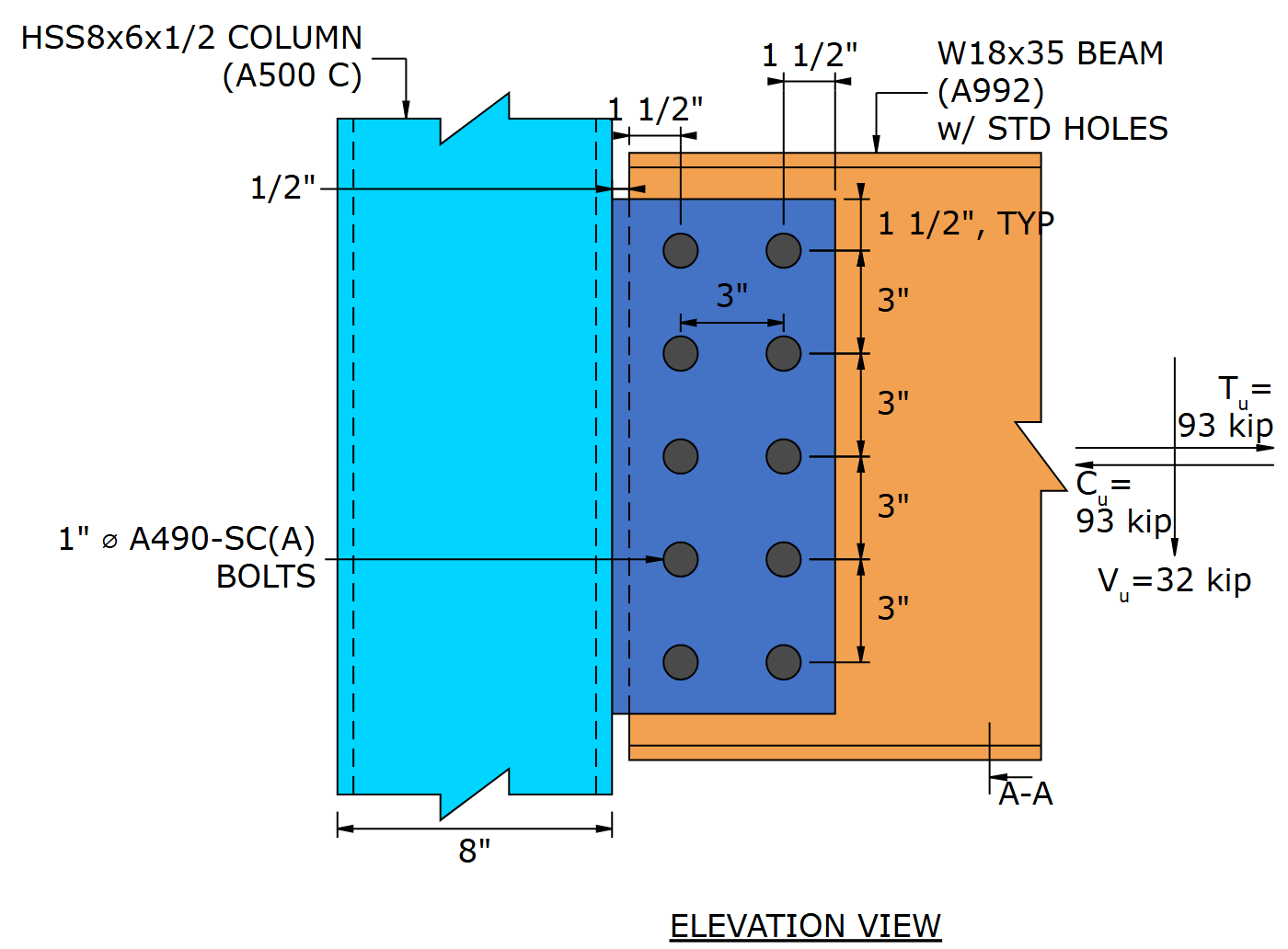
Örnek bağlantının yüksekliği, with the shear and the axial tension and compression acting at the bolt group.
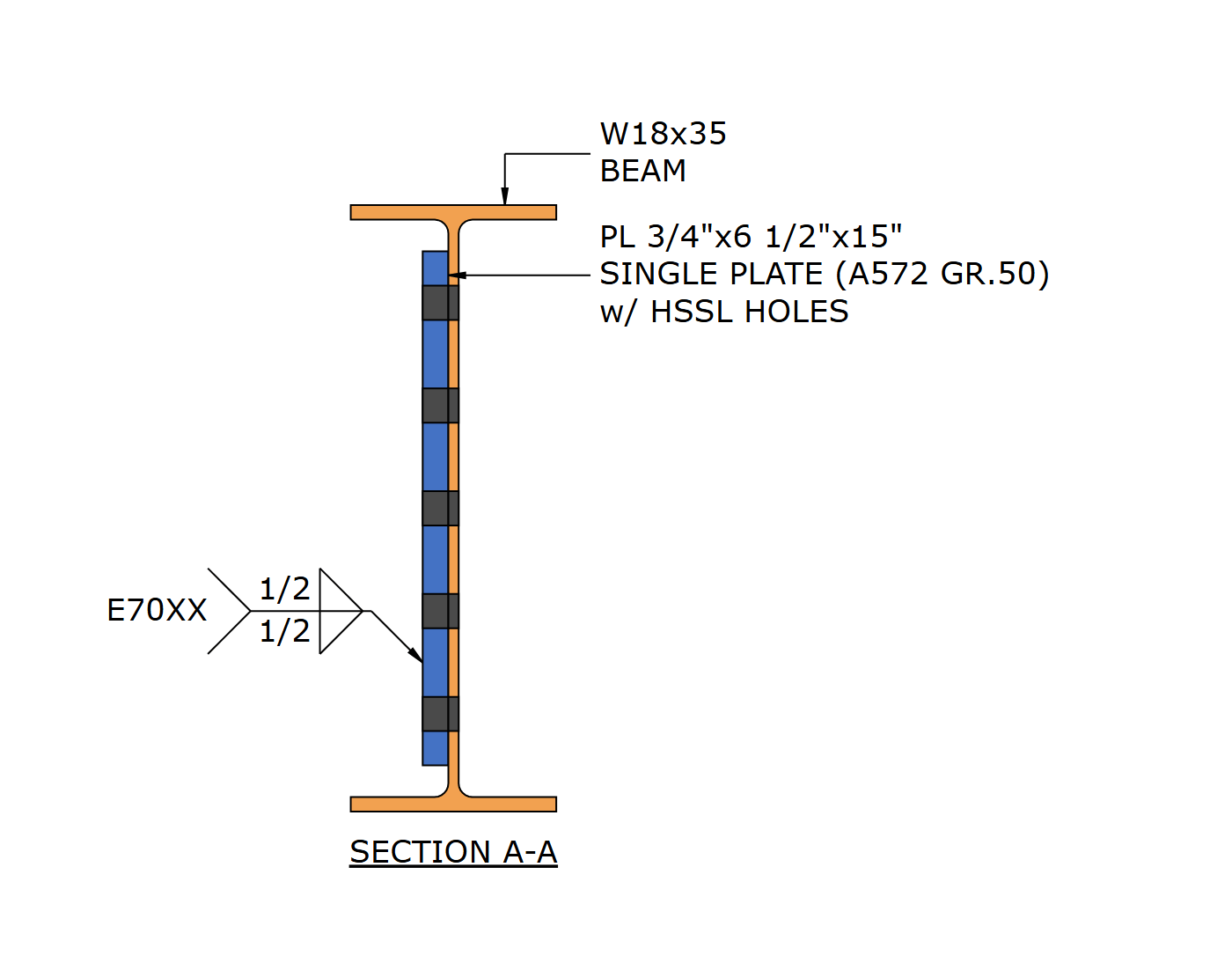
Bölüm A-A. Plakanın yatay kısa oluklu delikleri vardır ve 1/2 her iki tarafta köşe kaynağında.
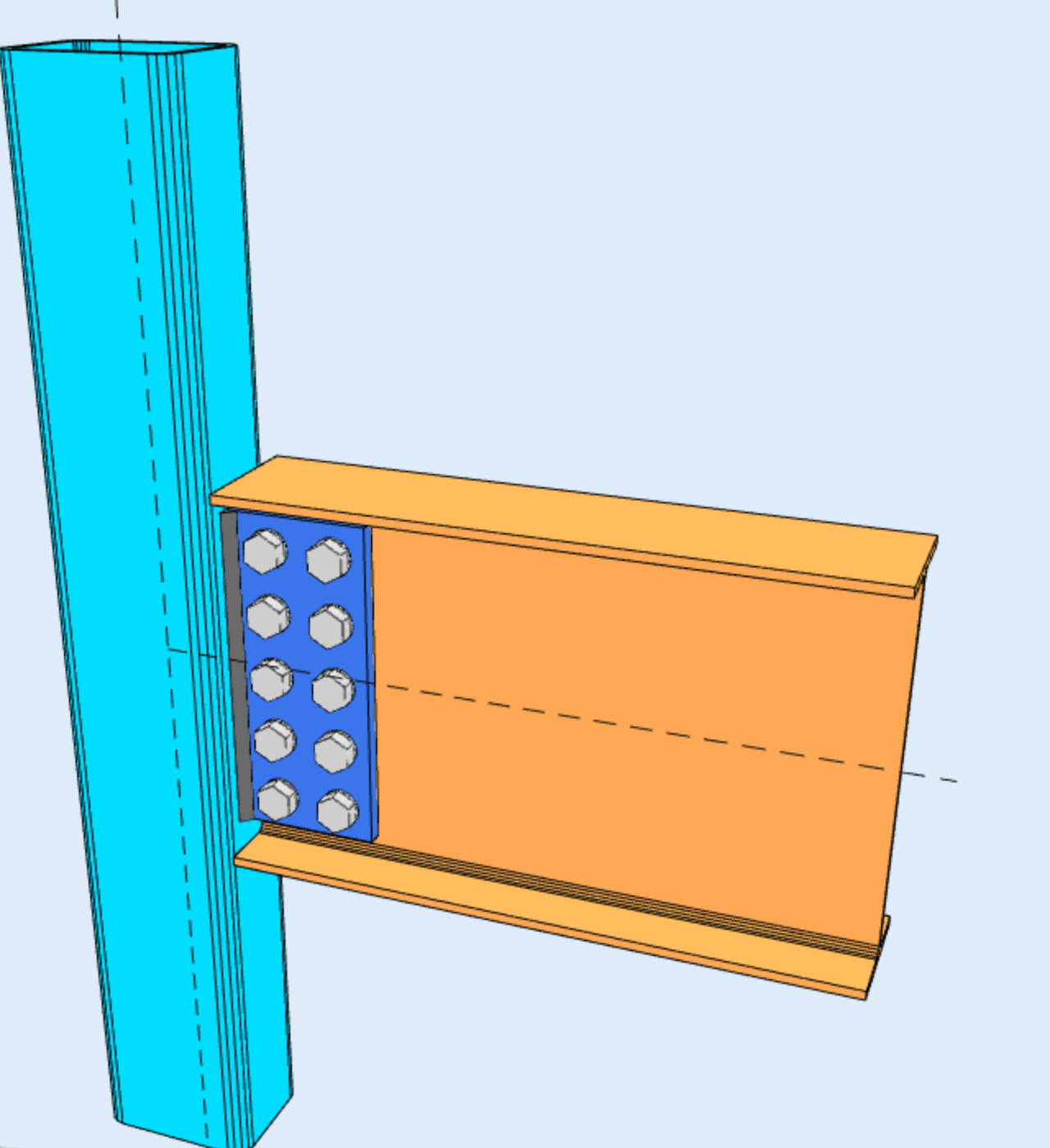
3SkyCiv Bağlantı Tasarımındaki bağlantının D görünümü.
Bir bakışta adımlar
The report runs 28 çekler. The ones in bold are added, or changed, by the axial force:
- Detailing limits at the beam.
- Bolt group in slip, under the resultant of shear and axial.
- Plaka sünekliği.
- Bearing and tear-out on the plate, kesme.
- Bearing and tear-out on the plate, eksenel gerginlik.
- Bearing and tear-out on the plate, eksenel sıkıştırma.
- Shear and axial interaction, plaka yatağı.
- Bearing and tear-out on the beam web, kesme.
- Bearing and tear-out on the beam web, eksenel gerginlik.
- Bearing and tear-out on the beam web, eksenel sıkıştırma.
- Shear and axial interaction, beam web bearing.
- Block shear of the plate, kesme.
- Block shear of the plate, eksenel.
- Shear and axial interaction, plate block shear.
- Shear yielding and rupture of the plate.
- Plaka bükülmesi.
- Plate tension yielding and rupture.
- Kesme, tension and flexure interaction, verimli.
- Kesme, tension and flexure interaction, yırtılma.
- Plaka sıkıştırma.
- Kesme, compression and flexure interaction.
- Kiriş ağının blok kesmesi, eksenel.
- Işın gerginliği kopması.
- HSS duvarındaki sınırların detaylandırılması.
- Plakayı geliştirmek için kaynak yapın.
- Weld to the HSS wall, under the resultant.
- HSS duvar delme.
- HSS wall under the axial force.
Bu örnek için tasarım girdileri
Tasarım kodu AISC'dir 360-16 LRFD. The beam and column are the same as in the shear-only example; cıvatalar, plate and weld are larger to carry the axial force. How the loads are entered is explained in yükler ve yük kombinasyonları.
| Kalem | Sembol | Değer |
|---|---|---|
| Faktoringli kesme | [mathin] V_{u} [mathin] | 32 kip |
| Faktörlü eksenel gerilim | [mathin] T_{u} [mathin] | 93 kip |
| Faktörlü eksenel sıkıştırma | [mathin] C_{u} [mathin] | 93 kip |
| Beam | G18x35, ASTM A992 (d = 17.7 içinde, tw = 0.3 içinde, bir = 10.3 inç², Fy / Fu = 50 / 65 ksi) | |
| Sütun | HSS8x6x1/2, ASTM A500 Gr. C (Fy / Fu = 50 / 62 ksi) | |
| HSS wall width / design thickness / workable flat | [mathin] b,\ t,\ W_{flat} [mathin] | 6 içinde / 0.465 içinde / 4.875 içinde |
| Kalem | Sembol | Değer |
|---|---|---|
| Tek plaka | PL 3/4 x 6 1/2 x 15, ASTM A572 Gr. 50 (Fy / Fu = 50 / 65 ksi) | |
| Cıvatalar | 1 A490-SC'de, A sınıfı solma yüzeyi | |
| Bolt shear stress / çekme gerilimi | [mathin] F_{nv},\ F_{nt} [mathin] | 68 ksi / 113 ksi |
| Delikler | Tabak: yatay kısa oluklu (HSSL). Kiriş ağı: liste yalnızca ABD'nin materyallerini içerir (STD) | |
| HSS duvarına kaynak yapın | 1/2 her iki tarafta fileto halinde, E70XX | |
| Cıvata satırları / satır aralığı | [mathin] n_{r},\ s_{r} [mathin] | 5 / 3 içinde |
| Cıvata sütunları / sütun aralığı | [mathin] n_{c},\ s_{c} [mathin] | 2 / 3 içinde |
| Weld line to first bolt line | [mathin] a [mathin] | 2 içinde |
| Edge distances, plate and beam | 1.5 içinde | |
| Tasarımın tuhaflığı (Manuel Tablo 10-9) | [mathin] e [mathin] | 3.5 içinde |
Adım 1: Kiriş tarafındaki limitlerin detaylandırılması (AISC 360-16 J3.3, J3.4)
The same limits as for the shear-only connection, now for a 1 cıvatada: 2.667 in minimum spacing, 1.25 in minimum edge from Table J3.4, ve 1.375 in at the plate’s slotted horizontal edge.
| Detaylandırma sınırı | Sınır (içinde) | Gerçek (içinde) | DCR | Sonuç |
|---|---|---|---|---|
| Minimum bolt row / sütun aralığı | 2.667 | 3.000 | 0.889 | GEÇMEK |
| Maximum bolt row / sütun aralığı | 6.000 | 3.000 | 0.500 | GEÇMEK |
| Plaka minimum dikey kenar mesafesi | 1.250 | 1.500 | 0.833 | GEÇMEK |
| Plaka minimum yatay kenar mesafesi | 1.375 | 1.500 | 0.917 | GEÇMEK |
| Kirişin minimum yatay kenar mesafesi | 1.250 | 1.500 | 0.833 | GEÇMEK |
| Minimum bağlantı derinliği | 7.750 | 15.000 | 0.517 | GEÇMEK |
| Maksimum bağlantı derinliği | 16.000 | 15.000 | 0.938 | GEÇMEK |
[math] DCR = \frac{15\,in}{16\,in} = 0.938 [math]
DCR = 0.938 < 1.0, TAMAM MI
Adım 2: Bolt group in slip under shear and axial (AISC 360-16 J3.8)
With slip-critical bolts the group is designed against slip, Eşitlik. J3-4, for the resultant of the shear and the axial force. Eksantriklik 3.5 in from Manual Table 10-9, and the ICOR coefficient for the inclined load on the 2 x 5 group is C = 8.41 (the IC converges at x = -0.78739 içinde, y = 13.997 içinde).
| cıvata | R (kip) | Rx (kip) | Ry (kip) | Mn (tavuklu) |
|---|---|---|---|---|
| 1 | 18.06 | 18.03 | 1.01 | 253.19 |
| 2 | 17.66 | 17.62 | 1.26 | 194.75 |
| 3 | 16.84 | 16.76 | 1.65 | 135.35 |
| 4 | 15.09 | 14.91 | 2.35 | 76.35 |
| 5 | 11.07 | 10.30 | 4.06 | 23.76 |
| 6 | 18.10 | 17.47 | 4.73 | 262.47 |
| 7 | 17.77 | 16.80 | 5.79 | 206.67 |
| 8 | 17.13 | 15.48 | 7.33 | 151.58 |
| 9 | 15.97 | 12.73 | 9.65 | 100.15 |
| 10 | 14.35 | 6.69 | 12.69 | 61.43 |
[math] R_{u} = \sqrt{V_{u}^{2} + T_{u}^{2}} = \sqrt{32^{2} + 93^{2}} = 98.351\,kip [math]
[math] \phi R_{n} = \phi\, \mu\, D_{u}\, h_{f}\, T_{b}\, N_{s}\, C = (0.85) \times (0.3) \times (1.13) \times (1) \times (64\,kip) \times (1) \times (8.41) = 155.09\,kip [math]
DCR = 98.351 kip / 155.09 kip = 0.634 < 1.0, TAMAM MI
Adım 3: Plaka sünekliği (AISC Kılavuzu sayfası 10-89)
Unlike the shear-only example, this layout does need the check. The moment coefficient of the group is C’ = 38.669 içinde:
[math] M_{max} = \frac{F_{nv}}{0.9}\, \frac{\pi}{4} d_{b}^{2}\, C’ = \frac{68\,ksi}{0.9} \times \frac{\pi}{4} (1\,in)^{2} \times (38.669\,in) = 191.22\,kip\text{-}ft [math]
[math] t_{max} = \frac{6 M_{max}}{F_{yp} d_{p}^{2}} = \frac{6 \times (191.22\,kip\text{-}ft)}{(50\,ksi) \times (15\,in)^{2}} = 1.2238\,in [math]
DCR = 0.75 içinde / 1.2238 içinde = 0.613 < 1.0, TAMAM MI
Adım 4: Plate bearing and tear-out under shear (AISC 360-16 J3.10)
As in the shear-only example, ile [mathin] d_{h} = 1.125\,in [mathin], an edge clear distance of 0.9375 içinde ve 1.875 in between bolts, scaled by C over the five bolts in a line:
[math] \phi R_{n} = (0.75) \left[ \min(1.2 \times 0.9375, 2.4) \times 0.75 \times 65 + \min(1.2 \times 1.875, 2.4) \times 0.75 \times 65 \times 4 \right] \times \frac{8.41}{5} = 622.67\,kip [math]
DCR = 32 kip / 622.67 kip = 0.051 < 1.0, TAMAM MI
Adım 5: Plate bearing and tear-out under axial tension (AISC 360-16 J3.10)
Under tension the bolts bear on the plate toward its free end. The hole dimension along the slot is [mathin] d_{h} = 1.3125\,in [mathin], yani net mesafeler:
[math] l_{c1} = L_{eh\_pl} – \frac{d_{h}}{2} = 1.5 – 0.65625 = 0.84375\,in, \qquad l_{c2} = s_{c} – d_{h} = 1.6875\,in [math]
Along the axial direction there are two bolts in each row, the outer one at the edge and the inner one behind it. The sum is scaled by C over the two bolt columns:
[math] \phi R_{n} = (0.75) \left[ \min(1.2 \times 0.84375, 2.4) \times 0.75 \times 65 + \min(1.2 \times 1.6875, 2.4) \times 0.75 \times 65 \times (2 – 1) \right] \times \frac{8.41}{2} = 467\,kip [math]
DCR = 93 kip / 467 kip = 0.199 < 1.0, TAMAM MI
Adım 6: Plate bearing and tear-out under axial compression (AISC 360-16 J3.10)
Under compression the bolts bear on the plate toward the support. The edge distance for the bolt nearest the wall is the 2 kaynak-cıvata mesafesinde:
[math] l_{c1} = a – \frac{d_{h}}{2} = 2 – 0.65625 = 1.3438\,in, \qquad l_{c2} = 1.6875\,in [math]
[math] \phi R_{n} = (0.75) \left[ \min(1.2 \times 1.3438, 2.4) \times 0.75 \times 65 + \min(1.2 \times 1.6875, 2.4) \times 0.75 \times 65 \times (2 – 1) \right] \times \frac{8.41}{2} = 559.25\,kip [math]
DCR = 93 kip / 559.25 kip = 0.166 < 1.0, TAMAM MI
Adım 7: Shear and axial interaction of plate bearing
The axial direction with the larger ratio of load to bearing strength is used, here tension:
[math] \left( \frac{V_{u}}{\phi R_{n,V}} \right)^{2} + \left( \frac{T_{u}}{\phi R_{n,T}} \right)^{2} = \left( \frac{32}{622.67} \right)^{2} + \left( \frac{93}{467} \right)^{2} = 0.042299 [math]
DCR = 0.042 < 1.0, TAMAM MI
Adım 8: Beam web bearing and tear-out under shear (AISC 360-16 J3.10)
[math] \phi R_{n} = (0.75) \times \min(1.2 \times 1.875, 2.4) \times (0.3\,in) \times (65\,ksi) \times (8.41) = 276.74\,kip [math]
DCR = 32 kip / 276.74 kip = 0.116 < 1.0, TAMAM MI
Adım 9: Beam web bearing and tear-out under axial tension (AISC 360-16 J3.10)
Under tension the bolts bear on the beam web toward the end of the beam, so the edge bolt uses the 1.5 in beam horizontal edge distance:
[math] l_{c1} = 1.5 – \frac{1.125}{2} = 0.9375\,in, \qquad l_{c2} = 3 – 1.125 = 1.875\,in [math]
[math] \phi R_{n} = (0.75) \left[ \min(1.2 \times 0.9375, 2.4) \times 0.3 \times 65 + \min(1.2 \times 1.875, 2.4) \times 0.3 \times 65 \times (2 – 1) \right] \times \frac{8.41}{2} = 207.56\,kip [math]
DCR = 93 kip / 207.56 kip = 0.448 < 1.0, TAMAM MI
Adım 10: Beam web bearing and tear-out under axial compression (AISC 360-16 J3.10)
Under compression the bolts bear toward the span, ağın sürekli olduğu yer. En uzaktaki cıvatanın ötesinde bir kenar yoktur, so it takes full bearing, 2.4 d t Fu:
[math] \phi R_{n} = (0.75) \left[ 2.4 \times 1 \times 0.3 \times 65 + \min(1.2 \times 1.875, 2.4) \times 0.3 \times 65 \times (2 – 1) \right] \times \frac{8.41}{2} = 285.97\,kip [math]
DCR = 93 kip / 285.97 kip = 0.325 < 1.0, TAMAM MI
Adım 11: Shear and axial interaction of beam web bearing
Tension governs again:
[math] \left( \frac{32}{276.74} \right)^{2} + \left( \frac{93}{207.56} \right)^{2} = 0.21414 [math]
DCR = 0.214 < 1.0, TAMAM MI
Adım 12: Plate block shear under shear (AISC 360-16 J4.3)
The block runs down the two bolt lines and out to the free edge. The report takes [mathin] U_{bs} = 0.5 [mathin] for this two-column layout:
[math] A_{nt} = 1.8281\,in^{2}, \quad A_{gv} = 10.125\,in^{2}, \quad A_{nv} = 6.1172\,in^{2} [math]
[math] \phi R_{n} = 0.75 \left( 0.6 \times 65 \times 6.1172 + 0.5 \times 65 \times 1.8281 \le 0.6 \times 50 \times 10.125 + 0.5 \times 65 \times 1.8281 \right) = 223.49\,kip [math]
DCR = 32 kip / 223.49 kip = 0.143 < 1.0, TAMAM MI
Adım 13: Plate block shear under axial load (AISC 360-16 J4.3)
Under the axial force the block tears out in the other direction: tension across the bolt rows to one plate edge, and shear along the outer bolt row to the plate end.
[math] A_{nt} = 0.75 \left[ (5 – 1) \times 3 + 1.5 – 4.5 \times (1.1875) \right] = 6.1172\,in^{2} [math]
[math] A_{gv} = 0.75 \left[ 1.5 + (2 – 1) \times 3 \right] = 3.375\,in^{2} [math]
[math] A_{nv} = 0.75 \left[ 6.5 – 2 – 1.5 \times (1.3125 + 0.0625) \right] = 1.8281\,in^{2} [math]
[math] \phi R_{n} = 0.75 \left( 0.6 \times 65 \times 1.8281 + 65 \times 6.1172 \le 0.6 \times 50 \times 3.375 + 65 \times 6.1172 \right) = 351.69\,kip [math]
DCR = 93 kip / 351.69 kip = 0.264 < 1.0, TAMAM MI
Adım 14: Shear and axial interaction of plate block shear
[math] \left( \frac{32}{223.49} \right)^{2} + \left( \frac{93}{351.69} \right)^{2} = 0.090431 [math]
DCR = 0.090 < 1.0, TAMAM MI
Adım 15: Plate shear yielding and rupture (AISC 360-16 J4.2)
[math] \phi R_{n\_sy} = 1.0 \times 0.6 \times 50 \times 11.25 = 337.5\,kip, \qquad \phi R_{n\_sr} = 0.75 \times 0.6 \times 65 \times 6.7969 = 198.81\,kip [math]
DCR = 32 kip / 198.81 kip = 0.161 < 1.0, TAMAM MI
Adım 16: Çift başlıklı kiriş prosedürünü kullanarak plaka bükülmesi (AISC 360-16 F11.2)
The same procedure as the shear-only example, üzerinde 2 kaynaktan cıvata hattına kadar. With Lb d / t² = 53.333, arasında 46.4 ve 1102, Eşitlik. F11-2 applies and the plate reaches its plastic moment:
[math] \phi M_{n} = 0.9 \times \min\left[ C_{b} \left( 1.52 – 0.274 \times 53.333 \times \frac{50}{29000} \right) \times 50 \times 28.125,\; 50 \times 42.188 \right] = 158.2\,kip\text{-}ft \;\Rightarrow\; \phi V_{n} = 949.22\,kip [math]
[math] Z_{net} = 25.892\,in^{3}, \qquad \phi M_{n} = 0.75 \times 65 \times 25.892 = 105.19\,kip\text{-}ft \;\Rightarrow\; \phi V_{n} = 631.11\,kip [math]
DCR = 32 kip / 631.11 kip = 0.051 < 1.0, TAMAM MI
Adım 17: Plate tension yielding and rupture (AISC 360-16 J4.1)
The plate is a tension member for the axial force, checked on its full 15 derinlemesine:
[math] \phi R_{n\_ty} = 0.9 \times F_{yp}\, t_{p}\, d_{p} = 0.9 \times 50 \times 0.75 \times 15 = 506.25\,kip [math]
[math] \phi R_{n\_tr} = 0.75 \times F_{up}\, t_{p} \left[ d_{p} – n_{r} (d_{h} + 0.0625) \right] = 0.75 \times 65 \times 0.75 \left[ 15 – 5 \times (1.1875) \right] = 331.35\,kip [math]
DCR = 93 kip / 331.35 kip = 0.281 < 1.0, TAMAM MI
Adım 18: Kesme, tension and flexure interaction, verimli (AISC Kılavuz Parçası 10)
[math] \left( \frac{T_{u}}{2 \phi R_{n\_ty}} + \frac{V_{u}}{\phi V_{n}} \right)^{2} + \left( \frac{V_{u}}{\phi R_{n\_sy}} \right)^{2} = \left( \frac{93}{2 \times 506.25} + \frac{32}{949.22} \right)^{2} + \left( \frac{32}{337.5} \right)^{2} = 0.024756 [math]
DCR = 0.025 < 1.0, TAMAM MI
Adım 19: Kesme, tension and flexure interaction, yırtılma (AISC Kılavuz Parçası 10)
[math] \left( \frac{T_{u}}{\phi R_{n\_tr}} + \frac{8 V_{u}}{9 \phi V_{n}} \right)^{2} + \left( \frac{V_{u}}{\phi R_{n\_sr}} \right)^{2} = \left( \frac{93}{331.35} + \frac{8 \times 32}{9 \times 631.11} \right)^{2} + \left( \frac{32}{198.81} \right)^{2} = 0.13202 [math]
DCR = 0.132 < 1.0, TAMAM MI
Adım 20: Plaka sıkıştırma (AISC 360-16 J4.4)
KL/r of the plate is no more than 25, yani Denklem. J4-6 applies with no buckling reduction:
[math] \phi R_{n} = 0.9\, F_{yp}\, t_{p}\, d_{p} = 0.9 \times 50 \times 0.75 \times 15 = 506.25\,kip [math]
DCR = 93 kip / 506.25 kip = 0.184 < 1.0, TAMAM MI
Adım 21: Kesme, compression and flexure interaction (AISC Kılavuz Parçası 10)
[math] \left( \frac{C_{u}}{2 \phi R_{n}} + \frac{V_{u}}{\phi V_{n}} \right)^{2} + \left( \frac{V_{u}}{\phi R_{n\_sy}} \right)^{2} = \left( \frac{93}{2 \times 506.25} + \frac{32}{949.22} \right)^{2} + \left( \frac{32}{337.5} \right)^{2} = 0.024756 [math]
DCR = 0.025 < 1.0, TAMAM MI
Adım 22: Beam web block shear under axial load (AISC 360-16 J4.3)
The tension force can also tear a block out of the beam web: tension across the five bolt rows and shear along the top and bottom rows to the beam end.
[math] A_{nt} = 0.3 \left[ (5 – 1) \times 3 – (5 – 1) \times (1.1875) \right] = 2.175\,in^{2} [math]
[math] A_{gv} = 2 \times 0.3 \left[ 1.5 + 3 \right] = 2.7\,in^{2}, \qquad A_{nv} = 2 \times 0.3 \left[ 3 + 1.5 – 1.5 \times (1.1875) \right] = 1.6313\,in^{2} [math]
[math] \phi R_{n} = 0.75 \left( 0.6 \times 65 \times 1.6313 + 65 \times 2.175 \le 0.6 \times 50 \times 2.7 + 65 \times 2.175 \right) = 153.75\,kip [math]
DCR = 93 kip / 153.75 kip = 0.605 < 1.0, TAMAM MI
Adım 23: Işın gerginliği kopması (AISC 360-16 D3, J4.1)
Yalnızca web cıvatalanmıştır, so shear lag reduces the effective net area of the beam. The report uses U = 0.73655 from Table D3.1 case 2:
[math] \phi R_{n\_tr} = 0.75 \times 65 \times 0.73655 \left[ 10.3 – 5 \times (1.125 + 0.0625) \times 0.3 \right] = 305.88\,kip [math]
DCR = 93 kip / 305.88 kip = 0.304 < 1.0, TAMAM MI
Adım 24: HSS duvarındaki sınırların detaylandırılması
The weld-on-flat and slenderness values are the module’s limits for a single plate on an HSS wall.
| Detaylandırma sınırı | Sınır (içinde) | Gerçek (içinde) | DCR | Sonuç |
|---|---|---|---|---|
| Kiriş açıklığı başına maksimum köşe kaynağı boyutu | 0.500 | 0.500 | 1.000 | GEÇMEK |
| HSS ile çalışılabilir düz parça başına maksimum köşe kaynağı boyutu | 1.538 | 0.500 | 0.325 | GEÇMEK |
| Maksimum HSS duvar narinliği b/t | 33.716 | 9.903 | 0.294 | GEÇMEK |
bu 1/2 in weld exactly fills the 1/2 ışın açıklığında, hangisine izin veriliyor:
[math] DCR = \frac{0.5\,in}{0.5\,in} = 1.000 [math]
DCR = 1.000, TAMAM MI
Adım 25: Tek plakayı geliştirmek için kaynak gerekli (AISC Kılavuzu sayfası 10-87)
[math] W_{duc} = \frac{5}{8} \times (0.75\,in) = 0.46875\,in [math]
DCR = 0.46875 içinde / 0.5 içinde = 0.938 < 1.0, TAMAM MI
Adım 26: Fillet weld strength to the HSS wall under the resultant (AISC 360-16 J2.4)
The weld now carries the resultant of the shear and the axial force, at an angle to its axis. That angle earns the directional strength increase of Eq. J2-5, which a pure shear load on a vertical weld does not get:
[math] \theta = 71.012^{\circ}, \qquad D_{max} = \frac{(0.375)(65) \le (0.465)(62)}{3.09} = 7.8883, \qquad L_{w} = 2 \left[ 15 – 2 \times 0.5 \right] = 28\,in [math]
[math] \phi R_{n} = 0.75 \times 0.6 \times 70 \times \frac{\sqrt{2}}{2} \times \min\left(0.5, \frac{7.8883}{16}\right) \times \left[ 1 + 0.5 \sin^{1.5}(71.012) \right] \times 28 = 448.85\,kip [math]
DCR = 98.351 kip / 448.85 kip = 0.219 < 1.0, TAMAM MI
Adım 27: HSS duvar delme (AISC Manuel Denklem. 10-7b, sayfa 10-153)
[math] \phi R_{n} = \frac{0.75 \times 62 \times 0.465 \times 15^{2}}{5 \times 3.5} = 278\,kip [math]
DCR = 32 kip / 278 kip = 0.115 < 1.0, TAMAM MI
Adım 28: HSS wall under the axial force
This is the check the axial force exists for. The plate pulls (or pushes) on the middle of the tube wall, and the wall resists by forming a yield line pattern across its workable flat. The report uses the yield line expression it attributes to R. Kapp, which is the software’s method for this limit state:
[math] \phi R_{n} = 0.75 \left[ \frac{F_{ys}\, t^{2}\, d_{p}}{0.5 (W_{flat} – t_{p})} + 4 F_{ys}\, t^{2} \sqrt{1 + \frac{t_{p}}{W_{flat} – t_{p}}} \right] [math]
[math] \phi R_{n} = 0.75 \left[ \frac{50 \times 0.465^{2} \times 15}{0.5 \times (4.875 – 0.75)} + 4 \times 50 \times 0.465^{2} \times \sqrt{1 + \frac{0.75}{4.875 – 0.75}} \right] = 94.23\,kip [math]
DCR = 93 kip / 94.23 kip = 0.987 < 1.0, TAMAM MI
The first term grows with the plate depth and falls as the workable flat gets wider, and both terms grow with the square of the wall thickness. That is why the wall, not the bolts or the plate, sets the axial capacity of this connection.
Tasarım kontrollerinin özeti
| Tasarım kontrolü | Talep | Kapasite | DCR | Sonuç |
|---|---|---|---|---|
| Kiriş tarafında detaylandırma | 15 derinlemesine | 16 maksimum | 0.938 | GEÇMEK |
| Bolt group in slip (sonuç) | 98.351 kip | 155.09 kip | 0.634 | GEÇMEK |
| Plaka sünekliği | 0.75 içinde | 1.2238 içinde | 0.613 | GEÇMEK |
| Plaka yatağı, kesme | 32 kip | 622.67 kip | 0.051 | GEÇMEK |
| Plaka yatağı, eksenel gerginlik | 93 kip | 467 kip | 0.199 | GEÇMEK |
| Plaka yatağı, eksenel sıkıştırma | 93 kip | 559.25 kip | 0.166 | GEÇMEK |
| Plate bearing interaction | 0.042 | GEÇMEK | ||
| Kiriş ağ yatağı, kesme | 32 kip | 276.74 kip | 0.116 | GEÇMEK |
| Kiriş ağ yatağı, eksenel gerginlik | 93 kip | 207.56 kip | 0.448 | GEÇMEK |
| Kiriş ağ yatağı, eksenel sıkıştırma | 93 kip | 285.97 kip | 0.325 | GEÇMEK |
| Beam web bearing interaction | 0.214 | GEÇMEK | ||
| Plaka blok kesme, kesme | 32 kip | 223.49 kip | 0.143 | GEÇMEK |
| Plaka blok kesme, eksenel | 93 kip | 351.69 kip | 0.264 | GEÇMEK |
| Plaka blok kesme etkileşimi | 0.090 | GEÇMEK | ||
| Plate shear yielding and rupture | 32 kip | 198.81 kip | 0.161 | GEÇMEK |
| Plaka bükülmesi | 32 kip | 631.11 kip | 0.051 | GEÇMEK |
| Plate tension | 93 kip | 331.35 kip | 0.281 | GEÇMEK |
| Etkileşim, tension yielding | 0.025 | GEÇMEK | ||
| Etkileşim, tension rupture | 0.132 | GEÇMEK | ||
| Plaka sıkıştırma | 93 kip | 506.25 kip | 0.184 | GEÇMEK |
| Etkileşim, sıkıştırma | 0.025 | GEÇMEK | ||
| Kiriş web blok kesmesi, eksenel | 93 kip | 153.75 kip | 0.605 | GEÇMEK |
| Işın gerginliği kopması | 93 kip | 305.88 kip | 0.304 | GEÇMEK |
| HSS duvarında detaylandırma | 0.5 kaynakta | 0.5 maksimum | 1.000 | GEÇMEK |
| Plakayı geliştirmek için kaynak yapın | 0.46875 içinde | 0.5 içinde | 0.938 | GEÇMEK |
| HSS duvarına kaynak yapın (sonuç) | 98.351 kip | 448.85 kip | 0.219 | GEÇMEK |
| HSS duvar delme | 32 kip | 278 kip | 0.115 | GEÇMEK |
| HSS wall under axial | 93 kip | 94.23 kip | 0.987 | GEÇMEK |
Bağlantı her kontrolü geçiyor. The HSS wall under the 93 kip axial force governs at 0.987, and the next strength checks are the bolt group in slip (0.634) and block shear of the beam web (0.605). Everything in the plate is lightly loaded. The two ratios at 0.938 ve 1.000 are detailing and weld sizing rules, not load against capacity.
Bir kontrol başarısız olursa ne değiştirilmelidir?
- HSS wall under axial: this is the usual limit. A thicker HSS wall helps most, because the strength grows with the square of the wall thickness. A deeper plate also helps. If neither can change, the axial force needs a different connection type.
- Bolt slip or bearing: add bolt rows or a bolt column, veya daha büyük bir cıvata kullanın. For bearing under tension, a larger edge distance to the free end helps.
- Beam web block shear or beam tension rupture: add bolt rows to lengthen the block and raise U, or use a beam with a thicker web.
- Plate tension, sıkıştırma veya blok kesme: Plakayı daha derin veya daha kalın yapın, while keeping the ductility check below 1.0.
- Kaynak: a larger weld, as long as it fits within the beam clearance and on the workable flat.
Auto Design is available for the single plate connection to an HSS column with shear and axial load. Cıvataları değiştirir, her kontrol geçinceye kadar plaka ve kaynaklar, ve üyelerinizi ve yüklerinizi girildiği gibi tutar. Bkz. Otomobil Tasarımı çalıştığı tercihler için sayfa.
Sıkça Sorulan Sorular
Why are the bolts slip-critical in this example?
A beam carrying both shear and an axial force that reverses between tension and compression is a typical case for slip-critical bolts, so the joint does not slip back and forth through the hole clearance. The report then checks the group against slip with Eq. J3-4 under the resultant of the two forces.
Why does the report check bearing in two axial directions?
In tension the bolts bear toward the free end of the plate and the end of the beam, where the edge distance is short. In compression they bear toward the support and the span, where the plate edge is the weld line and the beam web is continuous. The two give different tear-out strengths, so both are checked, and the interaction uses the direction with the larger ratio.
Why is the weld stronger under the combined load than under shear alone?
A fillet weld loaded at an angle to its axis is stronger than one loaded along it, faktöre göre 1 + 0.5 sin^1.5 of the angle in Eq. J2-5. The resultant here is at 71 degrees to the weld, which raises the weld strength by about 46%.
How does the shear-only connection compare?
The shear-only example, Tek Plakadan HSS Kolona Bağlantı Tasarımı, uses three 3/4 in bolts and a 3/8 in plate on the same beam and tube, and is governed by bolt shear at 0.660. The axial force here needs ten 1 in bolts and a 3/4 tabakta, and the tube wall becomes the limit.
Can the axial force be larger with this tube?
Not by much. Şurada: 93 kip the HSS wall check is already at 0.987. For a larger axial force, daha kalın duvarlı bir tüp veya daha derin bir plaka kullanın.
Design a shear and axial single plate to HSS column connection for free
Bu sayfadaki her sayı tek bir çözümden gelir. Bir HSS kolonuna tek plakalı bağlantıyı seçin, ışınına gir, tüp, cıvatalar, kesme ve eksenel yük, ve bu kontrollerin her birini tarayıcınızda görün. Yüklenecek hiçbir şey yok.
SkyCiv Bağlantı Tasarımı modülü, bu örneğin arkasındaki bağlantı tasarımı yazılımıdır. Size her denklem ve içindeki sayılarla birlikte tam hesaplama raporu verir., yukarıdaki adımlar gibi, artı her kapasite ve DCR, AISC Bağlantı ve Taban Plakası Tasarımı 360-22 ve AISC 360-16 (LRFD ve ASD) ve AS 4100:2020. bu cıvata hesaplayıcı ve kaynak hesaplayıcı cıvata grubunu ve kaynak kontrollerini kendi başlarına kapsar.
Referanslar
- AISC 360-16, Kullanıcı iş akışını basitleştirmek ve hızlandırmak için UI İyileştirmeleri: D3 (Tablo D3.1), F11.2 (Eşitlik. F11-2), J2.4 (Eşitlik. J2-4, J2-5), J3.3, J3.4 (Tablo J3.4), J3.5 (Tablo J3.5), J3.8 (Eşitlik. J3-4), J3.10 (Eşitlik. J3-6a, J3-6c), J4.1 (Eşitlik. J4-1, J4-2), J4.2 (Eşitlik. J4-3, J4-4), J4.3 (Eşitlik. J4-5), J4.4 (Eşitlik. J4-6).
- AISC Çelik Konstrüksiyon Kılavuzu, 15th Baskı: Bölüm 9, Eşitlik. 9-2, 9-4 ve 9-15; Bölüm 10, Tablo 10-9, sayfalar 10-87 ve 10-89 (Eşitlik. 10-3, 10-4), Eşitlik. 10-7b (sayfa 10-153); Bölüm 15, Tablo 15-3.
- HSS wall under axial load: yield line analysis by R. Kapp, as used in the report.
- Tek Plakalı Kesme Bağlantısı Nasıl Tasarlanır (W şeklindeki sütun)
- AISC kullanarak çelik bağlantıların tasarımı 360-16

Harold Munalem
Ürün Müdürü, Bağlantı Tasarımı
10+ çelik bağlantı tasarımında yıllar
LinkedIn
