
When a directly welded web connection carries an axial force as well as the end shear, two things change in the design to AISC 360. The welds now see a resultant force at an angle to their axis, which is larger than the shear alone but also earns the directional strength increase of Eq. J2-5. And the axial force is delivered to the column flange as a concentrated force, so the column has to be checked for flange local bending, web local yielding and, sıkıştırmada, web local crippling.
This page works the same connection as the shear-only directly welded web example, a W18x50 beam web welded to the flange of a W14x90 column with 3/16 E70XX köşe kaynaklarında 15.5 in long on both sides of the web, and adds an axial force of 132 kip in tension or compression to the 38 kip end shear (LRFD). Tasarım AISC'ye göredir 360-16 ve AISC Kılavuzu 15. Baskı. Her denklem sayılarıyla yazılmıştır, hesaplama tablosuyla aynı sırada SkyCiv Connection Design modül bu bağlantı için üretir.
What the axial force adds to a directly welded web connection
A beam in a braced frame or a diaphragm chord often carries an axial force along with its end reaction, for example as a strut or collector. With a directly welded web, that force has no plate or bolts to pass through: it goes straight from the web into the two fillet welds and from them into the column flange.
The member sizes, weld and the checks of the minimum weld size and the beam web in shear are the same as in the shear-only example, and give the same results. This page focuses on the weld under combined load and on the two support checks the axial force adds. The other shear connection types are on the kesme bağlantıları sayfa.
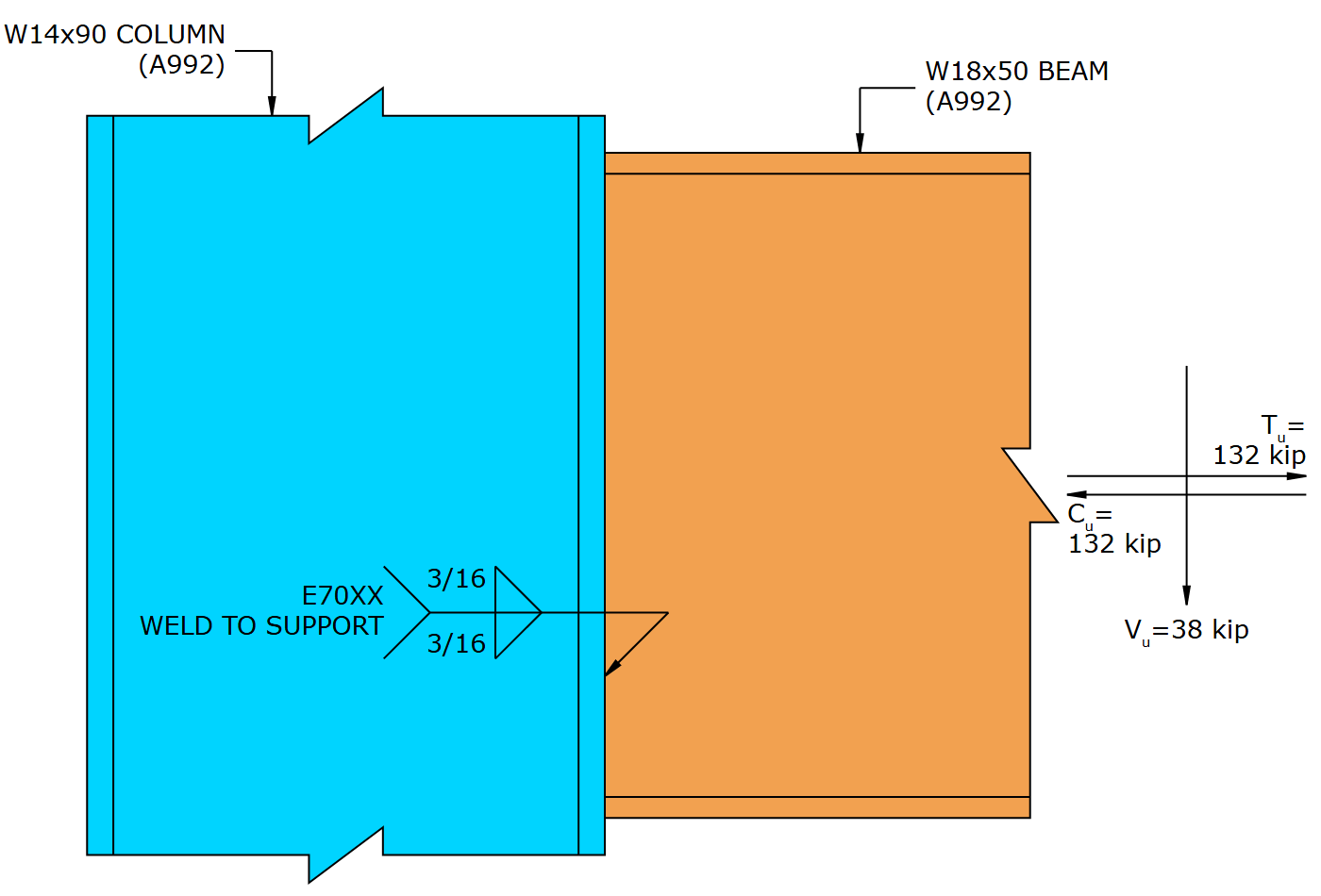
Örnek bağlantının yüksekliği, ile 38 kip kesme ve 132 kip tension or compression at the beam end.
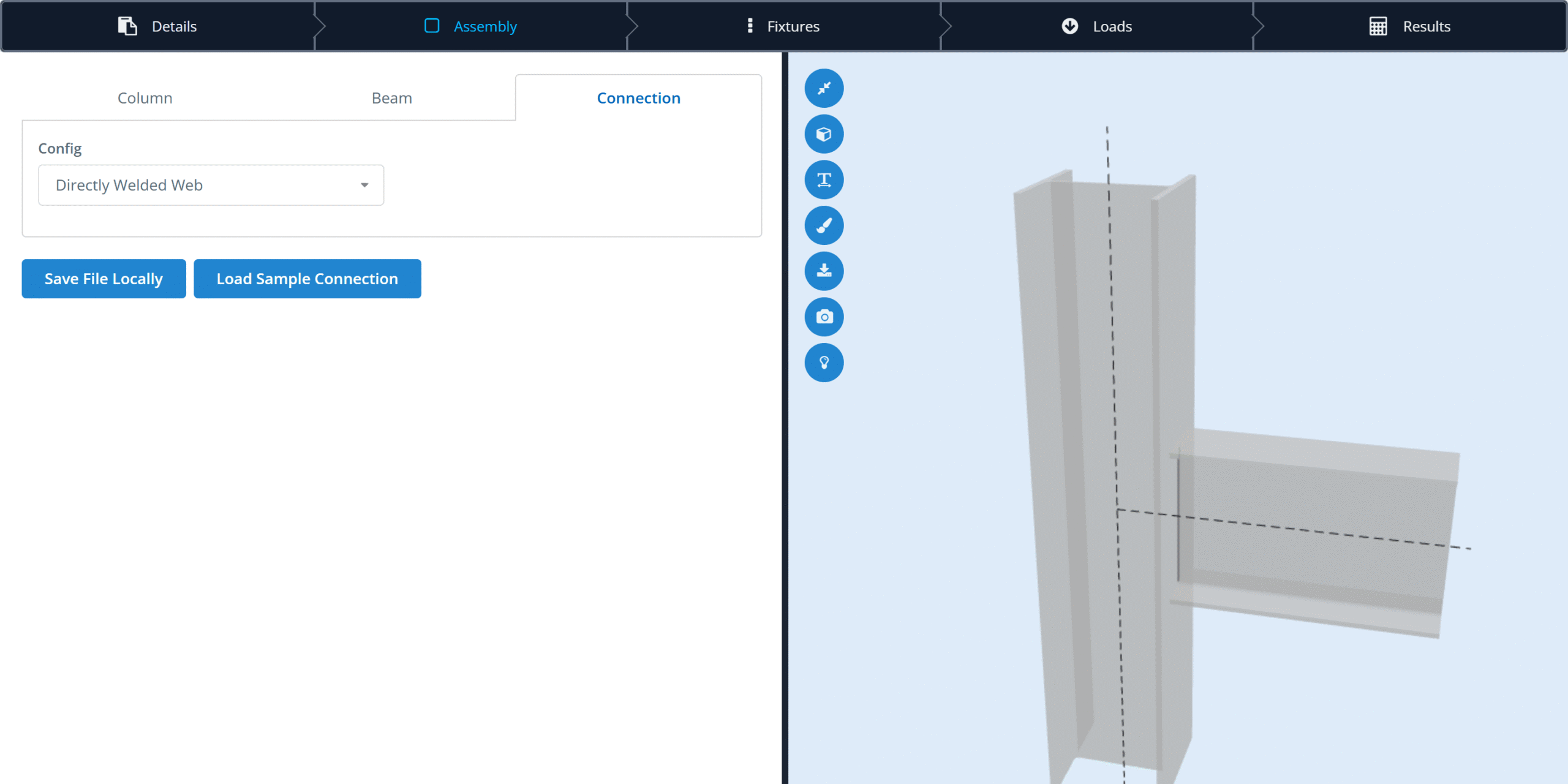
SkyCiv Bağlantı Tasarımında da aynı bağlantı, Montaj sekmesinde Doğrudan Kaynaklı Web yapılandırması ile.
Directly welded web shear and axial design: bir bakışta adımlar
- Minimum köşe kaynağı boyutunu kontrol edin.
- Check the welds for the resultant of the shear and the axial force.
- Kiriş ağını kesme durumunda kontrol edin.
- Check the column for the axial tension: flange local bending and web local yielding.
- Check the column for the axial compression: web local crippling and web local yielding.
Bu örnek için tasarım girdileri
Tasarım kodu AISC'dir 360-16 LRFD. Bölüm özellikleri AISC Kılavuzundan alınmıştır. Sütunun kde'leri, web yerel veriminde kullanılır, dır-dir 1.31 içinde.
| Kalem | Sembol | Değer |
|---|---|---|
| Faktoringli kesme | [mathin] V_{u} [mathin] | 38 kip |
| Faktörlü eksenel gerilim | [mathin] T_{u} [mathin] | 132 kip |
| Faktörlü eksenel sıkıştırma | [mathin] C_{u} [mathin] | 132 kip |
| Beam | Ana farkın, kiriş flanşlarının destek kolonuna bağlantısında yattığını fark edebilirsiniz., A992 | |
| Işın derinliği / ağ kalınlığı | [mathin] d_{bm},\ t_{wb} [mathin] | 18 içinde / 0.355 içinde |
| Sütun | W14x90, A992 | |
| Sütun derinliği / ağ kalınlığı | [mathin] d_{sup},\ t_{ws} [mathin] | 14 içinde / 0.44 içinde |
| Sütun flanş genişliği / kalınlık | [mathin] b_{fs},\ t_{fs} [mathin] | 14.5 içinde / 0.71 içinde |
| Sütun kodları | [mathin] k_{des} [mathin] | 1.31 içinde |
| Kiriş ve kolon verimi / çekme gerilimi | [mathin] F_{y},\ F_{u} [mathin] | 50 ksi / 65 ksi |
| Esneklik modülü | [mathin] E [mathin] | 29000 ksi |
| Kaynak | E70XX fileto, ağın her iki tarafı | |
| kaynak boyutu / length on each side | [mathin] W,\ L_{wv} [mathin] | 0.1875 içinde / 15.5 içinde |
Adım 1: Minimum köşe kaynağı boyutu (AISC 360-16 J2.2b, Tablo J2.4)
The axial force does not change this check. The thinner part joined is the 0.355 ışın ağında, so the Table J2.4 minimum is 3/16 içinde, and the weld is 3/16 içinde.
DCR = 0.1875 içinde / 0.1875 içinde = 1.000 ≤ 1.0, TAMAM MI
Adım 2: Welds under the resultant of shear and axial force (AISC 360-16 J2.4)
The base metal limit and the effective length are the same as for shear alone, half the web thickness against the column flange, and twice the weld size off each end:
[math] D_{max} = \frac{\min\left( t_{fs} F_{us},\ \frac{t_{wb}}{2} F_{ub} \right)}{3.09\ \text{kip/in}} = \frac{\min\left( (0.71\ \text{in})(65\ \text{ksi}),\ (0.1775\ \text{in})(65\ \text{ksi}) \right)}{3.09\ \text{kip/in}} = 3.7338 [math]
[math] L_{w} = 2\left[ L_{wv} – 2W \right] = 2 \times \left[ 15.5\ \text{in} – 2 \times 0.1875\ \text{in} \right] = 30.25\ \text{in} [math]
What changes is the load. The welds now carry the vertical shear along their axis and the axial force across it. The demand is the resultant of the two, at an angle to the weld axis:
[math] R_{u} = \sqrt{V_{u}^{2} + T_{u}^{2}} = \sqrt{(38\ \text{kip})^{2} + (132\ \text{kip})^{2}} = 137.36\ \text{kip} [math]
[math] \theta_{u} = \tan^{-1}\left( \frac{T_{u}}{V_{u}} \right) = \tan^{-1}\left( \frac{132}{38} \right) = 73.94^{\circ} [math]
A fillet weld loaded across its axis is stronger than one loaded along it, ve denklem. J2-5 rewards that with the directional term:
[math] \phi R_{n} = \phi\, 0.6\, F_{EXX} \frac{\sqrt{2}}{2} \min\left( W,\ \frac{D_{max}}{16} \right) \left[ 1 + 0.5 \left( \sin\theta_{u} \right)^{1.5} \right] L_{w} [math]
[math] \phi R_{n} = (0.75) \times 0.6 \times (70\ \text{ksi}) \times \frac{\sqrt{2}}{2} \times \min\left( 0.1875\ \text{in},\ \frac{3.7338}{16} \right) \times \left[ 1 + 0.5 \left( \sin 73.94^{\circ} \right)^{1.5} \right] \times (30.25\ \text{in}) = 185.84\ \text{kip} [math]
DCR = 137.36 kip / 185.84 kip = 0.739 < 1.0, TAMAM MI
Bu idari çek. The same welds are good for 126.33 kip under shear alone, so the load angle adds about 47% to their strength. The demand grows faster, Yine de, itibaren 38 kip to 137.36 kip, and the ratio rises from 0.301 -e 0.739. The tension and compression cases have the same resultant, so one weld check covers both.
Adım 3: Kesmedeki kiriş ağı (AISC 360-16 J4.2)
The beam web still carries only the 38 kesme makası, over its full depth:
[math] \phi R_{n} = \phi\, 0.6\, F_{yb}\, d_{bm}\, t_{wb} = (1) \times 0.6 \times (50\ \text{ksi}) \times (18\ \text{in})(0.355\ \text{in}) = 191.7\ \text{kip} [math]
DCR = 38 kip / 191.7 kip = 0.198 < 1.0, TAMAM MI
Adım 4: Eksenel gerilim altındaki sütun (AISC 360-16 J10.1, J10.2)
The axial tension pulls on the column flange along the line of the weld. AISC 360-16 J10 covers this as a concentrated force on the flange: flanş yerel bükme (J10.1), where it applies, ve web yerel getirisi (J10.2). Web yerel sakatlığı (J10.3) is for compressive forces only.
Flanş yerel bükme
J10.1 does not require a flange local bending check when the length of loading measured across the member flange is less than 0.15 times the flange width:
[math] 0.15\, b_{f} = 0.15\, b_{fs} = 0.15 \times (14.5\ \text{in}) = 2.175\ \text{in} [math]
The load is delivered by the beam web, so the loaded length across the column flange is the web thickness, [mathin] t_{wb} = 0.355\ \text{in} [mathin]. That is less than 2.175 içinde, so flange local bending need not be checked.
Web yerel getirisi
The force spreads through the column flange into the web over the weld length plus [mathin] 5k [mathin] (Eşitlik. J10-2):
[math] \phi R_{n} = \phi\, F_{ys}\, t_{ws} \left( 5 k_{des} + L_{wv} \right) = (1) \times (50\ \text{ksi}) \times (0.44\ \text{in}) \times \left( 5 \times 1.31\ \text{in} + 15.5\ \text{in} \right) = 485.1\ \text{kip} [math]
DCR = 132 kip / 485.1 kip = 0.272 < 1.0, TAMAM MI
Adım 5: Eksenel sıkıştırma altındaki sütun (AISC 360-16 J10.2, J10.3)
In compression the beam pushes on the column flange, so web local crippling joins web local yielding. Web yerel sakatlığı, Eşitlik. J10-4, with the weld length as the bearing length:
[math] \phi R_{n,wlc} = \phi\, 0.8\, t_{ws}^{2} \left[ 1 + 3\left( \frac{L_{wv}}{d_{sup}} \right) \left( \frac{t_{ws}}{t_{fs}} \right)^{1.5} \right] \sqrt{\frac{E F_{ys} t_{fs}}{t_{ws}}}\, Q_{f} [math]
[math] \phi R_{n,wlc} = (0.75) \times 0.8 \times (0.44\ \text{in})^{2} \left[ 1 + 3\left( \frac{15.5}{14} \right) \left( \frac{0.44}{0.71} \right)^{1.5} \right] \sqrt{\frac{(29000\ \text{ksi})(50\ \text{ksi})(0.71\ \text{in})}{0.44\ \text{in}}} \times (1) = 465.59\ \text{kip} [math]
Web local yielding is the same as in tension, 485.1 kip. The lower of the two governs:
[math] \phi R_{n} = \min\left( 465.59\ \text{kip},\ 485.1\ \text{kip} \right) = 465.59\ \text{kip} [math]
DCR = 132 kip / 465.59 kip = 0.284 < 1.0, TAMAM MI
Both column checks pass with room to spare, so this W14x90 needs no stiffeners or web doubler for these limit states.
Çeklerin özeti
| Tasarım kontrolü | Talep | Kapasite | DCR | Sonuç |
|---|---|---|---|---|
| Minimum köşe kaynağı boyutu | 0.1875 içinde | 0.1875 içinde | 1.000 | GEÇMEK |
| Welds under shear and axial force | 137.36 kip | 185.84 kip | 0.739 | GEÇMEK |
| Kesmedeki kiriş ağı | 38 kip | 191.7 kip | 0.198 | GEÇMEK |
| Eksenel gerilim altındaki kolon | 132 kip | 485.1 kip | 0.272 | GEÇMEK |
| Eksenel sıkıştırma altındaki sütun | 132 kip | 465.59 kip | 0.284 | GEÇMEK |
Every check in this directly welded web shear and axial connection design passes. bu 1.000 oran minimum köşe kaynağı boyutudur, hangisi 3/16 kaynakta tam olarak buluşuyor. Güç kontrollerinden, Kaynaklar yönetir 0.739 altında 137.36 kip resultant, aykırı 0.301 for the same welds under shear alone. The column checks for the axial force come next, with web local crippling in compression at 0.284.
Auto Design is available for the directly welded web connection with shear and axial load to a column flange. Her kontrol geçinceye kadar bağlantının tasarım değişkenlerini değiştirir, ve üyelerinizi ve yüklerinizi girildiği gibi tutar. Bkz. Otomobil Tasarımı çalıştığı tercihler için sayfa.
Bir kontrol başarısız olursa ne değiştirilmelidir?
- Kaynak gücü: lengthen the welds, increase the weld size up to the base metal limit of the half web, veya daha güçlü bir elektrot kullanın. Past that limit a larger weld adds no strength.
- Column web local yielding or crippling: a longer weld spreads the force over more of the column web and raises both strengths. Otherwise use a column with a thicker web, or add stiffeners or a web doubler.
- Flanş yerel bükme: with a directly welded web it only applies if the loaded length across the flange reaches 0.15 times the flange width.
- Minimum weld size or beam web shear: as for shear alone, meet the Table J2.4 minimum, veya daha ağır bir ışın kullanın.
Sıkça Sorulan Sorular
Why does the weld get stronger when the axial force is added?
The strength of a fillet weld depends on the direction of the load. Under pure shear the load runs along the weld, and the directional term of Eq. J2-5: 1. İle 132 kip of axial force the resultant turns to 73.94 degrees from the weld axis, and the term rises toward its maximum of 1.5 for a load at 90 derece. Here it lifts the weld strength from 126.33 kip to 185.84 kip.
Why is only one weld check reported for both tension and compression?
The axial force is 132 her iki şekilde de öp, so the resultant on the welds is the same 137.36 kip at the same angle. The sign of the axial force matters for the column, which is why the support is checked separately for tension and compression.
Why is flange local bending not checked?
J10.1 only requires it when the force is spread across a meaningful width of the column flange. Here the force comes in through a 0.355 ışın ağında, which is much less than 0.15 çarpı 14.5 flanş genişliğinde, 2.175 içinde, so J10.1 does not require the check.
Why is web local crippling checked only in compression?
Web local crippling is the buckling of the column web under a compressive force pushed through the flange. A tensile force pulls the web straight, so J10.3 applies to compressive forces only, while web local yielding applies to both.
LRFD yerine AISC ASD için bu nasıl değişir??
Sınır durumları ve nominal güçler aynıdır. AISC ASD ile servis seviyesi kuvvetlerini, güvenlik faktörüne bölünen nominal güçle karşılaştırırsınız: 0.75 for the welds and for web local crippling becomes a safety factor of 2.00, ve 1.00 for web shear yielding and web local yielding becomes 1.50.
Ücretsiz olarak doğrudan kaynaklı bir web bağlantısı tasarlayın
Bu sayfadaki her sayı tek bir çözümden gelir. Pick the directly welded web configuration with shear and axial load, ışınına gir, destek, weld and forces, ve ücretsiz hesap makinesi, herhangi bir kurulum gerektirmeden bu kontrollerin her birini tarayıcınızda çalıştırır.
SkyCiv Bağlantı Tasarımı modülü, bu örneğin arkasındaki bağlantı tasarımı yazılımıdır. Size her denklem ve içindeki sayılarla birlikte tam hesaplama raporu verir., yukarıdaki adımlar gibi, artı her kapasite ve DCR, AISC Bağlantı ve Taban Plakası Tasarımı 360-22 ve AISC 360-16 (LRFD ve ASD) ve AS 4100:2020. bu kaynak hesaplayıcı köşe kaynak gruplarını tek başına kapsar.
Referanslar
- AISC 360-16, Kullanıcı iş akışını basitleştirmek ve hızlandırmak için UI İyileştirmeleri: J2.2b (Tablo J2.4), J2.4 (Eşitlik. J2-4, J2-5), J4.2 (Eşitlik. J4-3), J10.1, J10.2 (Eşitlik. J10-2), J10.3 (Eşitlik. J10-4).
- AISC Çelik Konstrüksiyon Kılavuzu, 15th Baskı: Bölüm 9 (Eşitlik. 9-2), Bölüm 10 (Etkili kaynak uzunluğu).
- AISC kullanarak çelik bağlantıların tasarımı 360-16
- Otomobil Tasarımı SkyCiv Bağlantı Tasarımında

Harold Munalem
Ürün Müdürü, Bağlantı Tasarımı
10+ çelik bağlantı tasarımında yıllar
LinkedIn
