
When a directly welded web connection carries an axial force as well as the end shear, two things change in the design to AISC 360. The welds now see a resultant force at an angle to their axis, which is larger than the shear alone but also earns the directional strength increase of Eq. J2-5. And the axial force is delivered to the column flange as a concentrated force, so the column has to be checked for flange local bending, web local yielding and, 圧縮中, web local crippling.
This page works the same connection as the shear-only directly welded web example, a W18x50 beam web welded to the flange of a W14x90 column with 3/16 E70XX すみ肉溶接で 15.5 in long on both sides of the web, and adds an axial force of 132 kip in tension or compression to the 38 kip end shear (LRFD). デザインはAISCへ 360-16 およびAISCマニュアル第15版. すべての方程式は数値とともに書き出されます, 計算シートと同じ順序で、 SkyCiv Connection Design モジュールはこの接続用に生成します.
What the axial force adds to a directly welded web connection
A beam in a braced frame or a diaphragm chord often carries an axial force along with its end reaction, for example as a strut or collector. With a directly welded web, that force has no plate or bolts to pass through: it goes straight from the web into the two fillet welds and from them into the column flange.
The member sizes, weld and the checks of the minimum weld size and the beam web in shear are the same as in the shear-only example, and give the same results. This page focuses on the weld under combined load and on the two support checks the axial force adds. The other shear connection types are on the せん断接続 ページ.
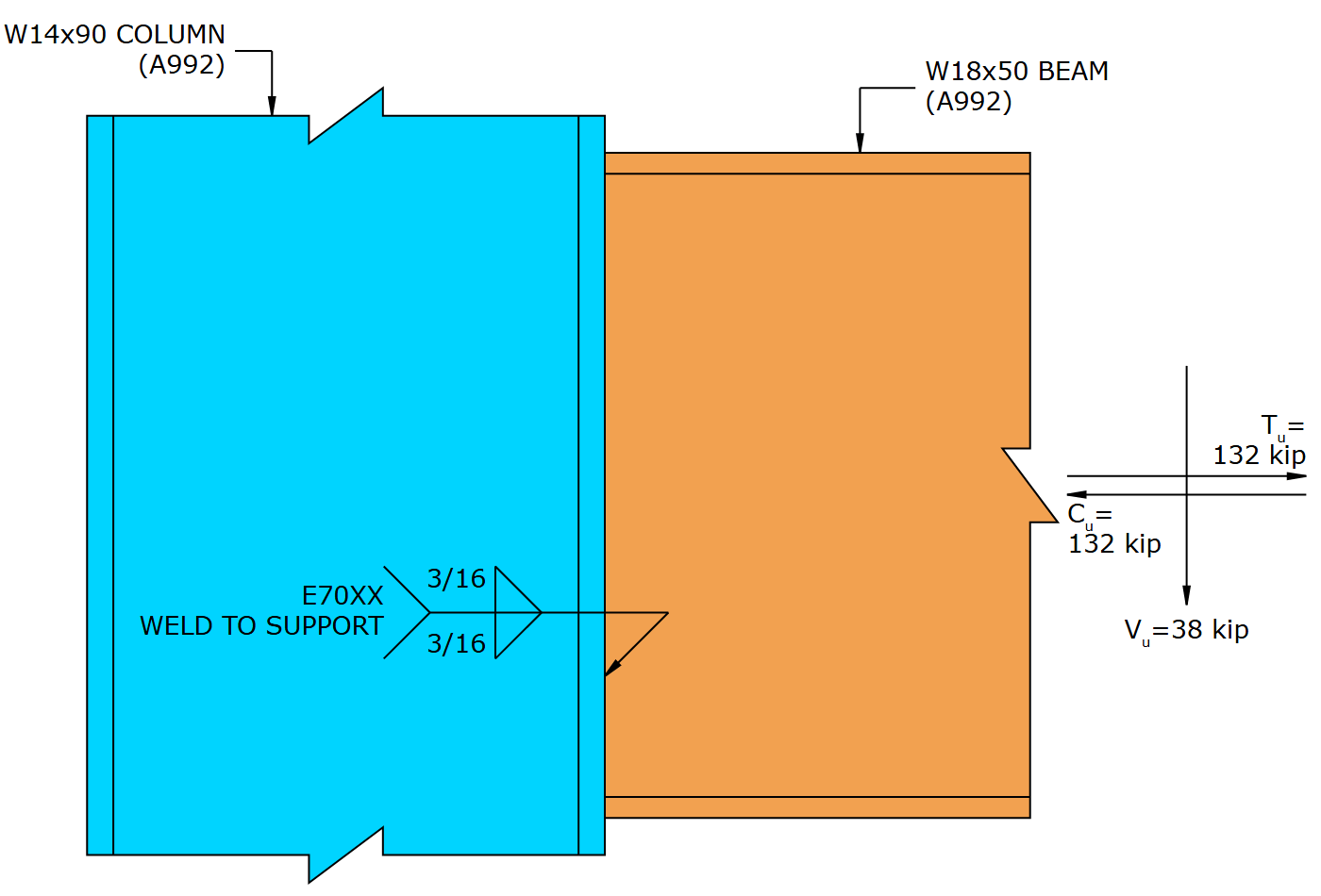
接続例の立面図, とともに 38 キップ・シアーと 132 kip tension or compression at the beam end.
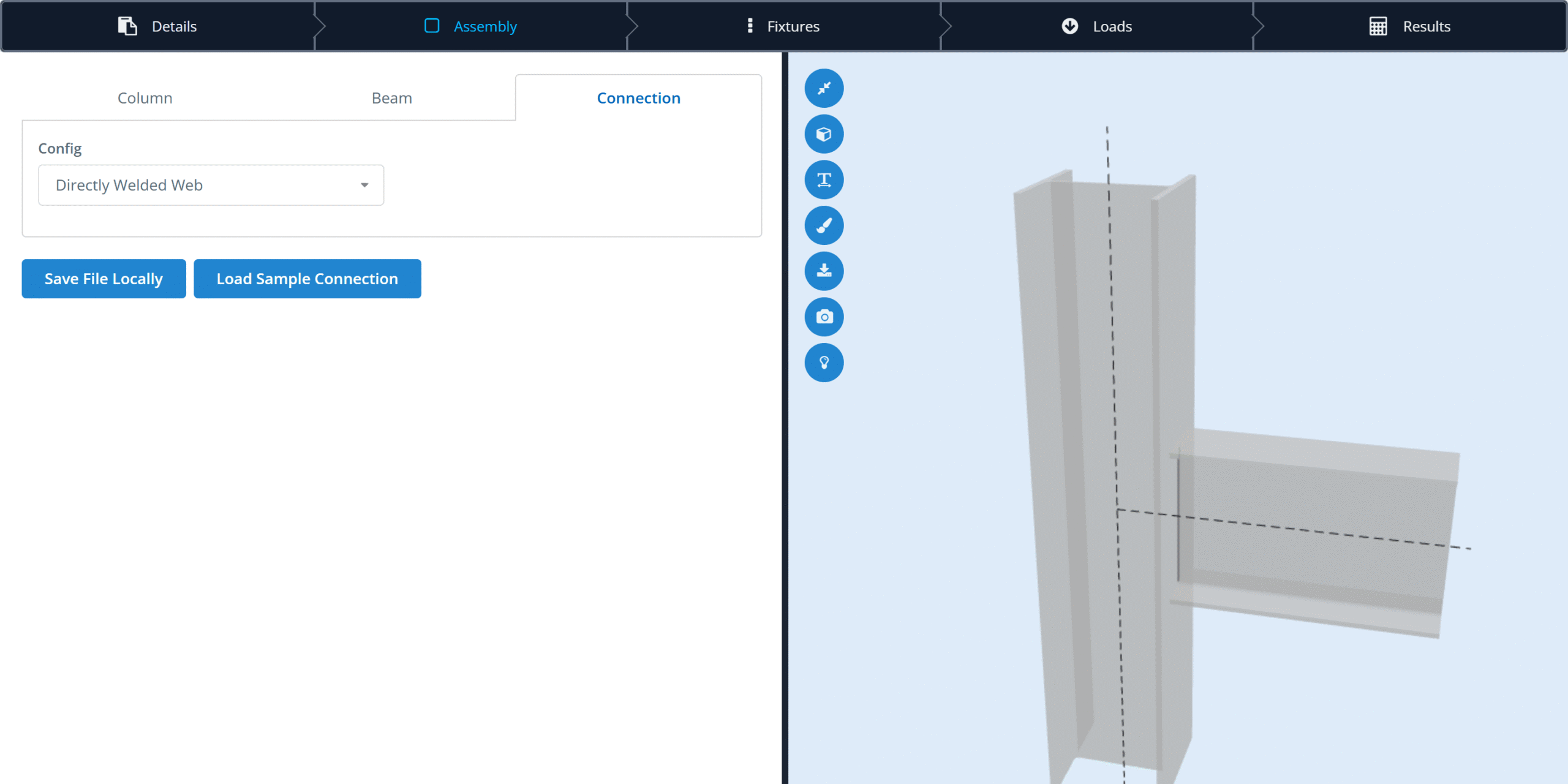
SkyCiv 接続設計での同じ接続, 「アセンブリ」タブの「直接溶接」Web 構成を使用.
Directly welded web shear and axial design: 一目でわかる手順
- 最小すみ肉溶接サイズを確認してください.
- Check the welds for the resultant of the shear and the axial force.
- せん断状態のビームウェブをチェックする.
- Check the column for the axial tension: flange local bending and web local yielding.
- Check the column for the axial compression: web local crippling and web local yielding.
この例の設計入力
設計コードはAISCです 360-16 LRFD. セクションのプロパティは AISC マニュアルからのものです. 列の kdes, Web ローカルの生成で使用される, です 1.31 に.
| アイテム | シンボル | 値 |
|---|---|---|
| 因数分解せん断 | [mathin] V_{u} [mathin] | 38 kip |
| 因数分解された軸張力 | [mathin] T_{u} [mathin] | 132 kip |
| 因数分解された軸圧縮 | [mathin] C_{u} [mathin] | 132 kip |
| Beam | W18x50, A992 | |
| ビーム深さ / ウェブの厚さ | [mathin] d_{bm},\ t_{wb} [mathin] | 18 に / 0.355 に |
| カラム | デッドロードからの反応, A992 | |
| 柱の深さ / ウェブの厚さ | [mathin] d_{sup},\ t_{ws} [mathin] | 14 に / 0.44 に |
| 柱フランジ幅 / 厚さ | [mathin] b_{fs},\ t_{fs} [mathin] | 14.5 に / 0.71 に |
| 列 kdes | [mathin] k_{des} [mathin] | 1.31 に |
| ビームとコラムの収量 / 引張応力 | [mathin] F_{y},\ F_{u} [mathin] | 50 KSI / 65 KSI |
| 弾性率 | [mathin] E [mathin] | 29000 KSI |
| 溶接 | E70XX fillet, ウェブの両側 | |
| 溶接サイズ / length on each side | [mathin] W,\ L_{wv} [mathin] | 0.1875 に / 15.5 に |
ステップ 1: 最小すみ肉溶接サイズ (AISC 360-16 J2.2b, 表 J2.4)
The axial force does not change this check. The thinner part joined is the 0.355 ビームウェブ内, so the Table J2.4 minimum is 3/16 に, and the weld is 3/16 に.
DCR = 0.1875 に / 0.1875 =で 1.000 ≤ 1.0, わかった
ステップ 2: Welds under the resultant of shear and axial force (AISC 360-16 J2.4)
The base metal limit and the effective length are the same as for shear alone, half the web thickness against the column flange, and twice the weld size off each end:
[math] D_{max} = \frac{\min\left( t_{fs} F_{us},\ \frac{t_{wb}}{2} F_{ub} \right)}{3.09\ \text{kip/in}} = \frac{\min\left( (0.71\ \text{in})(65\ \text{ksi}),\ (0.1775\ \text{in})(65\ \text{ksi}) \right)}{3.09\ \text{kip/in}} = 3.7338 [math]
[math] L_{w} = 2\left[ L_{wv} – 2W \right] = 2 \times \left[ 15.5\ \text{in} – 2 \times 0.1875\ \text{in} \right] = 30.25\ \text{in} [math]
What changes is the load. The welds now carry the vertical shear along their axis and the axial force across it. The demand is the resultant of the two, at an angle to the weld axis:
[math] R_{u} = \sqrt{V_{u}^{2} + T_{u}^{2}} = \sqrt{(38\ \text{kip})^{2} + (132\ \text{kip})^{2}} = 137.36\ \text{kip} [math]
[math] \theta_{u} = \tan^{-1}\left( \frac{T_{u}}{V_{u}} \right) = \tan^{-1}\left( \frac{132}{38} \right) = 73.94^{\circ} [math]
A fillet weld loaded across its axis is stronger than one loaded along it, と等価. J2-5 rewards that with the directional term:
[math] \phi R_{n} = \phi\, 0.6\, F_{EXX} \frac{\sqrt{2}}{2} \min\left( W,\ \frac{D_{max}}{16} \right) \left[ 1 + 0.5 \left( \sin\theta_{u} \right)^{1.5} \right] L_{w} [math]
[math] \phi R_{n} = (0.75) \times 0.6 \times (70\ \text{ksi}) \times \frac{\sqrt{2}}{2} \times \min\left( 0.1875\ \text{in},\ \frac{3.7338}{16} \right) \times \left[ 1 + 0.5 \left( \sin 73.94^{\circ} \right)^{1.5} \right] \times (30.25\ \text{in}) = 185.84\ \text{kip} [math]
DCR = 137.36 kip / 185.84 キップ = 0.739 < 1.0, わかった
これは統治小切手です. The same welds are good for 126.33 kip under shear alone, so the load angle adds about 47% to their strength. The demand grows faster, けれど, から 38 kip to 137.36 kip, and the ratio rises from 0.301 に 0.739. The tension and compression cases have the same resultant, so one weld check covers both.
ステップ 3: せん断中のビームウェブ (AISC 360-16 J4.2)
The beam web still carries only the 38 キップせん断, over its full depth:
[math] \phi R_{n} = \phi\, 0.6\, F_{yb}\, d_{bm}\, t_{wb} = (1) \times 0.6 \times (50\ \text{ksi}) \times (18\ \text{in})(0.355\ \text{in}) = 191.7\ \text{kip} [math]
DCR = 38 kip / 191.7 キップ = 0.198 < 1.0, わかった
ステップ 4: 軸張力を受ける柱 (AISC 360-16 J10.1, J10.2)
The axial tension pulls on the column flange along the line of the weld. AISC 360-16 J10 covers this as a concentrated force on the flange: フランジの局部曲げ (J10.1), where it applies, および Web ローカル イールド (J10.2). Web ローカルの機能不全 (J10.3) is for compressive forces only.
フランジの局部曲げ
J10.1 does not require a flange local bending check when the length of loading measured across the member flange is less than 0.15 times the flange width:
[math] 0.15\, b_{f} = 0.15\, b_{fs} = 0.15 \times (14.5\ \text{in}) = 2.175\ \text{in} [math]
The load is delivered by the beam web, so the loaded length across the column flange is the web thickness, [mathin] t_{wb} = 0.355\ \text{in} [mathin]. That is less than 2.175 に, so flange local bending need not be checked.
Web ローカル譲歩
The force spreads through the column flange into the web over the weld length plus [mathin] 5k [mathin] (Eq. J10-2):
[math] \phi R_{n} = \phi\, F_{ys}\, t_{ws} \left( 5 k_{des} + L_{wv} \right) = (1) \times (50\ \text{ksi}) \times (0.44\ \text{in}) \times \left( 5 \times 1.31\ \text{in} + 15.5\ \text{in} \right) = 485.1\ \text{kip} [math]
DCR = 132 kip / 485.1 キップ = 0.272 < 1.0, わかった
ステップ 5: 軸方向圧縮を受ける柱 (AISC 360-16 J10.2, J10.3)
In compression the beam pushes on the column flange, so web local crippling joins web local yielding. Web ローカルの機能不全, Eq. J10-4, with the weld length as the bearing length:
[math] \phi R_{n,wlc} = \phi\, 0.8\, t_{ws}^{2} \left[ 1 + 3\left( \frac{L_{wv}}{d_{sup}} \right) \left( \frac{t_{ws}}{t_{fs}} \right)^{1.5} \right] \sqrt{\frac{E F_{ys} t_{fs}}{t_{ws}}}\, Q_{f} [math]
[math] \phi R_{n,wlc} = (0.75) \times 0.8 \times (0.44\ \text{in})^{2} \left[ 1 + 3\left( \frac{15.5}{14} \right) \left( \frac{0.44}{0.71} \right)^{1.5} \right] \sqrt{\frac{(29000\ \text{ksi})(50\ \text{ksi})(0.71\ \text{in})}{0.44\ \text{in}}} \times (1) = 465.59\ \text{kip} [math]
Web local yielding is the same as in tension, 485.1 kip. The lower of the two governs:
[math] \phi R_{n} = \min\left( 465.59\ \text{kip},\ 485.1\ \text{kip} \right) = 465.59\ \text{kip} [math]
DCR = 132 kip / 465.59 キップ = 0.284 < 1.0, わかった
Both column checks pass with room to spare, so this W14x90 needs no stiffeners or web doubler for these limit states.
チェックの概要
| デザインチェック | 要求する | SkyCiv Foundationには、オーストラリア規格に準拠した孤立した基礎の設計が含まれています¹ | DCR | 結果 |
|---|---|---|---|---|
| 最小すみ肉溶接サイズ | 0.1875 に | 0.1875 に | 1.000 | 合格 |
| Welds under shear and axial force | 137.36 kip | 185.84 kip | 0.739 | 合格 |
| せん断中のビームウェブ | 38 kip | 191.7 kip | 0.198 | 合格 |
| 軸方向の張力がかかる柱 | 132 kip | 485.1 kip | 0.272 | 合格 |
| 軸圧縮を受けるコラム | 132 kip | 465.59 kip | 0.284 | 合格 |
Every check in this directly welded web shear and axial connection design passes. 1.000 比率は最小すみ肉溶接サイズです, 需要-容量比またはDCRで 3/16 溶接では正確に一致します. 強度チェックのうち, 溶接が支配するのは 0.739 下 137.36 kip resultant, に対して 0.301 for the same welds under shear alone. The column checks for the axial force come next, with web local crippling in compression at 0.284.
Auto Design is available for the directly welded web connection with shear and axial load to a column flange. すべてのチェックに合格するまで接続の設計変数を変更します, メンバーとロードを入力どおりに維持します. を参照してください オートデザイン 動作設定のページ.
チェックが失敗した場合に何を変更するか
- 溶接強度: lengthen the welds, increase the weld size up to the base metal limit of the half web, またはより強力な電極を使用する. Past that limit a larger weld adds no strength.
- Column web local yielding or crippling: a longer weld spreads the force over more of the column web and raises both strengths. Otherwise use a column with a thicker web, or add stiffeners or a web doubler.
- フランジの局部曲げ: with a directly welded web it only applies if the loaded length across the flange reaches 0.15 times the flange width.
- Minimum weld size or beam web shear: as for shear alone, meet the Table J2.4 minimum, またはより重いビームを使用する.
よくある質問
Why does the weld get stronger when the axial force is added?
The strength of a fillet weld depends on the direction of the load. Under pure shear the load runs along the weld, and the directional term of Eq. J2-5は 1. と 132 kip of axial force the resultant turns to 73.94 degrees from the weld axis, and the term rises toward its maximum of 1.5 for a load at 90 度. Here it lifts the weld strength from 126.33 kip to 185.84 kip.
Why is only one weld check reported for both tension and compression?
The axial force is 132 どちらにしてもキップ, so the resultant on the welds is the same 137.36 kip at the same angle. The sign of the axial force matters for the column, which is why the support is checked separately for tension and compression.
Why is flange local bending not checked?
J10.1 only requires it when the force is spread across a meaningful width of the column flange. Here the force comes in through a 0.355 ビームウェブ内, which is much less than 0.15 倍 14.5 フランジ幅で, 2.175 に, so J10.1 does not require the check.
Why is web local crippling checked only in compression?
Web local crippling is the buckling of the column web under a compressive force pushed through the flange. A tensile force pulls the web straight, so J10.3 applies to compressive forces only, while web local yielding applies to both.
LRFD ではなく AISC ASD の場合、これはどう変わるでしょうか?
限界状態と公称強度は同じです. AISC ASD を使用すると、サービスレベルの力を安全係数で割った公称強度と比較します。: 0.75 for the welds and for web local crippling becomes a safety factor of 2.00, と 1.00 for web shear yielding and web local yielding becomes 1.50.
直接溶接された Web 接続を無料で設計する
このページのすべての数字は 1 つの解決策から得られます. Pick the directly welded web configuration with shear and axial load, ビームを入力してください, サポート, weld and forces, 無料の計算機は、何もインストールせずにブラウザでこれらのチェックを実行します。.
SkyCiv 接続設計モジュールは、この例の背後にある接続設計ソフトウェアです. すべての方程式とその中の数値を含む完全な計算レポートが提供されます。, 上記の手順のように, すべての容量と DCR に加えて, AISC 360-22 およびAISC 360-16 (LRFDとASD) およびAS 4100:2020. 溶接計算機 すみ肉溶接グループを単独でカバーします.
参考文献
- AISC 360-16, 構造用鋼製建物の仕様: J2.2b (表 J2.4), J2.4 (Eq. J2-4, J2-5), J4.2 (Eq. J4-3), J10.1, J10.2 (Eq. J10-2), J10.3 (Eq. J10-4).
- AISC 鋼構造マニュアル, 15第版: 部 9 (Eq. 9-2), 部 10 (有効な溶接長).
- AISC を使用した鋼製接合の設計 360-16
- オートデザイン SkyCiv 接続設計

ハロルド・ムナレム
プロダクトマネージャー, 接続設計
10+ 鋼製接続設計に長年携わる
LinkedIn
