
A fillet weld group is the set of welds that join one part to another, for example the C-shaped weld around the leg of an angle on a beam web. When the load does not pass through the centroid of the group, the welds also resist a moment, and the strength of the group depends on its shape, the load direction and the eccentricity. AISC 360-16 Section J2.4 gives the strength of fillet welds, and the AISC Manual Part 8 turns it into the instantaneous center of rotation method for weld groups. This article explains how SkyCiv Connection Design applies that method and works it with the numbers from a real double angle connection.
What is the capacity of a fillet weld group?
A single fillet weld is strongest when it is loaded across its length and weakest when it is loaded along it: AISC 360-16 J2.4 increases the strength of a weld element by [mathin] 1.0 + 0.5\sin^{1.5}\theta [mathin], όπου [mathin] \theta [mathin] is the angle between the load and the weld axis. A weld group under an eccentric load rotates about a point called the instantaneous center (IC). Each short piece of weld moves at right angles to the line joining it to the IC, by an amount proportional to its distance, and resists with a force that follows the weld’s load and deformation curve. The group’s strength is the load at which the most strained piece reaches its deformation limit.
The weld group check governs where welds carry an eccentric load: angles and plates welded to a beam web, brackets, and welded legs of shear connections. It matters most when the load is large compared with the weld length or acts far from the weld group, and when the load has an axial part, because the direction of the resultant then changes how much each weld piece can carry. The base metal next to the weld can also limit the weld size that is worth using, so the check comes with a base metal limit.
The equations SkyCiv uses
For an eccentric weld group, the AISC Manual Part 8 writes the design strength as:
[math] \phi R_{n} = \phi C C_{1} D l \quad \text{(Manual Eq. 8-21)} [math]
όπου:
- [mathin] \phi = 0.75 [mathin] είναι ο παράγοντας αντίστασης (LRFD)
- [mathin] C [mathin] is the weld group coefficient, in kip/in per sixteenth of an inch of weld size, from the instantaneous center method
- [mathin] C_{1} [mathin] is the electrode strength coefficient, 1 για E70XX (Χειροκίνητος πίνακας 8-3)
- [mathin] D [mathin] is the weld size in sixteenths of an inch, limited to [mathin] D_{max} [mathin] for the base metal
- [mathin] l [mathin] is the length of the vertical weld
SkyCiv finds the IC by iteration. It splits the welds into short segments, works out each segment’s reaction from the Manual’s load and deformation relationship, and moves the IC until the segment reactions balance the applied load. [mathin] C [mathin] is the resulting group strength divided by [mathin] D l [mathin]. The base metal limit on the weld size is:
[math] D_{max} = \frac{\min\left( t_{a} F_{ua},\ d_{ct} F_{ub} \right)}{3.09\ \text{kip/in} \times F_{EXX}/F_{E70XX}} \quad \text{(Manual Eq. 9-2)} [math]
με [mathin] t_{a} [mathin] και [mathin] F_{ua} [mathin] for the angle, και [mathin] d_{ct} [mathin] και [mathin] F_{ub} [mathin] για τον ιστό της δοκού.
SkyCiv uses the instantaneous center method for eccentrically loaded weld groups such as the C-shaped angle weld below. Other welds in the software use simpler methods: straight welds loaded directly, such as a directly welded beam web, χρησιμοποιήστε το AISC 360-16 Εξ. J2-4 with the [mathin] 1.0 + 0.5\sin^{1.5}\theta [mathin] increase, and the welds of a double angle to its support use the elastic method of Manual Part 10, Εξ. 10-1ένα.
Δουλευμένο παράδειγμα: double angle welded to a beam web
This example is Check 2 Αγοράστε το μοντέλο φόρτωσης τώρα double angle shear and axial connection design example: δύο 5/8 in angles, 12 σε μακρύ, welded to the web of a W18x50 beam with 3/16 in E70XX fillet welds on three sides, and bolted to a W14x90 column flange. The connection carries [mathin] V_{u} = 38\ \text{kip} [mathin] shear and 132 kip axial tension or compression. Επιλύθηκε ξανά στην τρέχουσα έκδοση και οι αριθμοί είναι οι ίδιοι όπως στο δημοσιευμένο παράδειγμα.
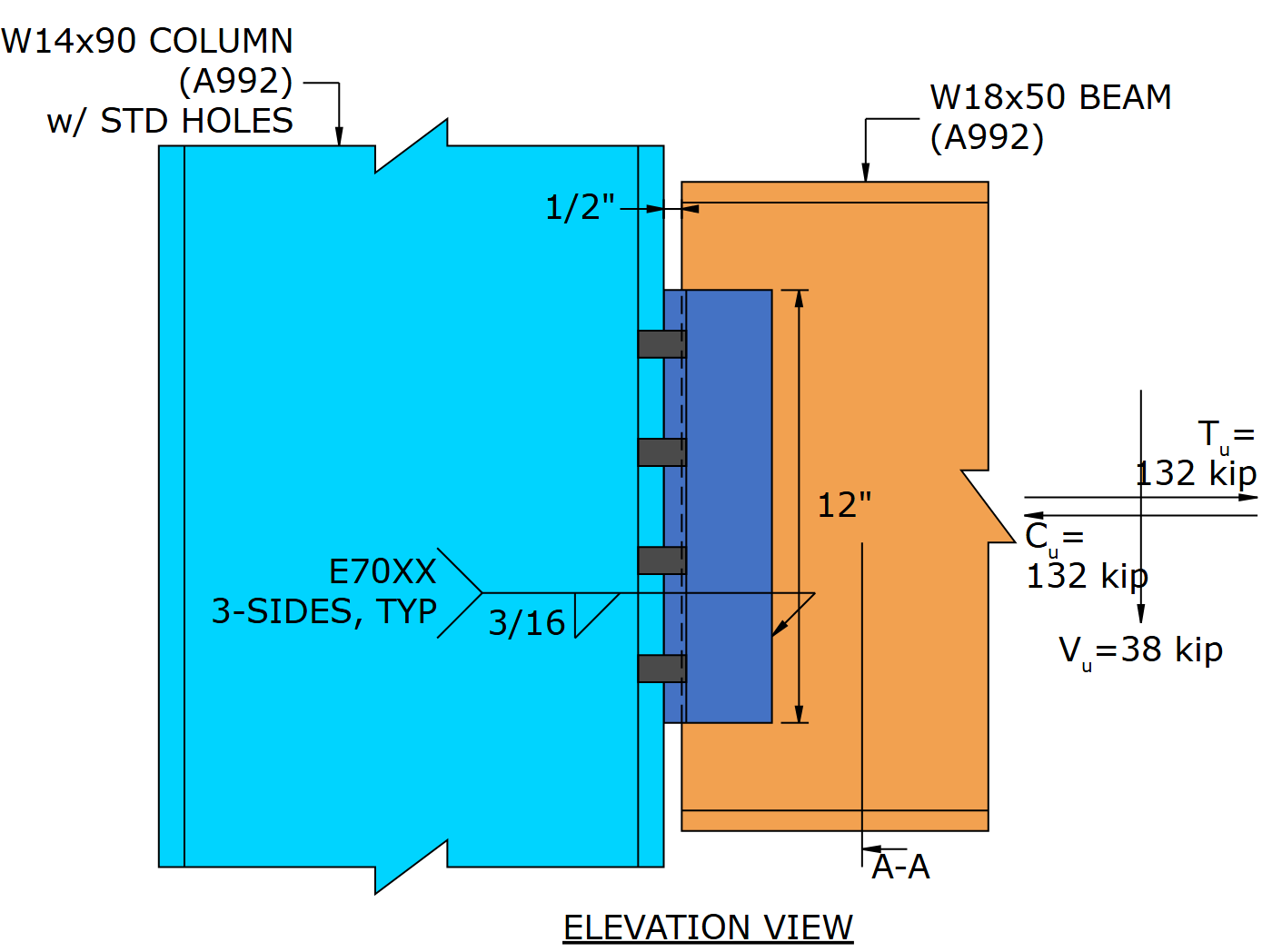
Ανύψωση. Each angle is welded to the beam web along its 12 in length and across its top and bottom, a C-shaped weld group on each side of the web.
Load on the welds
The welds carry the resultant of the shear and the axial force:
[math] R_{u} = \sqrt{38^{2} + 132^{2}} = 137.36\ \text{kip} [math]
Base metal limit
Οι γωνίες είναι 0.625 σε παχιά. The beam web is welded on both faces, so each weld is checked against half the 0.355 στον ιστό, [mathin] d_{ct} = 0.1775\ \text{in} [mathin]. Και τα δύο είναι [mathin] F_{u} = 65\ \text{ksi} [mathin]:
[math] D_{max} = \frac{\min\left( 0.625 \times 65,\ 0.1775 \times 65 \right)}{3.09 \times 1} = 3.7338 [math]
Το 3/16 σε συγκόλληση, [mathin] D = 3 [mathin], is below this limit, οπότε το πλήρες μέγεθος συγκόλλησης μετράει.
Συντελεστής ομάδας συγκόλλησης
Each weld group has a vertical length [mathin] L = 12\ \text{in} [mathin] and horizontal returns [mathin] kL = 2.5\ \text{in} [mathin], with an eccentricity [mathin] e = 2.6324\ \text{in} [mathin]. The report splits the group into 90 τμήματα, 30 along the vertical weld and 30 along each return. The iteration puts the IC at:
[math] x_{ic} = -1.2142\ \text{in}, \quad y_{ic} = 13.581\ \text{in} [math]
The segment reactions add up to [mathin] \Sigma r_{ux} = 109.68\ \text{kip} [mathin] και [mathin] \Sigma r_{uy} = 31.57\ \text{kip} [mathin], with a moment about the IC of [mathin] \Sigma M_{ru,ic} = 80.38\ \text{kip-ft} [mathin]. The ratio of the two sums is the same as 38 προς το 132, so the resultant is mostly along the beam axis, which is the direction of the axial load. Dividing the resultant of the sums by [mathin] D l = 3 \times 12 [mathin]:
[math] C = \frac{\sqrt{109.68^{2} + 31.57^{2}}}{3 \times 12} = 3.17\ \text{kip/in} [math]
Δύναμη σχεδιασμού
The two angles give two weld groups, so the length is [mathin] 2L = 24\ \text{in} [mathin]:
[math] \phi R_{n} = \phi C C_{1} D \left( 2L \right) = 0.75 \times 3.17 \times 1 \times 3 \times 24 = 171.18\ \text{kip} [math]
[math] DCR = \frac{R_{u}}{\phi R_{n}} = \frac{137.36}{171.18} = 0.80244 [math]
The weld passes with about 20% to spare. The base metal limit of [mathin] D_{max} = 3.7338 [mathin] means a 1/4 σε συγκόλληση ([mathin] D = 4 [mathin]) would only count as 3.7338 δέκατα έκτα, so the beam web, όχι η συγκόλληση, would limit a larger weld.
Πώς το αναφέρει το SkyCiv Connection Design
The weld group appears in the summary of checks as "Design Capacity of Weld at Beam Side" with a demand of 137.361 kip, a capacity of 171.18 kip and a DCR of 0.802435. The row links to the calculation, which shows the base metal limit with the numbers substituted, then a table of the weld segment coordinates, the IC location from the iteration, a table of the reactions of every segment with their sums, the coefficient [mathin] C [mathin], and finally Eq. 8-21 with the numbers in it and the PASS or FAIL result. The segment tables let you check the IC solution by hand.
Τι να αλλάξετε αν αποτύχει
- Use a longer angle or plate: a longer vertical weld raises [mathin] l [mathin] και, by reducing the relative eccentricity, also raises [mathin] C [mathin].
- Increase the weld size, but only up to [mathin] D_{max} [mathin]. Past that, the base metal governs and a bigger weld does not add strength.
- Increase the base metal: a thicker angle, or a beam with a thicker web, raises [mathin] D_{max} [mathin] and lets a larger weld count.
- Use longer returns if the detail allows: the horizontal welds help resist the moment.
- Use a stronger electrode only where the base metal is not the limit, Από [mathin] D_{max} [mathin] falls as [mathin] F_{EXX} [mathin] rises.
Συχνές ερωτήσεις
Why use the instantaneous center method instead of the elastic method?
The elastic method assumes every part of the weld stays elastic and the most stressed point governs, που είναι συντηρητικό. The instantaneous center method lets the welds redistribute load as they deform, so the whole group works together and the strength is higher for the same weld. Το μέρος του εγχειριδίου AISC 8 tables for eccentrically loaded weld groups are built on this method.
What does the weld group coefficient C mean?
[mathin] C [mathin] is the strength of the weld group per sixteenth of an inch of weld size per inch of vertical weld length. It already includes the effect of the eccentricity, the load direction and the shape of the group. Multiplying it by [mathin] \phi [mathin], [mathin] C_{1} [mathin], [mathin] D [mathin] και [mathin] l [mathin] gives the design strength. Εδώ [mathin] C = 3.17\ \text{kip/in} [mathin].
Why is the beam web only half its thickness in the base metal check?
There is a weld on each face of the web, one from each angle, and both pull on the same web. Giving each weld half of the web thickness, 0.1775 σε του 0.355 στον ιστό, accounts for the web being shared.
How does axial load change the weld check?
The welds carry the resultant of the shear and the axial force, and the direction of that resultant changes how much each weld segment can carry. In this example the 132 kip axial force is much larger than the 38 ψαλίδα, so the resultant of 137.36 kip acts mostly along the beam, and the segment reactions in the report point mostly in that direction.
Check a weld group in your own connection
Choose a welded shear connection in the δωρεάν αριθμομηχανή σχεδιασμού σύνδεσης, εισάγετε τα μέλη σας, welds and loads, and the weld group is solved by the instantaneous center method for you.
Η ενότητα SkyCiv Connection Design σάς παρέχει την πλήρη αναφορά υπολογισμού με κάθε εξίσωση και τους αριθμούς σας σε αυτήν, για AISC 360-22 και AISC 360-16 (LRFD και ASD) και ως 4100:2020. Το αριθμομηχανή συγκόλλησης covers weld groups on their own, και το αριθμομηχανή σύνδεσης διπλής γωνίας covers this connection type. The same instantaneous center approach for bolt groups is explained in Υπολογισμός ομάδας μπουλονιών με χρήση ICOR.
βιβλιογραφικές αναφορές
- AISC 360-16, Προδιαγραφές για δομικά κτίρια από χάλυβα: J2.4 (Εξ. J2-4).
- Εγχειρίδιο AISC Steel Construction, 15ου Έκδοση: Μέρος 8, eccentrically loaded weld groups (σελίδες 8-9 προς το 8-12, Εξ. 8-21, Τραπέζι 8-3); Μέρος 9 Εξ. 9-2; Μέρος 10 Εξ. 10-1ένα.
- Double angle shear and axial connection design example
- Συγκολλήσεις στο SkyCiv Connection Design

Χάρολντ Μουνάλεμ
Υπεύθυνος προϊόντων, Σχεδιασμός σύνδεσης
10+ χρόνια στο σχεδιασμό σύνδεσης χάλυβα
LinkedIn
