
This page explains the Direct Strength Method (DSM) for cold-formed steel design and how SkyCiv Section Builder calculates the DSM factors of a cold-formed section with its built-in Finite Strip Method (FSM) analyse de flambement. Conception des éléments en acier formé à froid is challenging due to the complex stability behavior of thin-walled members, and of the methods developed to address it, the DSM is the most flexible and modern approach.
The DSM predicts the strength of cold-formed members without calculating effective widths (1), a process that is often complex and limited when analyzing complex geometric shapes. The critical buckling strengths used by the method can be calculated in various ways, mainly with the Finite Strip Method (FSM) or the Finite Element Method (CINQ).
Regardez notre didacticiel sur le calcul des facteurs de la méthode de résistance directe
Quelle est la méthode de force directe (DSM)
Le Méthode de force directe (DSM) is a design approach used predominantly for the analysis and design of cold-formed steel members. Contrairement aux méthodes traditionnelles (comme la méthode de la largeur effective) qui reposent sur le calcul des propriétés de section efficaces pour tenir compte du flambement local, le DSM calcule directement la force du membre en utilisant sa force complète, propriétés transversales non réduites.
Pros and Cons of the Direct Strength Method
| Avantages | Les inconvénients |
|---|---|
| Simplifie le processus de conception: Réduit la complexité en éliminant les calculs de largeur effective. | Courbe d'apprentissage: Nécessite que les ingénieurs se familiarisent avec les nouveaux concepts et formulations. |
| Précision améliorée: Prend directement en compte les différents modes de flambement pour des prévisions précises de la résistance. | Données historiques limitées: Moins de données empiriques disponibles pour certaines applications spécifiques par rapport aux méthodes traditionnelles. |
| Application polyvalente: Convient aux sections complexes et non conventionnelles. | Dépendance logicielle: Peut nécessiter des outils logiciels avancés qui ne sont pas facilement accessibles à tous les praticiens. |
| Méthodologie unifiée: Fournit une approche cohérente pour différents comportements de flambement. | Conformité aux normes: Tous les codes régionaux ne peuvent pas encore pleinement intégrer les dispositions du DSM. |
| Facilite l’innovation: Encourage l'utilisation de nouveaux matériaux et formes grâce à son cadre adaptable. | Résistance au changement: L’inertie de l’industrie peut ralentir l’adoption alors que les praticiens s’en tiennent aux méthodes familières. |
Adoption et acceptation
Le DSM est reconnu et intégré aux principales normes de conception internationales, tel que:
- AISI S100: Spécification nord-américaine pour la conception des éléments de structure en acier formés à froid.
- AS / NZS 4600: Norme australienne/néo-zélandaise pour les structures en acier formées à froid.
DSM is also increasingly taught in universities and cold-formed design courses, and more structural analysis and design software packages are integrating it into their design modules.
Par contre, there are still obstacles to the DSM being widely adopted, since it is a relatively new method. La transition des méthodes traditionnelles nécessite une formation et une adaptation, que certains praticiens peuvent être réticents à entreprendre.
Méthode conventionnelle de bande finie
Le FSM a été créé comme une simplification du FEM. Both methods have the same theoretical background, et le FSM est aussi une méthode matricielle. En définissant les nœuds et les éléments d'une section, il est possible d'analyser n'importe quelle forme complexe, which encourages section optimization and simplifies the analysis process.
Plusieurs options, y compris des outils open source, are available to perform Finite Strip analysis. Par contre, l'intégration de ces outils avec des logiciels généraux d'analyse et de conception s'est avérée difficile en raison de leur nature complexe. SkyCiv has built a Finite Strip Method analysis tool which is fully integrated into its Section Builder Logiciel. This tool automates the calculation of DSM factors for standard and custom cold-formed sections, permettant la conception en acier DSM conformément à AISI S100, AS / NZS 4600 et d'autres normes internationales.
The FSM discretizes the section’s transverse shape into longitudinal strips (3). Cela simplifie le problème d'analyse 3D traditionnel avec 6 degrés de liberté à un problème avec 4 degrés de liberté. The strips are analyzed for different lengths, called half-wavelengths.
Utilisation des propriétés de section géométrique, le matériel, the stresses and the load condition, deux matrices globales sont construites: la matrice de rigidité élastique \(K_{e}\) et la matrice de rigidité géométrique \(K_{g}\).
Enfin, this is an eigenvalue problem, where the eigenvalues are the load factors and the eigenvectors contain the deformed shape:

Types de modes de flambage
Les cours de flambement sont organisés en trois groupes principaux, global, local and distortional, selon le type de panne.
Flambage local: Flambage impliquant une distorsion importante de la section transversale, mais cette distorsion n'inclut que la rotation, pas de traduction, au niveau des lignes de pliage internes (2).
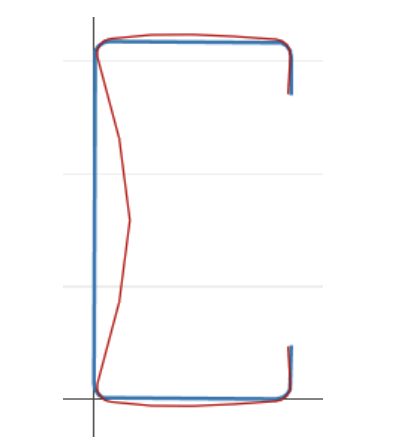
Flambage par distorsion: Flambage impliquant une distorsion importante de la section transversale, mais cette distorsion inclut la rotation et la translation au niveau d'une ou plusieurs lignes de pliage internes d'un élément (2).
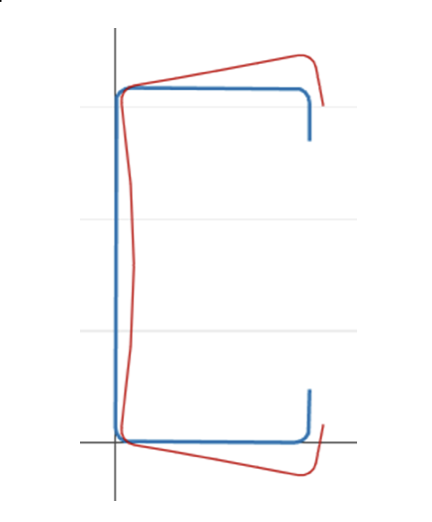
Flambage global: Flambage n’entraînant pas de distorsion de la section; centre de torsion, translation (flexion) et/ou rotation (torsion) de la section transversale entière se produit (2).
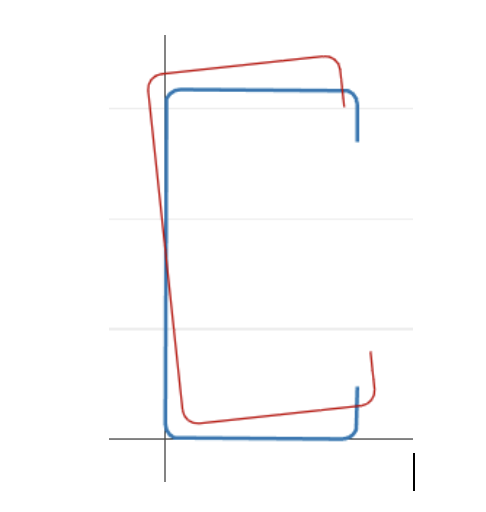
From these definitions, there is a strong geometric correlation between the buckling classification and the deformed shape, so the software shows the deformed shape for each point of the signature curve.
Facteurs DSM
Le DSM s'appuie sur des facteurs spécifiques pour tenir compte des effets des différents modes de flambement et pour calculer la résistance ultime des éléments en acier formés à froid.. These factors are tied to the member’s behavior under local, distortional and global buckling. The local and distortional factors are calculated automatically by the SkyCiv DSM calculator.
Critical Buckling Loads and Moments
Ces facteurs représentent les limites de flambement élastique de l'élément et sont utilisés pour déterminer le mode de rupture et son influence sur la résistance.:
- \(P_{cr}\): Charge de flambage globale élastique (flexion, torsional or flexural-torsional buckling). Remarque: ce facteur est calculé dans le module spécifique à la conception, for example AISI.
- \(P_{cr\ell}\): Charge critique élastique pour le flambement local.
- \(P_{crd}\): Charge critique élastique pour le flambement par distorsion.
- \(M_{cr}\): Moment critique élastique pour le flambement global en flexion. Remarque: ce facteur est calculé dans le module spécifique à la conception, for example AISI.
- \(M_{cr\ell}\): Moment critique élastique pour le flambement local en flexion.
- \(M_{crd}\): Moment critique élastique pour le flambement par distorsion en flexion.
These critical values are typically calculated from the eigenvalues of an FSM analysis or with approximate analytical formulas. Remarque: for non-symmetrical sections, the section may have different factors in the positive and negative directions, as in the SkyCiv DSM calculator shown below.
Méthode de bande finie dans SkyCiv Section Builder
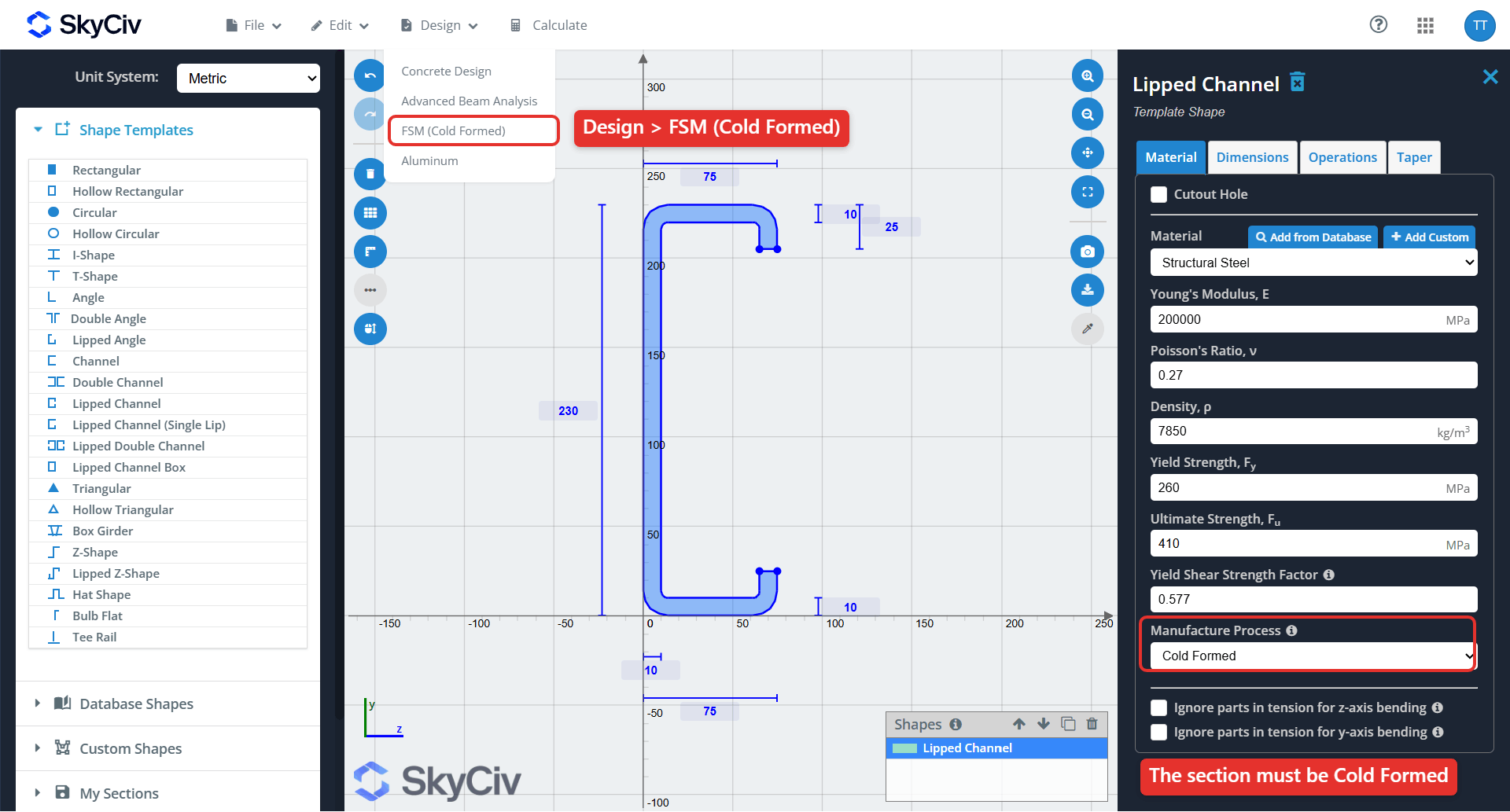
SkyCiv has a Direct Strength Method calculator built into its logiciel d'analyse de section (Section Builder de SkyCiv), which automatically calculates the key DSM factors for any custom cold-formed steel shape. Start from Section Builder by loading a cold-formed steel section and clicking Conception -> FSM (Formé à froid). De là, the DSM factors are calculated automatically, ready for you to review and submit (voir le step by step guide ci-dessous).
The local and distortional buckling minima are detected automatically, but you can override these values. Une fois soumis, the factors are used in the SkyCiv AISI S100 (2016) et AS/NZS 4600 (2018) cold-formed steel design modules.
The SkyCiv elastic buckling analysis uses the following assumptions and settings.
Maillage d'éléments
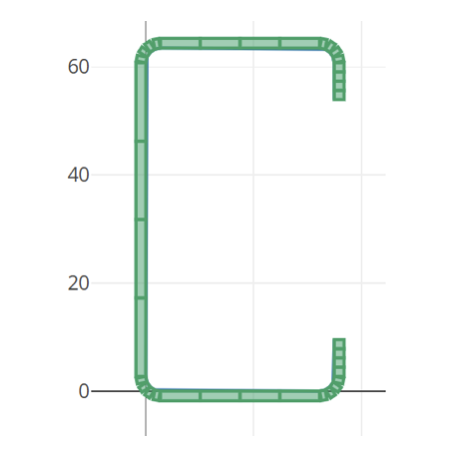
The mesh is generated automatically and can be viewed in the chart on the right. Each fillet is split into 4 éléments, and each straight segment into 4 des éléments aussi.
Longueurs d'analyse
The half-wavelengths used in the Finite Strip analysis are, par défaut, logarithmically spaced up to \(10^{3}\) in the imperial unit system and up to \(10^{3.5}\) in the metric system.
Conditions de charge
The signature curve is calculated for 5 load conditions:
- Charge axiale
- Bending moment about the X axis, positif
- Bending moment about the X axis, négatif
- Bending moment about the Y axis, positif
- Bending moment about the Y axis, négatif
Conditions aux limites
The analysis assumes the member is pinned and free to warp at both ends.
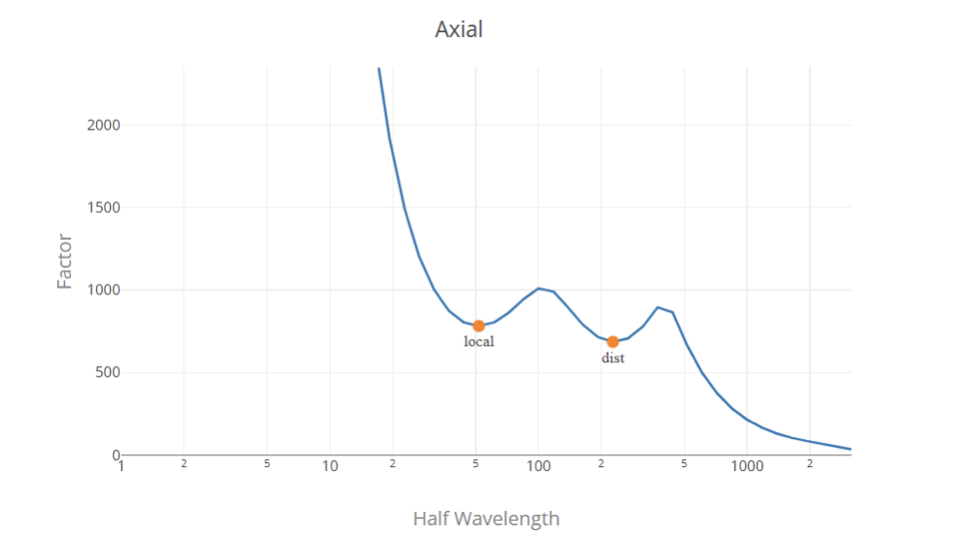
Signature curve
La courbe de signature est construite à l'aide de la méthode conventionnelle des bandes finies.. The yield stress is normalized (\(F_{y} = 1\)), so the load factors are given in stress units (MPa or ksi, according to the unit system).
Load factor selection
En général, the load factors are the local minimum points of the signature curve: the first one is the critical load factor for local buckling and the second one the critical load factor for distortional buckling. Determining the global load factor from the signature curve is difficult since it has no local minimum there. So the most appropriate solution is to use the local and distortional buckling load factors from the Finite Strip analysis, and the global buckling factor from the classical formulas.
An algorithm finds and classifies the load factors on the signature curve. Par contre, it does not guarantee a correct classification in all cases and does not replace engineering judgment: review the values and modify them if necessary before submitting.
Calculateur SkyCiv FSM: Guide étape par étape
To use the FSM calculator, open Section Builder and select the section you want to analyze. The section must meet the following requirements:
- La section doit être formée à froid (ensemble Manufacture Process à Formé à froid in the Material tab of the shape).
- The section must be an open shape from the database or one of these templates: Profilé en C, Canal à lèvres, Forme en Z, Lipped Z-Shape or Hat Shape.
- The thickness must be uniform.
To run the analysis, cliquez sur Conception, ensuite FSM (Formé à froid).
If DSM factors are already stored for the current section (as for many database sections), you are asked whether to override the previous values:

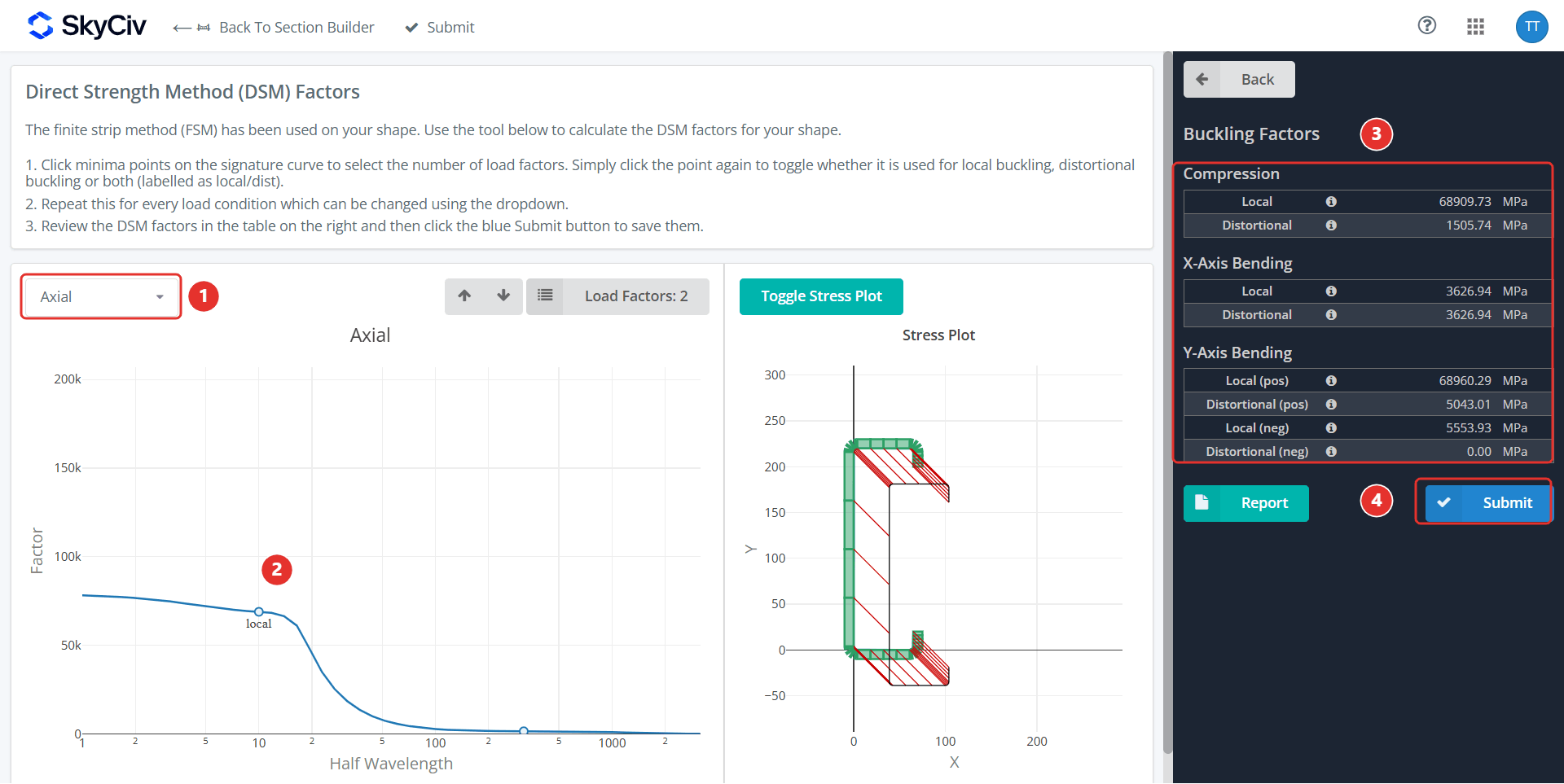
Le Méthode de force directe (DSM) Les facteurs page opens with (1) the load condition dropdown, (2) the signature curve of the selected load condition (Axial by default), l' Stress Plot of the section and (3) l' Buckling Factors table on the right, with the local and distortional factors for compression, X-axis bending and Y-axis bending (vous pouvez également accéder à nos modules de conception intégrés). Cliquez sur (4) Soumettre when the values are checked.
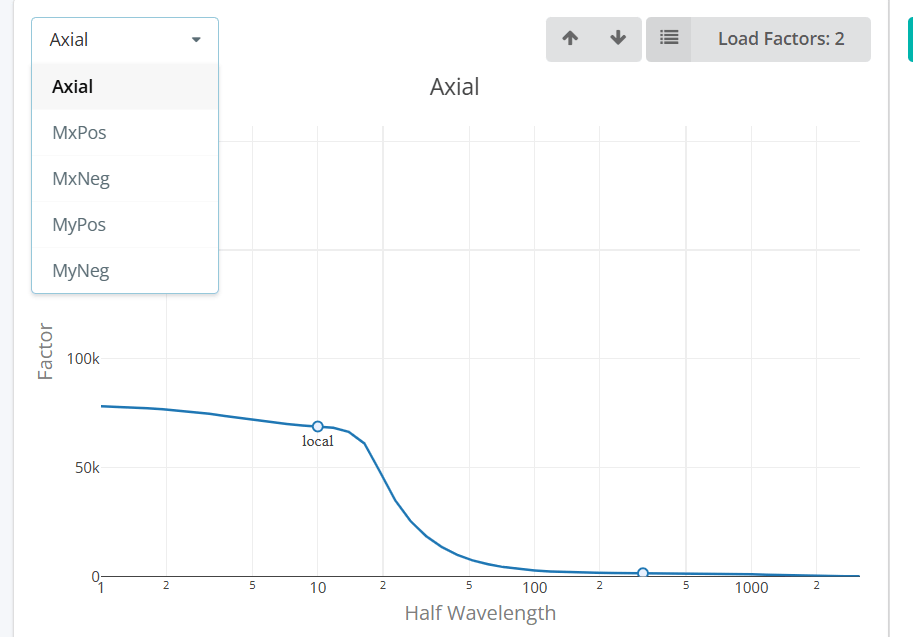
To switch between load conditions (Axial, MxPos, MxNeg, MyPos and MyNeg), use the dropdown on the left or the up and down arrow buttons next to it.
The software selects the minimum points on the curve automatically (l' Facteurs de charge button shows how many are selected). As this does not guarantee a correct classification in all cases, review the values and, si nécessaire, click a minimum point on the curve to select or deselect it, and click it again to toggle whether it is used for local buckling, distortional buckling or both (labelled local/dist). Hover the cursor over the curve to see the deformed shape at that half-wavelength in place of the stress plot, with its load factor; Toggle Stress Plot switches back to the stress distribution.
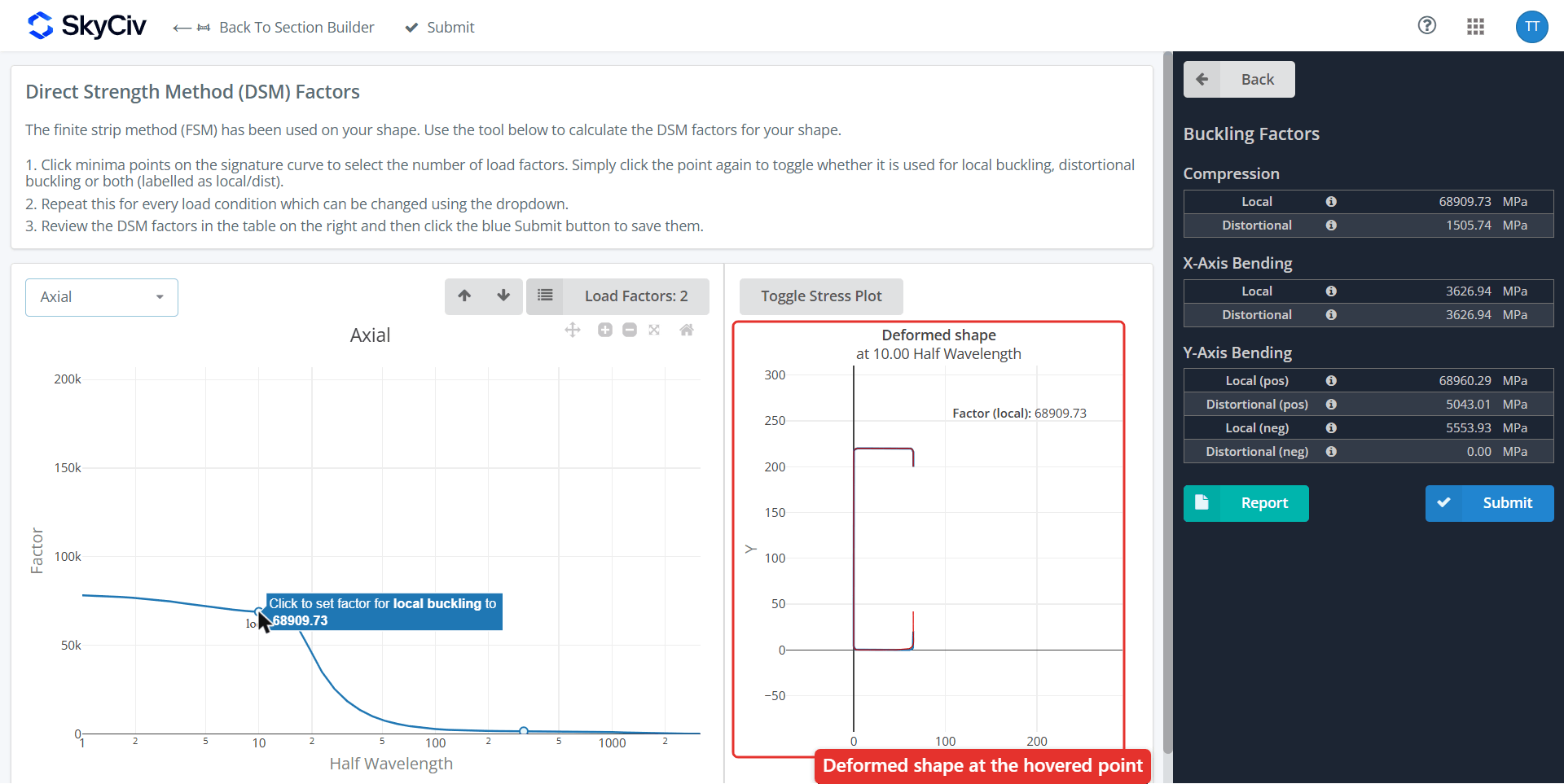
Après avoir vérifié toutes les valeurs, cliquez sur Soumettre. The values are stored with the section and used in member design to the cold-formed steel standards.

Ingénieur en structure
BEng (Civil), MEng (De construction)
Références
- Spécification nord-américaine pour la conception des éléments de structure en acier formés à froid, 2016 Édition, Institut américain du fer et de l'acier.
- Méthode de force directe (DSM) Guide de conception, 2006, Comité des spécifications pour la conception des éléments de structure en acier formés à froid.
- Analyse de flambement des éléments en acier formés à froid à l'aide du CUFSM: méthodes de bandes finies conventionnelles et contraintes, B.W.. Schäfer et S.. Adany, 2006, 18ème Conférence internationale spécialisée sur les structures en acier formées à froid.
- Logiciel de conception de membres en acier formé à froid SkyCiv
