australianas / Padrão da Nova Zelândia 4600 para estruturas de aço formadas a frio, 2018 Edição
O AS/NZS 4600:2018 module checks cold-formed steel members with the Método de Força Direta. It runs in SkyCiv Structural 3D and supports custom restraints along each member.
Para o 2005 edition, Vejo Design de membros AS4600.
With this module you can:
- Run design checks to AS/NZS 4600:2018 with the Direct Strength Method, incluindo:
- Member pre-qualification
- Axial tension
- Axial compression: section capacity, and member capacity for global, local and distortional buckling
- Bending about both axes: section capacity, and member capacity for lateral-torsional, local and distortional buckling
- Shear along both axes
- Combined bending and shear
- Combined compression and bending
- Combined tension and bending
- Design channels, Z sections, hat sections, back-to-back channels and lipped channel boxes, prismatic or non-prismatic
- Define custom restraints and pseudo-restraints along each member
- Export detailed step-by-step PDF reports
- Execute o SkyCiv Designer (Run Designer) to find the most efficient section
Current version support
Seções
- o canal
- Canal labial
- Lipped Channel single
- Seção Z
- Lipped Z
- especificação fornece um tratamento integrado do Projeto de Resistência Permitida
- Back-to-back Channels
- Back-to-back Lipped Channels
- Caixa de canal Lipped
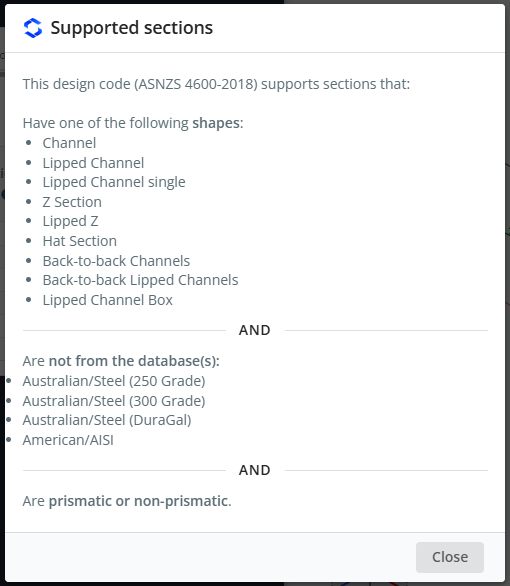
Back-to-back lipped channels and lipped channel boxes are supported only by this code. Sections can be prismatic or non-prismatic, and the material must be steel. Sections must not come from the Australian/Steel (250 Avaliar), Australian/Steel (300 Avaliar), Australian/Steel (Querido) or American/AISI databases.
To see this list in the software, open the log and click View supported sections.
Programas
- SkyCiv Structural 3D
AS / NZS 4600-2018 is also listed in the Código de Design dropdown of SkyCiv Beam. This page describes the module in SkyCiv Structural 3D.
Observação
Units must be in Métrica to use this design module. In the Model, abrir Configurações (top bar) > Unidades and set the unit system to Métrica.
Opening the module
- Solve the model.
- Clique Projeto in the top bar.
- No Select a Design Module, escolher Cold-Formed Steel Member.
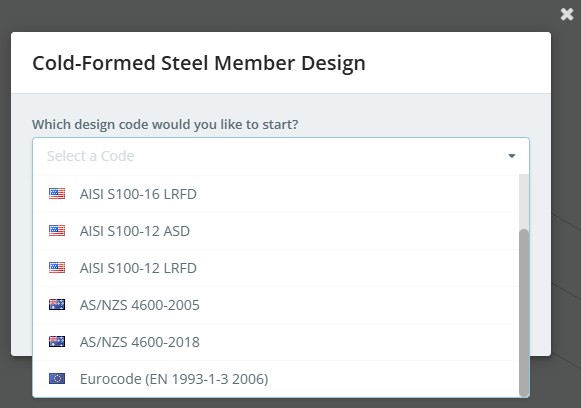
- No Which design code would you like to start?, pick AS / NZS 4600-2018, então clique Começar.
If a design module is already open, usar ferramenta integrada com Structural 3D que otimizará projetos de membros para usuários automaticamente no Projeto menu to switch codes.
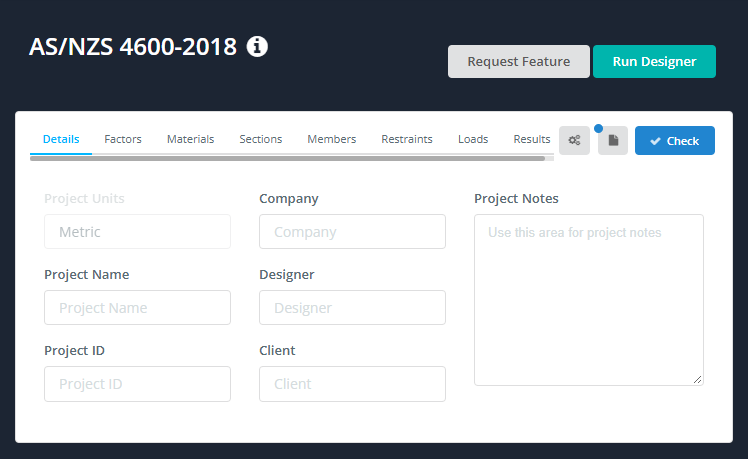
The design panel opens on the left, with the 3D model on the right. The header shows the code, plus Request Feature e Run Designer. On the right of the tab bar are three buttons:
- the settings (gear) botão, which opens Member Design Settings
- the log button, which opens the Member Design Log
- Verificar, which runs the design check
When the module starts, an alert may tell you that there are important messages. They are shown in the Member Design Log, for example "6 members were loaded with default values", or members that were not imported because their section or material isn’t supported. The log has a View supported sections link.
The tabs are Detalhes, Fatores, Materiais, Seções, Membros, Restrições, Cargas e Resultados.
Member Design Settings
Click the gear button to open Member Design Settings. It has one option:
- Checks based on geometric axes instead of principal axes: unchecked by default. It affects the capacity of sections that are not symmetric about both axes, such as Z sections.
As the dialog notes, engineering guidance should be used when you change these settings. Clique Salve aplicar.
Detalhes
No Detalhes tab you can enter the project details. You don’t have to fill them in, but anything you enter is shown in the Detalhes do Projeto table of your reports. Project Units shows Métrica and can’t be changed here.
Fatores
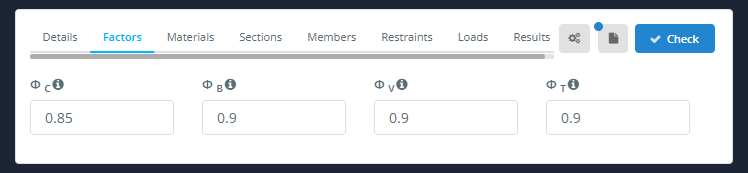
A Fatores tab shows the capacity reduction factors:
| Fator | Descrição | Padrão |
|---|---|---|
| A seguir estão as diferentes maneiras de determinar os coeficientes de pressão de terra para calcular a resistência ao atrito unitária de estacas em areiaC | compressão | 0.85 |
| A seguir estão as diferentes maneiras de determinar os coeficientes de pressão de terra para calcular a resistência ao atrito unitária de estacas em areiaB | Dobra | 0.9 |
| A seguir estão as diferentes maneiras de determinar os coeficientes de pressão de terra para calcular a resistência ao atrito unitária de estacas em areiaV | Cisalhamento | 0.9 |
| A seguir estão as diferentes maneiras de determinar os coeficientes de pressão de terra para calcular a resistência ao atrito unitária de estacas em areiaT | Tensão | 0.9 |
If a member is not pre-qualified (Cláusula 1.6.3(c)(I)), A seguir estão as diferentes maneiras de determinar os coeficientes de pressão de terra para calcular a resistência ao atrito unitária de estacas em areiaC, A seguir estão as diferentes maneiras de determinar os coeficientes de pressão de terra para calcular a resistência ao atrito unitária de estacas em areiaB and ΦV are reduced to 0.8. The factors used for each member are listed in its report under Strength Limit State Factors, with their clause references.
Materiais
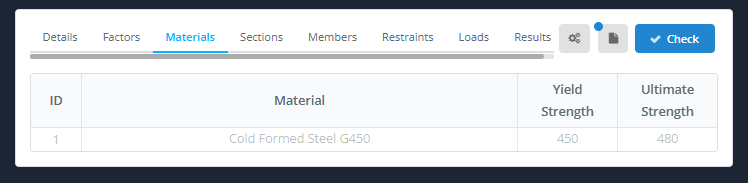
A Materiais tab lists the materials used by the designed members, with their Força de rendimento e Força máxima. The table is filled in from the model and can’t be modified here. To change a material, go back to the Model.
Seções
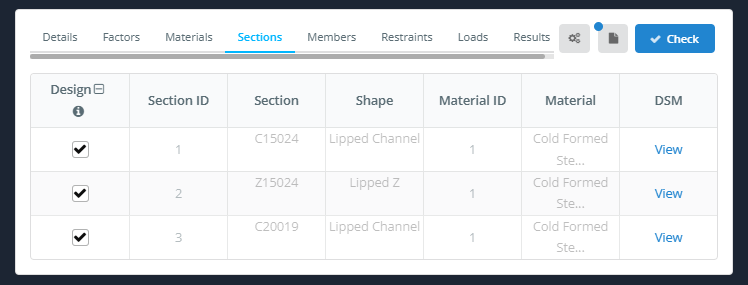
A Seções tab lists the sections used by the designed members. The section data comes from the model and can’t be modified here.
- Projeto: tick the box to design the members that use this section. The icon in the column header toggles all rows.
- ID da seção, Seção, Forma, ID de material e Material: taken from the model.
- DSM: clique Visualizar to see the DSM factors of the section.
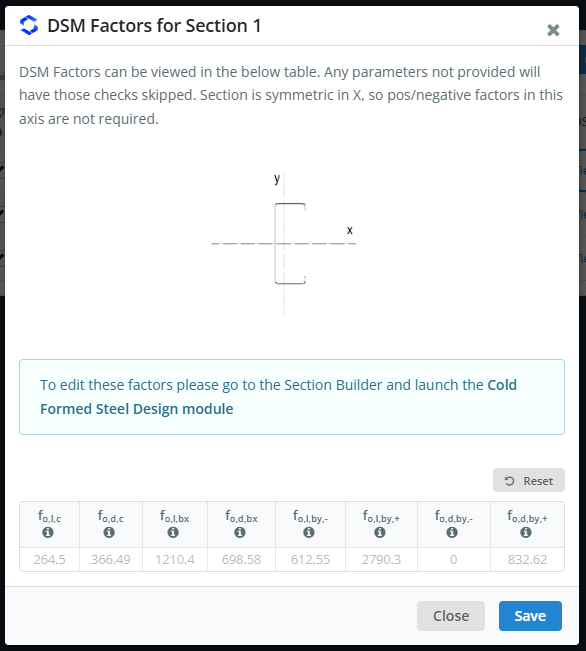
A DSM Factors for Section n dialog shows a sketch of the section with its axes, and the elastic buckling stresses (in MPa) used by the Direct Strength Method:
| Símbolo | Buckling stress |
|---|---|
| fo,eu,c | Flambagem local, compressão |
| fo,d,c | Flambagem distorcional, compressão |
| fo,eu,bx | Flambagem local, bending about x |
| fo,d,bx | Flambagem distorcional, bending about x |
| fo,eu,de,- e fo,eu,de,+ | Flambagem local, bending about y (negativo e positivo) |
| fo,d,de,- e fo,d,de,+ | Flambagem distorcional, bending about y (negativo e positivo) |
Any factor that is not provided has its check skipped. For a section that is symmetric about an axis, the positive and negative factors about that axis are not needed. The values can’t be edited here: to change them, vou ao Construtor de Seção and launch the Projeto de aço formado a frio módulo.
Membros
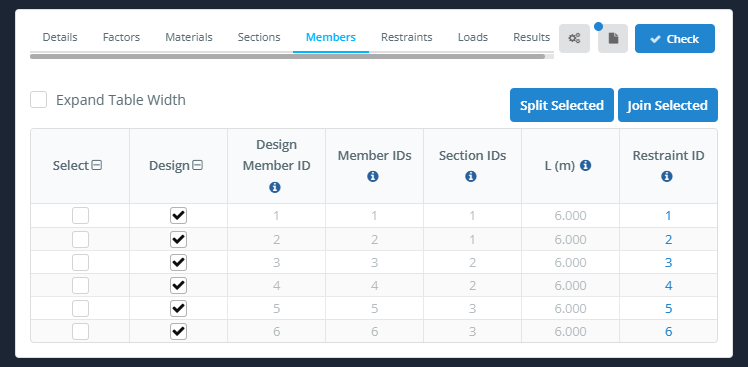
A Membros tab lists the design members. Each design member is made up of one or more model members.
- Expand Table Width: widens the table.
- Split Selected e Join Selected: split the selected design members, or join them into one design member.
| Coluna | Descrição |
|---|---|
| Selecione | Ticks the row, for example to split or join members |
| Projeto | Tick to include the member in the design check, untick to leave it out |
| Design Member ID | The ID of the design member |
| Recomenda-se dividir os membros antes de aplicar uma carga de área não retangular | The model member(s) that make up the design member |
| IDs de seção | enquanto a tensão no aço fs é menor que a tensão de escoamento f(s) of the design member |
| L (m) | The length of the design member |
| Restraint ID | The restraint set used by the member. Click it to open that restraint in the Restrições aba |
Design Member ID, Recomenda-se dividir os membros antes de aplicar uma carga de área não retangular, IDs de seção e L (m) come from the model and can’t be changed here. Effective lengths and K factors are not entered on this tab: they come from the Restrições aba.
Restrições
AS / NZS 4600:2018 supports custom restraints, so you can add your own restraints to be used in the calculations. For a full description, see our documentation on restrições de membros.
- Grupo automático: gives similar members the same restraint ID.
- Restraint ID: selects the restraint ID to view or edit. Use the down and up arrows to go to the next or previous ID.
- Assign to Member(s): assigns the current restraint ID to members.
- Duplicado: copies the current restraint ID to a new ID.
The restraint table is filled in from the model supports and connections. Por exemplo, a member supported at both ends gets a row at each end.
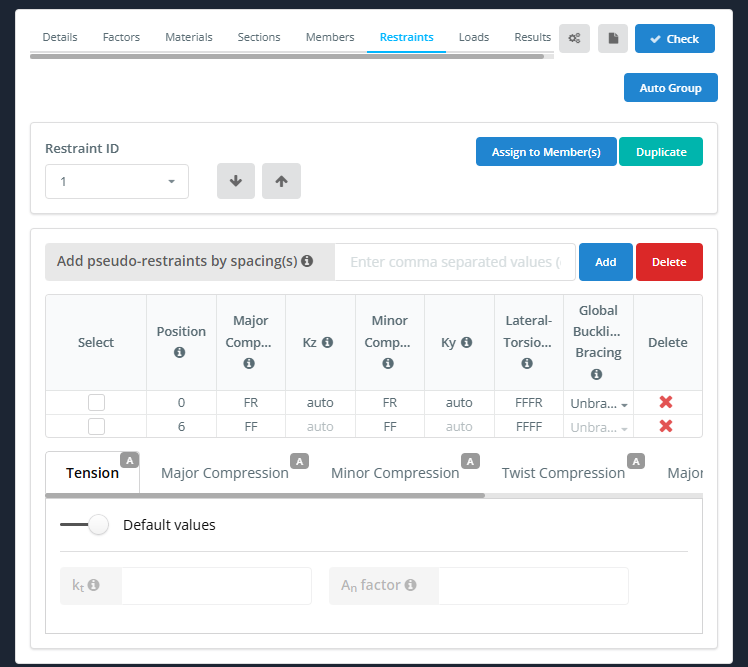
| Coluna | Descrição |
|---|---|
| Selecione | Ticks the row, for example to apply a standard restraint to it |
| Posição | Distance of the restraint from the start of the member |
| Major Compression | 2-key restraint code (F or R) for major-axis flexural buckling |
| Kz | Effective length factor for the major axis (auto por padrão) |
| Minor Compression | 2-key restraint code (F or R) for minor-axis flexural buckling |
| Ky | Effective length factor for the minor axis (auto por padrão) |
| Lateral-Torsional | 4-key restraint code (F, R or S) for lateral-torsional buckling |
| Global Buckling Bracing | Unbraced, Principal, Fundo ou Ambos. If the lateral-torsional restraint fully braces a flange, the global buckling check is skipped for the cases that the bracing covers. Hover over the ℹ icon for details |
| Excluir | Deletes the restraint row |
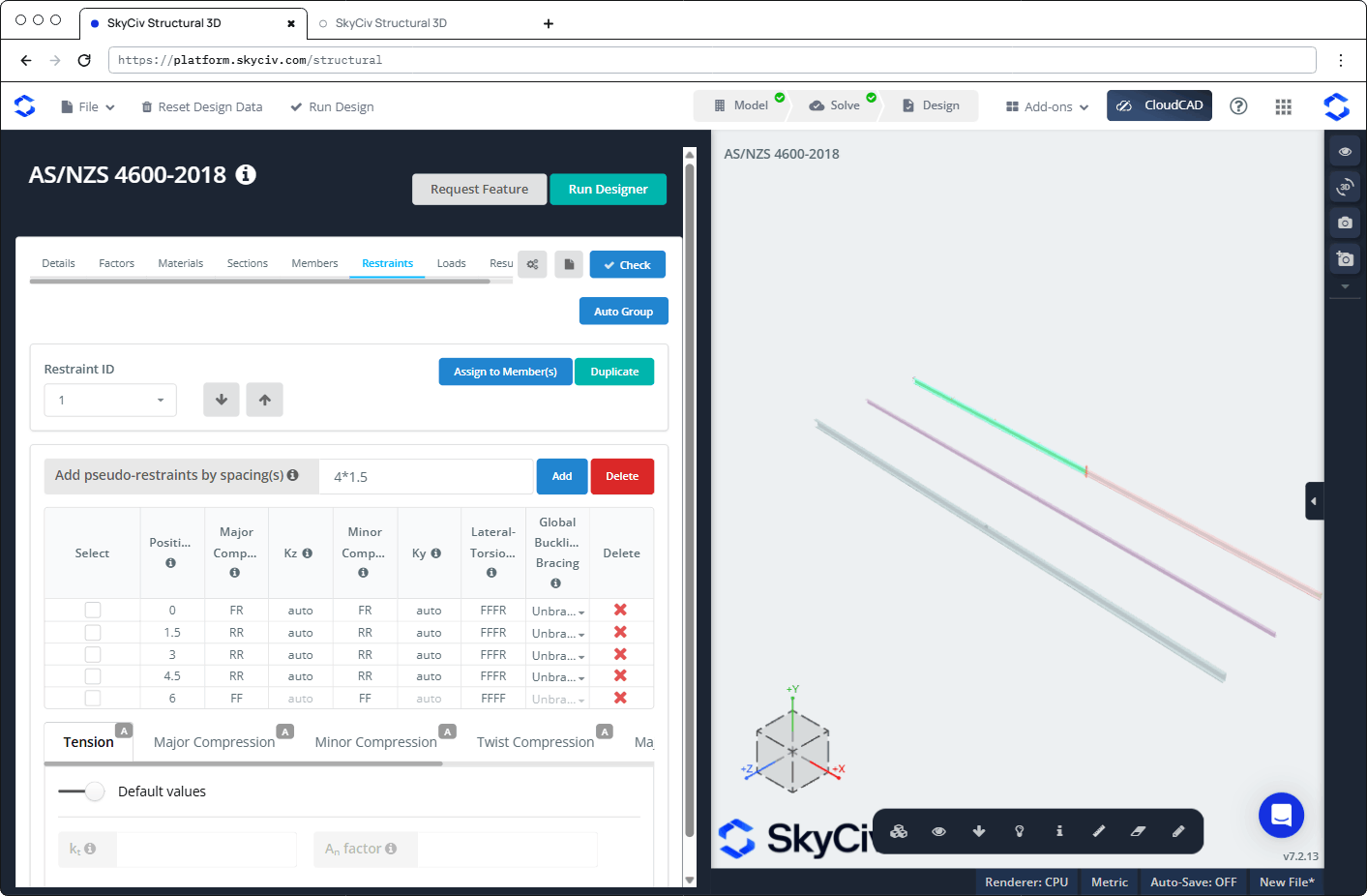
Para adicionar pseudo-restrições (restraints that are not modelled), enter the spacings in Adicione pseudo-restrições por espaçamento(s) e clique Adicionar. You can enter a comma separated list (por exemplo 1.5,1.5,1.5), use the multiply operator (4*1.5), or use the < operator to fit as many restraints as possible. Clique Excluir next to Adicionar to remove all the pseudo-restraints.
Pseudo-restraints are added as released (RR e RRRR), so they have no effect until you change their codes. No exemplo abaixo, 4*1.5 adds rows at 1.5, 3 e 4.5 m on a 6 m member, and their Lateral-Torsional code is changed to FFFR.
Below the table are sub-tabs, each with an A (automatic) badge by default:
- Tensão: com Default values -, the defaults are used. Switch it off to enter your own:
- kt: correction factor for the distribution of forces in a tension member. The default assumes a non-uniform force distribution, per AS/NZS 4600:2018 Cláusula 3.2.3.2.
- An são influenciados principalmente pelas dimensões da sapata: factor that reduces the gross area to the net area. O padrão é 0.85, which assumes a bolted connection.
- Major Compression (Lz, Kz), Minor Compression (LY, KY), Twist Compression (Lx, Kx), Major Lateral-torsional (Lb, kLT, Cb) e Minor Lateral-torsional (Lb, kLT): por padrão, Determine from restraints (as defined in the restraints table) está ligado. Switch it off to enter your own values for the whole member. Sob Standard Restraints, click an icon to apply a standard restraint to the selected rows.
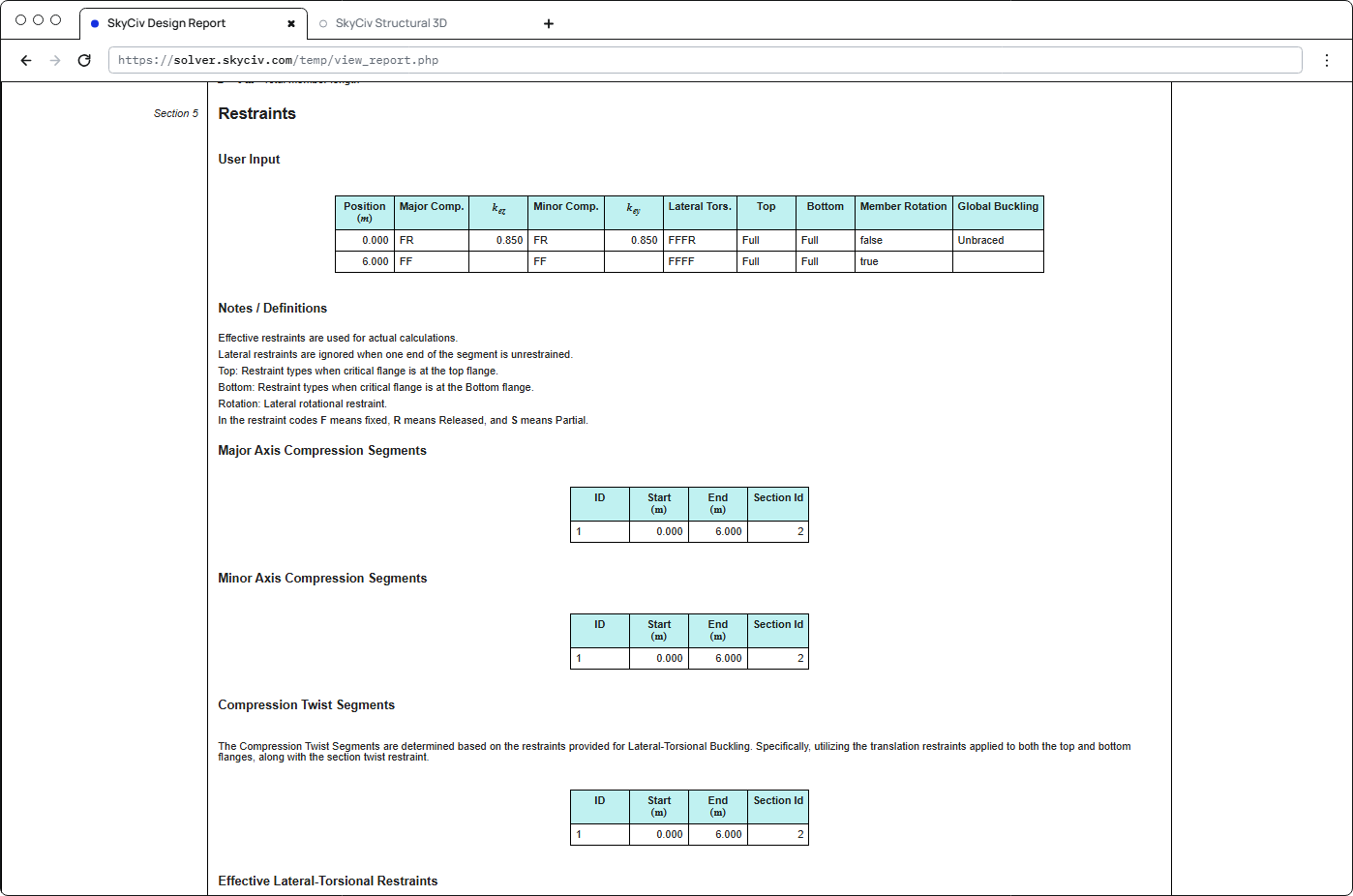
A Restrições section of each member report shows the restraints that were used: the user input (posição, códigos de restrição, knão e kei, top and bottom flange restraint, member rotation and global buckling bracing), the major-axis and minor-axis compression segments, the compression twist segments, the effective lateral-torsional restraints and the segments for each load combination.
Cargas
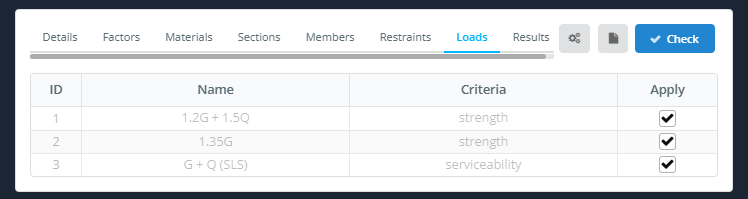
A Cargas tab lists the load combinations from the model, with their Nome e Critério. Tick Aplicar for each load combination you want to include. Serviceability combinations are listed and can be ticked, but no serviceability check is performed.
Resultados
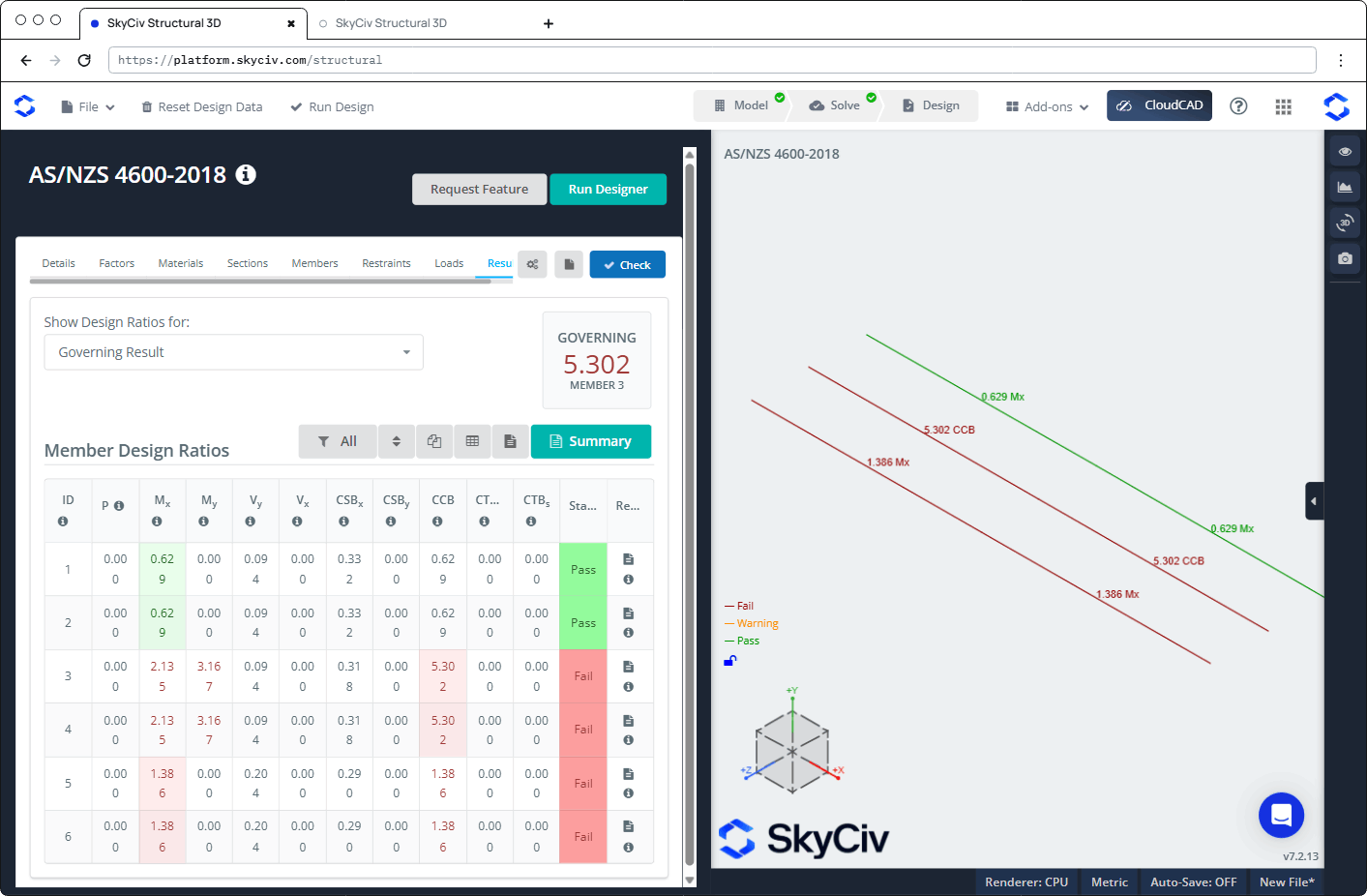
Clique Verificar to run the design check. A Resultados tab shows:
- Mostrar taxas de design para: chooses which ratios are shown, por exemplo Governing Result, Membros falhados, or a single check.
- GOVERNING: the highest ratio and its member.
- A toolbar to filter (Tudo), sort, Suprimindo e mudando sua estrutura Repita, show the table and open the report, mais tem Resumo button for the summary report.
- A Proporções de Design de Membros tabela, com um Status (Passar ou Falhou) e uma Relatório icon for each member. Hover over the ℹ icon in a column header to see the clause it refers to.
| Coluna | Verificar | Cláusula |
|---|---|---|
| P | Axial (tensão ou compressão) | 3.2 ou 7.2.1 |
| Mx | Bending about x | 7.2.2 |
| MY | Bending about y | 7.2.2 |
| VY | Shear along y | 7.2.3 |
| Vx | Shear along x | 7.2.3 |
| CSBx | Combined shear and bending, about x | 7.2.3 |
| CSBY | Combined shear and bending, about y | 7.2.3 |
| CCB | Combined compression and bending | 7.2.4 |
| CTBm | Combined tension and bending, capacidade dos membros | 7.2.5(1) |
| CTBs | Combined tension and bending, section capacity | 7.2.5(2) |
In the 3D view, each member is coloured Falhou, Aviso ou Passar and labelled with its governing ratio.
Verificações realizadas
| Verificar | AS / NZS 4600:2018 referência |
|---|---|
| Member pre-qualification (sets Φ) | Cláusula 1.6.3 |
| Axial tension, section capacity | Seção 3.2 |
| Axial compression, section capacity | Seção 7.2.1.3 |
| Axial compression, capacidade dos membros (global, local and distortional buckling) | Seção 7.2.1 |
| Bending about x and y, section capacity | Seção 7.2.2.3.2 |
| Bending about x and y, capacidade dos membros (lateral-torsional, local and distortional buckling), including positive and negative bending about y for singly symmetric sections | Seção 7.2.2.1 |
| Shear along y (rede) and along x (você teria uma boa noção de como as conexões simples são projetadas sob o AISC) | Seção 7.2.3 |
| Combined bending and shear, about both axes | Eq. 7.2.3(9) |
| Combined axial compression and bending | Eq. 7.2.4 |
| Combined axial tension and section bending capacity | Eq. 7.2.5(2) |
| Combined axial tension and member bending capacity | Eq. 7.2.5(1) |
The module does not check slenderness limits, deflexões (facilidade de manutenção), web crippling or torsion.
Relatórios
Click the report icon in a member’s Relatório column to open its design report. It opens in a Design Report for Member #n dialog with Close, Abrir em nova guia, Baixar HTML e Baixar PDF botões. The report is titled "AS/NZS 4600-2018 – Direct Strength Method", and contains:
- Detalhes do Projeto
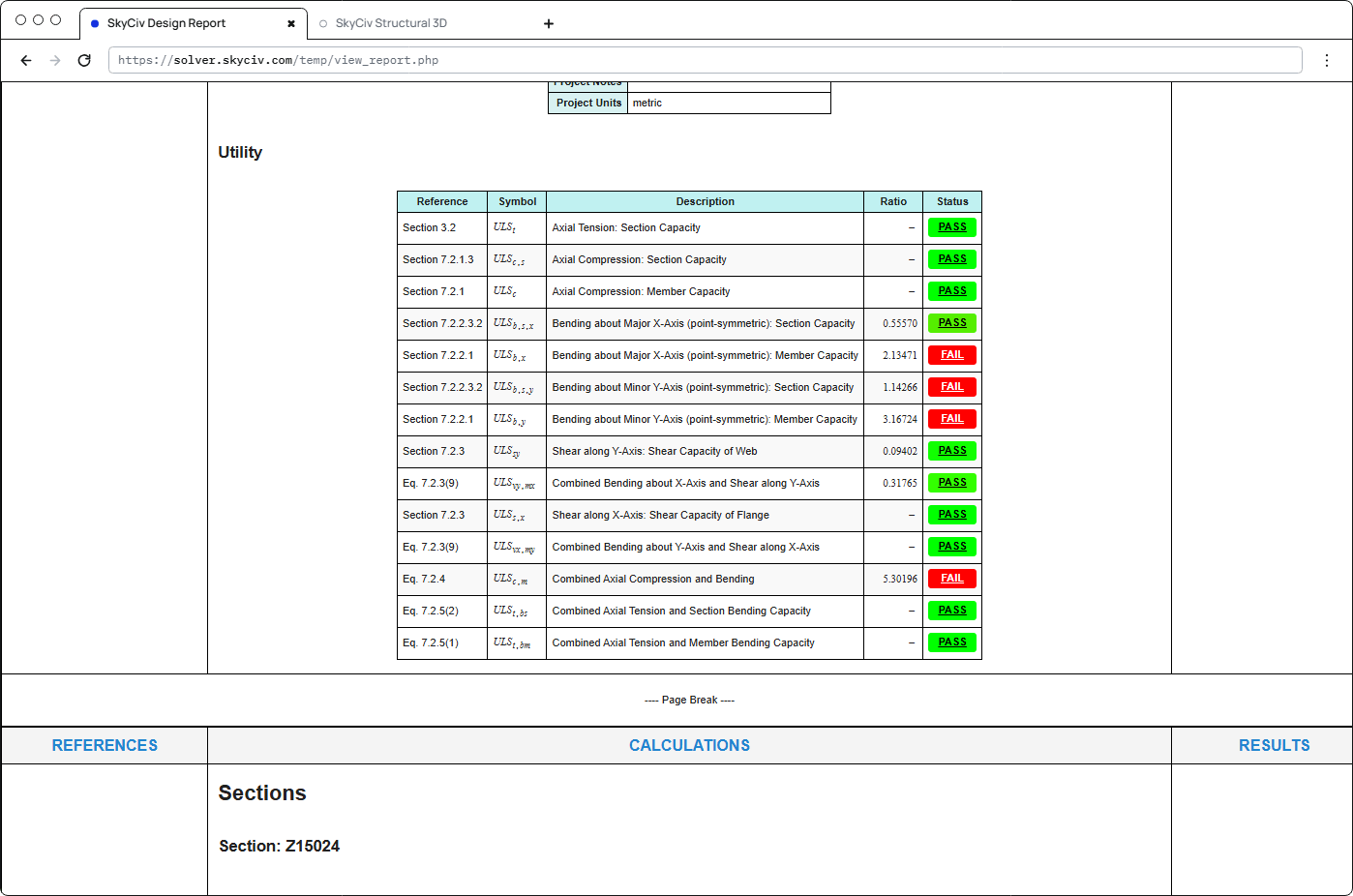
- Utilitário: every check with its reference, símbolo, description, proporção e status
- Seções: the dimensions and properties of the section
- Estados Limites Últimos: Pré-qualificação de membros, Strength Limit State Factors, Member Internal Actions, Member and Restraints, followed by each check step by step
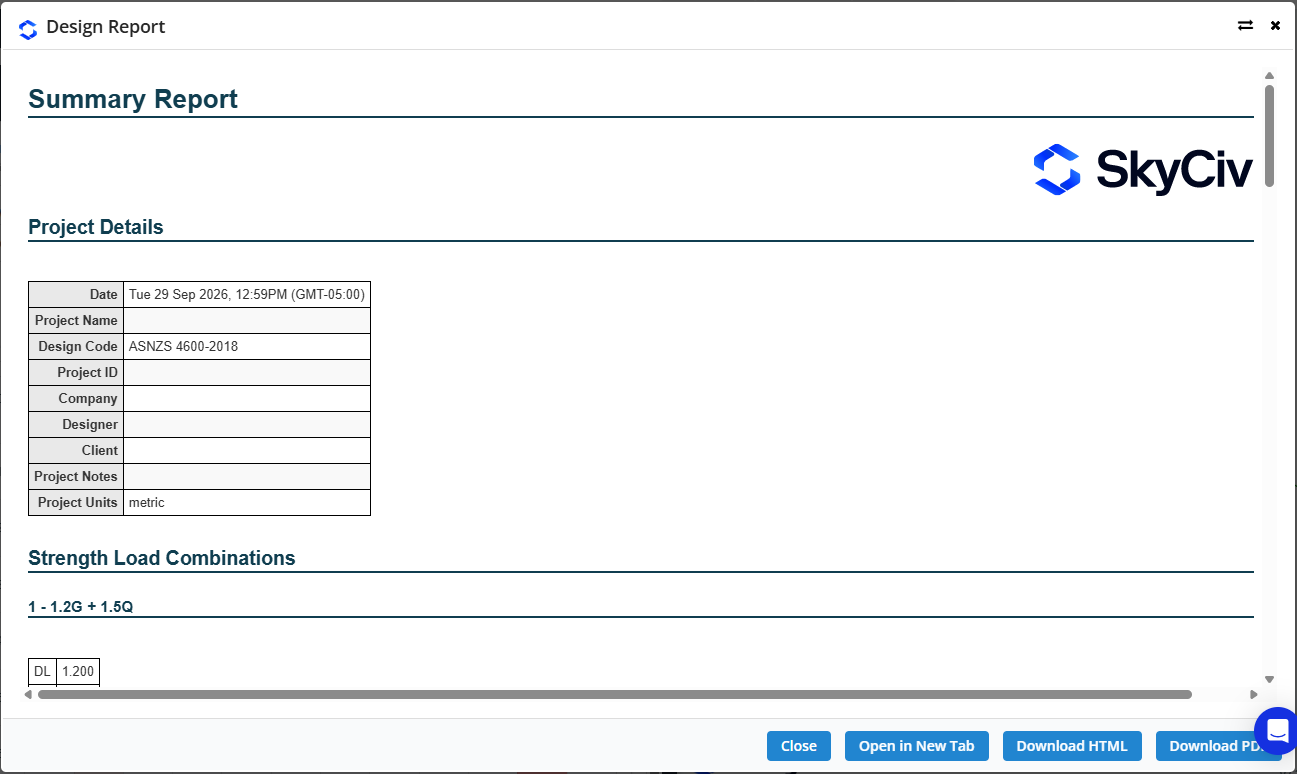
Clique Resumo on the Results tab to open the Relatório resumido. It lists the project details (including the design code), the strength load combinations with their factors, and the results for all members.