
VRIJE EINDPLAATVERBINDING CALCULATOR
SkyCiv eindplaatverbindingscalculator
Deze eindplaatverbindingscalculator controleert de boutspanning, nieuwsgierige actie, plaat buigen, lassterkte en baanuitscheuring tegen AISC 360, in ASS of LRFD.
In de werkplaats wordt aan het uiteinde van de balk een plaat gelast, vervolgens ter plaatse aan de ondersteunende kolom of ligger vastgeschroefd. Of de verbinding stopt bij de flenzen of daar voorbij reikt, bepaalt of de verbinding als een eenvoudige afschuifverbinding of als een starre momentverbinding fungeert.
Over de eindplaatverbindingscalculator
De rekenmachine verwerkt beide uiteinden van het bereik: eenvoudige afschuifdetails en momentbestendige details. Het evalueert de boutspanning, plaat buigen, lassterkte en baanuitscheuring, en rapporteert ontwerpcapaciteiten met nutsverhoudingen.
Alles is voor AISC 360, bij ASS of LRFD, dus de methode komt overeen met wat de projectspecificatie vraagt, in plaats van een conversie af te dwingen.
Wat is een eindplaatverbinding?
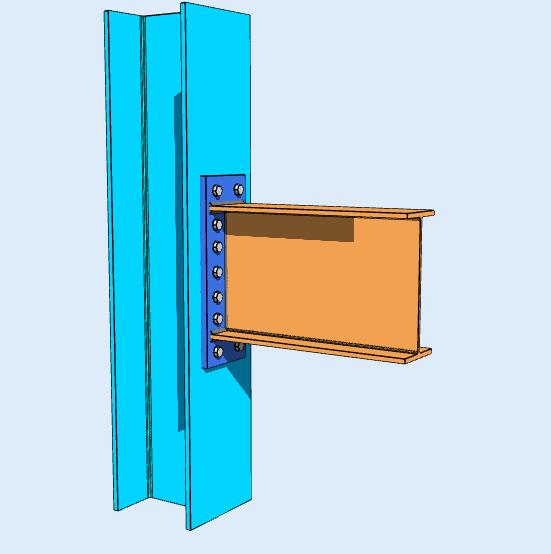
Een vlakke plaat die vierkant aan het uiteinde van een balk is gelast, over het lijf en ook over de flenzen als de verbinding stijf moet zijn, vervolgens in het veld vastgeschroefd aan een ondersteunende kolom of balk.
Hoe ver de plaat loopt, verandert zijn gedrag. Stop hem binnen de flenzen en de balk kan draaien, de verbinding is dus een flexibele afschuifverbinding. Verleng het voorbij de flenzen, met daarbuiten boutenrijen, en het weerstaat moment.
Het laswerk gebeurt in de werkplaats onder gecontroleerde omstandigheden, waardoor het werk ter plaatse als bouten blijft bestaan. Dat is de praktische aantrekkingskracht: het moeilijke deel gebeurt waar het goed kan worden geïnspecteerd.
Uit welke componenten bestaat het gewricht??
- Stalen eindplaat: een rechthoekige plaat die aan het uiteinde van de balk is gelast, op maat gemaakt rond het boutpatroon en de belasting.
- Winkel lassen: hoek- of volledige penetratielassen waarmee de plaat aan het liggerlijf en de flenzen wordt bevestigd.
- Veldbouten: bouten met hoge sterkte, typisch ASTM A325 of A490, het bevestigen van de plaat aan het steunorgaan.
- Ondersteunend lid: de kolomflens, kolomlijf of hoofdligger met de vastgeschroefde plaat.
- Verstevigingsplaten: optioneel, toegevoegd aan het kolomweb of aan een verlengde plaat waar zware krachten het plaatselijk zouden doen knikken.
Het laadpad is kort en direct, wat deel uitmaakt van de reden waarom het detail wordt vertrouwd: balk, lassen, bord, bouten, ondersteuning.
Waar worden deze verbindingen vaak gebruikt?
- Momentframes van ligger tot kolom in stalen gebouwen met meerdere verdiepingen.
- Dakportaalframes in industriële magazijnen en vrije overspanningen.
- Primaire ligger-ligger-schuifverbindingen in commerciële vloersystemen.
- Pijprekken en zware steunconstructies in industriële installaties.
Portaalframes zijn het duidelijkste geval voor het uitgebreide type: het consolegewricht draagt een groot moment, en boutrijen buiten de flens maken dat mogelijk zonder een gelaste locatieverbinding.
Welke soorten eindplaatverbindingen bestaan er??
De keuze volgt uit de vraag of het gewricht alleen schuifkracht draagt of schuifkracht en moment samen:
- Flexibel (gedeeltelijke diepte) eindplaat: alleen aan het liggerlijf gelast, overdracht van schuifkracht terwijl rotatie mogelijk is. Een eenvoudige ondersteuning.
- Verzonken eindplaat: de plaat komt overeen met de balkdiepte, geeft een matige momentweerstand naast afschuiving.
- Verlengde onverstijfde eindplaat: loopt langs één of beide flenzen zodat er extra boutrijen passen, voor hogere momentweerstand.
- Verlengde verstijfde eindplaat: voegt verticale verstijvingsribben toe boven of onder de flenzen, het verstijven van de plaat en het verminderen van nieuwsgierige blikken.
Elk heeft zijn eigen set AISC-controles, en ze kunnen alle vier in de rekenmachine worden gemodelleerd.
Hoe u de eindplaatverbindingscalculator gebruikt
- Selecteer het plaattype: flexibele schaar, spoelmoment, of verlengd.
- Definieer de geometrie: plaatdikte, breedte en hoogte, plus de ligger- en steunelementsecties.
- Specificeer bevestigingsmiddelen en lassen: bout kwaliteit, diameter, steek- en randafstanden, en de lasgroottes.
- Pas de ontwerpacties toe: gefactoriseerde afschuiving, axiale kracht en buigmoment.
Bereken, en je krijgt ontwerpcapaciteiten, de geldende faalmodus en de ASD- of LRFD-utiliteitsratio's samen. Weten welke modus regeert, is het nuttige deel, omdat het u vertelt of u de plaat moet vervangen, de bouten of de lassen.
Waarom kiezen voor de eindplaatverbindingscalculator van SkyCiv?
Nieuwsgierige actie is de controle die mensen met de hand verkeerd krijgen, en het is degene die de plaatdikte op een momentverbinding bepaalt. Het is mogelijk om dit in een spreadsheet te doen; het herhaaldelijk doen, voor elke boutrijindeling die het proberen waard is, gebeurt over het algemeen niet.
De uitsplitsing van de berekening wordt volledig weergegeven in plaats van samengevat, en de 3D-weergave weerspiegelt de geometrie die u daadwerkelijk hebt ingevoerd, er verschijnt dus een overbelast onderdeel terwijl de details nog steeds goedkoop te veranderen zijn.
- Beam Splice-verbindingscalculator
- Bout rekenmachine
- Gebout verbindingsontwerp
- Chevron Brace-verbindingscalculator
- Dubbele hoekverbindingscalculator
- Flensplaatverbindingscalculator
- Kniebrace-verbindingscalculator
- Moment verbinding
- Rekenmachine voor enkele hoekverbindingen
- Enkele plaatverbindingscalculator
- SkyCiv-verbindingsontwerp versus. Statisch idee
- SkyCiv-verbindingsontwerp versus. Ram-verbinding
- Lascalculator
- Gelast verbindingsontwerp
Veelgestelde vragen over het ontwerpen van geboute eindplaatverbindingen.
Uw vragen beantwoord

Intuïtieve interface
Onze gemakkelijk te leren, krachtig in gebruik, Dankzij de intuïtieve interface heeft u snel toegang tot alle functies die u nodig heeft. Boordevol slimme functies zoals de Pen-tool, Herhalen/ Spiegelen, en bulkbewerking. Uw inhoud komt hier terecht

Uitgebreide ontwerpcodeondersteuning
Onze software ondersteunt een uitgebreid assortiment staal, hout, en concrete ontwerpcodes, waaronder AISC, IN, AISI, NDS, ALS, en CSA.

API-technologie
SkyCiv is een oplossing op maat met naadloze integraties, eenvoudige implementaties, geautomatiseerde rapporten en een schaalbaar ontwerp en architectuur.

24/7 Klantenservice
SkyCiv is een oplossing op maat met naadloze integraties, eenvoudige implementaties, geautomatiseerde rapporten en een schaalbaar ontwerp en architectuur.
