
FREE MOMENT CONNECTION CALCULATOR
SkyCiv Moment Connection Calculator
This moment connection calculator checks flange plate, extended end plate and flush end plate details against AISC 360-16, in either ASD or LRFD.
These joints transfer bending between members rather than shear alone. The aim is to behave as closely as possible to a fixed joint, rigid in every direction, which is why these are also called rigid connections.
Contents
What is a Moment Connection?
A joint that transfers bending moment between a column and a beam, or between any two members. If the beam carries internal moment, the connection has to be able to transmit the load that moment produces.
The objective is to get as close as possible to a fixed joint, the fixity code FFFFFF, meaning rigid in all translational and rotational directions. That is where the alternative name comes from: rigid connections.
How Does It Differ From a Shear Connection?
Shear connections depend mostly on the web of a section. A rigid joint adds to that by strengthening the connectivity of the flanges, using plate stiffeners, welds or other fixtures that increase rigidity between the members.
The result is a joint that can carry far more moment. The cost is material, and it is not a small difference: the same members cost significantly more to join this way than with a shear connection.
That economics is worth stating plainly, because it drives real design decisions. A typical structure has only one or two unique moment connections, precisely to keep that cost contained. They are used where the frame needs them, not by default.
Types of Moment Connection
Three arrangements cover most of what gets built, and the calculator handles all three.
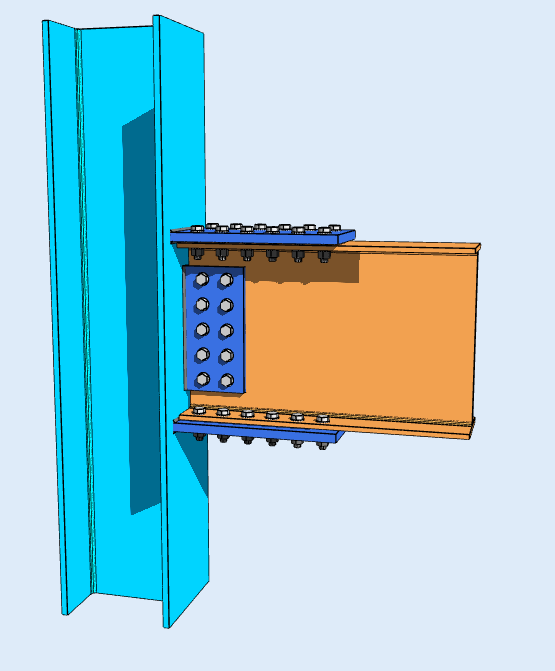
Flange Plate
Plates join the beam to the column, bolted or welded or both, to form a rigid fixture. In the arrangement below, two plates are bolted to the flanges of the beam to connect it to the column. As the beam bends, that action passes into the connected member.
Extended End Plate
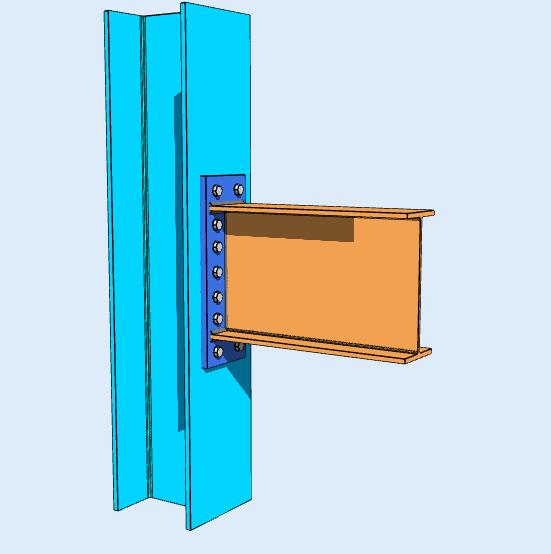
A rigid plate welded to the end of the beam, running past one or both flanges. That extension is doing something specific: it creates leverage, so extra rows of high-strength bolts can sit outside the beam profile.
The larger moment arm is what raises stiffness and capacity, by resisting the tension and compression forces more efficiently. It suits high-stress seismic work and heavy structural frames.
Flush End Plate
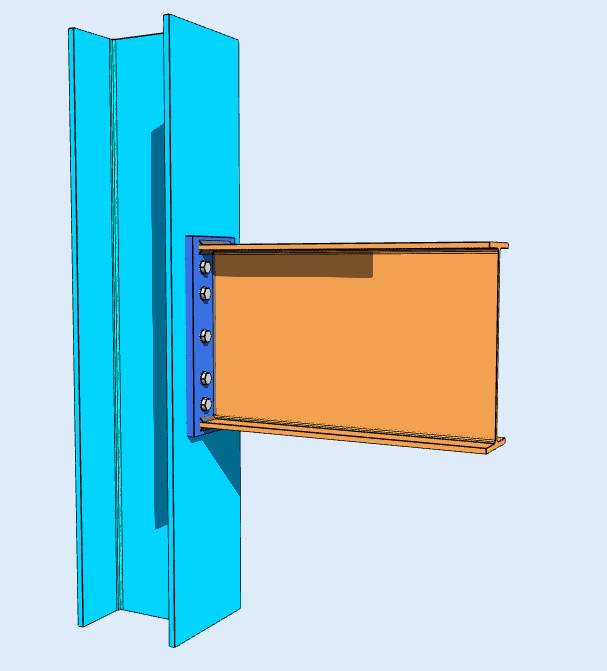
A rigid plate welded to the beam end and bolted to the face of the column, but stopping at the flanges rather than running past them.
Tension and compression go into the column mainly through the high-strength bolts packed between the beam’s flanges. Less capacity than an extended plate, and in exchange a compact profile that lines up with the beam’s outer edges.
How to Use the Moment Connection Calculator
- Choose the connection type: flange plate, extended end plate or flush end plate.
- Set the members: the beam and column sections being joined.
- Define the plate and bolt details: plate sizes, and the bolt grade and arrangement.
- Enter the design actions: the bending moment and the shear at the joint.
- Pick the design method: ASD or LRFD, to AISC 360-16.
Calculate, and the capacities come back with utility ratios so you can see which component is closest to its limit.
Why Choose SkyCiv’s Moment Connection Calculator?
Because these joints are expensive, the useful question is rarely whether one arrangement works. It is which of the three is the cheapest that still works, and that means checking all of them.
Running the checks to AISC 360-16 in ASD or LRFD without setting up the calculation by hand makes that comparison practical rather than theoretical, and the result comes with the working attached.
- Beam Splice Connection Calculator
- Bolt Calculator
- Bolted Connection Design
- Chevron Brace Connection Calculator
- Double Angle Connection Calculator
- End Plate Connection Calculator
- Flange Plate Connection Calculator
- Knee Brace Connection Calculator
- Single Angle Connection Calculator
- Single Plate Connection Calculator
- SkyCiv Connection Design Vs. Idea Statica
- SkyCiv Connection Design Vs. Ram Connection
- Weld Calculator
- Welded Connection Design
Common questions about moment connections and how they are checked.
Your Questions Answered

Intuitive Interface
Our easy to learn, powerful to use, intuitive interface allows you to quickly access all the features you need. Packed with smart features like the Pen tool, Repeat/Mirror, and Bulk Editing.Your Content Goes Here

Comprehensive Design Code Support
Our software supports a comprehensive array of steel, wood, and concrete design codes including AISC, EN, AISI, NDS, AS, and CSA.

API Technology
SkyCiv is a customised solution featuring seamless integrations, easy implementations, automated reports and a scalable design and architecture.

24/7 Customer Support
SkyCiv is a customised solution featuring seamless integrations, easy implementations, automated reports and a scalable design and architecture.
