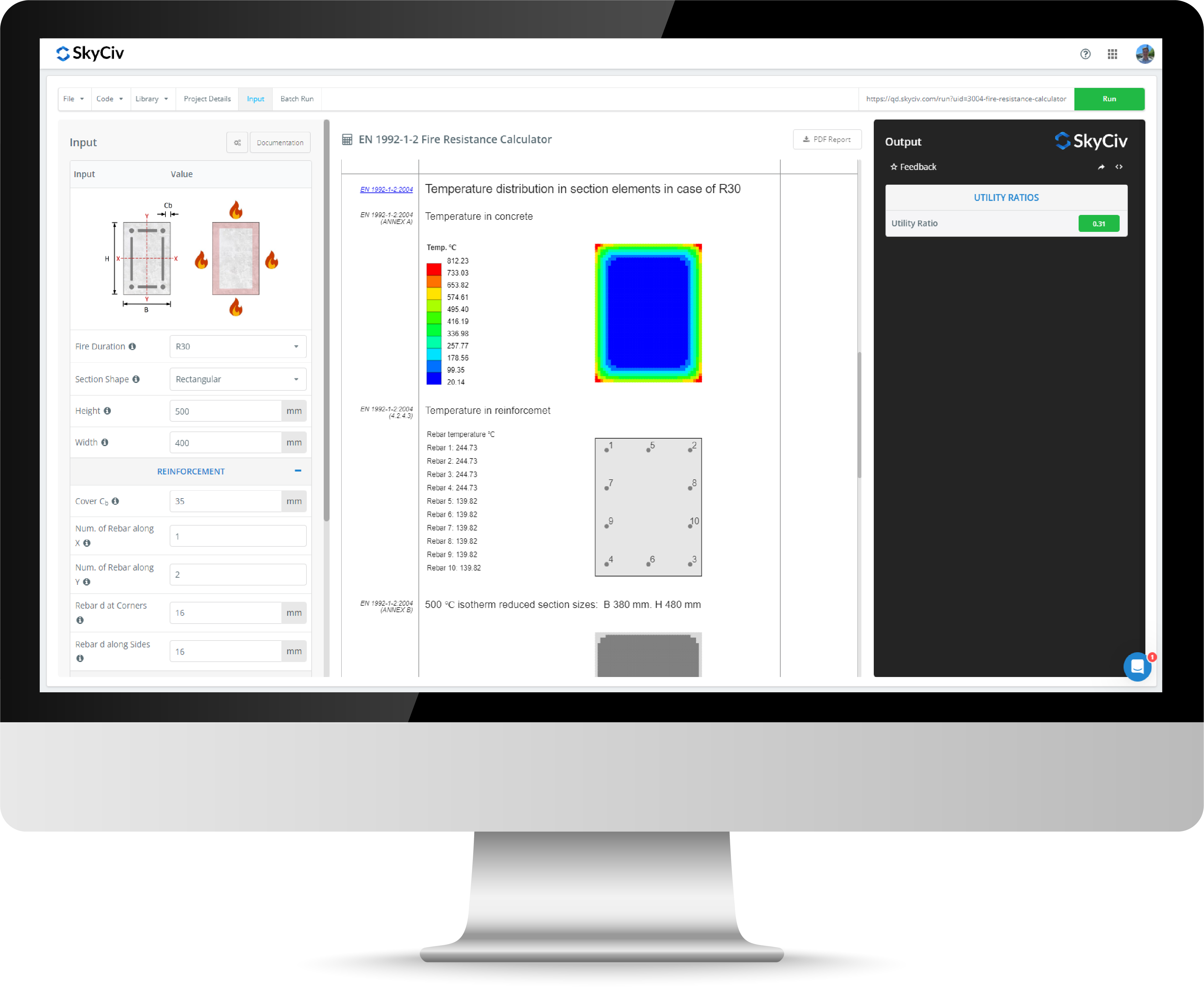
Reinforced Concrete Strip Footing Design Calculator
Strip footings are essential for supporting building loads and distributing them safely to the ground. As a fundamental type of shallow foundation, they are widely used because of their efficiency and simplicity in construction. In bouwtechniek, selecting and designing footings correctly is crucial to ensure both the safety and economic viability of structures.
De SkyCiv Strip Footing Calculator moet worden gebruikt voor de analyse en het ontwerp van stripfunderingen op basis van de ACI 318-19 Ontwerpstandaard. De controles die in de rekenmachine worden gebruikt, voldoen aan de vereisten van Hoofdstuk 13 van de ACI-code met betrekking tot stripfunderingen. The strip footing design tool can deal with either reinforced concrete footings and also with mass concrete footings according to the requirements of Chapter 14 van de ACI 318 Standaard. Deze module maakt deel uit van de Skyciv Quick Design Library.
Inhoudsopgave
Over de SkyCiv Strip Footing-ontwerpcalculator
Definition of Strip Footing: What is a Strip Footing?
A strip footing is a continuous, elongated concrete foundation that supports linear structural loads, typically beneath load-bearing walls. It transfers the load from the wall to a soil layer located relatively close to the ground surface. This footing type spreads concentrated loads from the superstructure over a wider area of soil, reducing pressure and mitigating settlement risks. The soil layer must have adequate bearing capacity and sufficient depth to prevent frost heave and other environmental issues.
When should a Strip Footings be used?
Strip footings are best suited for structures with walls, such as residential buildings, schools, and light commercial facilities. They are ideal when the soil has adequate bearing capacity at shallow depths, and the imposed loads are moderate and uniformly distributed. Common applications include supporting masonry or concrete walls, continuous columns, and situations where isolated pad footings are impractical due to wall geometry or load distribution.
Types of Strip footings
Typisch, two types of strip footings are used:
- Plain Concrete Strip Footings - which are ideal for lighter structures and low-rise buildings with stable bearing soils.
- Reinforced Concrete Strip Footings - which are used for heavier loads or when increased durability is required due to environmental conditions. These are suitable for heavier structures where the soil bearing capacity is relatively low.
Strip Footing Reinforcement
Flexural reinforcement is typically placed at the bottom of the footing, perpendicular to the face of the wall. In the transverse direction, shrinkage and temperature reinforcement should be provided parallel to the length of the wall.
Strip Footing Loading
Strip footings usually support linear loads beneath load-bearing walls. Echter, in sommige gevallen, a line of closely spaced columns may also be supported by a strip footing.
Failure Modes for Strip Footing
Strip footing failure modes can genrally be classified into three categories: soil bearing failures, stabiliteitsproblemen, en structurele mislukkingen. These are illustrated in the following figure.
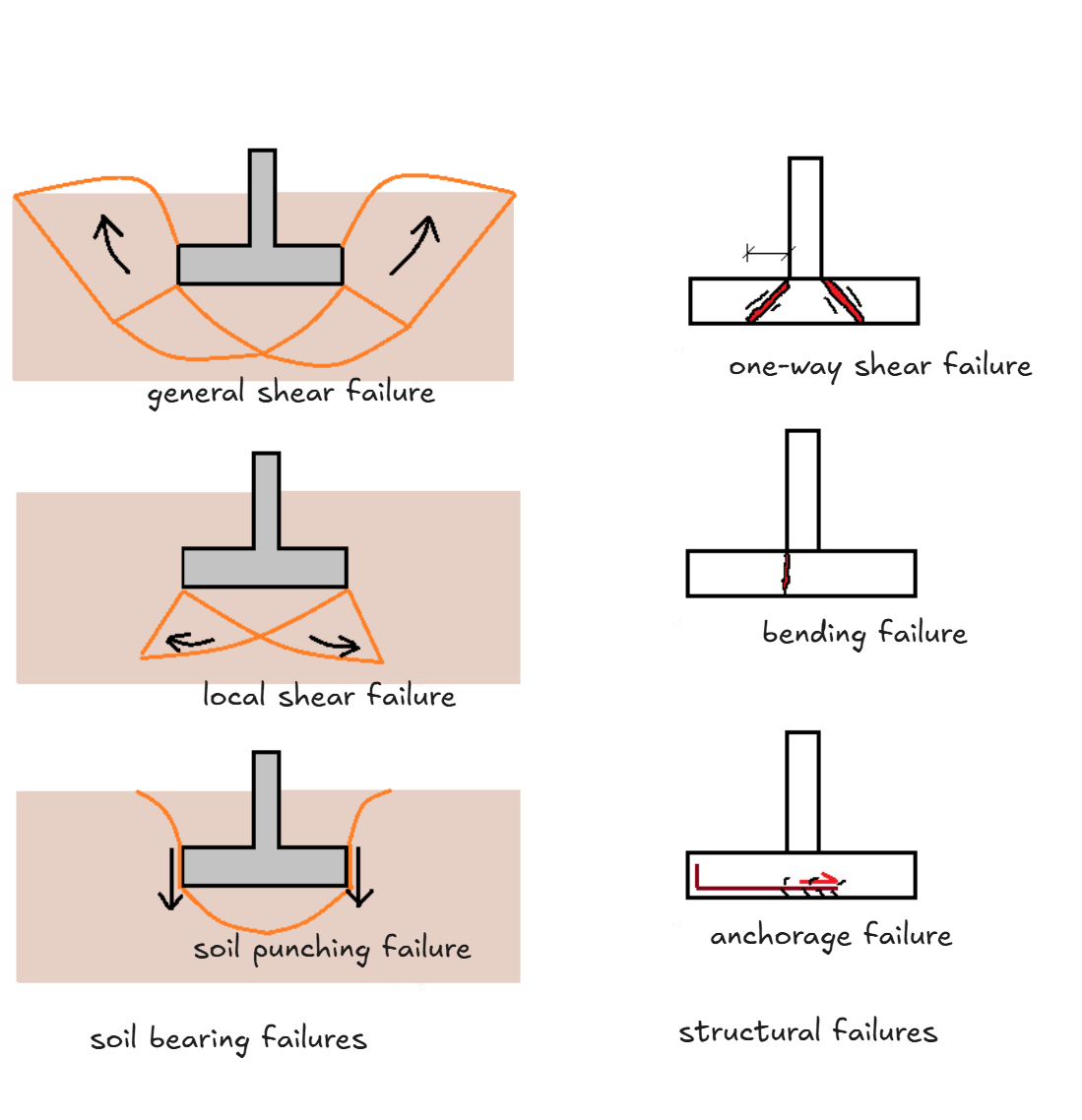
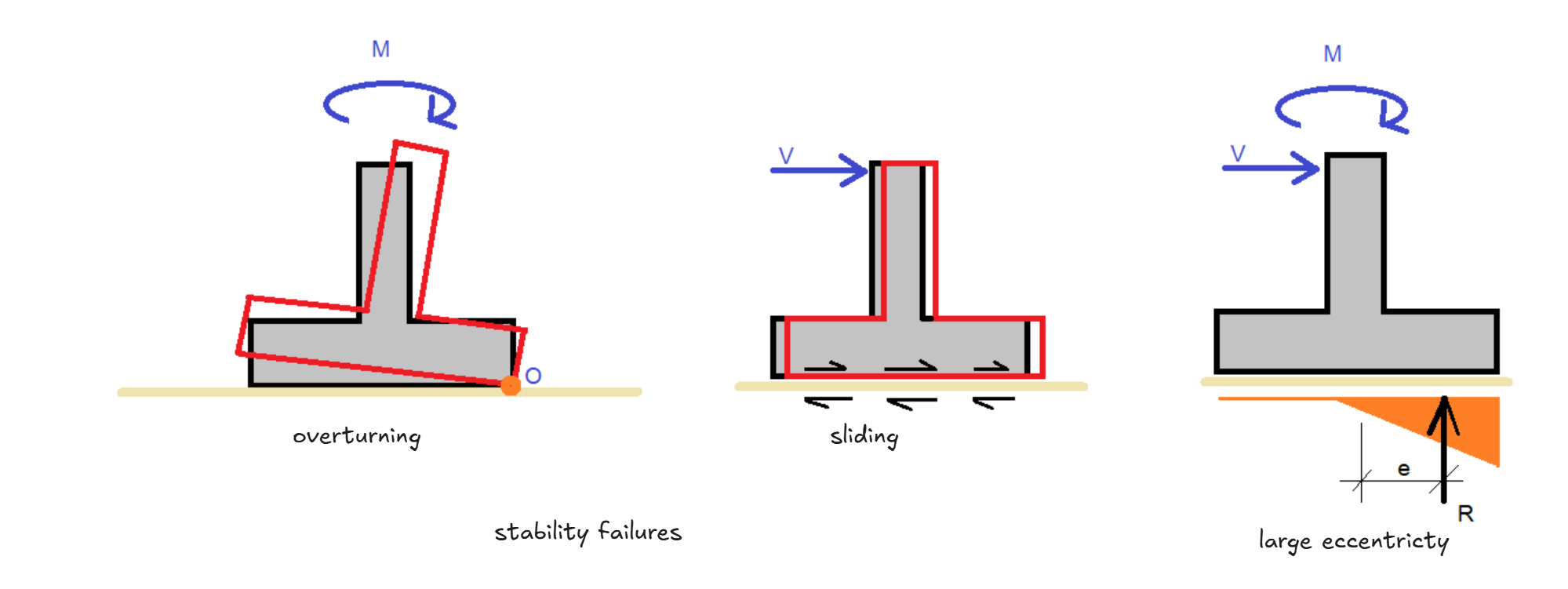
Figuur 1: Strip Footing Failure Modes
Strip Footing Design Procedure (ACI 318-19)
The design of strip footings involves several steps due to the various parameters and variables that affect the final dimensions and characteristics.
Stap 1: Geotechnical Investigation and Considerations
The design of foundations generally requires determining the behavior and stress-related deformability of the soil under the foundation. Om dit te behalen, de geotechnische eigenschappen van de bodem moeten worden bepaald. These properties include the grain-size distribution, soil classification, plasticiteit, samendrukbaarheid, en schuifsterkte. The investigation aims to determine the suitability of different foundation types and the soil's bearing capacity. This process normally includes performing the ultimate bearing capacity calculation and a settlement analysis. These steps determine the allowable bearing pressure (qeen) to avoid soil bearing failures. If a strip foundation is suitable, the engineer can then proceed to the next step.
Stap 2: Stabiliteitscontroles
Ensure the foundation system is safe against overturning, glijden, and avoid excessive uplift due to eccentricities.
Stap 3: Define the Base Area
In de VS, dit wordt bepaald aan de hand van de toelaatbare spanning en de gebruiksbelastingcombinaties. De vermoedelijke draagwaarden (IBC-tabel 1806.2) mag ook gebruikt worden indien toegestaan. De toelaatbare spanning wordt normaal gesproken opgenomen in het geotechnisch rapport, rekening houdend met het draagvermogen en eventuele zettingen. In a strip footing, de bodemspanning voor een fundering met een axiale belasting (P.) en moment (M) can be calculated as shown in Figure 2.
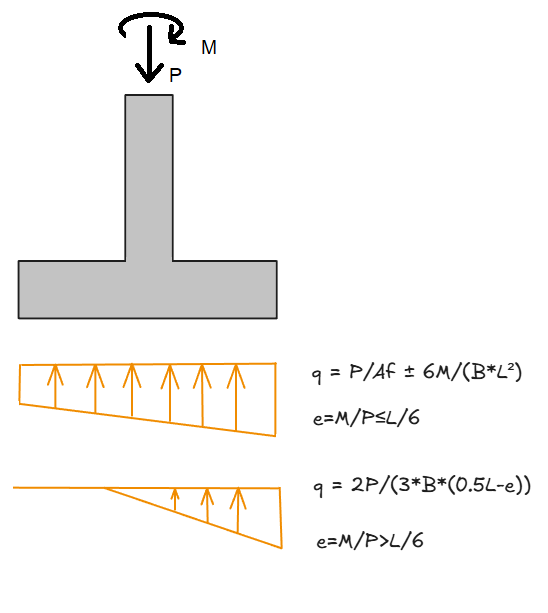
Figuur 2: Soil Stress Calcualtions in Strip Footing
Stap 4: Define Base Thickness and Calculate Bending Reinforcement
Normaal gesproken gebeurt dit via een proefondervindelijke procedure om structurele fouten te voorkomen. In dit geval, er wordt een voetdikte aangenomen, en vervolgens wordt gecontroleerd op buig- en schuifsterkte. In deze stap, de voet moet ontworpen zijn voor buigmomenten, eenrichtingsschaar (two-way shear is not applicable for strip footings) caused by the soil pressure due to factored loads. Een minimale diepte van 6 binnen moet worden overwogen (ACI 318-19 c13.3.1.2) en een minimale betondekking gelijk aan 3 voor beton dat tegen de grond wordt gegoten en permanent in contact is met de grond (ACI 318-19 c20.5.1.3.2). It is also important to consider the minimum footing thickness based on the development of the bars that start from the footing to the wall for concrete walls.
Als het buigmomentdiagram wordt geanalyseerd (zie figuur 2), it appears that the maximum moment in the strip footing occurs under the middle of the wall, but tests have shown that this is not correct because of the rigidity of the walls. ACI-code suggereert (ACI 318-19, c13.2.7.1) computing it at the face of the wall for reinforced concrete walls or at a section halfway from the face of the wall to its center for masonry walls. Bij de berekeningen, er hoeft alleen rekening te worden gehouden met de opwaartse druk die wordt veroorzaakt door de externe belastingen die op de voet worden uitgeoefend. Het eigen gewicht en het overbelastingsgewicht van de grond moeten worden verwaarloosd. Voor het structurele ontwerp mag alleen de nettodruk over de fundering worden gebruikt.
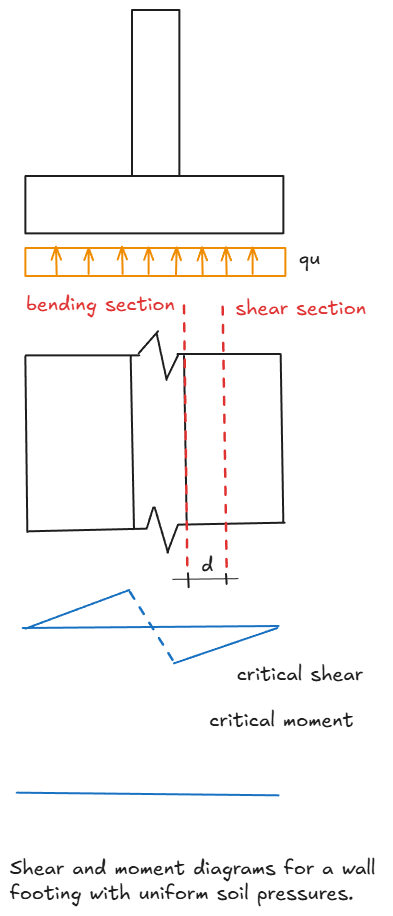
Figuur 3: Shear and Moment Diagrams for a Wall Footing with Uniform Soil Pressures
Als de muurfundering wordt belast totdat deze door afschuiving bezwijkt, the failure will not occur on a vertical plane at the wall face but rather at an angle approximately 45° with the wall face, daarom wordt de kritische sectie voor afschuiving berekend op een afstand “d” van het vlak (ACI 318-19c13.2.7.2), zijnde “d” de effectieve diepte, zie figuur 3. De effectieve diepte wordt berekend als:
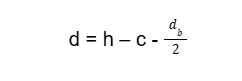
waarbij h de dikte van de voetplaat is, c is de omslag, and db is the bar diameter.
Eenmaal het maximale buigmoment (Mu) op het kritieke gedeelte is bepaald, het vereiste wapeningsgebied (As) wordt op dezelfde manier bepaald als elk ander buigelement. Hoewel een voet geen balk is, het is wenselijk dat het buigzaam is, en dit kan worden gedaan door de netto trekspanning in de trekwapening te beperken (et) to a value larger than εty + 0.003 (ACI 318-19 c21.2.2, ety is equal to fj/Es).
Met de vorige veronderstelling, het vereiste wapeningsoppervlak kan worden berekend met de volgende vergelijkingen
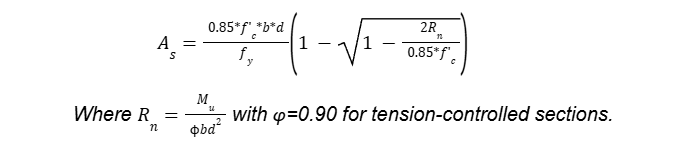
b is the section width, f’c is the specified compressive strength of concrete, fj is the specified yield strength of the reinforcement, en Es is the modulus of elasticity of the steel reinforcement.
The shear strength is normally calculated only considering the contribution of the concrete. It is not advisable to use shear reinforcement due to increased costs. Daarom, de afschuiving berekend bij de kritische afschuifsectie moet groter zijn dan de sterkte waartegen het beton weerstand biedt. Het wordt berekend met behulp van de vergelijking in de tabel 22.5.5.1(c) (ACI 318-19 c22.5.51)
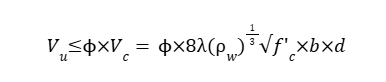
Where ρw is the reinforcement ratio equal to As/(b×d), λ is de modificatiefactor die de verminderde mechanische eigenschappen van lichtgewicht beton weerspiegelt, en ϕ is de afschuifreductiefactor.
Zodra de dikte van de voet is bevestigd, is deze bestand tegen buiging en afschuiving in één richting, en de aangenomen wapening is groter dan vereist, we kunnen doorgaan met de volgende stap.
Stap 5: Calculate the Transfer Forces
De verticale en horizontale krachten die op de fundering worden overgebracht door het dragen van het beton of een combinatie van dragen en grensvlakwapening moeten worden gecontroleerd. Deze vereiste wordt gedetailleerd beschreven in Hoofdstuk 22.8 van de ACI 318-19:

Waar een1 is het belaste gebied, A2 is de oppervlakte van de onderste basis van de grootste afgeknotte kegel van een piramide, kegel. De zijkanten van de piramide, kegel, of taps toelopende wig moet schuin zijn 1 verticaal naar 2 horizontale. En ϕ is een reductiefactor.
Stap 5: Detailleringscontroles
De laatste stap is gewijd aan de wapeningsdetails als minimale en maximale afstand, ontwikkelingslengte tot kritische secties. De details worden gegeven in Hoofdstuk 25 van ACI 318-19.
Strip vs. Muur funderingen
Wall footings are essentially a subset of strip footings and are often used interchangeably, as both describe a continuous, narrow footing that supports linear loads. Echter, strip footings have a broader definition and may also support a line of closely spaced columns, accepting point loads arranged in a row. In terms of reinforcement, both types are similar.
Stripfunderingen versus spreid- of padfunderingen
Strip footings are closely related to spread footings, as both are types of shallow foundations commonly used in small to medium structures due to their low cost. Strip footings are typically long and rectangular, while pad footings may be square, rechthoekig, of circulair. Strip footings generally support linear loads, terwijl pad footings support concentrated loads. In design, all checks performed for strip footings should also be applied to spread or pad footings, with additional checks such as the bidirectionele schaar (punching) rekening.
Hoe u de muurfunderingscalculator gebruikt?
De muurfunderingstool werkt met een try-and-error-filosofie. De gebruiker kan de invoergegevens wijzigen totdat alle controles zijn geslaagd. Normaal gesproken als er mislukkingen zijn, de oplossing omvat het vergroten van de voet of het vergroten van de wapening. In elk geval, de tool controleert ook de minimale en maximale omstandigheden die overmatige wapening helpen voorkomen. Er wordt voorgesteld om de hoogte te vergroten voor afschuiffouten, vergroot de breedte voor stabiliteitsfouten, en vergroot het wapeningsgebied voor buigfouten als de controles op de funderingshoogte en de dwarskracht in orde zijn.
Kernpunten - Strip Footings
- Strip footings are economical and widely used for shallow foundations.
- Goed geotechnisch onderzoek is essentieel.
- Het ontwerp moet rekening houden met bodembelasting, regeling, structurele sterkte, en stabiliteit.
- Volg ACI 318-19 voor alle controles en detaillering.
Referenties
- ACI 318-19: Bouwvereisten voor constructief beton
- IBC-tabel 1806.2: Vermoedelijke dragende waarden
- CRSI, Ontwerpgids voor de ACI 318 Bouwvereisten voor constructief beton, CRSI (2020).
- Gewapend beton: Mechanica en ontwerp 6e editie door James K. Wight, James G. MacGregor.
Veel Gestelde Vragen
Welke wrijvingshoek fundering-grond moet worden gebruikt?
Deze hoek ligt normaal gesproken tussen de helft en tweederde van de bodemwrijvingshoek. ("Principes van funderingstechniek" van Braja M. De)
Welke reductiefactoren worden gebruikt bij de sterkteverificaties?
De ACI-strookvoetcalculator gebruikt φ = 0.75 voor afschuiving, φ = 0.90 voor buigen (voor gewapend beton waarbij wordt uitgegaan van een spanningsgecontroleerde toestand met een wapeningsoppervlak dat kleiner is dan de maximumlimiet voor deze toestand), φ = 0.60 voor het buigen van gewoon beton, en φ = 0.65 voor lager.
Welke waarde wordt gebruikt voor het betongewicht ?
De standaardwaarde die wordt gebruikt is 150 lb/ft3 zoals voorgesteld door de norm voor beton met een normaal gewicht.
Welke waarde van het gewicht van de grondeenheid kan worden gebruikt?
De gemeenschappelijke waarden liggen tussen 90 naar 130 pond/ft3. Er wordt geadviseerd om de vochtwaarde te gebruiken die wordt voorgesteld in het geotechnisch rapport van het project.
Wordt de muurwapening gebruikt in de berekeningen?
Het wordt niet gebruikt, alleen voor tekendoeleinden. De muurpluggen, echter, worden gebruikt bij de controle van de overdracht van lastkrachten.
Waarom heeft mijn voet een kleine maximale afstand??
De ACI 318-19 Sectie 24.3.2 specificeert vrij lage waarden gezien de waarden die worden gebruikt voor de betondekking (normaal rond 3 inches). Enkele referenties (Problematisch gebruik van platen op de grond vermijden, Jan, 2021 Structuurtijdschrift door Alexander Newman, P.E., F.) vermelden dat de ACI zou moeten overwegen om deze bepalingen vrij te stellen voor funderingen en platen op de grond, maar, vanaf nu, ze zijn nog steeds van toepassing, en daarom zijn ze opgenomen in het programma.
Over SkyCiv
SkyCiv biedt een breed scala aan Cloud Structurele Analyse en Ontwerp Software voor ingenieurs. Als een voortdurend evoluerend technologiebedrijf, zijn we toegewijd aan het innoveren en uitdagen van bestaande workflows om ingenieurs tijd te besparen in hun werkprocessen en ontwerpen.