
FREE TOOLS
SkyCiv Punching Shear Calculator
The SkyCiv Punching Shear Calculator allows users to estimate the punching shear capacity of a reinforced concrete slab panel subject to point loading. Punching shear checks are used to ensure that a concrete slab is capable of resisting local forces concentrated around columns (under) or applied forces (over). Punching shear failure is a brittle failure mode, meaning that it can lead to structural collapse if not accounted for in design. In some cases, the minimum required slab thickness can be governed by punching shear resistance, rather than bending capacity or deflection.
SkyCiv offers tools to calculate punching shear resistance for the following codes:
- ACI 318-19: Building Code Requirements for Structural Concrete
- AS 3600:2018 Concrete Structures
The below calculator allows engineers to conduct punching shear checks to avoid punching shear failure and provides detailed, code referenced calculation reports explaining the results.
Contents
About the SkyCiv Punching Shear Calculator
What is punching shear?
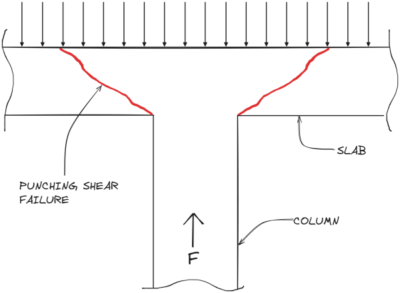
Punching shear refers to a mode of structural slab failure that occurs around concentrated load-bearing points. The most common causes of punching shear failure are punching of a column (under) or a point load (over) through a slab. Punching shear occurs as a “cone” failure through a slab (refer graphic below), where the slab cracks diagonally outwards from the point load/slab interface.
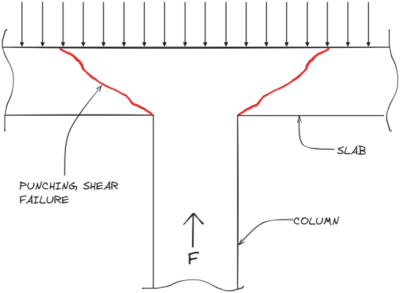
The failure “cone” through which punching shear occurs is referred to as the “critical shear perimeter”. This perimeter is proportional to the dimensions of the applied load, and the thickness of the slab supporting it. The larger the critical shear perimeter, the greater capacity against punching shear failure. Design to strengthen a slab against punching shear often includes increasing the size of this perimeter or strengthening it with reinforcement.
Bending moments within a slab can contribute to punching shear failure, as flexure cracking can exacerbate punching shear cracking. Hence the interaction of shear and bending needs to be taken into account in capacity calculations.
How to prevent punching shear failure?
Special detailing is required around columns and point loads to reinforce the slab against punching shear failure. Punching shear capacity can be increased by any of the following methods:
- Increasing slab depth
- Distributing point loads over a larger area
- Incorporating punching shear reinforcement over supports
- Local slab thickenings at supports (i.e. drop panels)
- Increasing concrete strength
These methods are all focused on either increasing the size of the critical shear perimeter or increasing the strength of the concrete section at the critical shear perimeter.
Punching shear with openings around the column
he ACI 318-19 punching shear calculator now allows for the design of punching shear with opening around the column. When the problem is analyzed with openings, the shear reinforcement is reduced by a factor that eliminates the rows affected by the opening’s area of influence (shown in yellow). ACI 318-19 provides no guidance on this matter; however, since CSA is more explicit, the calculator follows its recommendation. In any case, reinforcement within this “opening influence area” should still be placed or may be relocated nearby when it falls inside the opening, even though its contribution is not considered in the calculations. (CSA 23.3-24, Clause 13.1)
ACI 318-19 punching shear calculator notes
The ACI 318-19 punching shear calculator evaluates the punching shear strength of two-way slabs in accordance with ACI 318-19. It supports various column locations and boundary conditions, including:
- Interior Column/Load Transfer
- Edge Column/Load Transfer
- Corner Column/Load Transfer
The analysis incorporates combined shear and moment transfer (the eccentric shear model or Method) per ACI 318-19 Section 8.4.4.2, as detailed by Wight and MacGregor. Design and detailing of shear reinforcement follow the recommendations of ACI 421.1R-20. The calculator exclusions include:
- Varying Thickness: Limited to slabs with uniform thickness (no drop panels or capitals).
- Optimization: The tool does not automatically suggest optimal dimensions; it validates user-defined inputs.
- Integrity Members: Does not account for the contribution of beams or walls within the shear zone.
- Column Shapes: Limited to rectangular sections (use the “Equivalent Square” method for other shapes).
- Seismic Design: Does not include special seismic shear provisions (e.g., ACI 318-19 Section 18.14).
- Foundations: Does not account for soil reaction pressures (e.g., slabs-on-grade or mat foundations).
- Prestressing: Limited to non-prestressed reinforced concrete slabs.
How to do concrete slab punching shear calculation?
Punching shear capacity is calculated in the following sequence:
- Calculate critical shear perimeter, based on point load area and slab thickness.
- Calculate concrete shear strength, taking into account the critical shear perimeter and any bending moments within the slab.
- Calculate contribution of shear reinforcement to section shear capacity.
- Calculate overall concrete section shear capacity.
Calculation methods vary slightly across regions but are based in similar logic. SkyCiv offers calculation tools that support American (ACI) and Australian (AS) design standards.
Related Tools
- Shear Wall Calculator
- Lap Length Calculator
- Concrete Corbel Calculator
- Fire Resistance Calculator
- AS 2870 Residential Slab Design
- AS 4100:2020 Steel Design Software
- ACI 360 Slab on Grade Design Software
- ACI 318-19 Spread Footing Design Calculator
- ACI 318-19 Strip Footing Design Calculator
- Screw Pile Design Calculator
- Concrete Column Calculator
About SkyCiv
SkyCiv offers a wide range of Cloud Structural Analysis and Design Software for engineers. As a constantly evolving tech company, we’re committed to innovating and challenging existing workflows to save engineers time in their work processes and designs.
Punching shear calculator – FAQs
Your Questions Answered
PRICING
Access SkyCiv Quick Design

Intuitive Interface
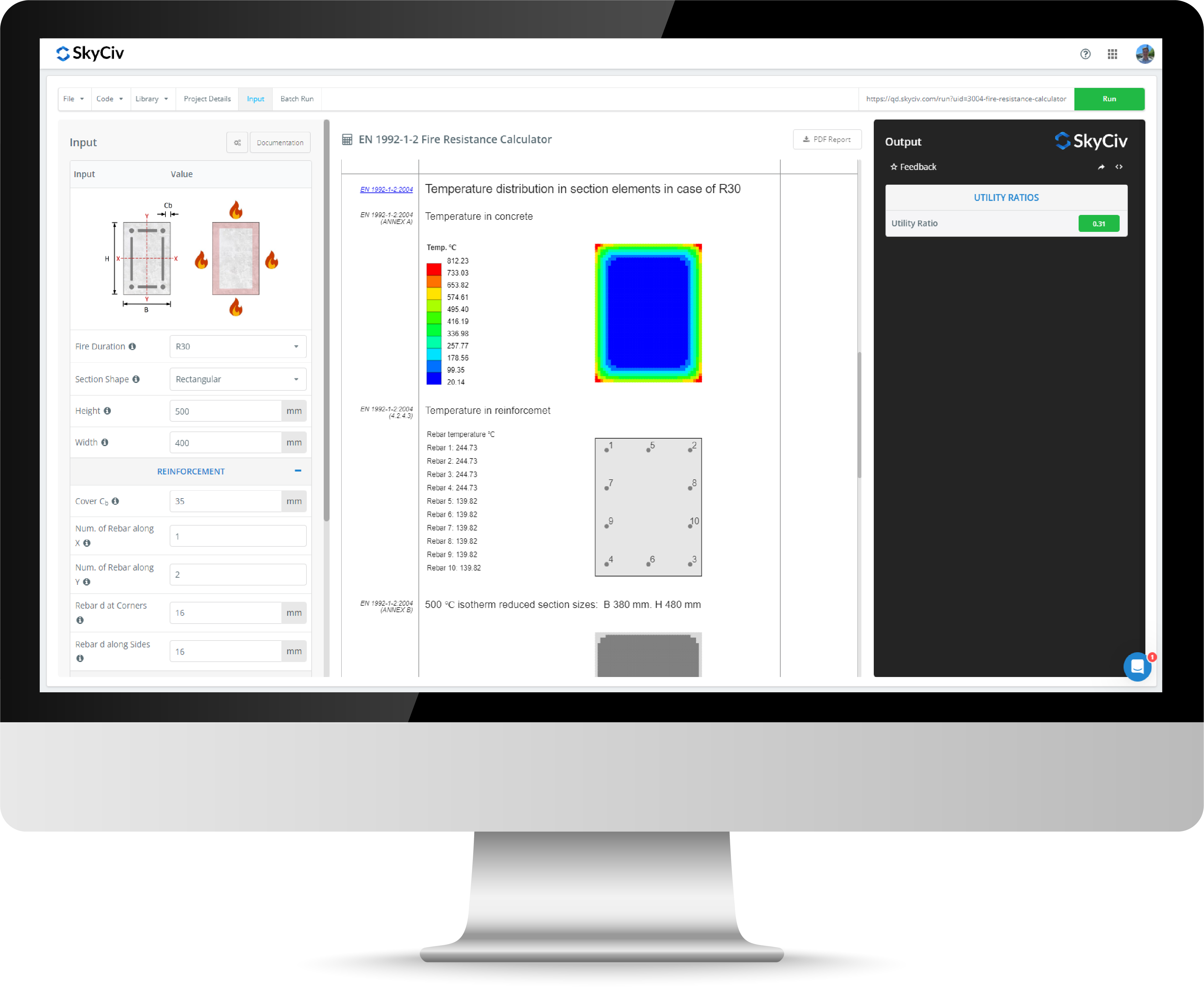
Our easy to learn, powerful to use, intuitive interface allows you to quickly access all the features you need. Packed with smart features like the Pen tool, Repeat/Mirror, and Bulk Editing.Your Content Goes Here

Comprehensive Design Code Support
Our software supports a comprehensive array of steel, wood, and concrete design codes including AISC, EN, AISI, NDS, AS, and CSA.

API Technology
SkyCiv is a customised solution featuring seamless integrations, easy implementations, automated reports and a scalable design and architecture.

24/7 Customer Support
SkyCiv is a customised solution featuring seamless integrations, easy implementations, automated reports and a scalable design and architecture.
