
FREE END PLATE CONNECTION CALCULATOR
SkyCiv End Plate Connection Calculator
This end plate connection calculator checks bolt tension, prying action, plate bending, weld strength and web tear-out against AISC 360, in either ASD or LRFD.
A plate is welded to the end of the beam in the shop, then bolted to the supporting column or girder on site. Whether it stops at the flanges or extends past them decides whether the joint acts as a simple shear connection or a rigid moment connection.
Contents
About the End Plate Connection Calculator
The calculator handles both ends of the range: simple shear details and moment-resisting ones. It evaluates bolt tension, plate bending, weld strength and web tear-out, and reports design capacities with utility ratios.
Everything is to AISC 360, in ASD or LRFD, so the method matches whatever the project specification asks for rather than forcing a conversion.
What is an End Plate Connection?
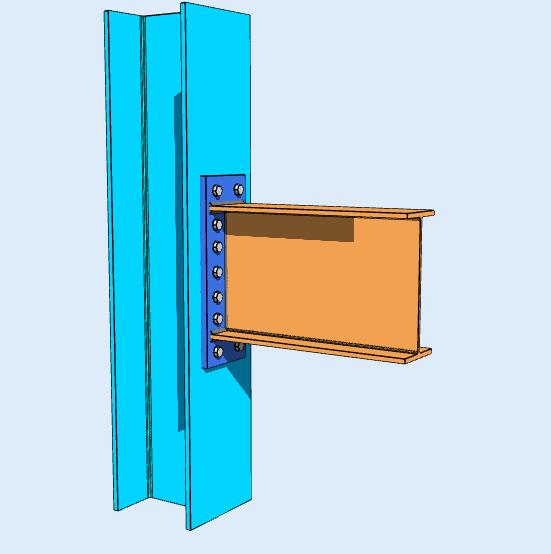
A flat plate welded square to the end of a beam, across the web and across the flanges too if the joint has to be rigid, then field-bolted to a supporting column or beam.
How far the plate runs is what changes its behaviour. Stop it inside the flanges and the beam can rotate, so the joint is a flexible shear connection. Extend it past the flanges, with bolt rows outside them, and it resists moment.
The welding is done in the shop under controlled conditions, which leaves site work as bolting. That is the practical appeal: the difficult part happens where it can be inspected properly.
What Components Make Up the Joint?
- Steel end plate: a rectangular plate welded to the beam end, sized around the bolt pattern and the load.
- Shop welds: fillet or complete-joint-penetration welds fixing the plate to the beam web and flanges.
- Field bolts: high-strength bolts, typically ASTM A325 or A490, tying the plate to the supporting member.
- Supporting member: the column flange, column web or primary girder taking the bolted plate.
- Stiffener plates: optional, added to the column web or to an extended plate where heavy moment would buckle it locally.
The load path is short and direct, which is part of why the detail is trusted: beam, weld, plate, bolts, support.
Where are These Connections Commonly Used?
- Beam-to-column moment frames in multi-storey steel buildings.
- Roof portal frames in industrial warehouses and clear-span structures.
- Primary beam-to-girder shear connections in commercial floor systems.
- Pipe racks and heavy support structures in industrial plant.
Portal frames are the clearest case for the extended type: the haunch joint carries a large moment, and bolt rows outside the flange are what make that possible without a welded site connection.
What Types of End Plate Connections Exist?
The choice follows from whether the joint carries shear alone or shear and moment together:
- Flexible (partial-depth) end plate: welded to the beam web only, transferring shear while allowing rotation. A simple support.
- Flush end plate: the plate matches the beam depth, giving moderate moment resistance alongside shear.
- Extended unstiffened end plate: runs past one or both flanges so extra bolt rows fit, for higher moment resistance.
- Extended stiffened end plate: adds vertical stiffener ribs above or below the flanges, stiffening the plate and reducing prying.
Each carries its own set of AISC checks, and all four can be modelled in the calculator.
How to Use the End Plate Connection Calculator
- Select the plate type: flexible shear, flush moment, or extended.
- Define the geometry: plate thickness, width and height, plus the beam and supporting member sections.
- Specify fasteners and welds: bolt grade, diameter, pitch and edge distances, and the weld sizes.
- Apply the design actions: factored shear, axial force and bending moment.
Calculate, and you get design capacities, the governing failure mode and ASD or LRFD utility ratios together. Knowing which mode governs is the useful part, because it tells you whether to change the plate, the bolts or the welds.
Why Choose SkyCiv’s End Plate Connection Calculator?
Prying action is the check people get wrong by hand, and it is the one that decides plate thickness on a moment joint. Doing it in a spreadsheet is possible; doing it repeatedly, for every bolt row arrangement worth trying, generally does not happen.
The calculation breakdown is shown in full rather than summarised, and the 3D view reflects the geometry you actually entered, so an overstressed component shows up while the detail is still cheap to change.
- Beam Splice Connection Calculator
- Bolt Calculator
- Bolted Connection Design
- Chevron Brace Connection Calculator
- Double Angle Connection Calculator
- Flange Plate Connection Calculator
- Knee Brace Connection Calculator
- Moment Connection
- Single Angle Connection Calculator
- Single Plate Connection Calculator
- SkyCiv Connection Design Vs. Idea Statica
- SkyCiv Connection Design Vs. Ram Connection
- Weld Calculator
- Welded Connection Design
Common questions about designing bolted end plate connections.
Your Questions Answered

Intuitive Interface
Our easy to learn, powerful to use, intuitive interface allows you to quickly access all the features you need. Packed with smart features like the Pen tool, Repeat/Mirror, and Bulk Editing.Your Content Goes Here

Comprehensive Design Code Support
Our software supports a comprehensive array of steel, wood, and concrete design codes including AISC, EN, AISI, NDS, AS, and CSA.

API Technology
SkyCiv is a customised solution featuring seamless integrations, easy implementations, automated reports and a scalable design and architecture.

24/7 Customer Support
SkyCiv is a customised solution featuring seamless integrations, easy implementations, automated reports and a scalable design and architecture.
